
In Safeness vs. Safetiness, both terms can describe safety, but safeness is recognized English while safetiness is generally nonstandard. When discussing safety, people may see safeness and safetiness as used interchangeably, yet a subtle difference exists in their usage and correctness. Safeness is a recognized English word and an accepted headword in major English dictionaries, although it is less common than safety. Safetiness, however, is generally nonstandard.
This difference may confuse English learners, students, writers, and professionals who are exploring similar words, including kindness, happiness, and readiness. Reliable dictionaries can clarify the meaning of each term and help you make the right word choice with greater confidence.
In real-life writing, choosing safeness instead of safetiness can make your writing clearer and more professional. The proper word depends on the situations where you use it, but standard English favors safety, while safeness remains a valid alternative. Understanding dictionary usage and this distinction strengthens word choice, writing clarity, and grammar improvement. Whether you’re working on an academic paper, business report, professional writing, academic writing, or business writing, this guide can help you write with confidence. A clear understanding of language and grammar also helps you recognize the correct word when comparing safeness vs. safetiness.
Quick Answer
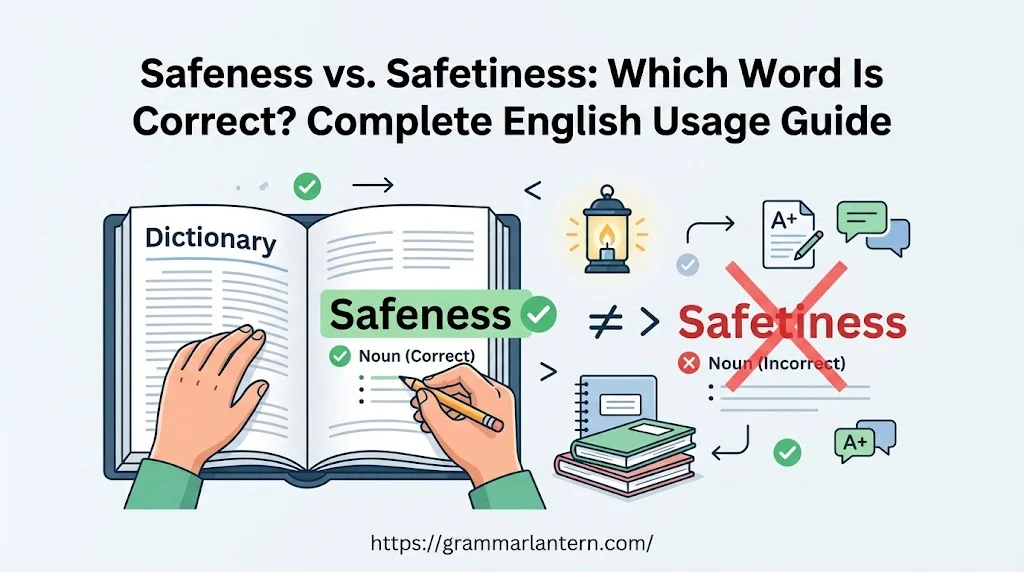
Safeness is a correct English word that means the quality or condition of being safe. However, it is not as common as safety.
Safetiness is generally considered unnatural and should be avoided in standard English.
In most situations, safety is the best choice.
| Word | Correctness | Meaning | Common Usage |
| Safety | Correct and preferred | Protection from danger or harm | Very common |
| Safeness | Correct but uncommon | The state or quality of being safe | Formal or analytical writing |
| Safetiness | Not commonly accepted | Intended meaning of being safe | Avoid using |
Examples:
- ✅ The safety of the new bridge was tested before opening.
- ✅ Researchers examined the safeness of the experimental material.
- ❌ Researchers examined the safetiness of the experimental material.
What Does Safeness Mean?
Safeness refers to the condition, quality, or degree of being safe. It describes how safe something is rather than the general concept of protection.
The word comes from:
Safe + ness = Safeness
The suffix -ness turns an adjective into a noun. It is commonly used to describe a state or quality.
Examples:
- Happy → Happiness
- Dark → Darkness
- Kind → Kindness
- Safe → Safeness
However, even though safeness follows a normal English pattern, it is not the word most people choose in daily communication.
A person might understand this sentence:
The safeness of the playground equipment was evaluated.
But most native speakers would naturally write:
The safety of the playground equipment was evaluated.
The second sentence sounds smoother because safety is the established noun form.
When Should You Use Safeness?
Although uncommon, safeness has specific situations where it can work well.
When Describing a Quality or Condition
Safeness can highlight the actual quality of being safe.
Examples:
- The study measured the safeness of different chemical materials.
- The report focused on the safeness of the new technology.
- Engineers analyzed the safeness of the building structure.
In these examples, the writer focuses on the degree or level of safety.
Read More: Envolve vs Involve: Correct Spelling, Meaning, and Usage
When Writing Academic or Technical Content
Scientific and analytical writing sometimes needs words that describe specific qualities.
For example:
The researchers evaluated the safeness of the procedure before approving further testing.
Here, safeness emphasizes the condition being measured.
However, even in technical writing, safety often works better:
The researchers evaluated the safety of the procedure before approving further testing.
The second version sounds more natural to most readers.
What Does Safetiness Mean?
Safetiness is a word people may create by mistake because it seems like a logical combination of “safe” and “-ness” or “safety” and “-ness.”
However, it is not a standard English word.
The problem is that English already has a well-established noun:
Safe → Safety
Adding another ending creates an unnecessary and awkward form.
For example:
- ❌ The safetiness of the equipment is important.
- ✅ The safety of the equipment is important.
The meaning is clear in both sentences, but only one sounds natural.
Why Does Safetiness Sound Wrong?
English does not accept every possible word combination. A word may follow a grammatical pattern but still feel unnatural.
Consider these examples:
- Happy → Happiness ✅
- Ready → Readiness ✅
- Safe → Safety ✅
- Safe → Safetiness ❌
Native speakers choose words based on common usage, history, and familiarity.
Language is not only about rules. It is also about how people actually communicate.
Safeness vs. Safety: Understanding the Difference
The biggest confusion is usually not between safeness and safetiness. It is between safeness and safety.
Both words relate to being protected from danger, but they have slightly different uses.
| Feature | Safety | Safeness |
| Meaning | Protection from danger | The condition of being safe |
| Frequency | Very common | Less common |
| Everyday use | Yes | Rarely |
| Professional writing | Very common | Sometimes used |
| Natural sound | High | Moderate |
Safety: The Common Choice
Safety is the standard noun used in everyday English.
Examples:
- Workplace safety is important.
- Road safety saves lives.
- Child safety should always come first.
- The company follows strict safety rules.
The word covers many situations involving protection, prevention, and reducing risk.
Safeness: A More Specific Description
Safeness focuses more on the quality or state of something.
Examples:
- The experiment tested the safeness of the new material.
- The researcher compared the safeness of two products.
Think of the difference like this:
Safety is the system. Safeness is the condition.
For example:
- A helmet provides safety.
- The level of protection provided by that helmet describes its safeness.
Why Do People Confuse?
Several language patterns create this confusion.
English Suffixes Are Not Always Predictable
Many adjectives become nouns by adding endings.
Examples:
- Weak → Weakness
- Beautiful → Beauty
- Secure → Security
- Safe → Safety
The challenge is that English developed over hundreds of years. Many words come from different languages and historical patterns.
A learner may think:
If happy becomes happiness, safe should become safeness or safetiness.
The logic makes sense, but English does not always follow perfect patterns.
Safety Already Fills the Role
The main reason safetiness fails is simple: English already has safety.
When a short, familiar word exists, speakers usually avoid longer alternatives.
Compare:
- The safety of the vehicle was tested. ✅
- The safetiness of the vehicle was tested. ❌
The first sentence is clearer and more natural.
Read More: 4 Ways To Spell the Sound of Spitting and Spit Onomatopoeia
Real-World Examples
Understanding examples makes the difference easier.
Workplace Example
Natural:
The company improved workplace safety by providing better training.
Less common:
The company studied the safeness of the workplace environment.
The first sentence discusses protection and rules. The second focuses on measuring the condition.
Technology Example
Natural:
Users want to know about the safety of artificial intelligence systems.
Possible but less common:
Researchers analyzed the safeness of artificial intelligence systems.
Both communicate the idea, but safety is more familiar.
Product Example
Natural:
Customers check product safety before making purchases.
Possible:
Customers evaluate the safeness of products before making purchases.
The second sentence is understandable but sounds more formal.
Common Mistakes
Mistake 1: Assuming Safetiness Is the Correct Form
Many people think:
Safe + ty + ness = Safetiness
But English does not create words this way.
Correct:
- Safety
- Safeness
Avoid:
- Safetiness
Mistake 2: Using Safeness Everywhere
Although safeness is correct, it can sound unusual in casual writing.
Instead of:
I checked the safeness of the neighborhood.
Most people say:
I checked the safety of the neighborhood.
Mistake 3: Confusing Safety With Security
These words overlap but are not identical.
| Word | Meaning | Example |
| Safety | Protection from accidents or harm | Road safety prevents crashes |
| Security | Protection from threats or attacks | Airport security prevents unauthorized access |
Examples:
- Wearing a seat belt improves safety.
- Using strong passwords improves security.
How to Choose the Right Word
Use this simple guide:
| Situation | Best Word |
| Daily conversation | Safety |
| Workplace discussions | Safety |
| Rules and regulations | Safety |
| Product reviews | Safety |
| Scientific research | Safety or Safeness |
| Measuring a specific quality | Safeness |
| Safetiness | Avoid |
A helpful rule:
When you are unsure, choose safety.
It is clearer, more common, and accepted in almost every situation.
FAQs
1. Is safeness a correct word?
Yes. Safeness is a recognized English word. It refers to the state or quality of being safe, although safety is much more common.
2. Is safetiness a correct word?
Safetiness is generally considered nonstandard English. While people may understand what it means, it isn’t the preferred choice in standard writing.
3. Which is more common, safeness or safety?
Safety is far more common in everyday and professional English. Safeness is valid but appears much less frequently.
4. Why do people use safetiness?
People may form safetiness by following patterns such as kindness, happiness, and readiness. However, English doesn’t apply the same suffix pattern to every adjective.
5. Can I use safeness in academic writing?
Yes, you can use safeness when it fits the meaning. However, safety will usually sound more natural and familiar in an academic paper.
6. Should I use safeness or safety?
In most situations, safety is the better choice. Use safeness when you specifically need to describe the quality or state of being safe.
7. Is safeness listed in dictionaries?
Yes. Safeness is recognized by major English dictionaries, although its usage is less common than safety.
8. Is safetiness acceptable in professional writing?
It’s best to avoid safetiness in professional writing. Choosing safety or, where appropriate, safeness will make your writing clearer and more standard.
9. Are safeness and safety interchangeable?
They can overlap in meaning, but safety is the normal and widely accepted term. Safeness has a more specific sense of the quality or condition of being safe.
10. What is the easiest way to remember the difference?
Remember this simple rule: safety is the standard everyday choice, safeness is a valid but uncommon word, and safetiness is generally nonstandard.
Conclusion
Understanding safeness vs. safetiness becomes easier when you focus on standard English usage rather than simply looking at how a word seems to be formed. Safeness is a recognized word, but safety remains the more natural and widely used option. Safetiness, meanwhile, is generally considered nonstandard, so it’s better to avoid it in formal, academic, and professional writing.
When you’re unsure which word to choose, safety is usually the safest choice. If you need to emphasize the quality or state of being safe, safeness can work in the right context. Checking a reliable dictionary can also help you make confident choices and keep your writing clear, accurate, and professional.

For Shafiq ur Rehman, writing is an art form and grammar is the toolbox that makes it beautiful. As a dedicated content writer at Grammar Lantern, Shafiq approaches every topic like an architect carefully laying down strong foundations of understanding before adding the finer details. He loves diving into the trickiest grammar points and resurfacing with simple, bite-sized takeaways that anyone can grasp. When he’s not crafting articles, you’ll likely find him strategizing over a game of chess, exploring dusty local bookshops, or quietly jotting down poetic observations in his notebook.



[…] Read More: Safeness vs. Safetiness: Which Word Is Correct? […]