Much More is a simple and useful phrase in everyday English. More is a good word when we want to show a greater quantity of something, while much adds extra emphasis. When we combine these words, the phrase much more becomes a natural expression for comparing one thing with something else. In this article, we explore how much more can describe something that is more valuable or useful to somebody than another option.
In everyday English, much more is a common and natural phrase. It works well when similar things are compared and one is clearly better, stronger, or more useful. It can also act as a quantifiable term when we want to explain a noticeable difference in quantity, value, or usefulness. For example, “This method is much more useful” tells the reader that one method offers greater benefits than another choice.
The phrase can also show that something ranks highly in a particular context. This is especially helpful when discussing likelihood, quality, or practical value. From my experience with English usage, using much more makes comparisons clearer and stronger without making the sentence complicated. It naturally emphasizes the difference between two options and helps readers understand which one provides greater value.
What Does “Much More” Mean?
The basic “much more” meaning is a significantly greater amount, degree, or extent.
The word more indicates an increase. The word much emphasizes the size of that increase.
Consider these sentences:
- This phone is more expensive than mine.
- This phone is much more expensive than mine.
Both sentences make a comparison. The second sentence emphasizes the difference.
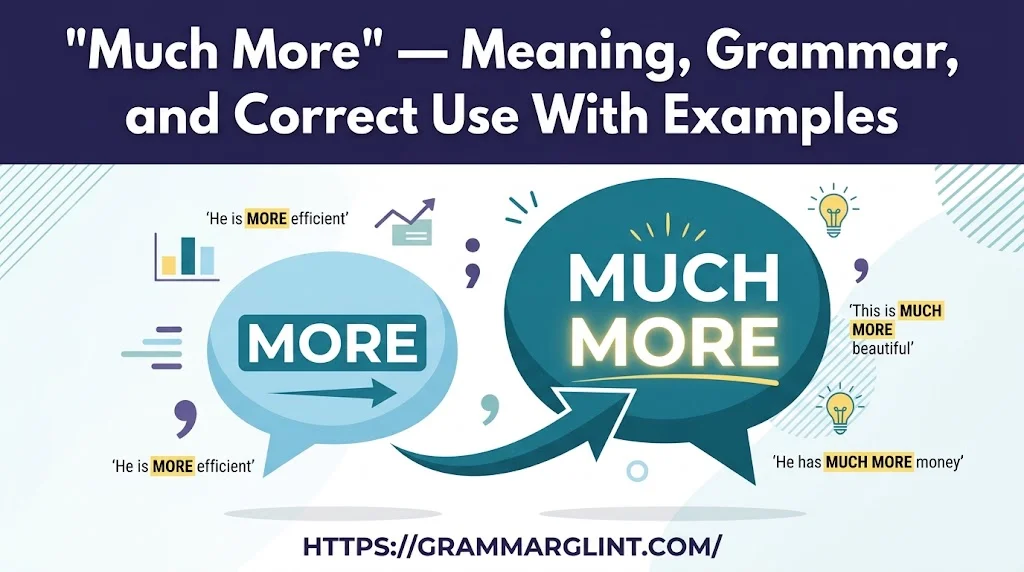
You can think of much as a volume knob. More turns the comparison on, while much turns it up.
Much more meaning in simple terms
“Much more” can mean:
- considerably more
- significantly more
- substantially more
- a great deal more
- noticeably more
The exact meaning depends on the context.
For example:
- I need much more time.
- She is much more confident now.
- This route is much more convenient.
- They spent much more money than expected.
In the first sentence, much more refers to an additional amount of time. In the second, it describes a stronger degree of confidence. The third compares convenience, while the fourth compares an amount of money.
So, “much more” isn’t restricted to one grammatical function.
Is “Much More” Grammatically Correct?
Yes. “Much more” is completely grammatically correct.
English regularly uses much to strengthen comparative forms.
Common patterns include:
- much better
- much bigger
- much faster
- much easier
- much more useful
- much more expensive
- much more carefully
The important point is that much doesn’t replace the comparative word. It modifies or intensifies it.
Compare:
| Expression | Meaning |
| more useful | useful to a greater degree |
| much more useful | useful to a considerably greater degree |
| more expensive | higher in price |
| much more expensive | considerably higher in price |
For example:
- The new software is more efficient.
- The new software is much more efficient.
The first sentence simply establishes a difference. The second emphasizes that the difference is substantial.
There is nothing redundant about much more. Each word contributes something different.
How “Much More” Works in English Grammar
The grammar becomes easier when you separate the two words.
What does “more” do?
More expresses comparison, increase, or an additional amount.
For example:
- I need more time.
- She wants more information.
- This option is more practical.
- He works more carefully now.
The meaning changes depending on what more modifies.
What does “much” do?
In “much more,” the word much intensifies the comparison or increase.
Compare:
- The new model is more powerful.
- The new model is much more powerful.
The second sentence suggests a meaningful difference.
This pattern also appears with other comparative expressions:
- much better
- much worse
- much smaller
- much larger
- much easier
- much more effective
- much less expensive
A useful rule is:
Use “much” before a comparative when you want to emphasize a noticeable difference.
That rule works in everyday conversation, professional writing, academic prose, and many other contexts.
Read More: Commit vs Comit: Which Spelling Is Correct?
Using “Much More” With Comparative Adjectives
One of the most common uses of “much more” appears before adjectives.
The basic structure is:
subject + be + much more + adjective
Examples include:
- This apartment is much more spacious.
- The second option is much more practical.
- Her explanation was much more detailed.
- The new system is much more reliable.
- This method is much more effective.
Here, more forms the comparison and much strengthens it.
“Much more” with “than”
When you explicitly name the thing you’re comparing against, use than.
The structure becomes:
subject + be + much more + adjective + than + comparison
Examples:
- This car is much more comfortable than the old one.
- The new version is much more reliable than the previous version.
- This exercise is much more difficult than it looks.
- Her second presentation was much more engaging than the first.
- The downtown apartment is much more expensive than the one outside the city.
The word than connects the two sides of the comparison.
Why “much” changes the meaning
Look at these examples:
The second route is more convenient than the first.
The second route is much more convenient than the first.
The first sentence says the second route has greater convenience. The second sentence emphasizes a substantial advantage.
That distinction matters when you’re communicating judgment, contrast, or emphasis.
“Much More” With Comparative Adverbs
You can also use “much more” with adverbs.
The structure usually looks like this:
subject + verb + much more + adverb
Examples:
- She speaks much more clearly now.
- He works much more efficiently than before.
- They responded much more quickly this time.
- The machine operates much more smoothly after the repair.
- He explained the problem much more carefully.
Here, much more modifies the comparative adverb.
Compare:
- She speaks more clearly now.
- She speaks much more clearly now.
Again, much emphasizes the degree of improvement.
“Much more carefully” vs. “more carefully”
Suppose someone previously made frequent mistakes.
You could say:
He checks his work more carefully now.
That tells readers his care has increased.
But:
He checks his work much more carefully now.
This suggests a noticeable improvement.
The distinction is small grammatically but useful stylistically.
Using “Much More” With Nouns
Here’s where things become slightly more interesting.
“Much more” can appear before uncountable nouns.
Examples include:
- much more time
- much more money
- much more information
- much more patience
- much more effort
- much more work
- much more experience
Consider:
We need more information.
This means additional information is needed.
Now compare:
We need much more information.
The second sentence indicates that the amount currently available falls considerably short of what’s needed.
Examples with uncountable nouns
- I need much more time to finish this.
- The project requires much more money.
- We need much more information before making a decision.
- She has much more experience than I do.
- This job requires much more patience than I expected.
In each example, the noun describes something that English normally treats as uncountable.
“Much More” vs. “Many More”
This distinction causes frequent mistakes.
The basic rule is straightforward:
- much more + uncountable noun
- many more + plural countable noun
Consider the difference:
| Correct expression | Why? |
| much more information | information is uncountable |
| much more time | time is uncountable in this meaning |
| much more money | money is uncountable |
| many more books | books are countable |
| many more students | students are countable |
| many more opportunities | opportunities are countable |
Incorrect and correct examples
❌ We need much more books.
✅ We need many more books.
❌ She gave us many more information.
✅ She gave us much more information.
❌ The company needs much more employees.
✅ The company needs many more employees.
The difference comes down to countability, not the size of the increase.
You could need a huge quantity of books and still say many more books. You could need only a small additional amount of information and still say much more information.
“Much More Than” — Meaning and Correct Use
“Much more than” adds an explicit comparison.
It means that one thing exceeds another by a significant amount or degree.
Examples:
- This job pays much more than my previous one.
- The repair cost much more than expected.
- She knows much more than I thought.
- The new model weighs much more than the old one.
- He talks much more than he listens.
The phrase can compare amounts, actions, qualities, or degrees.
“Much more than” with adjectives
Use this pattern when comparing qualities:
much more + adjective + than
Examples:
- This option is much more affordable than the first one.
- The new design is much more attractive than the original.
- She is much more confident than she was last year.
- The updated version is much more useful than the previous one.
“Much more than” with verbs
You can also compare actions or amounts associated with actions.
Examples:
- He earns much more than I do.
- She studies much more than her brother.
- They travel much more than they used to.
- The company spends much more than it did five years ago.
Notice that than doesn’t always introduce a noun.
For example:
She works much more than I do.
The comparison is between the amount of work she does and the amount I do.
Can You Use “Much More” Without “Than”?
Yes.
You don’t always need than after “much more.”
The comparison may already be clear from context.
For example:
This version is much more efficient.
The listener doesn’t need to know exactly what you’re comparing it with. The comparison could be with an older version, another method, or another product already discussed.
Other examples include:
- I feel much more comfortable here.
- The situation is much more complicated now.
- She seems much more confident.
- We need much more time.
- The process has become much more efficient.
The context supplies the missing comparison.
This is particularly common in conversation. People don’t repeat information when everyone already understands the reference point.
“More” vs. “Much More”
The difference between “more” and “much more” is primarily one of emphasis.
| Sentence | Implication |
| This one is more useful. | It has greater usefulness. |
| This one is much more useful. | It has considerably greater usefulness. |
| She is more confident now. | Her confidence has increased. |
| She is much more confident now. | Her confidence has increased substantially. |
| The new model is more expensive. | Its price is higher. |
| The new model is much more expensive. | Its price is significantly higher. |
Neither version is automatically better.
Use more when a neutral comparison is enough. Use much more when you want to highlight the size of the difference.
A practical example
Imagine two laptops.
Laptop A costs $700. Laptop B costs $750.
You might say:
Laptop B is more expensive.
That’s accurate.
But if Laptop B costs $1,400, saying:
Laptop B is much more expensive.
better reflects the substantial price difference.
The expression should match the scale of the contrast.
“Much More” vs. “A Lot More”
“A lot more” and “much more” often communicate a similar idea.
Compare:
- This method is much more efficient.
- This method is a lot more efficient.
Both suggest a significant improvement.
However, they can differ slightly in tone.
“Much more” works comfortably in formal and informal writing. “A lot more” often sounds more conversational.
Examples
More neutral or formal:
The revised process is much more efficient.
More conversational:
The revised process is a lot more efficient.
Neither expression is inherently incorrect.
The better choice depends on your audience and the tone you want.
| Expression | Typical feel |
| more | neutral |
| much more | emphatic and versatile |
| a lot more | emphatic and conversational |
| far more | emphatic and often more formal |
“Much More” vs. “Far More”
“Far more” can also intensify a comparative.
For example:
- This solution is far more effective.
- The new system is far more reliable.
- She is far more experienced than I am.
Much more and far more often overlap.
However, far more can sound particularly strong or formal.
Compare:
The new policy is much more effective.
The new policy is far more effective.
The second version can sound more forceful. It draws sharper attention to the contrast.
Still, context matters. These expressions aren’t mathematical measurements. They’re tools for expressing degree.
“Much More” vs. “Much”
These expressions aren’t interchangeable.
Consider:
I don’t have much time.
Here, much means a large amount in a negative construction.
Now:
I need much more time.
Here, much more means that you need a substantially larger amount than you currently have or than was previously discussed.
Compare the meanings:
| Expression | Meaning |
| much time | a large amount of time |
| more time | additional time |
| much more time | considerably more time |
The same distinction works with many uncountable nouns:
- much money
- more money
- much more money
- much effort
- more effort
- much more effort
- much information
- more information
- much more information
“Much More” in Questions and Negative Sentences
You can naturally use “much more” in questions and negative statements.
Questions
- Do you need much more time?
- Does the project require much more money?
- How much more information do we need?
- Can you explain much more about the process?
The phrase can ask about a substantial additional amount or degree.
Negative sentences
- We don’t need much more time.
- They can’t spend much more money.
- I don’t have much more information.
- She doesn’t need much more practice.
Notice that much more doesn’t always mean “a huge amount.” Context determines the scale.
For example, I don’t need much more time might mean only five additional minutes.
Common Mistakes
Understanding the rules becomes easier when you see where learners commonly go wrong.
Mistake: Using “much more” with plural countable nouns
❌ We need much more chairs.
✅ We need many more chairs.
Chairs are countable, so use many more.
Mistake: Using “many more” with an uncountable noun
❌ We need many more information.
✅ We need much more information.
Information is uncountable in standard English.
You can say:
We need many more pieces of information.
Here, pieces provides the countable unit.
Mistake: Saying “more much”
❌ This option is more much expensive.
✅ This option is much more expensive.
The intensifier much comes before the comparative expression.
The normal order is:
much + more + adjective
Not:
more + much + adjective
Mistake: Assuming “much more” always requires “than”
❌ The sentence is incomplete because there is no “than.”
That assumption is incorrect.
For example:
The new system is much more reliable.
This sentence is complete. The comparison is understood from context.
Mistake: Treating “much more” as redundant
Some writers mistakenly think that much adds nothing.
It does.
Compare:
- The second option is more expensive.
- The second option is much more expensive.
The second sentence adds emphasis. Removing much changes the force of the statement.
Common Sentence Patterns
Learning a few reliable patterns can make this expression easy to use.
Pattern: Much more + adjective
Subject + be + much more + adjective
Examples:
- This approach is much more practical.
- The new model is much more powerful.
- Her explanation is much more detailed.
Pattern: Much more + adjective + than
Subject + be + much more + adjective + than + comparison
Examples:
- This route is much more convenient than the other one.
- The new version is much more stable than the old one.
Pattern: Much more + adverb
Subject + verb + much more + adverb
Examples:
- She works much more efficiently now.
- He communicates much more clearly.
Pattern: Much more + uncountable noun
Subject + verb + much more + uncountable noun
Examples:
- We need much more time.
- They require much more information.
- The project needs much more funding.
Pattern: Verb + much more than
Subject + verb + much more than + comparison
Examples:
- She earns much more than I do.
- He exercises much more than before.
- They spend much more than expected.
These five patterns cover a large portion of everyday usage.
Everyday Examples
Context makes grammar easier to remember. Here are practical examples from common situations.
1.At work
- The new software is much more efficient.
- This process requires much more attention.
- The updated system is much more reliable.
- We need much more information before proceeding.
2.At school
- The final exam was much more difficult than the practice test.
- This topic is much more complicated than it first appears.
- Students need much more practice with comparative structures.
3.When discussing money
- The new car costs much more than the old one.
- The project needs much more funding.
- They spent much more than they originally planned.
4.When discussing time
- This task takes much more time than expected.
- We need much more time to finish the report.
- The second method is much more time-consuming.
5.When discussing people
- She seems much more confident now.
- He is much more experienced than his colleague.
- They communicate much more effectively as a team.
A Practical Case Study: Choosing the Right Expression
Imagine a student comparing two study methods.
The student first says:
Method B is more effective than Method A.
That’s a straightforward comparison.
After tracking test results, the student discovers that Method B consistently produces significantly better results.
Now the student writes:
Method B is much more effective than Method A.
The second sentence better communicates the size of the difference.
Next, the student wants to discuss the number of practice questions.
There are 20 questions in Method A and 50 in Method B.
The student should write:
Method B includes many more practice questions.
Not:
Method B includes much more practice questions.
Why? Questions are countable plural nouns.
Finally, the student discusses study time:
Method B requires much more time.
That’s correct because time, in this sense, is uncountable.
The case study reveals three useful patterns:
| What is being compared? | Correct expression |
| Effectiveness | much more effective |
| Number of questions | many more questions |
| Amount of time | much more time |
The choice isn’t arbitrary. Grammar follows the type of comparison.
Quick Reference: “More,” “Much More,” and “Many More”
| Phrase | Main use | Example |
| more | greater amount or degree | I need more time. |
| much more | significantly greater amount or degree | I need much more time. |
| many more | significantly greater number | I need many more examples. |
| a lot more | significantly greater amount or degree | I need a lot more time. |
| far more | strongly emphasizes a greater degree | This option is far more useful. |
The most important distinction is between much more and many more.
Remember:
Much more concerns amount or degree. Many more concerns number.
How to Make “Much More” Sound Natural
Correct grammar is only half the battle. Good writing also depends on natural phrasing.
Instead of repeating much more in every sentence, vary your language when the meaning allows it.
For example:
- The new system is much more efficient.
- The revised process is considerably faster.
- The updated version offers far greater flexibility.
- The new approach provides significantly better results.
This doesn’t mean you should avoid “much more.” It’s a perfectly natural expression. The goal is simply to prevent repetitive prose.
In conversation, however, repetition can be perfectly normal:
It’s much more comfortable, It’s much more convenient. It’s much more practical.
That rhythm sounds natural because the speaker is emphasizing several improvements.
When Should You Use “Much More”?
Use “much more” when you want to communicate a meaningful increase or stronger comparison.
It works especially well when:
- the difference is substantial
- you want to emphasize improvement
- you’re comparing two alternatives
- the context already establishes a reference point
- you’re discussing an additional amount of something uncountable
- you want stronger emphasis than more provides
For example:
The new route is more convenient.
This is neutral.
The new route is much more convenient.
This emphasizes the advantage.
Neither sentence is wrong. The second simply carries more weight.
Read More: 7 Words for Someone Who Uses Other People: 7 Terms Explained
FAQs
1. What does “much more” mean?
“Much more” means a noticeably greater amount, degree, value, or level of something compared with another thing.
2. Is “much more” grammatically correct?
Yes, “much more” is grammatically correct and commonly used in both spoken and written English.
3. What is the difference between “more” and “much more”?
“More” shows an increase or greater quantity, while “much more” emphasizes that the difference is significantly greater.
4. Can “much more” describe quantity?
Yes, “much more” can describe a larger quantity of something, especially when the difference is substantial.
5. Can “much more” describe quality?
Yes. For example, “This option is much more useful” shows that one option has considerably greater usefulness.
6. Can “much more” be used for comparisons?
Yes, it is frequently used to compare two people, things, ideas, choices, or situations.
7. Is “much more” common in everyday English?
Yes, “much more” is a very common expression in everyday conversations and formal writing.
8. Can “much more” describe likelihood?
Yes. For example, “This approach is much more likely to work” indicates a significantly higher likelihood.
9. What words can follow “much more”?
Depending on the sentence, “much more” can be followed by adjectives, adverbs, uncountable nouns, or other comparative structures.
10. Does “much more” always mean a large difference?
It usually emphasizes a noticeable difference, but the exact size of the difference depends on the context.
Conclusion
“Much more” is a simple and flexible expression that makes comparisons stronger and clearer. It can describe quantity, quality, value, usefulness, or likelihood, depending on the context. Understanding how much adds emphasis to more can help you create more natural English sentences.
In everyday communication, using “much more” is often helpful when you want to point out a meaningful difference between two choices or situations. Once you understand its basic structure, you can use it confidently in conversations, academic writing, professional communication, and ordinary comparisons.

For Shafiq ur Rehman, writing is an art form and grammar is the toolbox that makes it beautiful. As a dedicated content writer at Grammar Lantern, Shafiq approaches every topic like an architect carefully laying down strong foundations of understanding before adding the finer details. He loves diving into the trickiest grammar points and resurfacing with simple, bite-sized takeaways that anyone can grasp. When he’s not crafting articles, you’ll likely find him strategizing over a game of chess, exploring dusty local bookshops, or quietly jotting down poetic observations in his notebook.

[…] Read More: “Much More” Meaning, Grammar, and Correct Use With Examples […]
[…] Read More: “Much More” Meaning, Grammar, and Correct Use With Examples […]
[…] Read More: “Much More” Meaning, Grammar, and Correct Use With Examples […]