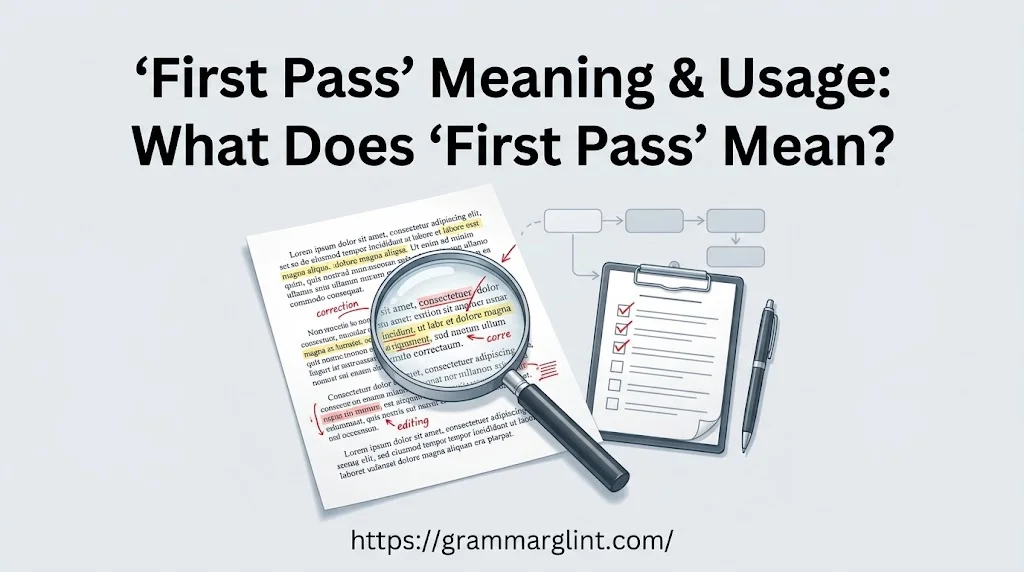
A First Pass is a term for an initial analysis or review of something. In different contexts, it can be appropriate when you need to know the basic meaning of an idea. It’s fairly easy to work out from the context where the term appears. A first impression or first idea often develops when you examine a piece of work before taking more time to understand it.
A first impression comes from an initial review of something. However, you may haven’t been able to examine every detail, so your impressions remain preliminary. The word designated describes this early stage, where you have only a primary view instead of a complete understanding. With time, you can examine the information more carefully.
During a first review, you can develop a full picture as you gather more information. Your primary analysis may change after deeper examination, and that’s perfectly normal. A first pass doesn’t mean your analysis is final. It simply shows what you currently understand at that stage and gives you a useful starting point for further review.
What Does “First Pass” Mean?
“First pass” means an initial attempt, review, examination, or processing stage.
The exact meaning depends on the context.
When someone says they took a first pass at a problem, they usually mean they made an initial attempt to solve it. When they say they took a first pass through a report, they usually mean they reviewed it initially.
The phrase doesn’t necessarily mean the work was rushed or poorly done. It simply identifies the first stage of attention or effort.
Think of it like walking through a large building for the first time. During your first walk, you might notice the main rooms and obvious problems. You could then return later to inspect smaller details.
That is the basic idea behind a first pass.
Simple Definition
A first pass is the first time you work through, examine, review, process, or attempt something.
It can refer to:
- An initial attempt
- An initial review
- A preliminary analysis
- A first round of editing
- An early version
- An initial inspection
- A first processing stage
- A preliminary assessment
| Example | Meaning |
| “This is my first pass at the proposal.” | An initial attempt at the proposal |
| “I took a first pass through the report.” | An initial review |
| “The first pass found several errors.” | An initial examination or processing stage |
| “Here’s my first pass at the design.” | An early version of the design |
| “We completed a first pass of the data.” | An initial round of analysis |
The common idea is initial work rather than necessarily final work.
Why Is It Called a “First Pass”?
The word pass can refer to a movement through or over something. It can also describe an attempt or a stage in a process.
That explains why first pass works so naturally.
Imagine an airplane flying over an area while looking for something on the ground. The first flight over the area gives the observers an initial view. A second flight could reveal things they missed.
The same metaphor works for documents and projects.
You can make one pass through an article to understand its structure. Then you can make another pass to fix grammar. A final pass might catch small spelling or formatting errors.
This idea also appears in technical language. A processing system can make one pass through information and then make another pass to refine or complete the result.
So, the phrase isn’t mysterious. A first pass is simply the first journey through something that may require further attention.
As an Initial Attempt
One of the most common uses of first pass describes an initial attempt.
For example:
“This is my first pass at the proposal.”
The speaker has made an initial effort to create or improve the proposal.
The proposal might be fairly polished. It might also contain obvious gaps. The phrase doesn’t tell you exactly how good the work is. It mainly tells you where the work stands in the process.
You might hear this language when someone wants feedback without presenting their work as completely finished.
Examples as an Initial Attempt
- “Here’s my first pass at the introduction.”
- “I made a first pass at the schedule.”
- “Let’s make a first pass at the problem.”
- “She took a first pass at the presentation.”
- “This is our first pass at the new design.”
- “I’ll take a first pass at the budget tonight.”
Each sentence describes an initial effort.
“First Pass” vs. “First Attempt”
The two expressions overlap, but they don’t always emphasize the same thing.
First attempt focuses on trying to accomplish something.
First pass often emphasizes moving through something as part of a larger process.
Compare these sentences:
“My first attempt to fix the computer failed.”
This focuses on the result of an attempt.
“I took a first pass at fixing the computer.”
This sounds more like an initial round of work.
The second sentence leaves more room for additional attempts or refinement.
Read More: Word for a Person Who Finds Fault in Everything: 10 Words
As a First Review
Another common meaning involves reviewing something for the first time.
You might take a first pass through:
- A contract
- A report
- A manuscript
- A spreadsheet
- A presentation
- A project plan
- A research paper
- A dataset
- A website
- A collection of files
During this first review, you might focus on major issues rather than tiny details.
For example:
“I took a first pass through the contract and found two clauses we should discuss.”
That sentence doesn’t necessarily mean the person completed a detailed legal review. It indicates an initial examination that uncovered some important points.
A first pass can therefore act as a filter.
You examine the material once. You identify what deserves deeper attention. Then you decide where to spend your time.
What Might You Look For During a First Review?
A first pass through a document might involve questions such as:
- Does the overall structure make sense?
- Is important information missing?
- Are there obvious errors?
- Are the main ideas clear?
- Does anything contradict another section?
- Which areas require closer attention?
- Are there unnecessary sections?
- Does the material meet its main purpose?
This approach becomes especially useful when the material is long or complicated.
You don’t always need to solve every small problem immediately.
In Writing and Editing
Writing and editing provide some of the clearest examples of first-pass usage.
A serious editing process often involves several rounds. Each round can have a different purpose.
During a first pass, an editor might focus on the article’s structure rather than individual commas.
For example, an editor may notice that:
- The introduction takes too long to reach the point.
- Two sections repeat the same idea.
- One important question remains unanswered.
- A paragraph contains information that belongs elsewhere.
- A conclusion introduces a completely new argument.
Those problems matter more than a misplaced comma at that stage.
There’s little value in perfecting a sentence that may disappear during restructuring.
What Happens During a First-Pass Edit?
A first-pass edit may focus on:
- Structure
- Organization
- Flow
- Clarity
- Repetition
- Missing information
- Logical gaps
- Weak transitions
- Unnecessary sections
- Overall readability
Later passes can focus on sentence-level details.
| Editing stage | Main focus |
| First pass | Structure and major problems |
| Second pass | Clarity and flow |
| Third pass | Grammar and style |
| Final pass | Proofreading and consistency |
This isn’t a rigid rule. Editors may combine or rearrange these stages. The important point is that different passes can serve different purposes.
Example of a First-Pass Edit
Imagine a 3,500-word article about personal finance.
During the first pass, an editor discovers that the article discusses credit cards three times. The editor combines those sections and moves the most useful explanation closer to the beginning.
The editor hasn’t necessarily checked every comma yet.
That’s fine.
The structure needs attention first.
Once the article’s organization works, the editor can move toward sentence-level improvements.
“First Pass” vs. “First Draft”
These phrases are related, but they aren’t interchangeable in every situation.
A first draft specifically describes an initial version of written or creative work.
A first pass has a broader meaning.
You can take a first pass at:
- A problem
- A design
- A contract
- A spreadsheet
- A website
- A budget
- A dataset
- A presentation
A first draft usually involves something that has been written or created as an initial version.
Compare:
“I finished the first draft of the article.”
This clearly means an initial written version exists.
Now consider:
“I took a first pass at the article.”
That could mean the person wrote it, revised it, edited it, reviewed it, or performed another initial stage of work.
| Expression | Meaning |
| First pass | Initial attempt, review, examination, or processing stage |
| First draft | Initial written or creative version |
| First attempt | Initial effort to accomplish something |
| First review | Initial examination |
| First edit | Initial editing round |
So, if you’re specifically talking about an early written version, first draft may be more precise.
In Business and Professional Communication
The expression is especially useful at work because projects rarely become final in one move.
A manager might ask:
“Can you take a first pass at the proposal?”
That usually means:
“Please work through it initially and give us something we can review.”
The request doesn’t necessarily demand a final document.
It creates room for collaboration.
One person creates the first version. Others provide feedback. The team then revises the material.
This makes first pass a useful phrase for managing expectations.
Common Workplace Examples
“I’ll take a first pass at the report before the meeting.”
“Can you do a first pass on these numbers?”
“Here’s my first pass at the project timeline.”
“The team completed a first pass of the proposal.”
“Let’s review the first-pass results tomorrow.”
“I’ll send you a first pass before we finalize anything.”
These sentences communicate progress without suggesting that the work is completely finished.
Why “First Pass” Works Well at Work
The phrase gives colleagues useful information.
It tells them:
- The work has started.
- An initial result exists.
- The result may still change.
- Further discussion or refinement may follow.
That combination makes the expression particularly handy in collaborative environments.
In Technical and Computing Contexts
In technical fields, first pass can describe an initial stage of processing.
A pass can mean one complete processing cycle through data, code, or another set of information.
For example, a system might make one pass through a dataset to identify certain characteristics. A later pass could perform another operation based on what the system discovered.
This usage is closely connected to the broader meaning of the phrase.
A Technical Example
Imagine a program processing a large collection of records.
During its first pass, it might:
- Read each record.
- Identify missing fields.
- Flag invalid values.
- Collect basic statistics.
- Build an initial index.
A second pass could then perform more detailed operations.
The first pass doesn’t necessarily represent an incomplete system. It can be an intentional stage in the algorithm.
Why Multiple Passes Can Be Useful
Breaking a complicated operation into passes can make the task easier to manage.
Instead of asking one stage to do everything, each pass can perform a defined job.
For example:
1.Pass: Identify relevant information.
2.Pass: Analyze relationships.
3.Pass: Produce refined output.
The exact process varies by technology. However, the underlying concept remains consistent.
A pass is a trip through the material. A first pass is the initial trip.
In Everyday Conversation
You don’t need to work in an office or technology company to use first pass.
The phrase can appear in everyday situations.
For example:
“I took a first pass through the garage and found the old boxes.”
Or:
“Let me take a first pass through these photos.”
Or:
“I’ll make a first pass at cleaning up the room.”
These examples are grammatically understandable. However, everyday speakers may choose simpler expressions depending on the situation.
For casual conversation, first look or first try can sometimes sound more natural.
That doesn’t make first pass incorrect. It simply gives the sentence a more deliberate or process-oriented tone.
“First Pass” vs. “First Impression”
This distinction deserves special attention.
A first impression is an initial opinion or feeling about someone or something.
A first pass is an initial attempt, review, examination, or processing stage.
Consider these examples:
“My first impression of the restaurant was excellent.”
This describes an immediate reaction.
“I took a first pass through the menu.”
This describes an initial examination.
The expressions can sometimes overlap conceptually because both involve an initial encounter. Their meanings remain different.
| First pass | First impression |
| Initial attempt or review | Initial opinion or feeling |
| Usually involves some action | Can form almost instantly |
| Often part of a process | Usually describes an initial reaction |
| Common in professional settings | Common in social and everyday settings |
| May be followed by another pass | May change after more experience |
So, don’t automatically use “first pass” when you mean “first impression.”
“First Pass” vs. “First Look”
First look usually sounds lighter and more conversational.
For example:
“I took a first look at the report.”
This suggests an initial examination.
Now compare:
“I took a first pass at the report.”
This can suggest a more deliberate round of work.
The difference isn’t absolute. Context matters.
Use “First Look” When:
- You want a casual tone.
- The examination was brief.
- You’re simply checking something initially.
- You don’t want to imply a structured workflow.
Use “First Pass” When:
- You’re describing a work process.
- You expect additional review.
- You’re making an initial attempt.
- You’re describing a structured examination.
- You’re discussing technical processing.
Read More: 1500 In Words: Fifteen Hundred or One Thousand Five Hundred?
Common Prepositions
The preposition that follows first pass can influence the meaning and naturalness of the sentence.
Several constructions appear in English.
“First Pass At”
“First pass at” commonly introduces something you’re attempting or working on.
Examples:
- “Here’s my first pass at the article.”
- “I’ll take a first pass at the proposal.”
- “She made a first pass at the problem.”
- “This is our first pass at the design.”
A useful structure is:
take a first pass at + task
For example:
“I’ll take a first pass at the budget this afternoon.”
The phrase suggests an initial effort.
“First Pass Through”
“First pass through” works well when someone examines material from beginning to end or moves through a collection.
Examples:
- “I took a first pass through the documents.”
- “She made a first pass through the spreadsheet.”
- “We did a first pass through the interview transcripts.”
- “After the first pass through the manuscript, several problems became obvious.”
Here, through emphasizes movement across the material.
“First Pass On”
You may also encounter “first pass on.”
For example:
“I’ll take a first pass on the document.”
This construction occurs in professional communication. However, when you’re describing an initial attempt at something, first pass at often sounds more natural.
Compare:
“I’ll take a first pass at the proposal.”
This clearly emphasizes an initial attempt.
“I’ll take a first pass on the proposal.”
This can still be understood, but the choice of at is often cleaner when the proposal represents the target of the attempt.
“At First Pass”
The expression “at first pass” can introduce an initial assessment.
For example:
“At first pass, the proposal looks reasonable.”
The speaker means that the proposal appears reasonable based on an initial examination.
You can often replace it with:
- At first glance
- On first review
- Initially
- On an initial examination
However, the tone changes slightly.
“At first glance” often sounds more immediate.
“At first pass” sounds more analytical or process-oriented.
How to Use It in a Sentence
Learning a few natural sentence patterns makes the expression much easier to use.
Take a First Pass At
“I’ll take a first pass at the report.”
Meaning: I’ll make an initial attempt to review or improve the report.
Make a First Pass At
“She made a first pass at the presentation.”
Meaning: She worked on an initial version or attempt.
Take a First Pass Through
“I took a first pass through the files.”
Meaning: I examined the files initially.
After the First Pass
“After the first pass, we identified several issues.”
Meaning: The initial stage revealed several problems.
On the First Pass
“The system detected the error on the first pass.”
Meaning: The system detected it during its initial processing cycle.
First-Pass Review
“The team completed a first-pass review.”
Meaning: The team conducted an initial review.
These patterns cover many of the situations in which you’ll encounter the expression.
Is It Hyphenated?
Usually, first pass appears as two separate words when it functions as a noun phrase.
For example:
“The first pass revealed several problems.”
Here, first pass names the initial stage.
When the phrase works together as a modifier before another noun, first-pass may be hyphenated.
For example:
“The first-pass review revealed several problems.”
Here, first-pass modifies review.
| Form | Function | Example |
| first pass | Noun phrase | “The first pass was useful.” |
| first-pass | Compound modifier | “The first-pass review was useful.” |
Hyphenation conventions can vary by style guide and publication. The practical distinction remains useful.
If first pass stands on its own as a noun phrase, leave it open.
If it acts as a compound modifier before another noun, a hyphen often improves clarity.
What Does “Take a First Pass” Mean?
“Take a first pass” means to make an initial attempt or perform an initial review.
It’s especially common when someone asks another person to begin working on something.
For example:
“Can you take a first pass at these figures?”
The speaker probably wants an initial analysis rather than a final audit.
Another example:
“I’ll take a first pass at the article tonight.”
This means the person will begin working through the article.
The expression often carries an unstated expectation:
The first stage will happen now, and refinement can happen later.
That doesn’t mean the first pass will be careless.
It simply means the process isn’t necessarily over.
What Does “Make a First Pass” Mean?
“Make a first pass” has essentially the same central meaning.
It describes an initial attempt, examination, or review.
For example:
“The editor made a first pass through the manuscript.”
The editor performed an initial review.
You could also say:
“She made a first pass at the design.”
That indicates an initial effort involving the design.
Both take a first pass and make a first pass are natural constructions.
The surrounding context usually determines which one fits better.
Does “First Pass” Mean the Work Is Finished?
Usually, no.
The phrase often suggests that the work has reached an initial stage.
It doesn’t necessarily mean the result is incomplete in a negative sense. A first pass can be thorough and highly useful.
It simply isn’t presented as the last possible stage.
Imagine polishing a piece of wood.
The first pass might remove the rough surface. A second pass could smooth it further. A final pass might produce the desired finish.
The same principle applies to writing, design, analysis, and planning.
Compare These Sentences
“I’ve finished the report.”
This sounds final.
“I’ve finished the first pass of the report.”
This sounds like one stage of the report’s development is complete.
That difference can be important in workplace communication.
Case Study: “First Pass” in Article Editing
Consider a writer working on a 4,000-word article.
The writer completes an initial draft and asks an editor to review it.
During the first pass, the editor notices:
- The introduction is too long.
- Two sections repeat the same argument.
- One important question remains unanswered.
- Several paragraphs contain unnecessary detail.
- The conclusion feels disconnected from the main topic.
The editor fixes the structure first.
During the next pass, the editor focuses on sentence clarity.
Later, the editor checks grammar, spelling, punctuation, formatting, and consistency.
The phrase first pass accurately describes the initial stage because the editor is working through the article before its final polish.
This approach also demonstrates an important principle:
Fix large problems before polishing tiny ones.
There’s little value in perfecting a sentence that may be deleted later.
Case Study: In a Business Proposal
Imagine a marketing team preparing a campaign proposal.
A team member says:
“I’ll take a first pass at the campaign plan.”
The person might prepare:
- Campaign objectives
- Target audience
- Core messaging
- Suggested channels
- Basic timeline
- Preliminary budget
The team then reviews that material.
Perhaps the budget needs adjustment. Maybe one marketing channel doesn’t fit the audience. Another team member might suggest a completely different campaign angle.
That’s exactly where first pass becomes useful.
The phrase creates room for collaboration without implying that the initial work has no value.
Case Study: In Data Analysis
A data analyst receives thousands of records.
Instead of immediately performing an exhaustive analysis, the analyst begins with an initial pass.
The first pass might identify:
- Missing values
- Duplicate records
- Obvious outliers
- Formatting errors
- Unexpected categories
- Basic patterns
The analyst can then investigate those findings in greater detail.
Here, first pass describes a preliminary analytical stage.
It doesn’t mean the analyst simply took a quick glance.
The analyst may have performed meaningful work. The term only indicates that it was the initial stage of analysis.
Common Mistakes
The phrase is simple, but several misunderstandings are worth avoiding.
Mistake: Treating “First Pass” as “First Impression”
A first impression is an initial opinion.
A first pass is an initial attempt, review, examination, or processing stage.
They aren’t interchangeable.
Mistake: Treating “First Pass” as “First Draft”
A first draft is an initial written version.
A first pass can involve many kinds of work.
You can take a first pass at a budget without writing a draft.
Mistake: Assuming a First Pass Must Be Quick
The phrase describes sequence, not duration.
A first pass could take ten minutes.
It could also take several days.
Mistake: Assuming a First Pass Means Poor Quality
Calling something a first pass doesn’t mean it’s sloppy.
A first pass can be carefully researched and highly effective.
The phrase simply identifies its position in the process.
Mistake: Using Every Preposition Interchangeably
First pass at, first pass through, and first pass on can appear in English. They don’t always express exactly the same relationship.
Choose the construction that best matches your meaning.
Natural Alternatives
Sometimes a simpler phrase communicates the idea better.
When You Mean an Initial Attempt
Consider:
- First attempt
- First try
- Initial effort
- Preliminary attempt
Example:
“This is my first attempt at solving the problem.”
This sounds straightforward and direct.
When You Mean an Initial Review
Consider:
- First review
- Initial review
- Preliminary review
- Initial assessment
Example:
“I completed an initial review of the contract.”
This sounds more formal and explicit.
When You Mean an Initial Look
Consider:
- First look
- Initial look
- First glance
- Quick review
Example:
“At first glance, the numbers look correct.”
This works well when the examination was brief.
Choosing the Right Expression
| If you mean… | Better choice |
| Initial effort | First attempt |
| Early written version | First draft |
| Initial examination | First review |
| Quick visual examination | First look |
| Initial opinion | First impression |
| Initial stage of a process | First pass |
These expressions overlap, but their subtle differences can make your writing more precise.
When Should You Use It?
Use first pass when you want to communicate that something has gone through an initial stage of work.
It’s especially useful when:
- More review may follow.
- A project is still developing.
- You’re presenting preliminary work.
- You want feedback before finalizing something.
- You’re describing a staged process.
- You’re reviewing complex material.
- You’re discussing technical processing.
- You’re conducting an initial analysis.
For example:
“Here’s my first pass. Let me know what you think before I refine it.”
This sentence communicates progress, openness to feedback, and the possibility of further work.
That’s one reason the phrase works so well in collaborative settings.
Examples in Different Contexts
| Context | Example | Meaning |
| Writing | “Here’s my first pass at the article.” | Initial version or revision |
| Editing | “I finished my first pass through the manuscript.” | Initial editing round |
| Business | “I’ll take a first pass at the proposal.” | Initial work on the proposal |
| Planning | “Here’s our first pass at the schedule.” | Preliminary schedule |
| Data | “The first pass revealed several outliers.” | Initial analysis |
| Technology | “The system handles this during the first pass.” | Initial processing stage |
| Design | “This is my first pass at the layout.” | Preliminary design |
| Research | “The first pass through the material revealed three themes.” | Initial examination |
| Problem-solving | “Let’s make a first pass at the problem.” | Initial attempt |
| Documents | “I took a first pass through the files.” | Initial review |
FAQs
1. What does “first pass” mean?
“First pass” means an initial review, analysis, or attempt at something before examining it more carefully.
2. Is “first pass” grammatically correct?
Yes, “first pass” is a standard and widely used English expression.
3. What is a first pass in simple English?
A first pass is your first look at something. You review the main points without studying every detail.
4. Can “first pass” mean a first impression?
Yes. A first pass can help you form an early impression or basic understanding of something.
5. How do you use “first pass” in a sentence?
You could say, “I’ll review the report on my first pass and check the details later.”
6. Does a first pass provide a complete picture?
Usually, no. A first pass gives you an initial understanding, which you can improve with further review.
7. Is a first pass the final analysis?
No. A first pass is generally preliminary. You may change or expand your analysis after examining more information.
8. When should you use “first pass”?
Use it when discussing an initial review, attempt, examination, or analysis of something.
9. What is another way to say “first pass”?
Depending on the context, you could say “initial review,” “first attempt,” “preliminary analysis,” or “initial assessment.”
10. Is “first pass” formal or informal?
“First pass” works in both professional and casual settings. Its suitability depends on the context.
Conclusion
“First pass” describes an initial attempt, review, or analysis before you explore something in greater detail. It helps communicate that your understanding is still developing.
You can use the expression when you want to describe an early stage of examining something. A first pass may not provide the full picture, but it gives you a useful starting point for deeper analysis.

Muhammad Haroon is the voice behind many of the clear, practical grammar guides you’ll find on Grammar Lantern. With a strong background in content writing and a genuine love for the English language, Haroon specializes in breaking down intimidating grammar topics into simple, digestible lessons. His goal is simple: to empower readers to write with confidence and clarity. Whether he’s explaining tricky tenses or demystifying punctuation, Haroon approaches each topic with patience, precision, and a touch of warmth—because he knows that learning grammar is a journey, not a race.