Have you ever paused while writing because you weren’t sure whether to use in line, inline, or in-line? You’re not alone. These three forms look similar, but each has a different purpose depending on the context. Understanding their correct usage helps you avoid common mistakes and improve your writing clarity. Although the differences may seem small, choosing the right spelling can make your sentences more accurate and professional.
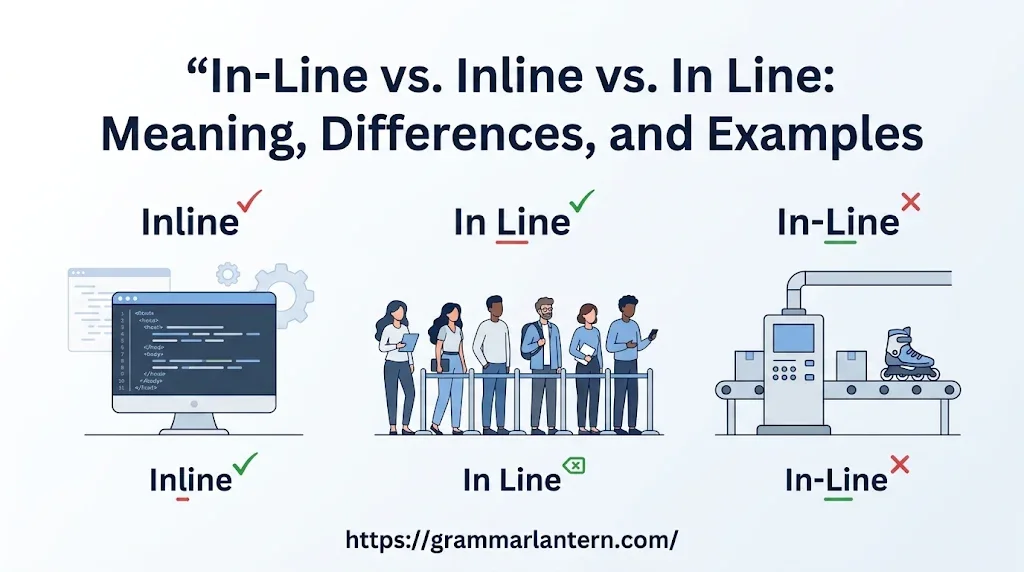
The main distinction between these three variations lies in their meaning and application. In line is generally a two-word phrase used when describing a queue, alignment, or agreement. Inline is commonly used in technology, computing, web development, and digital publishing. Meanwhile, in-line appears in certain contexts as a hyphenated compound, although many modern writing styles prefer other forms.
In this guide, you’ll discover the key differences, usage rules, and practical sentence examples that show when to use each form. Whether you’re writing business documents, academic papers, technical content, or everyday messages, these simple guidelines will help you choose the appropriate spelling and communicate your ideas with greater confidence.
Quick Answer
Inline is one word, commonly used for established terms such as inline code, inline images, and inline skating.
In line is a two-word phrase that describes being in a queue, arranged in a row, or consistent with a rule or expectation. Examples include standing in line and in line with company policy.
In-line is a hyphenated form used in certain technical expressions and compound modifiers when established usage or a style guide calls for it. Examples may include in-line inspection and in-line processing.
Here’s a quick comparison:
| Spelling | Main meaning or use | Example |
| Inline | An established closed compound, often used in technical terminology | The developer added inline code. |
| In line | A position, arrangement, or state of agreement | The customers waited in line. |
| In-line | A hyphenated form used in certain technical terms or modifiers | The technician performed an in-line inspection. |
The key is to consider the meaning first. Then check the established spelling for the particular expression you’re using.
What Does Inline Mean?
Inline is a single word that describes something placed within a line, integrated into a larger element, or arranged as part of a continuous sequence. Its precise meaning depends on the subject you’re discussing.
You’ll encounter inline frequently in computing, web design, sports, and engineering. In these fields, the closed spelling often forms part of an established technical term.
Inline in Computing and Programming
In programming, inline commonly describes code, content, or functionality incorporated directly into another part of a program or document.
For example, inline code appears within a line of text rather than in a separate code block. A technical explanation might say, “Use the print() function to display a message.” The code appears within the sentence, so inline code is the appropriate term.
Here are several examples:
- Inline code: The tutorial includes inline code to explain each command.
- Inline comments: The developer added inline comments to clarify the logic.
- Inline styles: The designer applied inline styles to an HTML element.
- Inline images: The article displays inline images alongside its text.
These expressions use inline as an established compound. Adding a hyphen isn’t necessary in ordinary usage unless a particular style guide or technical convention requires it.
Inline in Web Design
Web design provides another useful example of this spelling.
In CSS and HTML, inline can describe how an element behaves within the flow of text. An inline element generally occupies the space its content needs and doesn’t automatically begin a new line.
For instance, a link inside a paragraph usually appears inline with the surrounding words. The sentence continues naturally without forcing the link onto a separate line.
Consider this example:
“The designer added an inline link to the product page.”
Here, inline describes how the link appears within the surrounding content. Writing in line link would not be the standard spelling for this technical term.
One important distinction: the everyday word inline and the technical CSS concept of an inline element are related, but they aren’t identical definitions. Technical terminology follows the rules of the relevant technology.
Inline in Sports and Engineering
The closed spelling also appears in sports and mechanical terminology.
Inline skating involves skates with wheels arranged in a single line. The word inline describes the wheel arrangement, making it part of the sport’s established name.
In engineering, an inline engine has its cylinders arranged in a single row. This configuration differs from a V-shaped engine, in which the cylinders sit in two banks.
Examples include:
- She bought new inline skates for the weekend.
- The mechanic inspected the inline engine.
- The website loads inline images within the article.
In each sentence, inline functions as one word. The spelling reflects established terminology rather than a general rule that every pair of related words must be combined.
What Does In Line Mean?
In line is a two-word phrase that describes position, arrangement, or agreement with something. Unlike the closed compound inline, this phrase appears in several everyday expressions.
The words retain their separate identities because they work together as a phrase rather than forming the established compound used in technical terms.
In Line Means Waiting in a Queue
One of the most common uses of in line describes people waiting their turn.
For example, you might say:
- We stood in line for concert tickets.
- Several customers were waiting in line at the bank.
- Please get in line behind the other visitors.
- I waited in line for twenty minutes.
In American English, stand in line is the usual expression for waiting in a queue. The British English equivalent is often stand in a queue.
Notice that you wouldn’t normally write stand inline when describing people waiting for their turn. That spelling would suggest a different meaning or sound unnatural in this context.
In Line Means Arranged in a Row
The phrase can also describe objects positioned along a straight or common line.
For example:
- The chairs are in line with the windows.
- The fence posts stand in line along the road.
- Keep the boxes in line against the wall.
- The two markings aren’t in line with each other.
In these sentences, in line describes a physical relationship between objects. The phrase doesn’t necessarily mean that the objects form a perfect geometric line; context determines how precise the alignment needs to be.
For example, chairs placed along a wall may be approximately in line even if they’re not perfectly aligned.
In Line With Means Consistent With Something
Another important use appears in the expression in line with. It means consistent with, in agreement with, or following a particular standard.
Examples include:
- The decision is in line with company policy.
- Her actions were in line with the rules.
- The budget remains in line with our original plan.
- These recommendations are in line with current expectations.
This expression is common in business writing, academic discussions, professional communication, and everyday conversation.
Consider the difference between these two sentences:
Correct: The proposal is in line with our goals.
Incorrect in standard usage: The proposal is inline with our goals.
The second version uses the wrong form for the established expression. When you mean consistent with or in agreement with, choose the two-word phrase in line with.
What Does In-Line Mean?
In-line is the hyphenated form of the expression. Writers use it in certain established terms and compound modifiers, particularly in technical or specialized contexts.
However, the hyphen isn’t mandatory in every expression. Some dictionaries, industries, publications, and style guides prefer inline, while others retain in-line in particular terms.
The correct choice depends on the term’s established spelling and the writing convention you’re following.
In-Line in Technical Writing
Technical documents sometimes use in-line to describe equipment, processes, or operations integrated into a production system.
Examples may include:
- The factory uses an in-line inspection system.
- The engineer replaced the in-line filter.
- The technician monitored the in-line processing equipment.
These examples illustrate how a hyphenated form can appear in specialized writing. However, they don’t establish that the hyphen is always required. In many contexts, inline inspection, inline filter, and inline processing may also appear.
If you’re writing for a manufacturer, engineering company, or technical publication, check its preferred terminology before deciding which spelling to use.
Read More: 21 Best Replies to “God Bless You” For All Situations
Why Do Writers Use a Hyphen?
A hyphen connects words that function together as a unit. In some compound modifiers, it helps readers recognize the intended relationship between words.
For example, a publication might use in-line inspection as the preferred spelling of a particular technical process. The hyphen makes the expression consistent with that publication’s terminology.
However, don’t assume that every modifier needs a hyphen. English compounds often develop established spellings over time.
Compare these examples:
| Expression | Typical treatment |
| Inline code | Closed compound commonly used in computing |
| Inline skating | Established closed compound |
| In line with policy | Standard two-word expression |
| In-line inspection | Hyphenated variant used in some technical writing |
The safest approach is to follow established usage rather than adding or removing hyphens by instinct.
Key Differences
The three forms become easier to distinguish when you compare their grammatical roles and meanings.
| Feature | Inline | In line | In-line |
| Spelling | One word | Two words | Hyphenated |
| Common function | Adjective or adverb in established compounds | Phrase describing position or agreement | Modifier in certain technical expressions |
| Typical context | Programming, web design, sports, engineering | Queues, alignment, conformity | Specialized terminology and style-dependent compounds |
| Example | Inline skating is popular. | We waited in line. | The team used an in-line inspection system. |
| Main consideration | Established compound spelling | Meaning of the phrase | Preferred technical or editorial convention |
How Meaning Determines the Spelling
The easiest way to choose is to ask what you want to communicate.
If you’re describing a technical feature incorporated into a document or program, inline will often be appropriate.
If you’re describing people waiting their turn or something that agrees with a standard, use in line.
If you’re dealing with a specialized term that conventionally includes a hyphen, use in-line.
For example, consider these sentences:
- The developer inserted inline documentation.
- The employees stood in line outside the office.
- The technician checked the in-line equipment.
Each spelling fits a different context. Replacing one with another could make the sentence less natural or change its meaning.
When Should You Use Inline?
Use inline when the established term appears as one word. This spelling is particularly common in technical language, but it also appears in everyday descriptions.
Choose inline in contexts such as:
- Programming: inline code, inline comments, and inline functions.
- Web design: inline elements, inline styles, and inline images.
- Sports: inline skating and inline skates.
- Engineering: inline engines and other established equipment terms.
For example, “The developer added inline comments to explain the function” uses the standard closed compound.
Likewise, “She practices inline skating every Saturday” uses the established name of the sport.
A practical rule: Don’t split a recognized compound into two words simply because its parts have separate meanings. Established terms often develop their own spelling conventions.
When Should You Use In Line?
Use in line when you describe a queue, physical alignment, or consistency with a rule or expectation.
The following expressions normally use two words:
- Stand in line: We had to stand in line for admission.
- Get in line: The customers began to get in line.
- Keep something in line: The manager kept expenses in line with the budget.
- In line with: The new policy is in line with federal requirements.
- Fall in line: The team agreed to fall in line with the new procedures.
The last expression can mean following instructions, accepting expectations, or conforming to a group. Its exact meaning depends on context.
For example, “The students fell in line with the school’s requirements” suggests that they followed the established rules.
Don’t write inline with when you mean consistent with. The standard expression is in line with.
When Should You Use In-Line?
Use in-line when the hyphen belongs to an established term or follows the style requirements of your document.
You may encounter this spelling in technical manuals, manufacturing documents, engineering specifications, and specialized publications.
For example:
- The technician performed an in-line inspection.
- The engineer installed an in-line filter.
- The company upgraded its in-line processing equipment.
However, these examples don’t mean that you should always hyphenate the expressions. Many writers and technical publications use the closed spelling inline instead.
Before choosing, consider three things:
- Established terminology: Does your industry consistently use a particular spelling?
- Style requirements: Does your organization or publication specify how to write the term?
- Consistency: Have you used the same spelling throughout the document?
If a technical standard names a particular component or process, follow that standard’s terminology. Consistency matters more than personal preference when you’re writing formal documentation.
Common Mistakes to Avoid
Even experienced writers sometimes confuse these spellings. Most errors happen when someone focuses on the appearance of the words instead of their meaning.
Using Inline for a Queue
Incorrect: We stood inline for concert tickets.
Correct: We stood in line for concert tickets.
The two-word phrase describes people waiting their turn. Inline isn’t the standard spelling for this everyday expression in American English.
Writing Inline With Instead of In Line With
Incorrect: The proposal is inline with our objectives.
Correct: The proposal is in line with our objectives.
The expression in line with means consistent with or in agreement with something. Keep the words separate.
Adding a Hyphen to Every Modifier
Incorrect as a universal rule: Every phrase containing inline must become in-line before a noun.
Better approach: Follow the established spelling of the specific term.
For example, inline code is common in computing. Adding a hyphen without a reason can make your writing inconsistent with standard technical usage.
Removing a Hyphen Without Checking
Some specialized publications and technical documents consistently use hyphenated forms. If you’re editing such a document, don’t change every instance to inline without checking the terminology.
A spelling that looks unusual in everyday prose may reflect an established convention in a particular field.
Treating All Three Forms as Interchangeable
The biggest mistake is assuming these spellings are merely stylistic variations.
Consider the difference:
- The website displays an inline image.
- The visitors stood in line.
- The engineer inspected an in-line component according to the company’s terminology.
The first uses a closed compound. The second uses a phrase. The third illustrates a hyphenated variant whose appropriateness depends on the relevant technical convention.
Example Sentences
Examples make these distinctions easier to remember because they show how each spelling works in a complete sentence.
| Sentence | Correct form | Why it works |
| The programmer added inline comments. | Inline | The closed compound is standard in this technical context. |
| We waited in line outside the theater. | In line | The phrase describes a queue. |
| Her decision was in line with company policy. | In line | The expression means consistent with a policy. |
| She bought a pair of inline skates. | Inline | The spelling is established for the sport and equipment. |
| The technician checked the in-line filter. | In-line | This illustrates a hyphenated form used in some technical writing. |
| The article includes an inline image. | Inline | The image appears within the surrounding content. |
| The chairs were arranged in line with the windows. | In line | The phrase describes physical alignment. |
| The engineer documented the inline process. | Inline | The closed spelling may be appropriate if it matches the established technical term. |
A Short Real-World Editing Example
Imagine you’re editing a company’s website that includes customer instructions, software documentation, and equipment descriptions.
Your first draft contains these sentences:
- Customers should wait inline until their number is called.
- The tutorial includes in-line code examples.
- The technician inspected the inline filter.
Here’s how you might revise them:
- Customers should wait in line until their number is called.
- The tutorial includes inline code examples.
- The technician inspected the inline filter if that spelling matches the equipment documentation.
The first two corrections follow common American English and technical usage. The third depends on the company’s terminology; the original hyphenated spelling may also be appropriate under its style conventions.
This example highlights an important principle: correct editing requires attention to meaning and context, not just spelling patterns.
Is Inline One Word or Two?
Inline is one word when you’re using the established compound, as in inline code, inline skating, or inline images.
However, the phrase in line contains two words when you describe a queue, alignment, or agreement.
Compare these examples:
- One word: The designer inserted an inline image.
- Two words: The customers stood in line.
- Two words: The proposal is in line with the budget.
The spelling doesn’t depend only on whether the words appear before a noun. It depends on the expression’s meaning and established usage.
For instance, inline image uses the closed compound before a noun. Meanwhile, in line with the plan remains a two-word phrase even though it modifies the meaning of the sentence.
Is In-Line Hyphenated?
Yes, in-line is a valid hyphenated form in contexts where the term or style convention calls for it. However, the hyphen isn’t universally required.
English compounds can appear in three forms:
- Open compounds: Two separate words, such as in line.
- Hyphenated compounds: Words joined by a hyphen, such as in-line.
- Closed compounds: Words combined into one word, such as inline.
These categories help describe spelling patterns, but they don’t determine the correct form on their own. Established usage does that.
If you’re unsure whether to write inline inspection or in-line inspection, consult the relevant technical documentation or style guide. Then use the chosen spelling consistently.
Inline vs. In Line in Computing and Web Design
Computing is one of the clearest areas where the closed spelling inline appears frequently.
Inline Code
Inline code appears within a sentence, paragraph, or other block of text. Writers use it to identify commands, variables, functions, and short code fragments.
For example, a tutorial might say, “Call the calculateTotal() function to update the price.”
The function name appears within the sentence rather than in a separate code block. That’s why inline code is the natural term.
Inline Styles
An inline style is a CSS declaration applied directly to an HTML element through its style attribute.
For example, a developer might apply a text color directly to a paragraph element. This differs from placing the styling rules in a separate stylesheet or another CSS rule.
The term inline styles is standard in web development. You wouldn’t normally replace it with in-line styles unless a specific publication required that form.
Inline Elements
In HTML and CSS, inline behavior relates to how an element participates in the flow of surrounding content.
A link inside a paragraph typically appears alongside the other words. It doesn’t automatically start a new line merely because it’s a link.
However, an element’s display behavior depends on its CSS rules. A developer can change how many elements behave, so the word inline in technical discussions should be understood within the relevant context.
In Line With a Specification
Even in technical writing, the phrase in line with retains its ordinary two-word spelling.
For example:
“The updated interface is in line with the company’s accessibility requirements.”
Here, the phrase expresses agreement with a specification. It doesn’t describe an inline element or a closed technical compound.
This distinction is useful for developers, technical writers, documentation editors, and anyone who writes about software.
How to Remember the Difference Between Inline, In Line, and In-Line
You don’t need to memorize complicated grammar rules to choose the right spelling. Instead, connect each form with its most common use.
- Inline: Think of a technical feature or established compound, such as inline code or inline skating.
- In line: Think of people waiting in a queue or something that agrees with a plan.
- In-line: Think of a specialized term that follows a particular hyphenation convention.
When you’re unsure, use this quick decision process:
- Identify the meaning. Are you describing a queue, alignment, agreement, or a technical concept?
- Check the expression. Is the phrase conventionally written as one word or two?
- Verify the hyphen. If you’re dealing with specialized terminology, check the relevant reference or style guide.
- Stay consistent. Use the same established spelling throughout your article or document.
For example, if you’re writing about a web page, inline image will usually be appropriate. If you’re describing customers waiting for service, choose in line. If you’re preparing a technical manual, verify whether its terminology uses inline or in-line.
Read More: How Are You Faring or Fairing? Meaning, Difference, and Usage
FAQs
1. What is the difference between in line, inline, and in-line?
In line is usually a two-word phrase referring to a queue, alignment, or agreement. Inline is commonly used in computing and technology. In-line is a hyphenated form used in some contexts, depending on the style guide.
2. Is inline one word or two words?
Inline is one word. It commonly appears in technical writing, web development, and digital publishing. For example, “The developer added inline CSS to the webpage.”
3. Is in line always written as two words?
No, not always. The two-word form in line is common when describing a queue, position, or agreement. However, inline is the preferred spelling in many technical contexts.
4. Is in-line grammatically correct?
Yes, in-line can be correct in certain contexts. However, it is less common than in line or inline. Check your preferred dictionary or style guide to determine whether the hyphen is necessary.
5. Should I write standing in line or standing inline?
Write standing in line when referring to people waiting in a queue. For example, “We were standing in line to buy movie tickets.” The one-word form inline generally isn’t appropriate in this everyday expression.
6. What does inline mean in computing?
In computing, inline describes something placed directly within another element or structure. For example, inline CSS applies styling directly to an HTML element rather than using a separate stylesheet.
7. Is it in line with or inline with?
Use in line with when you mean consistent with, aligned with, or in agreement with something. For example, “Our decision is in line with company policy.” The three-word phrase is standard in this expression.
8. How do I use inline in a sentence?
You can use inline as an adjective or in technical expressions. For example, “The article includes inline images.” Here, the word describes images placed within the article’s content.
9. Does in-line need a hyphen in formal writing?
Not necessarily. The hyphen depends on the intended meaning, established usage, and style guide. In most everyday writing, use in line for queues and agreement, and inline for common technical meanings.
10. Which form should I use in professional writing?
Choose the spelling that matches your intended meaning. Use in line for queues, alignment, or agreement; inline for technology and related contexts; and in-line only when the context or your style guide supports the hyphenated form.
Conclusion
Choosing between in line, inline, and in-line becomes easier when you understand how each form works. Use in line when discussing queues, alignment, or agreement. Choose inline for common technical and digital contexts, such as inline code or inline styling. Reserve in-line for situations where a particular usage or style guide calls for the hyphen.
Before finalizing your writing, consider the meaning of the sentence rather than judging the spelling by appearance alone. A quick review can help you avoid common mistakes, improve clarity, and keep your writing consistent. Whether you’re preparing an academic paper, a business document, or a casual message, the right form will help you communicate your ideas clearly and confidently.

For Shafiq ur Rehman, writing is an art form and grammar is the toolbox that makes it beautiful. As a dedicated content writer at Grammar Lantern, Shafiq approaches every topic like an architect carefully laying down strong foundations of understanding before adding the finer details. He loves diving into the trickiest grammar points and resurfacing with simple, bite-sized takeaways that anyone can grasp. When he’s not crafting articles, you’ll likely find him strategizing over a game of chess, exploring dusty local bookshops, or quietly jotting down poetic observations in his notebook.