
If you’ve ever wondered whether how are you faring or fairing is correct, you’re not alone. These two words sound alike, but they have very different meanings. Choosing the right spelling matters, especially when you want your writing to sound clear and professional. The good news? Once you understand the difference, you’ll know which word to use without second-guessing yourself.
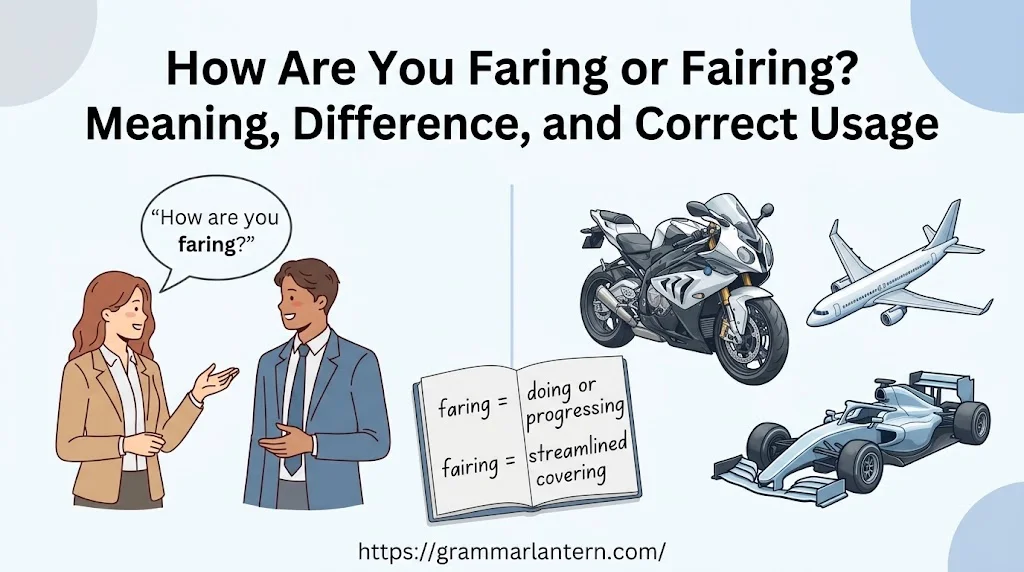
The correct expression is how are you faring, which asks how someone is doing, coping, or managing a situation. For example, you might ask a friend, “How are you faring in your new job?” The word fairing, however, refers to a covering designed to reduce air resistance or improve the shape of a vehicle, motorcycle, or aircraft. It doesn’t belong in this everyday question.
In this guide, you’ll learn the difference between faring vs fairing, explore their meanings and grammatical uses, and discover practical examples of each word. You’ll also find common mistakes and an easy memory trick to help you remember the correct spelling. By the end, you’ll feel confident using how are you faring in conversations and writing.
Quick Answer
“How are you faring?” is the correct phrase when asking someone how they’re doing, coping, or progressing. The word faring comes from the verb fare, which can describe how someone experiences a situation or how something performs.
By contrast, fairing is a noun that describes a structure or covering designed to create a smoother shape, often reducing air resistance on vehicles or aircraft.
Here’s the difference at a glance:
| Word or phrase | Meaning | Example |
| Faring | Doing, progressing, or experiencing a situation | How are you faring in your new job? |
| Fairing | A streamlined covering on a vehicle or machine | The motorcycle’s fairing protects parts of the bike and helps manage airflow. |
| Faring well | Experiencing a good outcome | She’s faring well in her new position. |
| How are you fairing? | Incorrect for asking about someone’s well-being | Write “How are you faring?” instead. |
Quick memory tip: If you’re asking about someone’s life, progress, or circumstances, use faring. If you’re discussing an aircraft, motorcycle, or another machine’s outer covering, use fairing.
What Does “How Are You Faring?” Mean?
The phrase “How are you faring?” asks about a person’s condition, progress, or experience. It can refer to almost any situation in which you want to know whether someone is managing well, struggling, or making progress.
The word faring is the present participle of fare. As a verb, fare describes how someone or something gets on in a particular situation. You can use it when discussing health, work, education, finances, relationships, or even the performance of a business.
For example, imagine your friend recently started a demanding job. Instead of asking only whether they like it, you might ask, “How are you faring in your new role?” This question invites them to share how they’re handling the workload and adjusting to their responsibilities.
Definition of “Faring”
Faring means doing, managing, progressing, or experiencing a particular outcome. The exact meaning depends on the surrounding words and the situation being discussed.
Here are some common expressions that show how the word works:
- Faring well: Experiencing positive results or managing successfully.
- Faring poorly: Experiencing difficulties or getting unfavorable results.
- Faring better: Improving or experiencing a more favorable outcome than before or compared with someone else.
- Faring worse: Experiencing a decline or a less favorable outcome.
- Faring reasonably well: Managing adequately, even if everything isn’t perfect.
Consider these examples:
- “The students are faring well in their final examinations.”
- “Small businesses are faring poorly because of rising operating costs.”
- “After several difficult weeks, Daniel is faring better at work.”
- “The new team is faring worse than expected this season.”
- “How are you faring with all your new responsibilities?”
Notice that faring doesn’t automatically mean doing well. It can describe a positive, negative, or mixed outcome. The surrounding words explain the situation.
When to Use “How Are You Faring?”
Use this phrase when you want to understand how someone is managing a particular experience or situation. It works especially well when the person faces a change, challenge, responsibility, or ongoing process.
Here are four common situations where the expression fits naturally.
Checking on someone’s well-being
If someone has been dealing with a difficult period, this question can show genuine interest.
Example: “I heard you’ve had a busy few weeks. How are you faring?”
Asking about work or a project
You can use the phrase to check someone’s progress without focusing only on the final result.
Example: “How are you faring with the new software system?”
Discussing education
Teachers, parents, and students can use faring to describe academic progress.
Example: “How are you faring in your advanced mathematics course?”
Following up during a challenging situation
The expression suits conversations about demanding circumstances, including relocation, major life changes, or financial pressure.
Example: “How are you faring after moving to a new city?”
In each example, the question asks more than whether something is technically happening. It asks how the person is getting along as the situation unfolds.
Examples of “How Are You Faring?” in Sentences
The best way to understand an expression is to see how it works in real conversations.
| Context | Example sentence | What it asks |
| Health | How are you faring after your surgery? | How is your recovery progressing? |
| Work | How are you faring in your new position? | How are you managing your job? |
| Education | How are you faring with your coursework? | Are you keeping up with your studies? |
| Finances | How is your family faring amid rising expenses? | How is your family managing financially? |
| Relationships | How are you faring after the separation? | How are you coping with the change? |
| Business | How is the company faring this year? | How is the company performing? |
| Sports | How is the team faring this season? | How well is the team performing? |
You can also use the expression in a statement rather than a question.
For example, “The company is faring better than expected” describes a positive business outcome. Similarly, “The family is faring reasonably well despite the unexpected move” indicates that they’re managing their circumstances fairly successfully.
What Does “Fairing” Mean?
Although fairing sounds like faring, it has a different meaning in standard modern English. A fairing is a structure or covering designed to create a smoother outer shape, often to reduce aerodynamic drag or protect components.
The term appears most often in engineering, transportation, and vehicle design. You might encounter it in discussions about aircraft, motorcycles, rockets, and other machines.
For example, a motorcycle may have a front fairing around the headlight and front section. An aircraft may use fairings to cover joints, equipment, or other parts that would otherwise disrupt its outer shape.
The important distinction is that fairing usually names a physical object. It doesn’t describe someone’s emotional state, personal progress, or ability to handle a difficult situation.
Definition of “Fairing”
In its engineering sense, fairing refers to a component that helps create a smooth, streamlined surface. Depending on its design and purpose, it may reduce air resistance, cover exposed components, or protect equipment.
Fairings serve different purposes across several types of vehicles:
- Motorcycles: Body panels can improve airflow, protect certain components, and shield riders from some wind.
- Aircraft: Fairings cover structural joints, landing gear components, or other equipment to create a smoother exterior.
- Rockets: A payload fairing protects a satellite or other cargo during the early stages of launch. It separates when the vehicle reaches the appropriate point in flight.
- Boats and marine equipment: Fairing can describe shaping or smoothing a surface to improve its form and interaction with water.
Not every fairing serves exactly the same function. Its design depends on the vehicle, the component it covers, and the conditions in which the machine operates.
Read More: Village vs. Subdivision: Definitions, Differences, and Examples
Examples of “Fairing” in Sentences
These examples show the word in its technical context:
- “The mechanic replaced the cracked fairing on the motorcycle.”
- “Engineers designed a new fairing to improve the aircraft’s outer profile.”
- “The rocket’s payload fairing protects the satellite during launch.”
- “The damaged fairing needed repairs before the motorcycle could return to the road.”
- “The technician removed the fairing to reach the components underneath.”
In each sentence, fairing refers to a physical structure or covering. Replacing it with faring would change the spelling to a verb form and make the sentence incorrect or confusing.
One additional point matters here: fairing can also have a less common British English meaning. It may refer to a small gift purchased or received at a fair. However, the engineering meaning is the one most relevant when comparing the word with faring in modern general usage.
Key Differences
The easiest way to distinguish these words is to consider their meanings and grammatical roles. Their pronunciation won’t help because they are homophones: words that sound alike but have different meanings and spellings.
Meaning and Part of Speech
Faring is the present participle of the verb fare. It describes how a person, group, business, or other subject is progressing or experiencing a situation.
Fairing is generally a noun in the engineering context. It names a component that creates a smoother outer shape or covers part of a vehicle or machine.
Compare these sentences:
- “The new employee is faring well.” Here, the word describes how the employee is doing.
- “The mechanic repaired the motorcycle’s fairing.” Here, the word names a physical component.
The grammar also differs. In the first sentence, faring forms part of the verb phrase is faring. In the second, fairing functions as a noun after the possessive phrase motorcycle’s.
Pronunciation and Spelling
In standard English, faring and fairing have the same pronunciation. Both sound like “FAIR-ing.”
This similarity explains why people sometimes confuse them in writing. When you hear the phrase aloud, you can’t determine which spelling the speaker intends from pronunciation alone.
Context provides the answer. If someone asks about your progress, the word is faring. If an engineer discusses a motorcycle component, the word is fairing.
| Feature | Faring | Fairing |
| Pronunciation | FAIR-ing | FAIR-ing |
| Usual part of speech | Verb form | Noun |
| Root word | Fare | Fair |
| Main meaning | Doing or progressing | Streamlined covering or structure |
| Common context | Personal circumstances, work, studies, performance | Vehicles, aircraft, engineering |
| Correct example | How are you faring? | The aircraft’s fairing needs repair. |
| Suitable for asking about well-being? | Yes | No |
Easy Ways to Remember the Difference
Spelling tricks work best when they connect a word to its meaning. You don’t need to memorize complicated grammar rules to choose correctly here.
Try these simple reminders:
- Faring = fare + ing. Think about how someone fares in a situation.
- Fairing = fair + ing. In engineering, remember the physical covering rather than the adjective fair.
- People fare through situations. If you’re asking about a person’s progress or circumstances, choose faring.
- Machines have fairings. If you’re naming an aerodynamic component, choose fairing.
Here’s a quick test. Imagine you’re emailing a colleague who has recently taken on a difficult assignment. Which sentence should you write?
A. “How are you fairing with the assignment?”
B. “How are you faring with the assignment?”
The correct answer is B. You’re asking how your colleague is managing the work, not referring to a physical component.
Is “How Are You Faring?” Grammatically Correct?
Yes. “How are you faring?” is grammatically correct and works in both spoken English and writing. You can use it to ask about a person’s circumstances, progress, or experience.
The sentence follows a standard question structure:
- How — asks about the manner or condition.
- Are — the auxiliary verb used with the subject you.
- You — the subject of the sentence.
- Faring — the present participle of fare.
Together, these words form a question about how someone is doing.
The same grammatical pattern appears in sentences such as “How are you feeling?” and “How are you managing?” In each case, the auxiliary verb are combines with a present participle.
Why “Faring” Follows “Are”
In English, the present continuous tense uses a form of be followed by a present participle. The structure often describes an action, condition, or process happening around the present time.
For example:
- “You are learning a new skill.”
- “You are adjusting to your new schedule.”
- “You are managing several responsibilities.”
- “You are faring well under the circumstances.”
The last sentence follows the same pattern. The verb are combines with faring to describe how the person is doing.
The question form places are before the subject:
- Statement: “You are faring well.”
- Question: “Are you faring well?”
- Open question: “How are you faring?”
All three forms are grammatically sound.
Is “How Are You Fairing?” Ever Correct?
Not when you’re asking about someone’s well-being or progress. In that context, fairing is the wrong word.
However, fairing can be correct in a different sentence that discusses an actual component. For instance, “Are you fairing the aircraft’s surface?” could be grammatical in a specialized technical context if fairing is being used as a verb meaning to smooth or shape a surface.
That technical use doesn’t make “How are you fairing?” a correct alternative to “How are you faring?” The intended meaning determines the appropriate word.
In Different Contexts
One reason faring remains useful is its flexibility. You can apply it to people, organizations, teams, and even systems. The word focuses on how something is progressing rather than simply stating what it is doing.
Faring at Work
Workplaces change constantly. Employees take on new duties, managers introduce unfamiliar systems, and teams face changing deadlines. The word faring lets you ask how someone is handling those demands.
For example:
- “How are you faring in your new position?”
- “The sales team is faring well despite the tighter deadline.”
- “Our department is faring better after reorganizing its workflow.”
- “The new employee is faring reasonably well during training.”
The expression can sound thoughtful and professional, particularly when you want to check on someone’s overall experience.
Consider this short workplace scenario.
Example: A colleague recently became a team leader. Their workload has increased, and they’re learning to manage several employees. You ask, “How are you faring in your new role?”
That question gives your colleague room to discuss their progress, difficulties, and adjustment. It doesn’t assume they’re succeeding or struggling.
Faring in School or College
Students often face demanding coursework, exams, deadlines, and unfamiliar subjects. In this context, faring can describe academic progress or performance.
Examples include:
- “How are you faring in your chemistry class?”
- “The students are faring better after receiving extra practice.”
- “She is faring well in her final semester.”
- “Several students are faring poorly in the advanced course.”
Notice that faring doesn’t specify a particular grade. It describes a broader outcome, which might include understanding the material, keeping up with assignments, or managing the course’s demands.
If you want to ask specifically about a test score, a more direct question may be better: “What grade did you get on the exam?” If you want to know how the student is managing the course overall, “How are you faring?” is appropriate.
Faring During Difficult Times
The phrase often appears when someone is dealing with a challenge. It can express concern without forcing the person to describe their feelings in a particular way.
For example:
- “How are you faring after the recent move?”
- “The family is faring well despite the unexpected expenses.”
- “He’s faring better now that he has settled into his new routine.”
- “How is your neighborhood faring after the storm?”
The expression can feel especially considerate when the situation involves uncertainty or a prolonged adjustment. It acknowledges that circumstances may be complicated.
Still, tone matters. If a close friend is having a difficult day, “How are you doing?” might sound warmer and more natural in casual conversation. “How are you faring?” can sound more reflective or formal, depending on the relationship and situation.
Faring in Competition
You can also use faring to discuss results in sports, tournaments, elections, and other competitive settings.
Examples:
- “How is the team faring this season?”
- “The defending champions are faring better than expected.”
- “The candidate is faring poorly in recent polling.”
- “How are the local players faring in the tournament?”
Here, the word focuses on performance or results. It doesn’t necessarily describe how competitors feel emotionally.
The same principle applies to businesses and public organizations. You might ask how a company is faring in a changing market or how a new product is faring against competing products.
Common Mistakes to Avoid
Even though the distinction is straightforward, several related errors can cause confusion. Understanding these mistakes will help you choose the correct word more consistently.
Using “Fairing” Instead of “Faring”
This is the most common mistake in the phrase “How are you faring?”
Incorrect: “How are you fairing in your new job?”
Correct: “How are you faring in your new job?”
The first sentence uses a word associated with a physical covering or technical shaping. The second correctly asks about the person’s experience at work.
Remember: When the subject is doing, progressing, or coping, use faring.
Assuming Identical Pronunciation Means Identical Meaning
English contains many homophones, including right and write, brake and break, and their and there. The same principle applies to faring and fairing.
Hearing a word correctly doesn’t guarantee that you’ll spell it correctly. You must also consider what the sentence means.
For example, if someone says, “The aircraft’s fairing is damaged,” the surrounding words identify the technical meaning. If someone asks, “How are you faring?” the question identifies the verb form.
Confusing “Faring” With “Ferrying”
These words look similar, but they have different meanings.
Faring describes how someone or something is doing.
Example: “The company is faring well this year.”
Ferrying means transporting people or goods from one place to another, often by boat or aircraft.
Example: “The boat is ferrying passengers across the river.”
The distinction is important because ferrying describes an activity, while faring describes progress or circumstances.
Assuming “Faring” Always Means Doing Well
The word itself doesn’t indicate success. You need additional words or context to show whether the outcome is positive or negative.
Compare these sentences:
- “The business is faring well.” The business is doing successfully.
- “The business is faring poorly.” The business is struggling.
- “The business is faring better than last year.” Its situation has improved.
- “The business is faring worse than its competitors.” Its performance is less favorable.
All four sentences use faring correctly. The words well, poorly, better, and worse clarify the outcome.
Using “Faring” When a Simpler Phrase Works Better
Correct grammar doesn’t always guarantee natural conversation. Although “How are you faring?” is valid, it may sound more formal than necessary in an ordinary text message.
For example, you might text a friend:
“How are you doing with the new apartment?”
That phrasing may sound more relaxed than “How are you faring with the new apartment?”
Neither is inherently wrong. Choose the expression that fits your audience, tone, and purpose.
Similar Expressions
Several everyday phrases communicate nearly the same idea as “How are you faring?” However, their tone and emphasis differ slightly.
“How Are You Faring?” vs. “How Are You Doing?”
Both questions ask about someone’s current circumstances, but they can create different impressions.
“How are you faring?” often emphasizes how someone is managing a situation or progressing through an experience. It may sound thoughtful, formal, or slightly literary.
“How are you doing?” is more common in everyday American English. Depending on context, it can function as a greeting or a genuine question about someone’s well-being.
Compare these examples:
| Situation | Natural expression | Why it works |
| Greeting a friend | How are you doing? | Casual and familiar |
| Checking on a colleague’s adjustment | How are you faring in your new role? | Focuses on the overall experience |
| Asking about someone’s recovery | How are you faring after surgery? | Shows interest in progress |
| Starting a casual conversation | How’s it going? | Relaxed and conversational |
If you want a warm, everyday greeting, How are you doing? is usually the easier choice. If you want to ask specifically about someone’s progress or circumstances, How are you faring? can be more precise.
“How Are You Faring?” vs. “How Are Things Going?”
“How are things going?” asks about a person’s situation, activities, or general progress. It’s conversational and works in many settings.
For example:
- “How are things going at your new job?”
- “How are you faring at your new job?”
Both sentences are correct. The first sounds more casual and broad, while the second places slightly more emphasis on how the person is managing the experience.
You can also ask about a specific project:
“How are things going with the website redesign?”
Or you can focus on the person’s experience:
“How are you faring with the website redesign?”
The difference is subtle, not absolute. Context and tone often matter more than a strict distinction between the two expressions.
“Faring Well” vs. “Doing Well”
Both phrases describe a positive situation, but faring well often highlights performance or how circumstances are unfolding.
Examples:
- “She’s doing well in her new job.”
- “She’s faring well in her new job.”
- “The company is doing well financially.”
- “The company is faring well despite increased competition.”
The first pair describes a person’s success at work. The second pair highlights a company’s financial or competitive circumstances.
In everyday conversation, doing well is generally more familiar. In reports, analyses, or discussions about performance, faring well can be a useful alternative.
Read More: Sang or Sung: Which Is Correct? Helpful Examples
FAQs
1. Is it “How are you faring” or “How are you fairing”?
How are you faring? is correct when asking someone how they are doing or managing a situation. For example, “How are you faring at your new job?” The word fairing refers to a covering that reduces air resistance around vehicles or aircraft.
2. What does “How are you faring?” mean?
“How are you faring?” means “How are you doing?” or “How are things going for you?” People use this expression to ask about someone’s progress, well-being, or ability to handle a situation.
3. What is the difference between faring and fairing?
Faring comes from the verb fare, meaning to get along, perform, or experience something. Fairing is a noun that usually describes a streamlined covering on a vehicle, motorcycle, or aircraft. Although they sound alike, their meanings and uses differ.
4. Is “faring” a real word?
Yes, faring is a correct English word. It’s the present participle of fare. You might see it in sentences such as “She is faring well in college” or “The company is faring better this year.”
5. Is “fairing” a real word?
Yes, fairing is also a correct English word. It commonly refers to a structure designed to reduce aerodynamic drag or create a smoother shape. For example, a motorcycle’s fairing can help reduce wind resistance and protect the rider from wind and debris.
6. How do you use “faring” in a sentence?
Use faring when describing how someone or something is doing. Here are a few examples:
- How are you faring after your first week at work?
- The students are faring well in their final exams.
- Our business is faring better than expected.
- How is your family faring after the move?
7. How do you use “fairing” in a sentence?
Use fairing when referring to a physical covering or streamlined structure. For example:
- The mechanic replaced the motorcycle’s damaged fairing.
- The aircraft’s fairing helps reduce aerodynamic drag.
- She ordered a new fairing for her racing bike.
8. Are faring and fairing pronounced the same way?
Yes, faring and fairing are generally pronounced the same way in standard English. They are homophones, meaning they sound alike but have different meanings and spellings. Their pronunciation makes them easy to confuse in writing.
9. Can I use “How are you fairing?” in a formal email?
No. If you’re asking about someone’s progress or well-being, use “How are you faring?” For example, you could write, “I hope you’re doing well. How are you faring with the new project?” This wording is suitable for professional emails, although “How are you doing?” may sound more conversational.
10. What is an easy way to remember faring vs. fairing?
Connect faring with fare, as in how someone fares in a situation. If you’re asking how a person is doing, choose faring. Connect fairing with vehicles and their streamlined coverings. This simple distinction can help you remember the correct spelling whenever you write the expression.
Conclusion
Choosing between how are you faring and how are you fairing becomes easy once you understand their meanings. Faring is the correct choice when asking how someone is doing, coping, or progressing. Fairing refers to a physical covering, often found on motorcycles, aircraft, and other vehicles. Both words are correct, but they serve different purposes.
When you’re unsure which spelling to use, remember the verb fare. If you’re asking someone about their life, work, health, or progress, write “How are you faring?” With this simple rule and a few examples for practice, you can avoid this common spelling mistake and communicate clearly in everyday conversations and professional writing.