Have you ever wondered whether to write others, other’s, or others’? These words look almost identical, but each serves a different purpose in English grammar. The correct choice depends on whether you’re referring to one person, several people, or something that belongs to someone. Understanding these word forms makes your writing clearer and helps you avoid common grammar mistakes. Although the differences seem small, one misplaced apostrophe can change the entire meaning of a sentence.
The word other refers to an additional person or thing, while others is its plural form. When you want to show ownership or possession, you need a possessive form. Use other’s for one person’s belongings and others’ for belongings shared by multiple people. These singular and plural distinctions follow simple grammatical rules that are easy to remember once you understand them.
In this guide, you’ll learn the correct usage of each form through simple examples and practical explanations. We’ll explore apostrophe placement, possessive construction, and common language rules to help you choose the right spelling. Whether you’re writing emails, reports, articles, or everyday messages, these tips will make your writing more accurate and natural.
Quick Answer
The correct form depends on what you want to communicate. Others is a plural pronoun without an apostrophe. Other’s is a singular possessive form, while others’ is a plural possessive form.
Here’s a quick comparison:
| Word | Meaning | Grammatical Function | Example |
| Others | Additional or different people or things | Plural pronoun | Others disagree with the decision. |
| Other’s | Belonging to one other person or thing | Singular possessive | I respected the other’s decision. |
| Others’ | Belonging to multiple other people or things | Plural possessive | We should respect others’ opinions. |
Remember these three simple rules:
- Others: No apostrophe because the word doesn’t express possession.
- Other’s: Apostrophe before the s because one other person or thing possesses something.
- Others’: Apostrophe after the s because multiple other people or things possess something.
The easiest way to choose correctly is to identify whether you’re describing additional people, one owner’s possession, or multiple owners’ possessions.
What Does Others Mean?
Others is the plural form of other when used as a pronoun. It refers to additional or different people or things that aren’t the same ones already mentioned.
Unlike possessive forms, others doesn’t show ownership. It simply identifies a different group or additional members of a group.
For example:
- Some employees arrived early while others arrived later.
- I enjoy reading novels, but others prefer biographies.
- Several students completed the assignment, while others needed more time.
- Some people enjoy traveling alone, while others prefer group trips.
In these sentences, others replaces a longer expression, such as other employees, other students, or other people.
This makes sentences shorter and prevents unnecessary repetition.
Examples of Others in Sentences
Understanding a word becomes easier when you see how people use it in different situations.
Consider these examples:
- Some customers preferred online shopping, while others visited the store.
- I finished my work before the deadline, but others needed another day.
- Some people believe in taking risks, while others prefer stability.
- A few children played outside while others stayed indoors.
- The first proposal received approval, but others were rejected.
- Some books explain basic grammar, while others cover advanced topics.
Notice that none of these examples requires an apostrophe. The word simply refers to additional people or things.
Important: Don’t write other’s when you mean multiple additional people. The apostrophe would incorrectly suggest possession.
Others vs. Other: What’s the Difference?
Although other and others look similar, they don’t always work in the same grammatical position.
Other commonly works as a determiner before a noun. It identifies something different or additional.
For example:
- I have other plans.
- She purchased other books.
- We need other options.
On the other hand, others usually functions as a pronoun. It replaces a noun phrase rather than introducing a noun.
For example:
- Some plans changed, but others remained the same.
- She purchased three books and recommended others.
- We considered several options, but others were unavailable.
Here’s the difference:
| Other | Others |
| Other students attended the meeting. | Others attended the meeting. |
| I need other options. | I need others. |
| She selected other books. | She selected others. |
Remember: Use other before a plural noun when appropriate. Use others when you want the pronoun to stand alone.
What Does Other’s Mean?
Other’s is the singular possessive form of other. It indicates that something belongs to one other person or thing.
The apostrophe appears before the final s because the possessive owner is singular.
However, there’s an important grammatical detail. In ordinary writing, other’s often appears as the other’s because other commonly needs a determiner when used as a singular pronoun.
For example:
- I respected the other’s decision.
- She preferred the other’s approach.
- Each person listened carefully to the other’s explanation.
In these examples, two people or things are being compared. The possessive form identifies something belonging to the second person or thing.
The noun after the possessive can also be understood from context.
For example:
“I chose my answer, and she chose the other’s.”
Here, the other’s refers to the other person’s answer. The word answer is omitted because readers can understand it from the sentence.
Examples of Other’s in Sentences
Here are some practical examples showing how to use other’s correctly:
- I appreciated the other’s willingness to help.
- She respected the other’s personal boundaries.
- Each participant considered the other’s suggestions.
- He preferred the other’s explanation of the problem.
- One person’s success shouldn’t diminish the other’s achievements.
- The two business partners carefully reviewed the other’s proposal.
In each example, the possessive form refers to one other person.
When Should You Use Other’s?
Use other’s when you’re discussing possession associated with one additional or different person or thing.
Common situations include:
- Opinions: The other’s opinion was different.
- Decisions: I respected the other’s decision.
- Responsibilities: She understood the other’s responsibilities.
- Ideas: His suggestion supported the other’s idea.
- Property: The other’s belongings remained in the office.
- Experiences: We listened to the other’s experience.
The context must make the singular owner clear.
For instance, imagine two colleagues discussing a project. One colleague shares an idea, and the second presents a different suggestion.
You might write:
“Each colleague listened carefully to the other’s ideas.”
Here, the possessive form indicates that each person has ideas belonging to them.
A useful distinction: If you’re referring to one person who isn’t identified by name, someone else’s often sounds more natural than other’s.
For example:
- Someone else’s opinion matters too.
- I accidentally picked up someone else’s notebook.
Both expressions communicate singular possession, but they have slightly different grammatical structures.
Read More: 8 Words for Someone Who Doesn’t Care About Others’ Feelings
What Does Others’ Mean?
Others’ is the plural possessive form of others. It indicates that something belongs to multiple additional or different people or things.
The apostrophe comes after the final s because the plural word already ends in s.
For example:
“Teachers should respect others’ opinions.”
The word others’ indicates that the opinions belong to multiple other people.
This form appears frequently in discussions about shared responsibilities, personal experiences, contributions, ideas, and belongings.
Examples of Others’ in Sentences
Consider these examples:
- We should respect others’ opinions even when we disagree.
- The company appreciates others’ contributions.
- Students can learn from others’ experiences.
- The manager considered others’ suggestions before making a decision.
- Children should respect others’ personal belongings.
- Successful teamwork requires understanding others’ expectations.
- The organization recognizes others’ achievements.
- We shouldn’t judge people based on others’ assumptions.
Each example refers to possession or association involving multiple people.
When Should You Use Others’?
Use others’ when the owners are plural and the sentence expresses possession.
Here are some common situations:
- Opinions: Different people have different opinions. Respect others’ opinions.
- Experiences: We can learn from others’ experiences.
- Contributions: The organization recognizes others’ contributions.
- Responsibilities: Everyone should understand others’ responsibilities.
- Belongings: Never take others’ belongings without permission.
- Achievements: Celebrate others’ achievements instead of comparing yourself constantly.
The most important point is the number of owners.
If multiple people own or contribute something, the plural possessive form is appropriate.
For example:
“Employees should understand others’ expectations before beginning a group project.”
The expectations belong to multiple people. Therefore, others’ is the correct choice.

Key Differences
Now that each form has been explained separately, let’s compare them directly.
The main distinction involves two questions:
- Does the sentence express possession?
- If possession exists, is the owner singular or plural?
Your answers determine the correct spelling.
Side-by-Side Grammar Comparison
| Feature | Others | Other’s | Others’ |
| Apostrophe | No | Before s | After s |
| Meaning | Additional people or things | One other owner’s possession | Multiple other owners’ possessions |
| Grammatical role | Plural pronoun | Singular possessive | Plural possessive |
| Expresses ownership | No | Yes | Yes |
| Example | Others arrived early. | The other’s bag is missing. | Others’ bags are missing. |
Let’s examine three sentences to see how apostrophe placement changes meaning.
Example One: Others
“Others joined the discussion.”
This sentence simply tells us that additional people participated. Nobody owns anything.
Example Two: Other’s
“The other’s notebook is missing.”
This sentence identifies a notebook belonging to one other person.
Example Three: Others’
“Others’ notebooks are missing.”
This sentence identifies notebooks belonging to multiple other people.
A single punctuation mark can change the grammatical meaning. That’s why apostrophe placement deserves attention.
How Apostrophe Placement Changes Meaning
English uses apostrophes to indicate possession in many noun forms. However, the placement depends on whether the owner is singular or plural.
Here’s a simple breakdown:
- Others: No apostrophe because there’s no possessive meaning.
- Other’s: Apostrophe before s because the possessive form is singular.
- Others’: Apostrophe after s because the possessive form is plural.
Think about the difference between a single student and a classroom full of students.
If one student owns a notebook, you might write:
“The other student’s notebook.”
If multiple students own notebooks, you might write:
“The other students’ notebooks.”
The same principle helps explain other’s and others’.
Other Related Forms You Should Know
Understanding these three spellings becomes easier when you recognize related words.
English has several expressions that look similar but perform different grammatical jobs.
Other vs. Others
Other generally appears before a noun or after a determiner. Others usually replaces a plural noun phrase.
Examples:
- I have other questions.
- I have several others.
- Some employees work remotely, while others work onsite.
- We should consider other possibilities.
The important distinction is whether the word introduces a noun or replaces one.
Another vs. Other
Another combines an and other. It generally refers to one additional or different person or thing.
For example:
- Would you like another cup of coffee?
- She needs another opportunity.
- I purchased another notebook.
Other can introduce singular or plural nouns depending on its determiner and surrounding structure.
For example:
- I have other responsibilities.
- The other student submitted the assignment.
- We considered the other options.
Remember that another generally takes a singular countable noun in standard usage. You wouldn’t normally write “another books.”
Another’s vs. Other’s
Both forms can indicate singular possession, but their meanings differ.
Another’s refers to something belonging to another person or an additional person.
Other’s generally refers to something belonging to the other person or thing already established by context.
Examples:
- I shouldn’t use another’s personal information.
- Each person should respect the other’s decision.
The first sentence refers to an additional person’s information. The second refers to the other member of an established pair or comparison.
Others vs. The Others
These expressions differ mainly in specificity.
Others refers to additional people or things without necessarily identifying a particular remaining group.
Example:
“Some students passed the examination, while others failed.”
Here, others refers to additional students.
The others refers to a specific remaining group whose identity becomes clear from context.
Example:
“Ten students joined the class. Three left early, but the others stayed.”
The phrase the others identifies the seven remaining students.
Others’ vs. Other People’s
Both expressions can communicate plural possession.
For example:
- We should respect others’ opinions.
- We should respect other people’s opinions.
Both sentences communicate the same basic idea.
However, others’ is more concise, while other people’s can sometimes sound clearer when the reference needs additional context.
Choose the expression that makes your sentence easiest to understand.
Common Mistakes
Even experienced English writers sometimes confuse these forms. Most mistakes happen because people add apostrophes without checking whether the sentence expresses possession.
Let’s examine the most common errors.
Adding an Apostrophe to Others Without Showing Possession
Incorrect: Other’s are waiting outside.
Correct: Others are waiting outside.
The sentence refers to additional people. It doesn’t indicate ownership.
Therefore, others is the correct form.
Using Other’s for Multiple Owners
Incorrect: Other’s opinions deserve respect.
Correct: Others’ opinions deserve respect.
The sentence refers to opinions belonging to multiple people. The plural possessive form needs an apostrophe after s.
Forgetting the Apostrophe in Others’
Incorrect: We should respect others opinions.
Correct: We should respect others’ opinions.
The word opinions belongs to multiple other people. Therefore, the possessive apostrophe is necessary.
Placing the Apostrophe Before the S
Incorrect: The others’s belongings are missing.
Correct: The others’ belongings are missing.
The plural form already ends in s. Adding another s isn’t necessary.
Confusing Other’s With Someone Else’s
Incorrect: I accidentally took other’s phone.
Correct: I accidentally took someone else’s phone.
The first sentence lacks the determiner needed for the intended meaning. The second sentence communicates singular possession naturally.
You could also write:
“I accidentally took the other person’s phone.”
Both corrected versions work.
Incorrect vs. Correct Examples
| Incorrect | Correct |
| Other’s are coming. | Others are coming. |
| Others opinion matters. | Others’ opinions matter. |
| The others belongings are missing. | The others’ belongings are missing. |
| I respect other’s choices. | I respect others’ choices. |
| Someone others bag is here. | Someone else’s bag is here. |
| The other students opinion matters. | The other students’ opinions matter. |
Checking the owner and the intended meaning will prevent most of these mistakes.
How to Choose the Correct Form: Simple Rules
You don’t need to memorize complicated grammar definitions every time you write. A simple decision-making process can help you select the correct form.
Follow these steps.
Step One: Determine Whether Possession Exists
Ask yourself whether the sentence shows that something belongs to someone or something.
For example:
“Others attended the meeting.”
This sentence doesn’t express ownership. Therefore, use others.
However:
“Others’ opinions influenced the meeting.”
This sentence expresses possession. The opinions belong to multiple people, so others’ is correct.
Step Two: Identify the Number of Owners
If the sentence expresses possession, determine whether one person or multiple people own something.
- One other person: other’s
- Multiple other people: others’
For example:
“The other’s suggestion was helpful.”
One other person’s suggestion is being discussed.
“Others’ suggestions were helpful.”
Multiple people’s suggestions are being discussed.
Step Three: Check the Apostrophe Position
Once you’ve identified the owner, check the spelling.
- No possession: others
- Singular possession: other’s
- Plural possession: others’
This final check helps catch punctuation mistakes before you publish or submit your writing.
Practical Examples in Everyday Writing
These three forms appear in everyday communication more often than you might realize.
Knowing when to use each one can make your writing clearer and more professional.
Using Others, Other’s, and Others’ in Workplace Communication
Professional communication often involves opinions, decisions, responsibilities, and contributions.
For example:
- Others may have different suggestions for improving the project.
- The other’s decision should be considered before proceeding.
- Managers should recognize others’ contributions.
- Employees should respect others’ professional boundaries.
Using the correct possessive form prevents confusion when discussing responsibilities or individual contributions.
Using These Forms in Academic Writing
Academic writing frequently compares ideas, research findings, and individual perspectives.
Consider these examples:
- Some researchers support the theory, while others question its accuracy.
- The other’s interpretation offers a different perspective.
- Students should acknowledge others’ contributions when discussing previous research.
The final example is particularly important. The possessive form identifies contributions belonging to multiple other people.
Using These Forms in Everyday Conversations
You don’t need formal writing situations to encounter these words.
For example:
- Others are already waiting outside.
- I understand the other’s point of view.
- Respect others’ feelings.
- Some people like spicy food, while others prefer mild dishes.
These expressions work naturally in everyday conversations, messages, and social media posts.
Real-Life Case Study: Choosing the Correct Apostrophe
Imagine two coworkers, Sarah and Daniel, preparing a presentation.
Sarah completes her slides first. Daniel then reviews her work and suggests several changes.
Later, their manager asks both employees to review additional suggestions from the remaining team members.
Consider these sentences:
Situation One: Additional People
“Others joined the presentation meeting.”
The sentence refers to additional team members. No possession exists, so others is correct.
Situation Two: One Person’s Possession
“Sarah reviewed the other’s presentation.”
Here, the other refers to Daniel in the context of the two coworkers. The presentation belongs to one other person, so other’s is correct.
Situation Three: Multiple People’s Possessions
“Sarah reviewed others’ presentations.”
Now, Sarah reviews presentations belonging to several additional team members. The plural possessive form others’ communicates that meaning.
This example demonstrates how context determines the correct form.
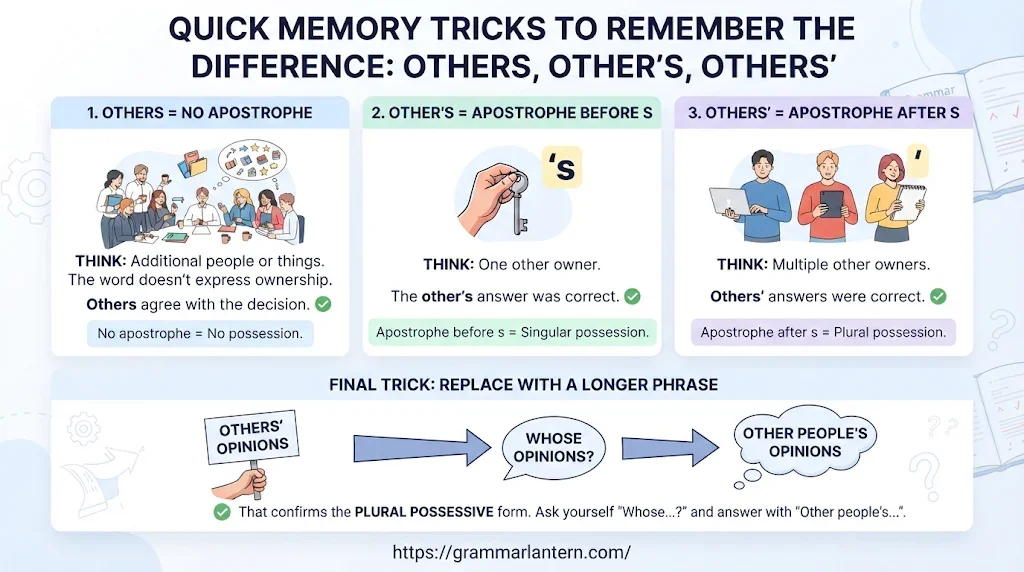
Quick Memory Tricks to Remember the Difference
If you frequently confuse these spellings, use these simple memory tricks.
Others = No Apostrophe
Think of additional people or things. The word doesn’t express ownership.
Example: Others agree with the decision.
Other’s = Apostrophe Before S
Think of one other owner.
Example: The other’s answer was correct.
Others’ = Apostrophe After S
Think of multiple other owners.
Example: Others’ answers were correct.
You can also remember the difference with this simple pattern:
- No apostrophe = No possession.
- Apostrophe before s = Singular possession.
- Apostrophe after s = Plural possession.
One final trick is to replace the possessive expression with a longer phrase.
For example:
“Others’ opinions”
Ask yourself: Whose opinions?
The answer is: Other people’s opinions.
That confirms the plural possessive form.
Read More: Wise vs. Wize: Which Spelling Is Correct?
FAQs
1. What is the difference between others and other’s?
Others refers to additional people or things, while other’s shows ownership by one person or thing. For example, “Others agreed with the decision” and “The other’s opinion was different.”
2. Is others’ grammatically correct?
Yes, others’ is grammatically correct. It is the plural possessive form of other and shows that something belongs to multiple people or things. For example, “We respected the others’ opinions.”
3. When should I use other’s?
Use other’s when something belongs to one additional person or thing. For example, “I borrowed the other’s notebook.” The apostrophe comes before the final s to indicate singular possession.
4. When should I use others’ in a sentence?
Use others’ when referring to something owned by multiple people or things. For example, “The others’ suggestions helped us improve the project.” The apostrophe comes after the s because the noun is plural.
5. Is others a plural possessive form?
No, others is a plural pronoun, not a possessive form. It refers to additional people or things without showing ownership. To express possession, write others’ instead.
6. Does the apostrophe change the meaning of other’s and others’?
Yes, apostrophe placement changes the meaning. Other’s indicates singular possession, whereas others’ indicates plural possession. This small punctuation difference helps readers understand who owns something.
7. Can I use others without an apostrophe?
Absolutely! Use others when referring to additional people or things without expressing ownership. For example, “Some students enjoy reading, while others prefer sports.”
8. What is the difference between other and others?
Other generally works as a determiner before a noun or as a singular pronoun in suitable contexts. Others is a plural pronoun that refers to additional people or things. For example, “I need another option” and “Others have different opinions.”
9. What are common mistakes when using other’s and others’?
A common mistake is placing the apostrophe incorrectly. Writers sometimes use other’s when they mean plural ownership or write others’ when referring to one owner. Always identify the number of owners before choosing the possessive form.
10. How can I remember the correct usage of others, other’s, and others’?
Use this simple trick:
- Other: Refers to an additional person or thing.
- Others: Refers to multiple additional people or things.
- Other’s: Shows ownership by one person or thing.
- Others’: Shows ownership by multiple people or things.
Remember that the apostrophe’s position tells you whether the owner is singular or plural.
Conclusion
Understanding the difference between others, other’s, and others’ doesn’t have to be difficult. Each form has a specific purpose in English grammar. Use others for additional people or things, other’s for singular possession, and others’ for plural possession. Paying attention to apostrophe placement helps you avoid confusing these similar-looking words.
The next time you use these forms in an email, report, article, or everyday conversation, consider who owns the item or whether you’re simply referring to additional people. This simple habit makes correct usage easier and improves your overall writing accuracy. Once you understand these basic grammatical rules, choosing the right form will become second nature.

For Shafiq ur Rehman, writing is an art form and grammar is the toolbox that makes it beautiful. As a dedicated content writer at Grammar Lantern, Shafiq approaches every topic like an architect carefully laying down strong foundations of understanding before adding the finer details. He loves diving into the trickiest grammar points and resurfacing with simple, bite-sized takeaways that anyone can grasp. When he’s not crafting articles, you’ll likely find him strategizing over a game of chess, exploring dusty local bookshops, or quietly jotting down poetic observations in his notebook.