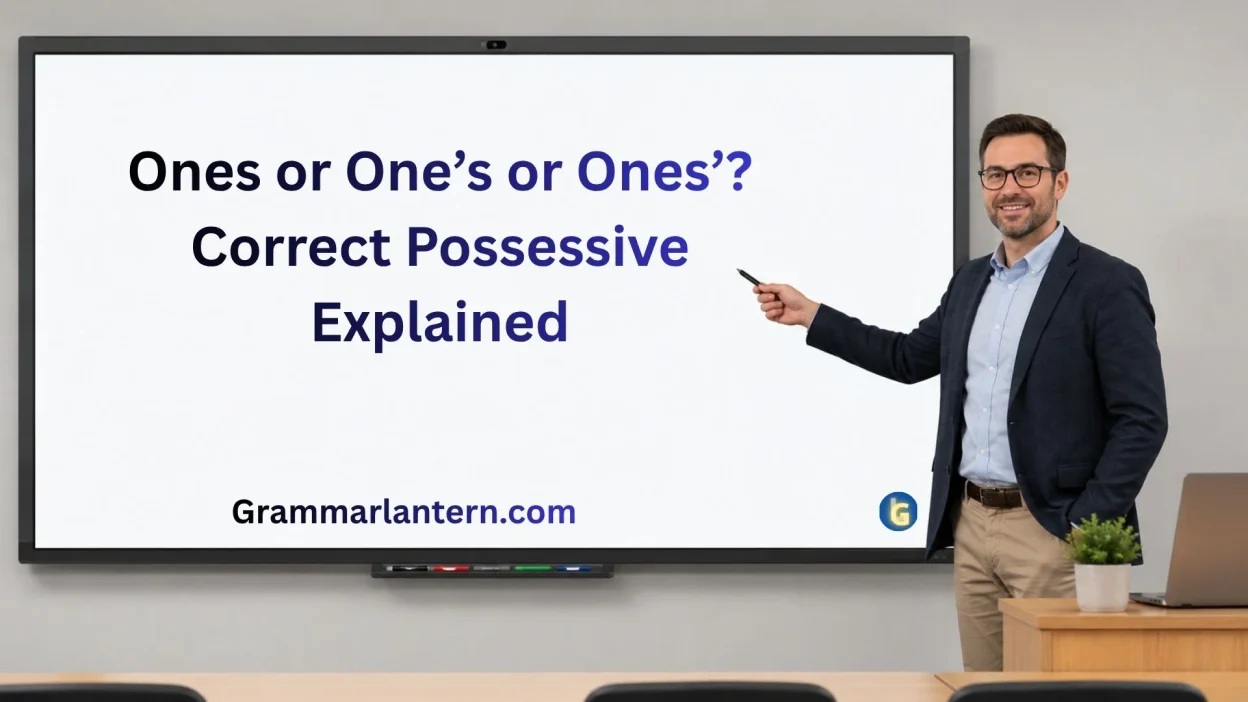
Have you ever paused while writing and wondered whether to use ones, one’s, or ones’? These three forms look almost identical, but a small apostrophe can completely change their meaning and grammatical role. Understanding the difference helps you avoid common grammar mistakes and improve your everyday writing. Although the distinction seems confusing at first, each form follows a simple rule that becomes easier with practice.
The word ones is the plural form of one and refers to multiple people or things. In contrast, one’s generally expresses ownership or association, while ones’ indicates plural possession in specific contexts. Knowing these possessive forms and punctuation rules makes it easier to choose the correct word without second-guessing yourself.
Whether you’re preparing academic papers, writing professional emails, creating reports, or communicating in everyday situations, correct apostrophe usage matters. This guide explains the grammatical differences through simple explanations and practical examples. By learning these straightforward rules, you’ll strengthen your writing skills, improve clarity, and use all three forms with confidence.
Quick Answer
The correct choice depends on what you want to express. Ones is the ordinary plural form, one’s indicates singular possession or represents a contraction, and ones’ is the plural possessive form.
| Spelling | Grammatical Function | Meaning | Example |
| Ones | Plural | More than one person or thing | I prefer the blue ones. |
| One’s | Singular possessive | Belonging to one person | One’s health matters. |
| One’s | Contraction | One is or one has | One’s been waiting. |
| Ones’ | Plural possessive | Belonging to multiple ones | The selected ones’ names appeared on the list. |
Here is the easiest way to remember:
- Use ones when referring to multiple people or things.
- Use one’s when showing possession by one person or expressing one is or one has.
- Use ones’ when showing possession by multiple people or things described as ones.
One important distinction: ones’ is grammatically possible, but it is uncommon and often sounds awkward. Most writers choose a clearer alternative.
What Does Ones Mean?
Ones is the plural form of one. It refers to multiple people or things and doesn’t require an apostrophe.
Writers commonly use this word to avoid repeating a noun. Instead of mentioning the same object several times, you can replace it with ones when the context makes its meaning clear.
For example:
- I bought two jackets, but the black ones were expensive.
- These shoes look better than the old ones.
- The ripe apples taste sweeter than the green ones.
- Among all the available options, these ones seem practical.
In each example, ones replaces a previously mentioned plural noun. The word keeps the sentence natural while preventing unnecessary repetition.
When to Use Ones
Use ones when you need to identify multiple people, objects, choices, or members of a group.
Here are the most common situations.
When referring to multiple objects
You can use ones when comparing items that share a general category.
Examples:
- The larger ones need more storage space.
- I prefer comfortable shoes over expensive ones.
- The damaged ones should be replaced.
When avoiding repeated nouns
Sometimes repeating a noun makes a sentence sound clumsy. Ones provides a simple alternative.
For example:
- Repetitive: I like the red shirts, but I don’t like the blue shirts.
- Better: I like the red shirts, but I don’t like the blue ones.
When comparing different choices
The word also works when discussing alternatives or selecting items.
Examples:
- Which ones would you choose?
- The cheaper ones offer better value.
- I selected the ones with stronger materials.
When referring to people
In certain contexts, ones can refer to individuals within a group.
Examples:
- The responsible ones completed their assignments.
- The brave ones stepped forward.
- The kind ones often help without expecting anything.
Examples of Ones in Sentences
| Sentence | Explanation |
| The small ones fit inside the drawer. | Refers to multiple small objects. |
| I prefer these ones. | Identifies several preferred items. |
| The expensive ones weren’t worth buying. | Replaces a repeated noun. |
| Choose the ones you like. | Refers to multiple choices. |
| The honest ones earned everyone’s respect. | Refers to multiple people. |
Notice that none of these sentences needs an apostrophe. The word simply indicates a plural reference.
Common Mistakes With Ones
Writers often add an apostrophe because they assume every word ending in s needs one. That assumption creates unnecessary errors.
Consider these examples:
- Incorrect: I bought three new one’s.
- Correct: I bought three new ones.
- Incorrect: The red one’s are beautiful.
- Correct: The red ones are beautiful.
- Incorrect: Which one’s do you prefer?
- Correct: Which ones do you prefer?
The apostrophe doesn’t create a plural. It changes the grammatical function of the word.
What Does One’s Mean?
One’s is the singular possessive form of the pronoun one. It can also represent a contraction of one is or one has.
The apostrophe appears before the final s. Its meaning depends on how the word functions within the sentence.
For example:
- One’s responsibilities should never be ignored.
- One’s personal choices deserve respect.
- One’s been working on this project all morning.
The first two examples express possession or association. The third uses a contraction.
One’s as a Possessive Form
Use one’s when referring to something belonging to or associated with an individual.
Here, one acts as an indefinite pronoun. It refers to a person without identifying a particular individual.
This construction appears frequently in formal English, educational writing, general advice, and philosophical statements.
Examples include:
- One’s education can influence future opportunities.
- One’s actions reveal personal values.
- Protecting one’s privacy is important.
- Everyone should take responsibility for one’s decisions.
The possessive form connects an individual with something related to that person.
Consider this simple example:
“One should respect one’s parents.”
The first one refers to a person generally. The second one’s indicates that the parents belong to or are associated with that individual.
Read More: Charles’ or Charles’s? The Correct Possessive Form
One’s as a Contraction
Another important use of one’s involves contractions.
A contraction combines two words by removing certain letters. An apostrophe marks the omitted letters.
In this case, one’s can mean:
- One is
- One has
The surrounding sentence determines which meaning applies.
One’s meaning one is
Example:
“One’s responsible for checking the final report.”
Expanded version:
“One is responsible for checking the final report.”
One’s meaning one has
Example:
“One’s made considerable progress this year.”
Expanded version:
“One has made considerable progress this year.”
However, contractions with one are relatively uncommon in everyday American English. Writers generally prefer you’re, someone’s, or a complete expression when those forms better fit the intended meaning.
For example, one has made progress often sounds more natural in formal writing than one’s made progress.
Examples of One’s in Sentences
| Sentence | Meaning |
| One’s health deserves attention. | Singular possessive |
| One’s decisions affect the future. | Singular possessive |
| One’s been waiting outside. | One has |
| One’s responsible for the outcome. | One is |
| Protecting one’s identity matters. | Singular possessive |
Common Mistakes With One’s
Even experienced writers sometimes confuse the possessive form with the plural.
Here are several mistakes worth avoiding:
- Incorrect: Everyone should protect ones privacy.
- Correct: Everyone should protect one’s privacy.
- Incorrect: Ones opinion matters.
- Correct: One’s opinion matters.
- Incorrect: A person should understand ones responsibilities.
- Correct: A person should understand one’s responsibilities.
Remember that one’s refers to something associated with a single individual. The apostrophe isn’t optional when the sentence requires this possessive form.
What Does Ones’ Mean?
Ones’ is the plural possessive form of the noun one. It indicates that something belongs to multiple individuals or objects described as ones.
The apostrophe comes after the final s because the word already has its plural ending.
Although this construction follows standard English possessive rules, it isn’t particularly common. Writers often find alternative expressions clearer and more natural.
For example:
- The selected ones’ names appeared on the final list.
- The red ones’ prices were higher than expected.
- The chosen ones’ responsibilities began immediately.
In these sentences, the apostrophe indicates that the names, prices, and responsibilities belong to multiple selected individuals or items.
When to Use Ones’
Use ones’ when the plural noun ones acts as the owner of something.
However, the sentence must establish exactly which people or objects the word represents.
Common situations include:
- Showing group ownership: The selected ones’ belongings were collected.
- Identifying shared characteristics: The successful ones’ achievements inspired others.
- Describing multiple objects: The damaged ones’ colors had faded.
- Discussing group responsibilities: The chosen ones’ duties were clearly explained.
These constructions are grammatically possible. However, they may sound unnatural without a clear reason to use ones as a noun.
Examples of Ones’ in Sentences
Here are some examples that demonstrate plural possession.
| Sentence | What Belongs to the Ones? |
| The selected ones’ names appeared on the board. | Names |
| The red ones’ prices increased. | Prices |
| The chosen ones’ responsibilities were different. | Responsibilities |
| The damaged ones’ labels were missing. | Labels |
| The successful ones’ stories inspired the team. | Stories |
The apostrophe follows the plural s because the sentence describes possession by multiple ones.
Why Ones’ Is Rarely Used
Although ones’ is grammatically valid, it often creates unnecessarily complicated sentences.
English offers several alternatives that communicate the same idea more smoothly.
Consider these examples:
- Awkward: The selected ones’ names appeared on the document.
- Clearer: The names of those selected appeared on the document.
Another example:
- Awkward: The red ones’ prices were higher.
- Clearer: The prices of the red items were higher.
The second versions identify the owners more directly. They also avoid making readers pause to understand what ones represents.
Practical tip: Don’t use ones’ simply because you want to sound formal. Choose it only when the plural noun ones fits naturally into your sentence.
Ones vs. One’s vs. Ones’: Key Differences
The difference between these three forms becomes easier when you compare their meanings side by side.
All three contain the same basic word. However, apostrophe placement and grammatical context determine their functions.
Difference in Meaning
The most important distinction involves number and possession.
Ones refers to more than one person or thing. It doesn’t indicate ownership.
Example: “The green ones are fresh.”
One’s refers to something belonging to one person or represents a contraction.
Example: “One’s reputation takes years to build.”
Ones’ indicates possession by multiple people or things described as ones.
Example: “The selected ones’ applications were approved.”
Difference in Apostrophe Placement
Apostrophe placement follows different grammatical rules.
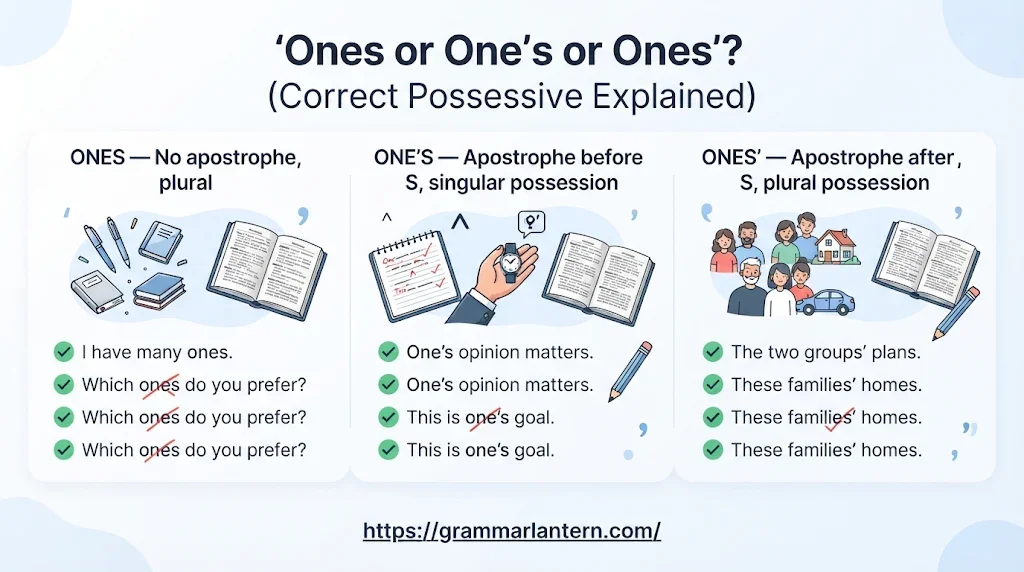
Ones — No apostrophe
Used for an ordinary plural.
Example: The expensive ones are unavailable.
One’s — Apostrophe before s
Used for singular possession or contraction.
Example: One’s personal information deserves protection.
Ones’ — Apostrophe after s
Used for plural possession.
Example: The selected ones’ preferences were recorded.
The simplest rule is to identify the grammatical purpose before deciding where the apostrophe belongs.
Side-by-Side Sentence Comparisons
Compare these sentences to see how a small punctuation change affects meaning.
| Form | Example | Explanation |
| Ones | I prefer the larger ones. | Multiple objects |
| One’s | One’s choices matter. | Possession by one person |
| Ones’ | The selected ones’ choices mattered. | Possession by multiple individuals |
Notice how the words surrounding each spelling provide additional information.
If you remove the apostrophe from one’s, you lose the possessive meaning. If you add one to ordinary ones, you introduce a grammatical function the sentence may not need.
How to Choose Between Ones, One’s, and Ones’
Choosing the correct spelling doesn’t require memorizing complicated grammar terminology. A few simple questions can help you identify the right form.
Start by examining what the sentence communicates.
A Simple Apostrophe Test
Use these steps whenever you’re unsure.
Step 1: Determine whether you’re referring to multiple things.
If you’re simply talking about more than one person or object, use ones.
Example:
“I like the comfortable ones.”
You’re identifying multiple comfortable items. No apostrophe is necessary.
Step 2: Check whether something belongs to one person.
If the sentence expresses singular possession, use one’s.
Example:
“One’s responsibilities should be taken seriously.”
The word expresses responsibilities associated with an individual.
Step 3: Test whether it’s a contraction.
Replace one’s with one is or one has.
For example:
“One’s responsible for organizing the event.”
Replace the contraction:
“One is responsible for organizing the event.”
The sentence still makes sense. Therefore, one’s is appropriate as a contraction.
Step 4: Identify whether multiple ones own something.
If several individuals or objects described as ones possess something, ones’ may be appropriate.
Example:
“The selected ones’ applications were reviewed.”
The applications belong to multiple selected individuals.
Step 5: Consider rewriting an awkward sentence.
Even when ones’ is technically correct, another construction might communicate your point more clearly.
Example:
- Original: The selected ones’ opinions were considered.
- Alternative: The opinions of those selected were considered.
Both communicate plural possession, but the alternative sounds more natural.
Common Sentence Corrections
The following examples show how to correct frequent mistakes.
| Incorrect Sentence | Correct Sentence | Reason |
| I like the blue one’s. | I like the blue ones. | Ordinary plural needs no apostrophe. |
| Everyone should respect ones privacy. | Everyone should respect one’s privacy. | Singular possessive form. |
| The ones opinion matters. | One’s opinion matters. | Correct singular possessive. |
| The selected one’s names were recorded. | The selected ones’ names were recorded. | Plural possession. |
| Which one’s are yours? | Which ones are yours? | Ordinary plural reference. |
| One responsibility is everyone’s, but one’s is different. | One responsibility belongs to everyone, but one’s own duties may differ. | Context determines possession. |
The final example also highlights an important point: one’s doesn’t automatically refer to every person in a group. Its intended reference must remain clear.
In Different Writing Contexts
Understanding these spellings helps in more than grammar exercises. You may encounter them in emails, articles, assignments, reports, and everyday conversations.
Each form has a different purpose, regardless of the writing situation.
Everyday Conversations and Informal Writing
In casual communication, ones appears frequently when people compare objects or make choices.
Examples:
- Which ones do you want?
- I like the black ones better.
- The smaller ones are easier to carry.
People also use one’s in general statements, although your or someone’s may sound more conversational.
For example:
- Formal: One’s attitude can influence one’s success.
- Conversational: Your attitude can influence your success.
Both express a similar idea, but the second sounds more natural in everyday American English.
Academic and Formal Writing
Academic writing often uses one’s to express general principles without referring to a specific person.
Examples:
- One’s interpretation of a text depends on its context.
- Protecting one’s intellectual property is important.
- One’s understanding develops through practice and experience.
However, formal writing doesn’t require complicated constructions.
When a sentence becomes difficult to follow, consider replacing one’s with a more specific expression.
For example:
- General: One’s performance depends on one’s preparation.
- More direct: A student’s performance depends on preparation.
The second sentence identifies the subject more clearly.
Business Emails and Professional Communication
Professional writing requires accuracy because small grammar mistakes can affect the impression a message creates.
You might use ones when comparing products, services, or available options.
Examples:
- The revised versions are better than the previous ones.
- Please review the approved ones before submission.
- We selected the ones that meet the project requirements.
You can also use one’s in general professional statements.
Example:
“One’s professional reputation develops through consistent work and reliable communication.”
However, in most business emails, direct language works better.
Creative Writing and General Content
Writers use these forms when describing characters, choices, relationships, and ownership.
For example:
- The brave ones never abandoned their friends.
- One’s past doesn’t always determine one’s future.
- The chosen ones’ journey began at sunrise.
In creative writing, context matters especially because readers may interpret a sentence differently depending on surrounding details.
Using the correct apostrophe placement prevents unnecessary confusion and keeps the story flowing.
Singular and Plural Possessives: Understanding the Apostrophe Rule
To understand one’s vs. ones’, it helps to learn the broader rules governing singular and plural possessives.
An apostrophe shows possession in many noun constructions. Its placement depends on whether the owner is singular or plural.
Singular Possessive Examples
For most singular nouns, add an apostrophe followed by s to express ownership.
The pattern is:
Singular noun + ‘s
Examples:
- The student’s notebook is missing.
- The teacher’s explanation was helpful.
- The customer’s order arrived.
- One’s responsibilities deserve attention.
In each example, the possessive form identifies something associated with one person.
The word one follows this singular possessive pattern, which explains why one’s places the apostrophe before the final s.
Plural Possessive Examples
Regular plural nouns ending in s generally form their possessives by adding an apostrophe after the existing s.
The pattern is:
Plural noun ending in s + ‘
Examples:
- The students’ assignments were collected.
- The teachers’ meeting starts tomorrow.
- The customers’ complaints were investigated.
- The selected ones’ names were published.
This explains why ones’ places the apostrophe after the final s.
However, irregular plural nouns that don’t end in s usually take apostrophe plus s.
Examples:
- The children’s playground is nearby.
- The men’s uniforms were delivered.
- The women’s team won the competition.
The placement depends on the noun’s plural form, not simply on whether the word refers to multiple people.
Possessive Pronouns and Apostrophes
One common source of confusion involves possessive pronouns.
Words such as yours, hers, ours, and theirs express possession without apostrophes.
For example:
- This notebook is yours.
- The decision was hers.
- That responsibility is ours.
- Their house is larger than ours.
Why don’t these words need apostrophes?
Because possessive pronouns already have established possessive forms. Adding an apostrophe would create an incorrect spelling.
Compare the following:
| Correct Form | Incorrect Form |
| Yours | Your’s |
| Hers | Her’s |
| Ours | Our’s |
| Theirs | Their’s |
| Its | It’s (when possession is intended) |
One important exception worth remembering is it’s. This is a contraction of it is or it has, not the possessive form of it.
Similarly, one’s follows its own established grammatical pattern. It isn’t interchangeable with ones or ones’.
Common Mistakes to Avoid
Even a small apostrophe error can change a sentence’s meaning. These are ten mistakes worth checking when editing your writing.
1. Adding an apostrophe to ordinary plurals: Write the red ones, not the red one’s.
2. Using ones instead of one’s for possession: Write one’s responsibility when referring to an individual’s responsibility.
3. Confusing possession with contraction: Remember that one’s can mean one is or one has.
4. Placing the apostrophe incorrectly: Use one’s for singular possession and ones’ for plural possession.
5. Treating ones’ as the standard plural: The ordinary plural is ones. The apostrophe is unnecessary unless possession is involved.
6. Using one’s when referring to several objects: Write the blue ones when discussing multiple blue items.
7. Assuming every word ending in s needs an apostrophe: Plural nouns don’t automatically require possessive punctuation.
8. Confusing possessive pronouns with possessive nouns: Remember that yours and theirs don’t need apostrophes.
9. Creating unnecessarily complicated possessive constructions: Replace awkward phrases with clearer alternatives when possible.
10. Ignoring context: Always examine the sentence’s meaning before selecting a spelling.
A quick proofreading check can catch most of these mistakes. Look for apostrophes first, then determine whether they express possession or omitted letters.
Read More: Can You Start a Sentence With “So”? With Examples
FAQs
1. What is the difference between ones, one’s, and ones’?
Ones is the plural form of one and refers to multiple people or things. One’s shows singular possession or association, while ones’ indicates plural possession. The apostrophe placement determines the meaning and grammatical function of each form.
2. Is ones the plural form of one?
Yes, ones is the plural form of one. It refers to multiple people or things, especially when the noun is already understood from the context. For example, “I prefer the blue ones” refers to multiple blue items.
3. When should I use one’s in a sentence?
Use one’s when expressing possession or association with the pronoun one. For example, “One should always take responsibility for one’s actions.” Here, one’s refers to the actions belonging to or associated with a person.
4. Is ones’ grammatically correct?
Yes, ones’ is grammatically possible when referring to possession by multiple people or things already described as ones. However, this construction is uncommon and can sound awkward. In most everyday writing, rephrasing the sentence makes the meaning clearer.
5. Does ones need an apostrophe?
No, ones does not need an apostrophe when you’re using it as a plural word. For example, “The new shoes are more comfortable than the old ones.” Adding an apostrophe would incorrectly change the grammatical meaning.
6. What is the difference between one’s and ones?
The main difference is possession. One’s indicates ownership or association, whereas ones simply identifies multiple people or things. For example, “One’s opinion matters” expresses association, while “Choose the better ones” refers to multiple choices.
7. Can I use ones’ in formal writing?
Yes, you can use ones’ in formal writing when the context genuinely requires plural possession. However, because the construction is rare, consider rewriting the sentence to avoid confusion. Clear wording is especially important in academic papers, reports, and professional communication.
8. Is one’s always possessive?
Generally, yes. One’s is the possessive form of the pronoun one. It can also express a general relationship or association rather than direct ownership. For example, “One’s responsibilities should never be ignored.”
9. How can I remember the correct apostrophe placement?
Remember these three simple rules:
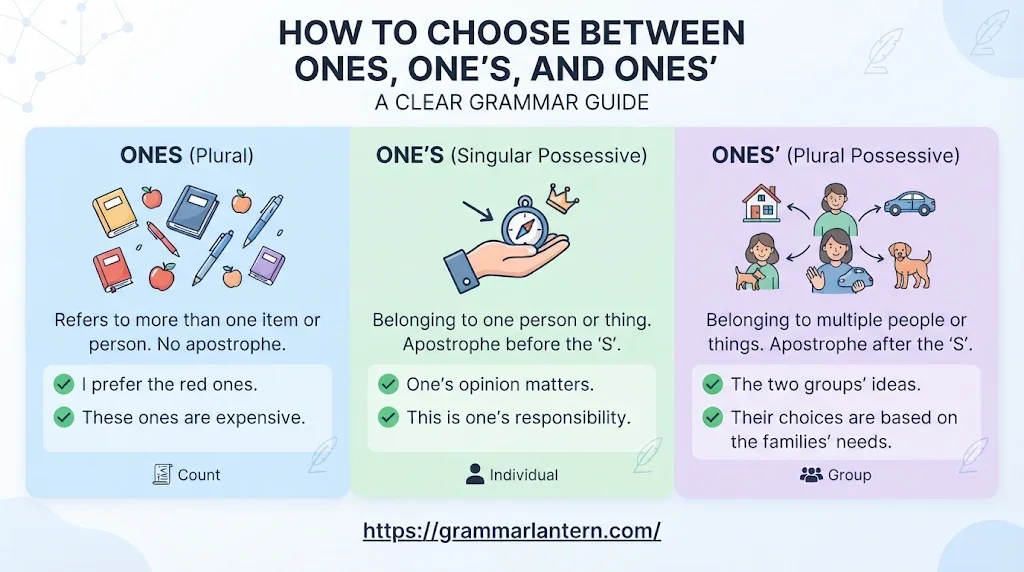
- Ones: No apostrophe because it is plural.
- One’s: Apostrophe before the s because it shows singular possession.
- Ones’: Apostrophe after the s because it indicates plural possession.
Learning these patterns makes choosing the correct form much easier.
10. Which form should I use in everyday English?
In everyday English, you’ll mostly use ones and one’s. Use ones when referring to multiple people or things and one’s when expressing possession or association. The form ones’ is rarely necessary, so avoid forcing it into sentences where a clearer alternative works better.
Conclusion
Understanding the difference between ones, one’s, and ones’ doesn’t have to be difficult. Each form serves a different grammatical purpose. Ones represents the plural of one, one’s expresses singular possession or association, and ones’ indicates plural possession in specific situations. Once you understand these simple grammar rules, you’ll find it easier to recognize the correct form and avoid unnecessary apostrophe mistakes.
Good writing depends on small details, and apostrophe placement is one of them. Whether you’re preparing academic papers, writing professional emails, creating reports, or communicating in everyday situations, choosing the correct form improves clarity and consistency. Keep these distinctions in mind, review practical examples, and practice using them in your sentences. A little attention to punctuation can make your writing more accurate, natural, and polished.