Have you ever wondered whether to write which, witch, or wich? These words can be confusing because which and witch sound alike but have completely different meanings. Meanwhile, wich is generally considered a spelling mistake in standard English. Understanding which vs witch vs wich helps you avoid common spelling errors and communicate more clearly. Although these words may look similar, each has a different place in English vocabulary.
The word which is a question word and relative pronoun used to ask questions or identify choices. Witch refers to a person associated with magic, witchcraft, or supernatural powers, often appearing in folklore and Halloween stories. On the other hand, wich is usually an incorrect spelling of the first word, except in certain historical terms and proper names.
In this guide, you’ll learn the meanings, definitions, pronunciation, and correct usage of which, witch, and wich. We’ll also explore practical examples, common mistakes, and simple memory tricks to help you remember the difference. Whether you’re writing emails, academic assignments, or everyday messages, you’ll know exactly which spelling to choose.
Quick Answer
The correct spelling depends on what you want to communicate.
- Which: A standard English pronoun or determiner used to ask questions, identify choices, or introduce information.
- Wich: Generally a nonstandard spelling of which. It can also appear in proper names, place names, and informal expressions.
- Witch: A standard English noun describing someone traditionally believed to practice magic or use supernatural powers.
Here’s a quick comparison:
| Word | Meaning | Part of Speech | Example |
| Which | Identifies a choice or introduces information | Pronoun or determiner | Which dress do you prefer? |
| Wich | An uncommon spelling or informal word element | Context-dependent | Let’s grab a chicken-wich. |
| Witch | A person associated with magic | Noun | The witch lived in an old cottage. |
Remember: If you’re asking a question or choosing between options, use which. If you’re discussing magic or folklore, use witch. Avoid using wich as a substitute for either word in standard writing.
What Does Which Mean?
Which is a common English word that helps you identify a particular person, object, place, or choice from a group. It functions as both a pronoun and a determiner.
You usually use which when the available options are known or understood. For example, if someone offers you three different drinks, you might ask, “Which would you like?”
The word also introduces relative clauses that provide additional information about something mentioned earlier.
Consider these examples:
- Which movie should we watch tonight?
- Which student won the competition?
- I bought a new laptop, which works much faster than my old one.
- Which road leads to the airport?
In each example, which helps readers understand a question, choice, or additional detail.
Which as an Interrogative Pronoun
An interrogative pronoun replaces a noun when someone asks a question. Which performs this function when the speaker wants to identify one option from several possibilities.
For example:
- Which is your favorite?
- Which belongs to you?
- Which looks better?
- Which would you choose?
Notice that which doesn’t need another noun immediately after it in these sentences. It represents the thing or option being discussed.
You might use it when shopping, making plans, or comparing different possibilities.
Example in conversation:
Person A: We have three restaurants nearby. Where should we eat?
Person B: Which serves Italian food?
Here, which replaces the name of a restaurant. The speaker wants to identify a particular option.
Which as an Interrogative Determiner
Which also works as an interrogative determiner when it appears directly before a noun.
It helps narrow down the available choices by identifying the person or thing someone wants to know about.
Examples include:
- Which book are you reading?
- Which color matches this shirt?
- Which employee completed the project?
- Which bus goes downtown?
- Which subject do you enjoy most?
In these examples, which comes before a noun, such as book, color, employee, bus, or subject.
This structure appears frequently in everyday conversations because people constantly make decisions and compare options.
Read More: Ceil vs. Seal vs. Seel: Meaning, Differences, and Examples
Which in Relative Clauses
Another important use of which involves relative clauses. A relative clause adds information about a noun or an entire idea in a sentence.
For example:
The phone, which I purchased last week, already needs an update.
The main sentence is “The phone already needs an update.” The additional clause explains when the speaker purchased it.
Which can introduce nonrestrictive relative clauses that provide extra information without identifying the noun itself.
Consider another example:
She missed the train, which made her late for work.
Here, which refers to the entire preceding situation rather than one individual noun.
A useful punctuation rule applies:
- Use commas around nonessential information.
- Don’t use commas when a restrictive clause identifies something necessary to the sentence’s meaning.
In American English, which commonly introduces nonrestrictive clauses. That distinction helps readers understand whether the information is essential or simply additional.
Example Sentences With Which
Here are several examples showing how to use which correctly:
- Which restaurant has the best breakfast menu?
- I don’t know which answer is correct.
- Which shoes would look better with this dress?
- She purchased a laptop, which came with a two-year warranty.
- Which of these students completed the assignment?
- He couldn’t decide which road to take.
- The house, which stands near the river, belongs to my uncle.
- Which language would you like to learn?
- I watched a documentary, which explained the subject clearly.
- Can you tell me which train arrives first?
Each sentence uses which to ask a question, identify an option, or introduce additional information.
What Does Wich Mean?
Wich is not the standard spelling of the English word which. If you write “Wich one do you prefer?” in an ordinary sentence, you’ve made a spelling mistake.
However, the spelling does appear in certain contexts. You might encounter it in business names, product branding, place names, or playful food-related expressions.
For example, some food businesses use names such as “Chicken Wich” or “Burger Wich” as creative alternatives to traditional sandwich-related wording.
These expressions use wich as part of a name or informal wordplay. They don’t make it a standard replacement for which.
Is Wich a Real Word?
The answer depends on what you mean by a real word.
In standard modern English, wich isn’t an accepted substitute for which. However, the spelling has legitimate appearances in other contexts.
There are three important situations worth understanding:
1. Proper names
Some businesses, products, and organizations use Wich as part of their official names. A brand can create its own spelling for recognition or marketing.
2. Place names
The spelling appears in English geographical names and historical place-name elements. For example, Norwich and Sandwich contain the letters “wich.”
These names have historical linguistic roots. Their spelling doesn’t indicate that wich can replace which in ordinary sentences.
3. Informal food expressions
Some restaurants and food brands use wich as a shortened or playful form associated with sandwich.
For instance, a business might advertise a “chicken-wich” instead of writing chicken sandwich.
The key distinction is simple: a spelling can appear in a legitimate name without functioning as a standard English word in ordinary writing.
Why Do People Write Wich Instead of Which?
People commonly write wich because they accidentally leave out the letter h.
This mistake can happen for several reasons:
- Typing errors: Someone types quickly and misses a letter.
- Autocorrect problems: A keyboard may fail to recognize the intended word.
- Pronunciation confusion: People sometimes spell words according to how they sound.
- Limited vocabulary knowledge: English learners may not recognize the correct spelling.
- Informal messaging: Fast texting can encourage careless spelling habits.
For example:
Incorrect: Wich movie do you want to watch?
Correct: Which movie do you want to watch?
Incorrect: I don’t know wich option is better.
Correct: I don’t know which option is better.
The correction requires only one additional letter. However, that small change makes the difference between standard spelling and an error.
Example Sentences and Uses of Wich
The following examples demonstrate how wich can appear in names or informal expressions.
- We ordered a chicken-wich from the restaurant.
- The café introduced a new breakfast-wich.
- Norwich is a historic city in England.
- The restaurant advertises its signature Burger Wich.
- Sandwich is a town in Kent, England.
Important: These examples involve proper names, geographical names, or creative expressions. Don’t copy their spelling pattern when writing ordinary sentences.
For example, “Wich book should I buy?” remains incorrect. The correct sentence is “Which book should I buy?”
What Does Witch Mean?
A witch is a person traditionally believed to possess magical abilities or practice witchcraft.
The word commonly appears in folklore, fairy tales, fantasy stories, Halloween traditions, and historical discussions about supernatural beliefs.
In traditional stories, witches may perform spells, prepare magical potions, communicate with supernatural forces, or use special objects to perform magic.
However, the meaning of witch depends heavily on context. Some stories portray witches as frightening villains, while others present them as helpful characters or powerful individuals.
Modern usage also includes people who identify with contemporary forms of witchcraft or spiritual practice.
Unlike which, witch is a noun in its ordinary use.
Witch as a Person Associated With Magic
Throughout history, different societies have developed beliefs about witchcraft and supernatural powers.
Folklore often describes witches as people who possess unusual abilities. Popular stories frequently portray them with recognizable objects and characteristics.
Common images associated with witches include:
- Pointed black hats
- Broomsticks
- Magical wands
- Cauldrons
- Spell books
- Black cats
- Magical potions
These familiar images appear in children’s stories, movies, Halloween decorations, and fantasy entertainment.
However, not every witch in folklore or modern culture fits this traditional image.
For example, Shakespeare’s Macbeth features three witches who deliver mysterious prophecies. Their presence influences the atmosphere and major events of the play.
This literary example demonstrates how the word witch can represent supernatural characters in storytelling.
Witch in Modern English
Today, witch appears in several different contexts.
Literature and storytelling: Writers use witches as characters in fantasy novels, fairy tales, and supernatural stories.
Movies and television: Witch characters appear in fantasy films, horror movies, and family entertainment.
Halloween celebrations: Witch costumes, decorations, and themed activities remain popular during Halloween.
Historical discussions: The word appears when discussing historical accusations of witchcraft and related legal or social events.
Modern spiritual practices: Some people use the term to describe their personal spiritual identity or involvement in contemporary witchcraft traditions.
The word also appears in familiar expressions.
For example, someone might describe a fictional character as a “good witch” or a “wicked witch.” These expressions communicate different character roles.
Example Sentences With Witch
Here are ten examples showing how to use witch correctly:
- The witch lived in a small cottage near the forest.
- Children dressed as witches for Halloween.
- The old story described a powerful witch who could cast spells.
- The movie features a young witch learning magic.
- The witch prepared a mysterious potion.
- The villagers believed that a witch lived nearby.
- She wore a black witch costume to the party.
- The fantasy novel introduces a friendly witch.
- The fictional witch used her magical powers to protect the village.
- My daughter enjoys reading stories about witches and wizards.
In every example, witch refers to a person or character associated with magic.
Key Differences
Although these three spellings look similar, their meanings and grammatical functions differ considerably.
The easiest way to understand them is to compare their purposes rather than relying on their appearance.
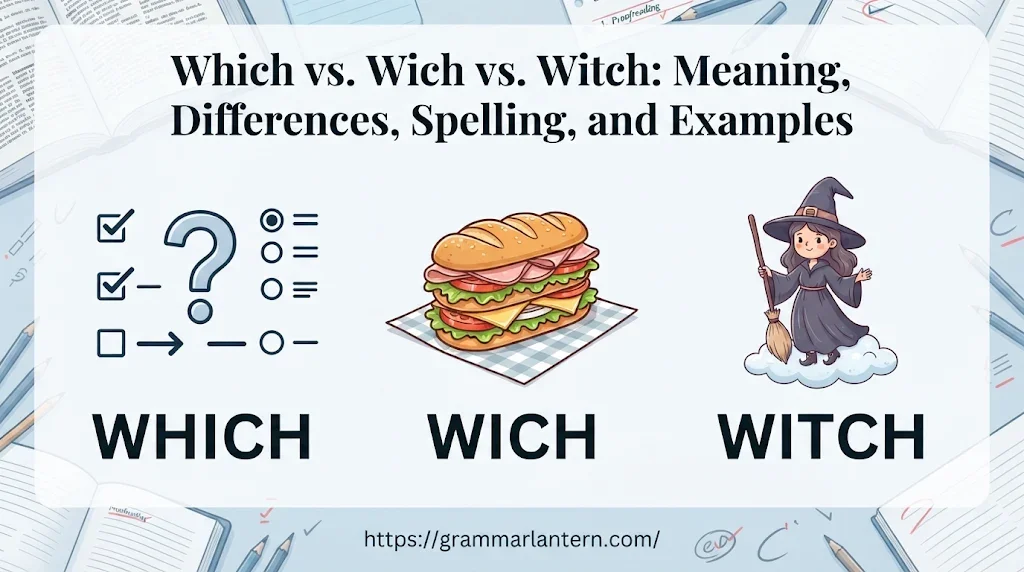
Which helps identify choices. Witch describes a person associated with magic. Wich generally represents a misspelling or appears in specific names and informal expressions.
Meaning and Definition Differences
Let’s examine their meanings side by side.
| Word | Definition | Example |
| Which | Used to ask about or identify a choice | Which one is yours? |
| Wich | An uncommon spelling used in certain names or informal expressions | The shop sells a chicken-wich. |
| Witch | A person traditionally associated with magic | The witch cast a spell. |
The meanings aren’t interchangeable.
For example, “Which character is the witch?” contains both standard words.
Here, which asks about a particular character. Witch identifies the character’s role.
Spelling Differences Between Which, Wich, and Witch
The three spellings differ by their letters and arrangement.
- Which: W-H-I-C-H
- Wich: W-I-C-H
- Witch: W-I-T-C-H
Notice that wich lacks the first h found in which. Meanwhile, witch contains a t instead of the second h found in which.
These small spelling differences create entirely different words or word forms.
A helpful way to remember them is to connect each spelling with its meaning:
- Which = questions and choices.
- Wich = nonstandard spelling or a specific name.
- Witch = magic and supernatural characters.
Pronunciation Differences Between Which, Wich, and Witch
Pronunciation creates much of the confusion surrounding these words.
In most varieties of American English, which and witch are homophones. That means they sound the same despite having different spellings and meanings.
Both are generally pronounced /wɪtʃ/.
The word wich, when someone pronounces it according to its usual spelling, also commonly sounds like /wɪtʃ/.
However, some English accents distinguish which from witch.
In those accents, which may begin with a voiceless /ʍ/ sound while witch begins with /w/.
For most American English speakers, though, listening alone won’t reliably distinguish which from witch.
Context becomes the deciding factor.
For example:
- Which book did you buy? (A question about a choice.)
- The witch bought a book about magic. (A person associated with magic.)
Both words may sound identical when spoken aloud. Their meanings reveal the correct spelling.
Grammatical Differences Between Which, Wich, and Witch
Grammar provides another reliable way to separate these spellings.
| Word | Grammatical Role | Typical Function |
| Which | Pronoun | Replaces a noun in questions |
| Which | Determiner | Appears before a noun |
| Wich | No standard general grammatical role | Appears in names and informal formations |
| Witch | Noun | Names a person associated with magic |
Consider these examples:
- Which is your favorite? (Pronoun)
- Which movie are you watching? (Determiner)
- The witch disappeared into the forest. (Noun)
- We ordered a chicken-wich. (Informal food-related expression)
Understanding the grammatical role helps you choose the right spelling.
Detailed Comparison Table: Which vs. Wich vs. Witch
| Feature | Which | Wich | Witch |
| Standard English word | Yes | Not as a general substitute | Yes |
| Main meaning | Identifying a choice | Context-specific spelling | Person associated with magic |
| Part of speech | Pronoun or determiner | Context-dependent | Noun |
| Common American pronunciation | /wɪtʃ/ | Usually /wɪtʃ/ when pronounced as spelled | /wɪtʃ/ |
| Used in questions | Yes | No | No |
| Used for magic-related characters | No | No | Yes |
| Common writing context | Questions and relative clauses | Names and informal branding | Stories and discussions of witchcraft |
Why Are They So Easily Confused?
The confusion between which and witch mainly comes from their similar pronunciation.
When two words sound alike but have different spellings and meanings, English grammar calls them homophones.
Other familiar examples include:
- Their and there
- To and too
- Right and write
- Hear and here
- Flower and flour
Which and witch belong to this group for speakers whose accents pronounce them identically.
The problem becomes especially noticeable in conversations. Someone might hear a sentence correctly but struggle to select the right spelling when typing it.
Are Which and Witch Homophones?
Yes. In most American English accents, which and witch are homophones.
They share the same pronunciation but serve completely different purposes.
Consider these examples:
Which:
Which person called you yesterday?
Witch:
The witch appeared in the story yesterday.
When spoken aloud, these sentences contain words that generally sound identical in American English.
However, their grammatical functions make the difference obvious.
A useful distinction is that which normally introduces a question or additional information. Witch identifies a person or character.
How Context Helps You Choose the Correct Word
Context tells readers what a sentence means. It also helps writers choose the correct spelling.
Consider these paired examples:
Example One
- Which character is your favorite?
- The witch is my favorite character.
The first sentence asks someone to identify a character. The second identifies a magical character.
Example Two
- Which book contains the story?
- The witch wrote a mysterious book.
The first sentence asks about a particular book. The second describes an action performed by a witch.
Example Three
- Which costume should I wear?
- I want to dress like a witch.
The first sentence asks someone to select a costume. The second explains the desired appearance.
Whenever you’re uncertain, identify the sentence’s intended meaning before choosing a spelling.
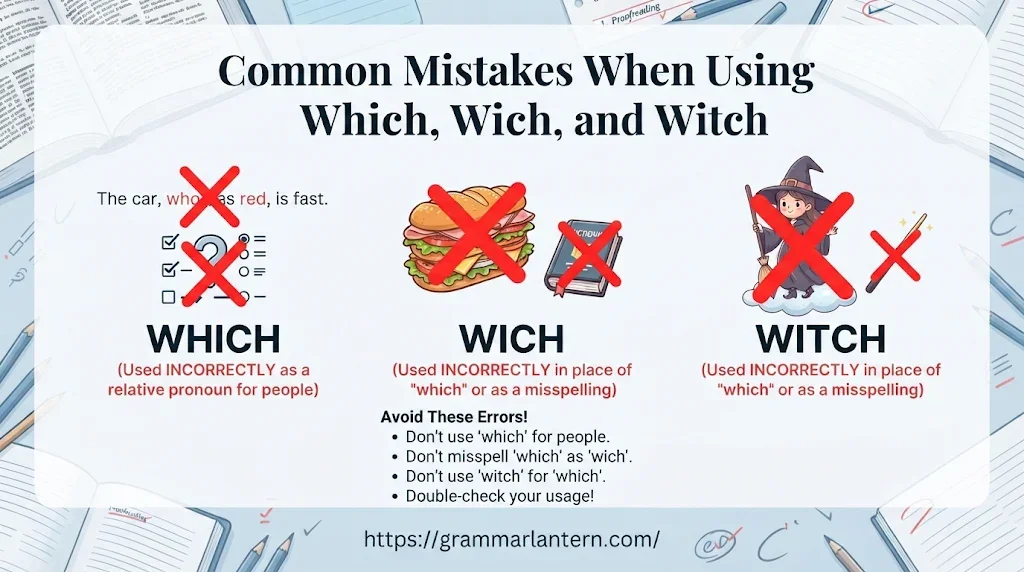
Common Mistakes When Using Which, Wich, and Witch
Even experienced writers occasionally confuse words with similar sounds. Fortunately, these mistakes are easy to correct once you understand their meanings.
Here are some common examples.
Using Wich Instead of Which
This mistake happens when writers leave out the letter h.
Incorrect: Wich subject do you like most?
Correct: Which subject do you like most?
Incorrect: I forgot wich restaurant we selected.
Correct: I forgot which restaurant we selected.
Incorrect: Wich one belongs to Sarah?
Correct: Which one belongs to Sarah?
Writing tip: Whenever you’re asking someone to identify a choice, check that you’ve spelled which correctly.
Using Witch Instead of Which
This error usually happens because which and witch sound identical in many accents.
Incorrect: Witch movie should we watch?
Correct: Which movie should we watch?
Incorrect: I don’t remember witch answer is correct.
Correct: I don’t remember which answer is correct.
Incorrect: Witch color looks better?
Correct: Which color looks better?
Remember that witch refers to a person associated with magic. It doesn’t introduce ordinary questions about choices.
Using Which Instead of Witch
Writers sometimes make the opposite mistake.
Incorrect: The which flew across the sky on her broomstick.
Correct: The witch flew across the sky on her broomstick.
Incorrect: A wicked which lived in the forest.
Correct: A wicked witch lived in the forest.
Incorrect: My daughter dressed as a which for Halloween.
Correct: My daughter dressed as a witch for Halloween.
These corrections demonstrate why spelling matters. One misplaced or missing letter can change the entire meaning.
Which, Wich, and Witch in Different Contexts
Understanding how these spellings work in different situations helps you avoid errors in everyday writing.
Let’s look at some practical contexts.
Which, Wich, and Witch in Academic and School Writing
Students frequently use which when answering questions, comparing ideas, and writing explanations.
For example:
- Which theory explains the experiment?
- The research paper, which examines climate change, presents several findings.
- Which historical event influenced the outcome?
Witch may appear in literature assignments, historical discussions, and creative writing.
For example:
- Shakespeare’s Macbeth includes three mysterious witches.
- The novel presents a witch as its central character.
However, avoid using wich as a replacement for either word in formal academic writing.
Spelling accuracy matters because teachers and readers expect standard written English.
Which, Wich, and Witch in Professional Emails and Business Communication
Professional communication requires clear wording. Even a small spelling error can distract readers from your message.
Consider this email:
Incorrect: Please confirm wich meeting time works best for you.
Correct: Please confirm which meeting time works best for you.
The corrected sentence looks professional and communicates the intended question clearly.
You might also use which when discussing project decisions:
- Which proposal should we approve?
- Please let me know which document needs revision.
- Which department handles customer complaints?
Witch is less common in business communication, although it may appear when discussing a book, movie, event, or Halloween activity.
Which, Wich, and Witch in Text Messages and Social Media
Informal communication often encourages quick typing. People may shorten words, ignore punctuation, or rely heavily on autocorrect.
However, the spelling distinction remains important.
For example:
Friend: Which restaurant should we visit?
You: Let’s try the new Italian place.
A spelling mistake such as “Wich restaurant should we visit?” might not prevent someone from understanding the message. Nevertheless, it remains incorrect in standard English.
On social media, wich may also appear in creative usernames, business names, hashtags, and food-related branding.
These uses don’t change the standard spelling rules.
Which, Wich, and Witch in Creative Writing and Storytelling
Creative writers use which and witch for different purposes.
Which helps introduce choices, descriptions, and additional details.
For example:
The castle, which stood on a distant hill, looked abandoned.
Witch helps introduce magical characters and supernatural themes.
For example:
The young witch discovered an ancient spell hidden inside a dusty book.
Writers can use both words naturally in the same passage.
For instance:
Which witch had discovered the secret passage beneath the castle?
This sentence contains both words correctly. Which asks a question while witch identifies the person being discussed.
Easy Ways to Remember Which, Wich, and Witch
Spelling becomes easier when you connect each word with a specific meaning.
Instead of memorizing random letters, use simple associations that you can recall quickly.
Remember Which With Questions and Choices
Think of which whenever you’re selecting something from a group.
For example:
- Which shirt should I wear?
- Which answer is correct?
- Which road leads home?
You can associate which with making a choice.
Whenever your sentence asks someone to identify an option, which is usually the spelling you need.
Remember Witch With Magic
The easiest way to remember witch is to connect it with magic.
Picture a traditional Halloween witch wearing a pointed hat and holding a broomstick.
That mental image creates a simple association:
Witch = Magic
Use witch when discussing magical characters, witchcraft, folklore, or related subjects.
For example:
- The witch cast a spell.
- The witch entered the haunted house.
- The children read a story about a friendly witch.
Remember That Wich Is Not the Standard Spelling
The spelling wich is the one that needs extra attention.
If you’re writing an ordinary English sentence, don’t use wich instead of which or witch.
For example:
Incorrect: Wich answer did you select?
Correct: Which answer did you select?
However, you may encounter wich in certain geographical names, brand names, or informal expressions.
Remember that a name or creative spelling doesn’t automatically become a standard English alternative.
A Simple Memory Trick for All Three Words
Use this quick reference:
- Which: Think of a question or choice.
- Wich: Think of a nonstandard spelling or specific name.
- Witch: Think of magic and Halloween.
You can also remember this sentence:
Which witch would you choose?
It contains both standard words and demonstrates how they work together.
Practice Quiz
Now it’s time to test your understanding.
Choose the correct spelling for each sentence. Consider the meaning before selecting your answer.
Fill in the blanks:
- ______ dress should I wear to the party?
- The ______ prepared a magical potion.
- I don’t know ______ restaurant serves Italian food.
- The children dressed as a ______ for Halloween.
- ______ of these books belongs to you?
- The story features a friendly ______ who helps villagers.
- Can you tell me ______ train arrives first?
- The restaurant introduced a new chicken-______.
- ______ character would you like to play?
- The ______ disappeared into the dark forest.
Practice Quiz Answers and Explanations
- Which – It introduces a question about choosing a dress.
- Witch – It refers to a person associated with magic.
- Which – It identifies a restaurant from several possibilities.
- Witch – It describes a Halloween costume.
- Which – It asks someone to identify a particular book.
- Witch – It identifies a magical character.
- Which – It introduces a question about selecting a train.
- Wich – It appears as an informal food-related expression.
- Which – It asks someone to choose a character.
- Witch – It refers to a magical character in a story.
How did you do? If you answered all ten correctly, you’ve understood the main differences between these spellings.
If you missed a few, review the definitions and example sentences. The more you recognize each word in context, the easier the distinction becomes.
Read More: Bosses vs. Boss’s vs. Boss’? The Correct Possessive Explained
FAQs
1. What is the difference between which, witch, and wich?
Which is a question word and relative pronoun used to identify choices or introduce information. Witch refers to a person associated with magic or witchcraft. Wich is generally a misspelling of which, although it appears in some proper names and historical terms.
2. Is which or witch the correct spelling?
Both which and witch are correct English words, but they have different meanings. Use which when asking about a choice or identifying something. Use witch when referring to someone associated with magic or witchcraft.
3. Is wich a real English word?
Wich exists in a few specialized historical, geographical, and proper-name contexts. However, it isn’t a standard alternative spelling of which. In everyday writing, using wich instead of which is considered a spelling mistake.
4. Why do which and witch sound the same?
Which and witch are homophones in most modern English accents. They share the same pronunciation but have different spellings and meanings. This similarity makes them easy to confuse when writing or reading quickly.
5. How do you use which in a sentence?
Use which when asking a question about a choice or adding information about something already mentioned.
Examples:
- Which dress would you like to wear?
- I bought a new laptop, which works perfectly.
- Which road leads to the station?
6. How do you use witch in a sentence?
Use witch as a noun when referring to someone believed to practice magic or possess supernatural powers.
Examples:
- The witch cast a spell in the fairy tale.
- Children dressed as a witch for Halloween.
- The story follows a young witch learning magic.
7. Is which a question word or a pronoun?
Which can function as both an interrogative word and a relative pronoun. As an interrogative word, it helps ask questions about choices. As a relative pronoun, it introduces additional information about a noun or an entire clause.
8. What is an easy trick to remember which vs witch?
Remember that which contains the letters wh, just like other question words such as what, when, and where. Witch contains tch, which can remind you of Halloween costumes, magical spells, and fictional witches. This simple association makes the difference easier to remember.
9. Can I use wich instead of which in informal writing?
No. Even in casual conversations, text messages, and social media posts, which is the correct spelling. Although people might understand what you mean when you write wich, it still counts as a spelling error in standard English.
10. Are which and witch pronounced differently in British and American English?
In most modern British and American accents, which and witch are pronounced identically. However, some speakers, particularly those who maintain the traditional wine–whine distinction, pronounce the initial sounds differently. Their meanings remain unchanged regardless of accent.
Conclusion
Understanding which vs witch vs wich doesn’t have to be difficult. Although these words look and sound similar, their meanings and uses are quite different. Which is used to ask questions, identify choices, and introduce additional information. Witch refers to someone associated with magic, supernatural powers, or witchcraft. Meanwhile, wich is generally an incorrect spelling of which in everyday English.
The easiest way to remember these words is to connect which with questions and choices, witch with magic and Halloween, and wich with a spelling mistake. Pay attention to their meanings whenever you write emails, assignments, blog posts, or everyday messages. With a little practice, you’ll avoid confusing these words and make your writing clearer, more accurate, and more confident.

For Shafiq ur Rehman, writing is an art form and grammar is the toolbox that makes it beautiful. As a dedicated content writer at Grammar Lantern, Shafiq approaches every topic like an architect carefully laying down strong foundations of understanding before adding the finer details. He loves diving into the trickiest grammar points and resurfacing with simple, bite-sized takeaways that anyone can grasp. When he’s not crafting articles, you’ll likely find him strategizing over a game of chess, exploring dusty local bookshops, or quietly jotting down poetic observations in his notebook.