
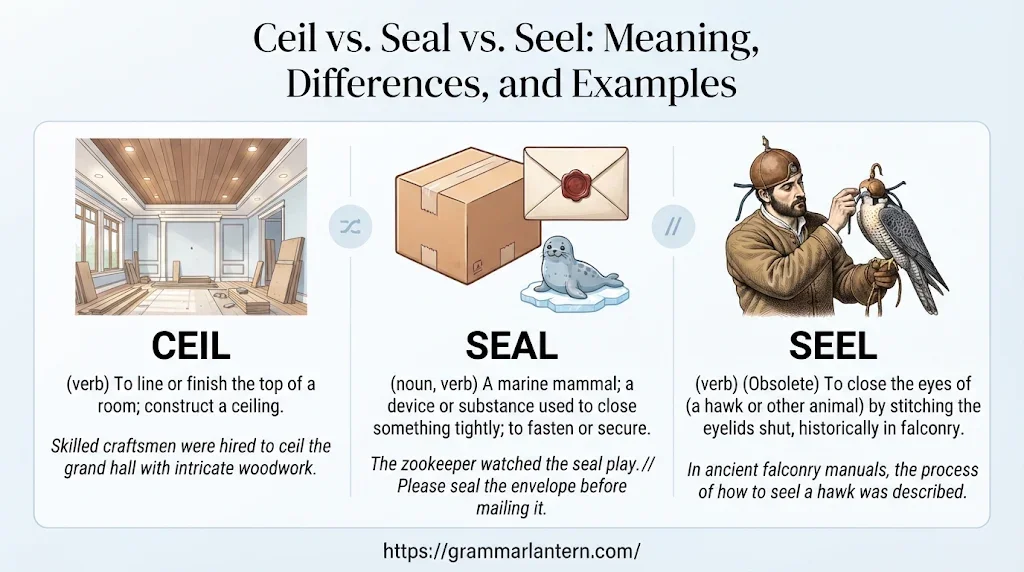
When comparing Ceil vs. Seal vs. Seel, you might notice that these words sound similar but have completely different meanings. Seal is the most common and versatile word. It works as both a noun and a verb. As a noun, it describes an aquatic, carnivorous marine mammal, such as a harbor seal or sea lion. It can also mean an official stamp, emblem, or tight fastener that prevents leaks.
As a verb, seal means to close something tightly, secure an envelope or container, or authenticate important documents. For example, you can use wax for the sealing of a letter. A seal can also provide protection, waterproofing, and fastening. Meanwhile, ceil is a rare architectural and archival verb related to a ceiling. It means to cover a room or line a ship’s interior with planking.
Finally, seel is an archaic verb associated with medieval times and historical falconry. It refers to stitching a young hawk’s eyes or eyelids closed during bird training. Although falconers once practiced this technique, the word now mainly appears in historical terminology. Understanding these differences helps you choose the correct spelling and improve your English grammar and vocabulary.
Quick Answer
The main difference between ceil, seal, and seel is their meaning and application. All three are legitimate English words, but they serve different purposes.
- Ceil: A verb meaning to cover or provide the upper interior surface of a room with a ceiling.
- Seal: A noun or verb referring to something that closes, secures, or authenticates an object. It also names a marine mammal.
- Seel: A rare, historical verb meaning to close the eyes of a hawk or falcon, traditionally through a falconry practice.
Here’s a quick comparison:
| Word | Part of Speech | Meaning | Common Usage |
| Ceil | Verb | To provide or cover a room with a ceiling | Construction and architecture |
| Seal | Noun and verb | To close, secure, authenticate, or identify a marine animal | Everyday English, business, construction, and wildlife |
| Seel | Verb | To close the eyes of a hawk or falcon | Historical falconry and literature |
Remember: Use ceil when discussing ceilings, seal when discussing closing or securing something, and seel when referring to its specialized historical meaning.
What Does Ceil Mean?
Ceil is a verb that means to cover the upper interior surface of a room or building with materials such as plaster, wood, or boards. It can also mean to provide a room with a ceiling.
The word belongs mainly to construction and architectural vocabulary. Although people rarely use it in everyday conversations, it remains a recognized English word.
For example, a construction worker might describe finishing a room by saying:
“The builders will ceil the new bedroom before painting the walls.”
In this sentence, ceil describes the process of providing the room with a finished ceiling.
The word is closely connected to ceiling, which is the upper interior surface of a room. However, the two words have different grammatical functions.
- Ceil: A verb describing the action of installing or covering a ceiling.
- Ceiling: A noun referring to the overhead surface inside a room.
Examples of Ceil in Sentences
Understanding ceil becomes easier when you see how it works in practical situations.
- The contractors will ceil the living room with wooden panels.
- Workers plan to ceil the kitchen after completing the electrical installation.
- The carpenter was hired to ceil the newly constructed office.
- They decided to ceil the basement using lightweight boards.
- The renovation team will ceil the entire house next month.
- The builder carefully ceiled the room with decorative wooden materials.
Each sentence uses ceil to describe covering or providing an interior space with a ceiling.
When Should You Use Ceil?
Use ceil when discussing the construction, installation, or finishing of an interior ceiling.
You might encounter this word in:
- Architectural descriptions.
- Construction documents.
- Home renovation discussions.
- Historical building descriptions.
- Technical writing about interior finishes.
However, everyday English speakers generally prefer more familiar expressions.
For example:
| Less Common Expression | More Natural Alternative |
| The workers will ceil the room. | The workers will install the ceiling. |
| They ceiled the basement. | They finished the basement ceiling. |
| We need to ceil the kitchen. | We need to install a ceiling in the kitchen. |
Both forms can communicate the intended meaning. The alternative expressions simply sound more familiar in modern everyday conversation.
Common Mistakes When Using Ceil
Writers sometimes confuse ceil with seal because both words sound alike.
Consider these examples:
- Incorrect meaning: “Please ceil the envelope before mailing it.”
- Correct: “Please seal the envelope before mailing it.”
An envelope needs to be closed, not fitted with a ceiling.
Another mistake involves treating ceil as a noun. In its standard construction sense, it functions as a verb.
What Does Seal Mean?
Seal is the most familiar and widely used word in this comparison. It functions as both a noun and a verb, and its meaning changes according to the sentence.
As a verb, seal means to close something securely, prevent leakage, protect an opening, or make an agreement official.
As a noun, it can describe a fastening device, an official mark, a protective closure, or an aquatic mammal.
For example:
- Please seal the package before sending it.
- The company placed its official seal on the document.
- We watched a seal swimming near the shore.
Notice how the spelling stays the same while the meaning changes.
Read More: Others or Other’s or Others’? Correct Possessive Explained
Seal as a Noun
When used as a noun, seal has several meanings. The surrounding words usually make its intended meaning clear.
1. An official mark or stamp
An official seal identifies or authenticates a document. Government agencies, organizations, and institutions may use seals to show authority or approval.
Example: “The certificate carried the university’s official seal.”
2. A fastening or closure
A seal can be a device or material that closes an opening and prevents unwanted substances from entering or escaping.
Example: “The rubber seal around the refrigerator door needs replacing.”
3. A protective layer
In construction and maintenance, a seal can refer to a protective substance applied to a surface.
Example: “The workers added a protective seal to the wooden floor.”
4. A marine mammal
A seal is an aquatic mammal with flippers and a streamlined body. Seals live in marine environments and spend considerable time swimming.
Example: “A young seal rested on the rocks near the beach.”
These meanings demonstrate why context matters. A seal on a document has nothing to do with the animal swimming in the ocean.
Seal as a Verb
As a verb, seal describes an action that closes, protects, or secures something.
Here are some common situations:
- Sealing an envelope: Closing its flap to prevent the contents from falling out.
- Sealing a container: Making the container airtight or watertight.
- Sealing a contract: Making an agreement official or final.
- Sealing a leak: Blocking an opening where liquid or air escapes.
- Sealing a surface: Applying a protective coating to prevent damage.
For example:
“The plumber used waterproof material to seal the leaking pipe.”
Here, seal means closing the opening to stop water from escaping.
Examples of Seal in Sentences
The following sentences demonstrate different grammatical uses of seal.
- Please seal the envelope before placing it in the mailbox.
- The workers used silicone to seal the bathroom windows.
- The company placed its official seal on the agreement.
- We saw a beautiful seal swimming in the ocean.
- The mechanic replaced the damaged rubber seal.
- The manager hopes to seal the business deal today.
- Make sure you seal the food container tightly.
- The court document carried an official seal.
These examples show why seal appears in everyday conversations, professional communication, construction, and legal writing.
Common Expressions and Phrases With Seal
The word seal appears in several familiar English expressions.
| Expression | Meaning | Example |
| Seal the deal | Finalize an agreement | They signed the contract to seal the deal. |
| Seal of approval | Official or clear acceptance | The proposal received the manager’s seal of approval. |
| Seal an envelope | Close an envelope securely | She sealed the envelope before mailing it. |
| Seal off | Close an area to prevent access | Police sealed off the damaged building. |
| Under seal | Protected from public access or disclosure by legal authority | The court kept the document under seal. |
| Seal a leak | Close an opening that allows something to escape | The plumber sealed the leak in the pipe. |
These expressions are useful in both casual and professional communication. Learning them also helps you recognize the correct spelling naturally.
What Does Seel Mean?
Seel is a rare English verb with historical roots in falconry. It describes the practice of closing or sewing together the eyelids of a hawk or falcon, traditionally to keep the bird calm during parts of its training.
The word also has an older figurative meaning: to close someone’s eyes or blind them.
Unlike seal, which appears regularly in modern English, seel rarely occurs in everyday conversations. You’ll mainly encounter it in historical dictionaries, older literature, and discussions of traditional falconry.
Its origin traces back to Middle French ciller, which relates to the eyelid or eyelashes. This historical connection explains why the word specifically refers to closing the eyes.
Examples of Seel in Sentences
Here are some examples showing how seel works in historical and literary contexts.
- The historical account described how falconers would seel a hawk’s eyes.
- The old manuscript explained the practice of using threads to seel a bird’s eyelids.
- The poet used the word seel to describe closing someone’s eyes.
- The literary passage referred to a night that seemed to seel the eyes of the world.
- Students encountered the unusual verb seel while studying historical falconry.
These examples illustrate the word’s specialized meaning. They aren’t recommendations for modern everyday writing.
Seel in Literature and Historical Writing
Historical literature provides some of the most recognizable examples of seel.
One famous example appears in William Shakespeare’s Macbeth. The character Lady Macbeth says:
“Come, seeling night,
Scarf up the tender eye of pitiful day.”
In this passage, Shakespeare uses seeling figuratively. The image suggests night covering or closing the eyes of daylight.
This example demonstrates how historical writers used falconry-related language to create vivid descriptions.
The word also appears in discussions of older hunting practices. Falconers historically used methods involving the temporary closure of a bird’s eyelids while handling or training it.
Understanding this background helps readers recognize seel without confusing it with the much more common seal.
When Should You Use Seel?
Use seel only when its historical or specialized meaning fits the context.
Appropriate situations include:
- Writing about historical falconry.
- Explaining older English vocabulary.
- Analyzing Shakespearean literature.
- Discussing historical descriptions of blindness.
- Translating or interpreting older literary passages.
For ordinary communication, choose a more familiar alternative.
| Intended Meaning | Better Modern Word |
| Close someone’s eyes | Close |
| Prevent someone from seeing | Blind |
| Shut something tightly | Seal |
| Cover a room’s upper surface | Ceil |
For example, write “Close your eyes” rather than “Seel your eyes” when communicating with a modern audience.
Key Differences Explained
Although these words look and sound similar, their meanings are quite different. Understanding their grammatical roles makes the distinction much easier.
Ceil belongs to construction vocabulary. It describes covering or providing a room with a ceiling.
Seal has several everyday meanings. It can describe closing something securely, applying a protective layer, authenticating a document, or identifying a marine animal.
Seel belongs mainly to historical and specialized vocabulary. Its best-established modern dictionary meaning concerns closing a hawk’s or falcon’s eyes in falconry.
Here’s a more detailed comparison:
| Feature | Ceil | Seal | Seel |
| Part of speech | Verb | Noun and verb | Verb |
| Main meaning | Provide or cover with a ceiling | Close, secure, authenticate | Close a bird’s eyes |
| Commonness | Rare | Very common | Very rare |
| Main context | Construction | Everyday and professional English | Historical falconry |
| Noun usage | Not in its standard construction sense | Yes | Not in its principal falconry sense |
| Example | They will ceil the room. | Seal the package. | Falconers historically seeled hawks. |
Differences in Grammatical Forms
Another useful way to distinguish these words is to examine their verb forms.
| Word | Present Form | Past Tense | Present Participle |
| Ceil | Ceil | Ceiled | Ceiling |
| Seal | Seal | Sealed | Sealing |
| Seel | Seel | Seeled | Seeling |
Notice that ceiling is also a common noun. In the grammatical table, however, it functions as the present participle of ceil.
The same spelling can serve different grammatical purposes depending on the sentence.
For example:
- “The workers are ceiling the room.” Here, it is a verb form.
- “The ceiling needs painting.” Here, it is a noun.
This distinction is especially helpful when editing sentences about construction.
Why Choosing the Correct Word Matters
Using the wrong spelling can change your message entirely.
Consider these three sentences:
- “The builders will ceil the room.”
- “The workers will seal the room.”
- “The falconer historically seeled the bird’s eyes.”
Each sentence describes a different action.
The first concerns installing or finishing a ceiling. The second describes closing or securing a space. The third refers to a historical falconry practice.
A spell-checker might not flag these words because all three are legitimate English spellings. You must understand the context to select the correct one.
Are Ceil, Seal, and Seel Homophones?
Yes. Ceil, seal, and seel are homophones because they share the same pronunciation in standard English.
A homophone is a word that sounds like another word but has a different spelling or meaning.
For example:
- Sea and see.
- Right and write.
- Pair and pear.
- Sale and sail.
- Ceil, seal, and seel.
All three words in this comparison are pronounced /siːl/ in standard American English.
IPA pronunciation: /siːl/
The pronunciation consists of one syllable. The initial sound is /s/, followed by the long vowel /iː/ and the final consonant /l/.
Because their pronunciation is identical, listeners cannot always identify the intended spelling from sound alone.
For instance, if someone says, “The workers will seal the room,” you need the surrounding conversation to understand whether they mean closing an opening or something else.
Why Homophones Cause Spelling Confusion
English contains many words with identical or nearly identical pronunciations. Their spellings often reflect different historical origins and meanings.
That’s why listening alone isn’t enough when choosing between ceil, seal, and seel.
Instead, ask yourself:
- Am I describing a ceiling or construction work?
- Am I talking about closing, securing, or authenticating something?
- Am I discussing historical falconry or an older literary expression?
Your answer will point you toward the correct spelling.
How to Use Ceil, Seal, and Seel Correctly in Sentences
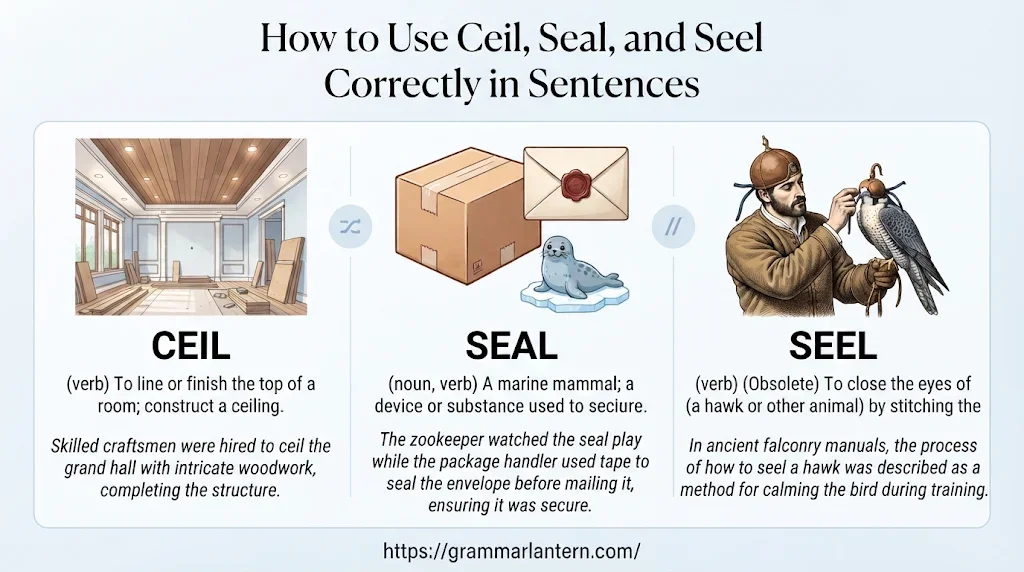
Choosing the correct word becomes easier when you focus on what the sentence actually describes.
Rather than relying on pronunciation, identify the action, object, or situation first.
Consider the following practical examples.
Construction and Home Improvement Examples
Construction is the main context where ceil becomes relevant.
Suppose you’re renovating a house. The contractor needs to install plasterboard across the upper interior surface of a bedroom.
You could write:
“The contractor will ceil the bedroom with plasterboard.”
However, most modern speakers would naturally say:
“The contractor will install a plasterboard ceiling in the bedroom.”
Both sentences communicate the construction activity.
Now consider another situation:
“The workers will seal the gaps around the windows.”
Here, seal is correct because the workers need to close openings and prevent air or water from passing through.
Compare these examples:
| Situation | Correct Word | Example |
| Installing a room ceiling | Ceil | They will ceil the room. |
| Closing window gaps | Seal | They will seal the windows. |
| Protecting a wooden floor | Seal | Apply a coating to seal the floor. |
| Discussing historical falconry | Seel | The account described how falconers seeled hawks. |
Business and Legal Examples
The word seal appears frequently in professional and legal communication.
For example, a business may place an official seal on a certificate to demonstrate its authenticity.
Similarly, two companies might negotiate an agreement and finally sign it to seal the deal.
Consider these sentences:
- The organization placed its official seal on the certificate.
- Both companies agreed to seal the partnership.
- The lawyer reviewed the document before it was placed under seal.
- The company used tamper-evident seals on its shipping packages.
Neither ceil nor seel would communicate these meanings correctly.
Historical and Literary Examples
Historical writing requires a different approach because older vocabulary sometimes appears in modern editions of classic literature.
For example:
“Come, seeling night, scarf up the tender eye of pitiful day.”
This line from Shakespeare’s Macbeth uses seeling as a figurative expression.
A modern writer might explain the same image as:
“Let the darkness cover the eyes of daylight.”
Here, seel helps preserve the historical language and literary meaning.
However, it would sound unusual in a modern business email or casual conversation.
Common Mistakes to Avoid
Even though these words have different definitions, their identical pronunciation makes spelling mistakes easy.
Here are the mistakes worth watching for.
Using seal instead of ceil
Incorrect: “The carpenter will seal the bedroom ceiling with wooden panels.”
Correct: “The carpenter will ceil the bedroom with wooden panels.”
The first sentence suggests closing or protecting something. The second describes providing the room with a ceiling.
Using ceil instead of seal
Incorrect: “Please ceil the package before shipping it.”
Correct: “Please seal the package before shipping it.”
Packages need secure closures, not ceilings.
Using seel instead of seal
Incorrect: “Please seel the envelope before mailing it.”
Correct: “Please seal the envelope before mailing it.”
The historical falconry meaning of seel doesn’t apply to ordinary packaging.
Assuming all three words have the same meaning
Similar pronunciation doesn’t make words interchangeable. Their spelling and definitions determine their proper use.
Relying entirely on spell-checkers
Spell-checking software may accept all three words because each has a legitimate dictionary entry.
For example, a sentence containing “Please ceil the envelope” might pass a basic spelling check even though the meaning is wrong.
Always review the context rather than trusting automatic corrections.
Easy Tricks to Remember
Remembering the difference doesn’t require memorizing complicated dictionary definitions. A simple connection between each spelling and its meaning can help you avoid mistakes.
Here are three easy memory tricks:
1. Ceil = Ceiling
Both words begin with the letters “cei.” Connect ceil with a room’s ceiling or construction work.
Example: “The builders will ceil the new office.”
2. Seal = Secure
Think about sealing an envelope, closing a container, or protecting a surface.
Example: “Please seal the box before delivery.”
3. Seel = Specialized Falconry
Associate seel with historical falconry and the closing of a bird’s eyes.
Example: “The historical account described how falconers seeled hawks.”
Here’s a quick memory chart:
| Word | Memory Association | Remember It As |
| Ceil | Ceiling | Construction |
| Seal | Secure | Closing or protecting |
| Seel | Seel a hawk | Historical falconry |
The easiest rule: Ceil relates to ceilings, seal relates to securing, and seel relates to historical falconry.
Practice Exercises
Now that you understand the definitions, test your knowledge with these fill-in-the-blank exercises.
Choose the correct word: ceil, seal, or seel.
- The construction company plans to ______ the new living room.
- Please ______ the envelope before sending it.
- The historical text describes how falconers used to ______ hawks’ eyes.
- Workers applied waterproof material to ______ the bathroom windows.
- The carpenter will ______ the bedroom with wooden panels.
- The company placed its official ______ on the certificate.
- The plumber needs to ______ the leaking pipe.
- Shakespeare used the word “seeling” in his description of nighttime.
- The contractors will ______ the basement during renovation.
- Make sure you ______ the food container tightly.
Answers and Explanations
| Question | Correct Answer | Explanation |
| 1 | Ceil | Describes providing a room with a ceiling. |
| 2 | Seal | Means closing an envelope securely. |
| 3 | Seel | Refers to the historical falconry practice. |
| 4 | Seal | Means closing gaps to prevent water or air from entering. |
| 5 | Ceil | Describes covering the interior upper surface. |
| 6 | Seal | Refers to an official mark or stamp. |
| 7 | Seal | Means closing an opening to stop leakage. |
| 8 | Seel | Refers to Shakespeare’s historical and figurative usage. |
| 9 | Ceil | Describes installing or finishing a ceiling. |
| 10 | Seal | Means closing a container securely. |
What Did You Learn?
If you answered all ten questions correctly, you understand the main differences between these homophones.
If you missed a few, revisit their basic meanings:
- Ceil: Cover or provide a room with a ceiling.
- Seal: Close, secure, protect, or authenticate something.
- Seel: Historically, close the eyes of a hawk or falcon.
A little practice makes these spelling choices much easier.
Read More: Bosses vs. Boss’s vs. Boss’? The Correct Possessive Explained
FAQs
1. What is the main difference between ceil, seal, and seel?
Ceil means to cover a room or line a ship’s interior. Seal means to close something securely or refers to a marine animal. Seel is an archaic verb associated with falconry.
2. Is seal the most commonly used word?
Yes. Seal is widely used in everyday English as both a noun and a verb. You might use it when discussing marine animals, official stamps, or closing containers.
3. What does ceil mean in English?
Ceil is a rare architectural verb. It means to cover a room with a ceiling or line the interior of a ship with planking.
4. Is ceil related to the word ceiling?
Yes. Ceil is the root word associated with ceiling. However, modern English speakers generally use ceiling much more often.
5. What does seel mean?
Seel is an archaic verb that means to stitch or sew a falcon’s or hawk’s eyelids closed. It describes a historical bird-training practice.
6. Is seel still used in modern English?
Seel is rarely used in everyday conversations or modern writing. You’ll mostly encounter it in historical texts, literature, and discussions about traditional falconry.
7. Can seal be used as both a noun and a verb?
Yes. As a noun, seal can describe a marine mammal or an official stamp. As a verb, it means to close, secure, or authenticate something.
8. What is an example of seal used in a sentence?
Here’s a simple example: “Please seal the envelope before sending the letter.” In this sentence, seal means to close the envelope securely.
9. Are ceil, seal, and seel pronounced the same?
Yes. In standard English pronunciation, all three words are homophones. They sound alike but have different spellings, meanings, and grammatical uses.
10. How can I remember the difference between ceil, seal, and seel?
Remember these simple connections: ceil relates to ceilings and architectural work, seal relates to closing things or marine animals, and seel relates to historical falconry.
Conclusion
Understanding Ceil vs. Seal vs. Seel becomes easier when you focus on their meanings and everyday uses. Although these words sound identical, they serve different purposes in English. Seal is the most common choice, while ceil belongs mainly to architectural vocabulary and seel appears in historical contexts.
The next time you encounter these spellings, consider the sentence before choosing one. A little attention to context can prevent spelling mistakes and make your writing clearer.

For Shafiq ur Rehman, writing is an art form and grammar is the toolbox that makes it beautiful. As a dedicated content writer at Grammar Lantern, Shafiq approaches every topic like an architect carefully laying down strong foundations of understanding before adding the finer details. He loves diving into the trickiest grammar points and resurfacing with simple, bite-sized takeaways that anyone can grasp. When he’s not crafting articles, you’ll likely find him strategizing over a game of chess, exploring dusty local bookshops, or quietly jotting down poetic observations in his notebook.