
Countries or Country’s or Countries’ can confuse both English learners and native speakers because these forms look and sound similar. Countries is the plural form of country, used for more than one country. The spelling changes because country ends in y, so the y becomes ies. Therefore, countrys is an incorrect spelling. This simple rule helps improve accuracy in writing, school assignments, business communication, travel content, emails, blogs, and everyday conversations.
Country’s is the singular possessive form, showing that something belongs to one country. The apostrophe shows possession or ownership, such as a country’s culture. By contrast, countries’ is the plural possessive form, showing that something belongs to multiple countries. For example, “the countries’ cultures” refers to cultures belonging to several countries.
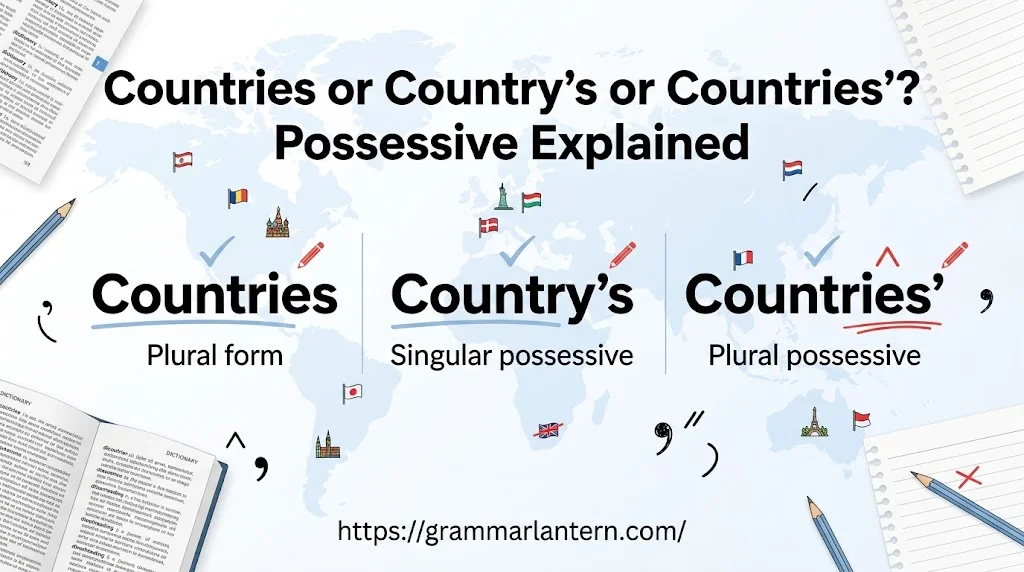
A useful way to remember the difference is simple: countries means several, country’s means something belongs to one, and countries’ means something belongs to several. These possessive rules apply in both US English and UK English.
Quick Answer
Countries is the plural form of country. It means two or more countries and does not show possession.
Country’s is the singular possessive form of country. It usually means something belongs to, comes from, or relates to one country.
Countries’ is the plural possessive form. It usually means something belongs to, comes from, or relates to two or more countries.
| Form | Grammatical use | Meaning | Example |
| countries | Plural | More than one country | Several countries joined the agreement. |
| country’s | Singular possessive | Something related to one country | The country’s economy is growing. |
| countries’ | Plural possessive | Something related to multiple countries | The countries’ economies differ greatly. |
The easiest rule is simple: no apostrophe for the ordinary plural, ’s for one country’s possession, and s’ for possession involving several countries.
Countries: The Plural Form of Country
When you simply mean more than one country, use countries. There is no apostrophe because the word doesn’t show ownership.
For example:
- Many countries have different education systems.
- Several countries signed the agreement.
- The tournament attracted teams from 20 countries.
- European countries often cooperate on regional issues.
- Developing countries may face different economic challenges.
The spelling changes because country ends in a consonant followed by y. To form the plural, English changes the y to ie and adds s.
country → countries
This pattern also appears in other English nouns:
- city → cities
- family → families
- story → stories
- company → companies
- country → countries
Notice that countries simply tells you there is more than one country. It doesn’t tell you that one country or several countries own something.
Why Countries Doesn’t Need an Apostrophe
Apostrophes don’t normally form ordinary plurals in English. Their main jobs include showing possession and forming contractions.
Therefore:
- Three countries ✅
- Three country’s ❌
- Three countries’ ❌ when no possession is intended
Consider this sentence:
Five countries participated in the meeting.
The word countries only identifies the participants. Nothing belongs to the countries in this sentence. An apostrophe would therefore serve no grammatical purpose.
Country’s: The Singular Possessive Form
Things get more interesting when you want to show that something belongs to or relates to one country. In that case, use country’s.
The apostrophe comes before the s because country is singular.
country + ’s = country’s
For example:
- The country’s capital attracts millions of visitors.
- The country’s economy depends heavily on exports.
- The country’s government introduced new policies.
- The country’s borders have changed over time.
- The country’s culture reflects centuries of history.
In each example, the writer has one particular country in mind.
What Does Country’s Actually Show?
Possession doesn’t always mean literal ownership. In grammar, possessive forms can show many kinds of relationships.
For example, the country’s economy doesn’t mean the country physically owns an economy like an object. It means the economy belongs to or is associated with that country.
The same pattern appears in:
- the country’s population
- the country’s history
- the country’s laws
- the country’s language
- the country’s natural resources
- the country’s president
This distinction becomes especially important in formal writing because a sentence can become unclear if the apostrophe is missing or misplaced.
Read More: Secretaries or Secretary’s or Secretaries’? An Easy Guide
Countries’: The Plural Possessive Form
When several countries possess something or share a relationship with something, use countries’.
Here, the apostrophe comes after the s.
countries + ’ = countries’
For example:
- The countries’ leaders met to discuss trade.
- The countries’ economies are closely connected.
- The countries’ borders were examined during the negotiations.
- The countries’ governments agreed to cooperate.
- The countries’ citizens benefited from the new agreement.
The form countries’ indicates that the possessive noun is plural.
Why Does the Apostrophe Come After the S?
The word countries already represents more than one country. Since it ends in s, English generally places the possessive apostrophe after that final s.
Compare the progression:
One country: country
More than one country: countries
One country’s possession: country’s
Several countries’ possession: countries’
This is the pattern worth remembering.
The Main Difference
The difference becomes much clearer when the forms appear in similar sentences.
| Sentence | Meaning |
| Countries cooperate on trade. | Multiple countries cooperate. |
| The country’s trade policy changed. | One country has a trade policy that changed. |
| The countries’ trade policies changed. | Multiple countries have trade policies that changed. |
| Countries have different laws. | Several countries have different laws. |
| The country’s laws are strict. | One country’s laws are strict. |
| The countries’ laws are different. | The laws of several countries differ. |
The apostrophe doesn’t simply make a word look formal. It changes the grammatical relationship.
A Useful Way to Think About It
Think of the three forms as three different questions:
Countries: How many countries?
Country’s: What belongs to one country?
Countries’: What belongs to several countries?
For example, imagine a discussion about education.
Countries invest in education.
This means multiple countries invest in education.
A country’s education system reflects its history.
This refers to one country.
Countries’ education systems can differ dramatically.
This compares education systems belonging to or associated with multiple countries.
The context tells you which form works.
Country’s vs. Countries’: Singular and Plural Possession
The most common confusion occurs between country’s and countries’. Both are possessive, but they don’t refer to the same number of countries.
Compare these sentences:
The country’s population increased.
Here, the sentence discusses the population of one country.
The countries’ populations increased.
Here, the sentence discusses the populations of multiple countries.
That difference can affect the entire meaning of a sentence.
One Country
Use country’s when one country has a relationship with the following noun.
Examples:
- The country’s currency became stronger.
- The country’s population reached a new level.
- The country’s president addressed the public.
- The country’s coastline attracts tourists.
Multiple Countries
Use countries’ when multiple countries have that relationship.
Examples:
- The countries’ currencies are widely traded.
- The countries’ populations have grown.
- The countries’ presidents attended the summit.
- The countries’ coastlines support major tourism industries.
The practical question is: How many countries are involved?
If the answer is one, choose country’s. If the answer is more than one, choose countries’.
Common Mistakes
A few errors appear again and again in English writing.
Using Country’s as the Plural
One frequent mistake is treating country’s as the plural of country.
Incorrect:
Many country’s participate in international trade.
Correct:
Many countries participate in international trade.
The problem isn’t possession. The sentence simply refers to several countries.
Using Countries’ Without Possession
Another mistake occurs when writers add an apostrophe simply because the noun is plural.
Incorrect:
Several countries’ joined the competition.
Correct:
Several countries joined the competition.
The apostrophe in countries’ indicates possession. Without a possessive relationship, it doesn’t belong there.
Using Country’s for Several Countries
Incorrect:
The country’s governments signed the treaty.
Correct:
The countries’ governments signed the treaty.
The plural governments belong to multiple countries. Therefore, countries’ fits the meaning.
Using Countries When Possession Is Intended
Incorrect:
The countries economies are growing.
Correct:
The countries’ economies are growing.
Without the apostrophe, countries is simply plural. The sentence needs the possessive form because the economies are associated with those countries.
How to Choose the Correct Form
When you’re unsure, don’t guess based on how the word looks. Follow a quick three-step check.
Step One: Ask Whether You Mean More Than One Country
If yes, the basic plural is countries.
Several countries attended the conference.
There is no possession here.
Step Two: Ask Whether One Country Is Related to Something
If one country possesses or relates to something, use country’s.
The country’s economy is expanding.
One country is involved.
Step Three: Ask Whether Several Countries Are Related to Something
If multiple countries possess or relate to something, use countries’.
The countries’ economies are expanding.
Multiple countries are involved.
This simple check handles most cases.
Countries, Country’s, and Countries’ in Formal Writing
These forms appear frequently in academic, legal, economic, political, and professional writing.
A research paper might discuss countries’ economies when comparing several nations. A report might describe a country’s legal system when focusing on one nation. A news article could state that countries signed an agreement when the sentence focuses on the participating nations rather than something they possess.
For example:
Several countries signed the agreement.
The subject is multiple countries.
Each country’s representative signed the document.
Now the sentence focuses on the representative associated with each individual country.
The countries’ representatives met afterward.
Here, the representatives collectively relate to multiple countries.
Small grammatical choices can therefore make dense information easier to understand.
A Special Point About “Country’s”
There is another detail worth knowing: country’s can sometimes represent a contraction rather than possession.
For example:
The country’s becoming more industrialized.
In this sentence, country’s means country is.
Compare:
The country’s economy is growing.
Here, country’s shows possession or association.
The country’s becoming more industrialized.
Here, country’s is a contraction for country is.
Context normally makes the meaning clear.
A quick test can help. If you can replace ’s with is and the sentence still makes grammatical sense, the form may be a contraction.
Real-World Case Study: Comparing National Economies
Imagine an article comparing the economies of the United States, Canada, and Mexico.
The following sentence would work:
The countries’ economies are closely connected through trade.
Why? The sentence refers to economies associated with multiple countries.
Now narrow the discussion to one nation:
The country’s economy depends heavily on international trade.
Here, country’s refers to one country.
Finally, consider:
Several countries rely on international trade.
There is no possessive relationship. The sentence simply says that multiple countries rely on trade.
These three sentences use nearly the same vocabulary, yet each form communicates something different.
Read More: Churches or Church’s or Churches’? (Possessive Explained)
A Second Case Study: Governments and Policies
Consider a sentence about several governments:
The countries’ governments adopted different policies.
The phrase countries’ governments means the governments of multiple countries.
Now compare:
The country’s government adopted a new policy.
This refers to the government of one country.
Finally:
Several countries adopted new policies.
This sentence doesn’t use a possessive construction. It simply identifies several countries as the subject.
These examples show why apostrophe placement deserves attention. It can tell readers whether the sentence concerns one country or several countries.
Common Patterns to Remember
Many phrases follow the same grammatical structure.
Singular Possessive
- a country’s economy
- a country’s history
- a country’s population
- a country’s government
- a country’s laws
- a country’s culture
Plural Possessive
- countries’ economies
- countries’ histories
- countries’ populations
- countries’ governments
- countries’ laws
- countries’ cultures
Simple Plural
- countries and regions
- countries around the world
- countries with large populations
- countries that share borders
- countries participating in the event
The structure becomes predictable once you identify whether you’re dealing with plurality or possession.
Which One Is Correct?
All three forms can be correct. The right choice depends on what the sentence means.
1.Use countries when you’re talking about multiple nations without showing possession.
2.Use country’s when you’re referring to something associated with one country.
3.Use countries’ when you’re referring to something associated with multiple countries.
The Fastest Memory Rule
Remember this three-part pattern:
Countries = plural
Country’s = one country + possession
Countries’ = multiple countries + possession
The apostrophe carries meaning. It isn’t decorative punctuation.
FAQs
1. Is “countrys” a correct spelling?
No. Countrys is incorrect. The correct plural spelling is countries.
2. What is the plural of “country”?
The plural of country is countries. The y changes to ies.
3. What does “country’s” mean?
Country’s is the singular possessive form. It shows that something belongs to one country.
4. What does “countries’” mean?
Countries’ is the plural possessive form. It shows that something belongs to two or more countries.
5. When should I use “countries”?
Use countries when talking about more than one country, such as “Many countries have different cultures.”
6. When should I use “country’s”?
Use country’s when something belongs to one country, such as “The country’s economy is growing.”
7. When should I use “countries’”?
Use countries’ when something belongs to several countries, such as “The countries’ leaders attended the meeting.”
8. Is “many country’s” correct?
No. Many country’s is incorrect because many requires the plural countries.
9. Is “countries culture” correct?
Usually, no. If the culture belongs to several countries, write countries’ culture or, depending on the meaning, countries’ cultures.
10. Are these rules different in US and UK English?
No. US English and UK English generally follow the same rules for countries, country’s, and countries’.
Conclusion
Understanding the difference between countries, country’s, and countries’ makes English writing clearer and more accurate. Remember that countries is the plural form, country’s shows possession by one country, and countries’ shows possession by multiple countries. The incorrect spelling countrys should not be used.
Once these simple rules become familiar, you can avoid common mistakes in school assignments, business writing, travel content, emails, blogs, and everyday communication. The apostrophe has an important role, so always consider whether you are talking about more than one country or showing ownership before choosing the correct form.

Muhammad Haroon is the voice behind many of the clear, practical grammar guides you’ll find on Grammar Lantern. With a strong background in content writing and a genuine love for the English language, Haroon specializes in breaking down intimidating grammar topics into simple, digestible lessons. His goal is simple: to empower readers to write with confidence and clarity. Whether he’s explaining tricky tenses or demystifying punctuation, Haroon approaches each topic with patience, precision, and a touch of warmth—because he knows that learning grammar is a journey, not a race.