Using “Sorry to Bother You” appropriately reflects good manners, professional etiquette, consideration, and respect for another person’s time. This phrase suits emails, texts, workplace requests, business inquiries, or situations requiring assistance. However, certain contexts benefit from wording that sounds confident, polished, direct, or natural. Learning alternatives strengthens communication skills and creates positive impressions.
Modern workplaces rely on email etiquette during scheduling, time management, project coordination, online appointments, shared calendars, meetings, client interactions, and correspondence. Replacing unnecessary apologies with thoughtful expressions demonstrates confidence, courtesy, clarity, professionalism, and writing ability. These choices support accurate grammar, consistent English usage, and smoother conversations, helping recipients understand requests.
This guide presents seven alternatives to “Sorry to Bother You”, with examples and advice. Writers can approach colleagues, clients, managers, supervisors, or partners appropriately. Understanding varied phrasing makes messages easier to receive, encourages courteous exchanges, and promotes effective business communication. Applying these options can improve quality, strengthen relationships, and convey ideas with greater professionalism.
Quick Answer
Here are seven useful alternatives to “Sorry to Bother You” in an email:
| Alternative | Best Use | Tone |
| I Hope I’m Not Interrupting | Unexpected contact | Considerate |
| Do You Have a Moment? | Quick questions | Friendly and direct |
| When You Have a Moment | Non-urgent requests | Relaxed and respectful |
| I Hope This Is a Good Time to Reach Out | New or unexpected contact | Professional |
| I Wanted to Follow Up on… | Follow-up emails | Clear and confident |
| Could You Please Help Me With…? | Asking for assistance | Polite and direct |
| I’d Appreciate Your Help With… | Requests needing cooperation | Warm and professional |
The best alternative isn’t always the most formal one. Choose the phrase that matches the reason for your email. That simple change can make your message sound more natural and confident.
What Does “Sorry to Bother You” Mean in an Email?
“Sorry to bother you” usually means that you recognize the other person’s time is valuable. The phrase suggests that you hope your message isn’t causing an unwanted interruption.
For example, someone might write:
“Sorry to bother you. Could you send me the latest sales figures?”
The writer isn’t necessarily admitting that the email causes a problem. Instead, the phrase softens the request and signals politeness.
This wording often appears when you contact someone who seems busy. It can also appear when you need help from a manager, client, professor, coworker, or unfamiliar professional.
However, there’s an important distinction between being considerate and over-apologizing.
If you send five routine emails during a normal workday and begin every one with “Sorry to bother you,” the wording may make ordinary communication sound like an inconvenience. In many situations, you have every right to ask a reasonable question.
That’s why alternatives can improve your email. They let you acknowledge someone’s time without automatically placing yourself in the position of an intruder.
Is “Sorry to Bother You” Professional?
Yes. “Sorry to bother you” can be professional, especially when you genuinely interrupt someone or contact them at an inconvenient time.
The problem usually isn’t grammar. It’s context and frequency.
Imagine a coworker asks you to review a document that falls within your normal responsibilities. Saying “Sorry to bother you” may sound unnecessarily apologetic. A simple “Could you please review this when you have a moment?” communicates the same respect with more confidence.
On the other hand, suppose you contact a senior executive unexpectedly because an urgent issue needs clarification. In that situation, acknowledging the interruption can make sense.
A useful rule is:
Apologize for a real inconvenience. Don’t apologize merely for communicating.
This distinction helps you sound courteous without making every request seem like a burden.
7 Other Ways to Say “Sorry to Bother You” in an Email
I Hope I’m Not Interrupting
“I hope I’m not interrupting” works well when you’re unsure whether the recipient is available.
The phrase directly recognizes the possibility that you’re reaching out at a busy moment. It can sound especially natural when you contact someone without a scheduled conversation.
For example:
“I hope I’m not interrupting. Could I ask you a quick question about tomorrow’s presentation?”
This opening feels considerate because it doesn’t assume that the recipient has unlimited time.
It works well when:
- You contact someone unexpectedly.
- You need a quick answer.
- The recipient has a busy role.
- You aren’t sure whether the timing is convenient.
- You’re starting an informal professional conversation.
Still, don’t use it for every routine message. If you’re emailing a teammate about a normal task, the phrase may create unnecessary hesitation.
Read More: Words for When Someone Accuses You of What They Are Guilty Of
Do You Have a Moment?
When you need a quick answer, “Do you have a moment?” is often better than apologizing.
It focuses on the recipient’s availability rather than framing your email as a disturbance. The wording is short, natural, and easy to understand.
For example:
“Do you have a moment? I’d like to clarify one point about the project timeline.”
You can also make it more specific:
“Do you have a moment to review the revised schedule?”
This alternative works particularly well in workplace communication. It suits colleagues, managers, supervisors, and people you already know.
However, it isn’t ideal when you need the recipient to complete a lengthy task. Asking for “a moment” can make a substantial request sound much smaller than it really is.
When You Have a Moment
For non-urgent communication, “When you have a moment” is one of the most useful alternatives to “Sorry to bother you.”
It gives the recipient flexibility. More importantly, it doesn’t demand an immediate response.
Consider this example:
“When you have a moment, could you review the attached proposal?”
The sentence communicates two things at once. You need the person’s help, but you aren’t demanding their immediate attention.
Use this phrase when:
- The task isn’t urgent.
- You want to avoid pressuring someone.
- You’re asking for feedback.
- You’re sharing a document for review.
- You work with someone who has a busy schedule.
There’s also a subtle benefit. The phrase sounds confident without sounding forceful.
Instead of apologizing for taking someone’s time, you simply recognize that they can respond when their schedule allows.
I Hope This Is a Good Time to Reach Out
Some emails need a softer introduction because the relationship is new or the contact is unexpected.
“I hope this is a good time to reach out” fits those situations well.
For example:
“I hope this is a good time to reach out. I’m contacting you about the partnership proposal we discussed.”
The phrase works particularly well when emailing:
- A new client
- A potential business partner
- A professional contact
- Someone you haven’t contacted recently
- A senior person outside your immediate team
It has a polished tone without sounding excessively formal.
However, there’s no need to use it when you’re sending a routine email to someone you communicate with every day. In that situation, a direct opening usually sounds more natural.
I Wanted to Follow Up on…
A follow-up email doesn’t always need an apology.
In fact, “I wanted to follow up on…” often sounds more professional than “Sorry to bother you again.”
Compare these two approaches:
“Sorry to bother you again. I just wanted to ask if you had seen my previous email.”
Versus:
“I wanted to follow up on my previous email regarding the proposal.”
The second version gets straight to the point. It doesn’t sound rude. It simply identifies the purpose of the message.
This alternative works especially well when:
- You’re waiting for a response.
- Someone promised to provide information.
- You need an update.
- You’re checking the status of a task.
- You previously contacted the recipient.
A follow-up isn’t automatically an inconvenience. Sometimes the recipient simply missed the earlier message.
Could You Please Help Me With…?
When the purpose of your email is to request assistance, “Could you please help me with…?” gives you a straightforward and polite opening.
For example:
“Could you please help me with the final figures for the quarterly report?”
The phrase doesn’t weaken your request. Instead, it makes the action you need clear.
It also avoids unnecessary apology language.
Use this wording when you need:
- Technical assistance
- Clarification
- Feedback
- Instructions
- A document
- Someone’s expertise
You can make the request more specific by naming the exact task:
“Could you please help me confirm which version of the contract we should use?”
Specific requests are easier to answer. They also reduce back-and-forth messages.
I’d Appreciate Your Help With…
If you want your request to sound warm and appreciative, “I’d appreciate your help with…” is an excellent choice.
For example:
“I’d appreciate your help with reviewing the budget before Friday.”
This wording focuses on appreciation rather than interruption. That small change can make the entire email feel more positive.
It works especially well when someone is providing expertise or taking meaningful time to help you.
You can use it for:
- Reviewing documents
- Giving professional advice
- Providing feedback
- Solving a problem
- Confirming information
- Helping with an important task
There is also a useful psychological difference between apology and appreciation.
“Sorry to bother you” focuses on the inconvenience.
“I’d appreciate your help” focuses on the value of the person’s assistance.
That makes the second approach particularly useful when you want to build a cooperative tone.
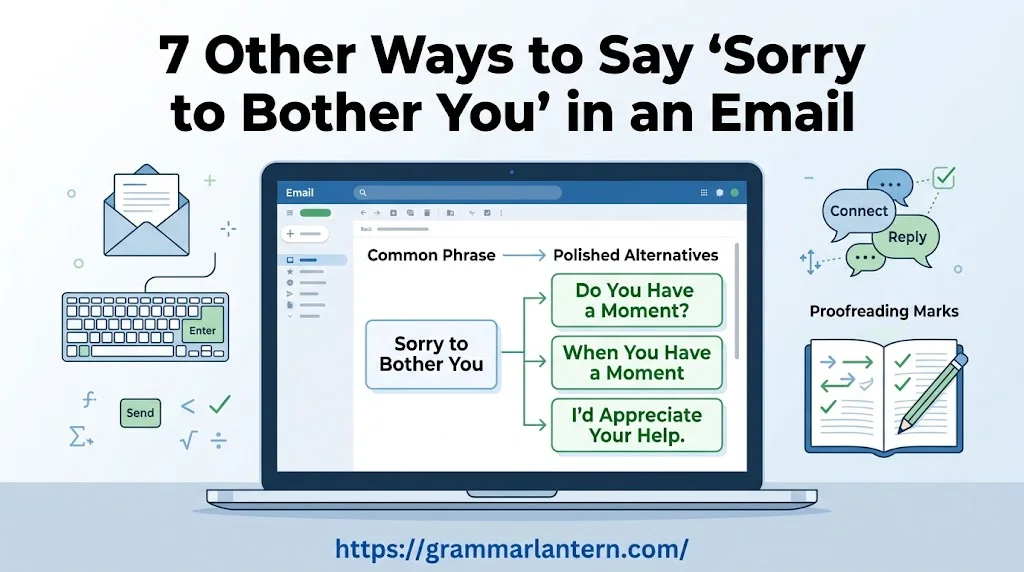
“Sorry to Bother You” Alternatives at a Glance
Choosing the right phrase becomes easier when you consider the purpose and urgency of your email.
| Phrase | Formality | Best Situation | Urgency |
| I Hope I’m Not Interrupting | Medium | Unexpected contact | Low to medium |
| Do You Have a Moment? | Medium | Quick question | Low to medium |
| When You Have a Moment | Medium | Routine request | Low |
| I Hope This Is a Good Time to Reach Out | Medium-high | New contact | Low to medium |
| I Wanted to Follow Up on… | Medium | Follow-up | Varies |
| Could You Please Help Me With…? | Medium | Direct assistance | Varies |
| I’d Appreciate Your Help With… | Medium | Important request | Low to medium |
The table reveals an important pattern. There isn’t one perfect replacement for every situation.
A phrase that sounds friendly in a message to a coworker may sound too casual when you’re contacting an unfamiliar executive. Likewise, a highly formal expression can make a simple workplace request feel stiff.
How to Choose the Right Alternative to “Sorry to Bother You”
Start with one question: Why are you writing?
If you’re asking a quick question, “Do you have a moment?” may work well.
If the request can wait, “When you have a moment” gives the recipient more breathing room.
If you’re following up, “I wanted to follow up on…” makes more sense than another apology.
If you’re asking for meaningful assistance, “I’d appreciate your help with…” creates a warmer tone.
Consider the relationship too.
A message to your close coworker doesn’t need the same language as an email to a new client. The closer the relationship, the more naturally you can write.
Urgency matters as well. Don’t use “When you have a moment” when you actually need an answer within the next ten minutes. That wording can unintentionally hide the importance of your request.
Instead, explain the deadline clearly.
For example:
“Could you please review this today? We need to submit the final version by 4 p.m.”
That sentence is more useful than a vague apology followed by an urgent request.
When You Should Actually Apologize in an Email
Sometimes an apology is exactly right.
If your message genuinely creates an inconvenience, saying “Sorry” can show good judgment.
You might apologize when:
- You contact someone outside normal working hours.
- You accidentally sent the wrong document.
- You need someone to correct a problem you caused.
- You missed an agreed deadline.
- You sent several unnecessary follow-ups.
- Your request creates an unusual amount of extra work.
For example:
“Sorry for the late message. The deadline changed unexpectedly, and I wanted to give you the update tonight.”
Here, the apology has a clear reason.
By contrast, this may be unnecessary:
“Sorry to bother you. Could you tell me where the meeting room is?”
If the person is responsible for helping you find the room, asking the question isn’t really a bother.
The goal isn’t to eliminate apologies. It’s to make them meaningful.
How to Sound Polite Without Saying “Sorry”
Politeness doesn’t depend on the word “sorry.”
You can create a respectful email by combining a clear request with appropriate consideration.
State the reason for writing
Don’t make the reader guess why you’ve contacted them.
Instead of:
“Sorry to bother you. I had a question.”
Try:
“I’m writing to clarify the delivery schedule.”
The second version gives useful information immediately.
Respect the recipient’s time
For non-urgent requests, phrases such as “when you have a moment” or “at your convenience” can show consideration.
Don’t add unnecessary urgency if none exists.
Make your request specific
A vague request forces the recipient to ask another question.
Instead of:
“Could you help me with this?”
Try:
“Could you help me confirm the figures in the second section?”
Specificity saves time for everyone.
Use appreciation naturally
A simple “Thank you for your help” can create a warmer ending than repeated apologies.
You can also say:
“I appreciate you taking the time to look into this.”
That sentence recognizes effort without making the recipient feel guilty for receiving your email.
Case Studies: Choosing the Best Alternative
Case Study: Asking a Manager for Clarification
Imagine a manager sends a project brief with an unclear deadline.
A hesitant email might begin with:
“Sorry to bother you. I know you’re busy, but I wanted to ask…”
A cleaner version would be:
“Could you please clarify the deadline for the final report?”
The second email respects the manager’s time while getting directly to the point.
Case Study: Following Up With a Client
Suppose a client hasn’t responded to a proposal after several days.
Writing:
“Sorry to bother you again…”
can make the follow-up sound unnecessarily apologetic.
Instead:
“I wanted to follow up on the proposal we sent last Thursday.”
Now the reader immediately understands why the email arrived.
Case Study: Asking a Coworker for Help
Suppose a colleague understands a software system better than you do.
Instead of:
“Sorry to bother you. Can you help me?”
try:
“I’d appreciate your help with one issue in the reporting dashboard.”
This approach sounds collaborative. It also tells the coworker what the request concerns.
Common Mistakes
Even a polite alternative can become ineffective when you use it poorly.
Over-apologizing
Starting every request with “Sorry” can make you sound less confident.
One apology may be appropriate. Five apologies in five emails can become distracting.
Using overly formal language
Don’t turn a simple message into a legal document.
For example, “I would be most grateful if you could possibly…” is usually unnecessary in everyday workplace communication.
Hiding the actual request
Your reader shouldn’t need to dig through three sentences before discovering what you need.
Lead with the purpose whenever possible.
Making an urgent request sound optional
If something needs attention today, don’t disguise the deadline with vague wording.
Tell the recipient what you need and when you need it.
Choosing a phrase that doesn’t fit the relationship
A casual coworker email can sound strange if it uses highly formal language. A message to a new professional contact may need more courtesy.
Match the wording to the relationship, not just the dictionary definition.
Before and After: Making Emails More Confident
| Less Confident | More Direct |
| Sorry to bother you. Can you check this? | Could you please check this? |
| Sorry to bother you again about the report. | I wanted to follow up on the report. |
| Sorry to bother you, but I have a question. | Could you clarify one point for me? |
| Sorry to bother you when you’re busy. | When you have a moment, could you review this? |
| Sorry to bother you with another request. | I’d appreciate your help with this request. |
The goal isn’t to make every email blunt. Confidence and politeness can live in the same sentence.
A professional email should make the reader feel respected while making the writer’s purpose easy to understand.
Tips for Writing a Better Professional Email
Keep these practical habits in mind when choosing alternatives to “Sorry to Bother You”:
- Lead with your purpose.
- Use a polite request instead of an unnecessary apology.
- Mention deadlines when timing matters.
- Give the recipient enough context to respond.
- Avoid apologizing for ordinary communication.
- Thank people when they provide meaningful assistance.
- Use softer wording when the contact is unexpected.
- Keep routine requests short and clear.
- Choose language that matches your relationship with the recipient.
A good email doesn’t need to sound robotic. It needs to make the reader’s job easier.
Read More: Day vs. Date: Difference Explained With Clear Examples
FAQs
1. What does “Sorry to Bother You” mean?
“Sorry to Bother You” is a polite expression used before making a request or interrupting someone. It shows consideration for their time.
2. Is “Sorry to Bother You” professional?
Yes, it can be professional, especially when used appropriately. However, repeated apologies may sometimes make your message sound less confident.
3. What is a professional alternative to “Sorry to Bother You”?
You can say “I hope I’m not interrupting,” “When you have a moment,” or “Could I ask for your assistance?” depending on the situation.
4. Can I use this phrase in an email?
Yes. “Sorry to Bother You” is commonly used in emails when contacting someone who may be busy.
5. Should I apologize before asking a colleague for help?
Not always. If your request is reasonable, you can use a direct but courteous opening instead of apologizing.
6. Is “Sorry to Bother You” too informal?
No. The phrase is generally acceptable in both casual and professional communication, although the surrounding wording affects its tone.
7. What can I say instead when contacting my manager?
Try “Could I ask for your guidance?” or “When you have a moment, could we discuss this?” These options sound respectful and confident.
8. Is “Sorry to Bother You” grammatically correct?
Yes. It is grammatically correct and functions as a polite introductory expression before a request or interruption.
9. Can I use alternatives in business emails?
Absolutely. Choosing suitable alternatives can make business communication clearer, more confident, and appropriate for different workplace relationships.
10. How do I choose the best alternative?
Consider your relationship with the recipient, the urgency of your request, and the level of formality required. Select wording that sounds respectful without being unnecessarily apologetic.
Conclusion
“Sorry to Bother You” is a useful expression for showing politeness, but it is not always the strongest choice in professional communication. Selecting an appropriate alternative can help you sound more confident while maintaining respect and courtesy.
Whether you are writing an email, requesting assistance, contacting a manager, or communicating with a client, thoughtful wording can improve your overall professionalism. By understanding different alternatives and their suitable contexts, you can make your messages clearer, more natural, and more effective.

Muhammad Haroon is the voice behind many of the clear, practical grammar guides you’ll find on Grammar Lantern. With a strong background in content writing and a genuine love for the English language, Haroon specializes in breaking down intimidating grammar topics into simple, digestible lessons. His goal is simple: to empower readers to write with confidence and clarity. Whether he’s explaining tricky tenses or demystifying punctuation, Haroon approaches each topic with patience, precision, and a touch of warmth—because he knows that learning grammar is a journey, not a race.