
Seal vs Seel can confuse readers because the words sound alike, yet their meanings, uses, and spelling are different in modern English today. When you see seal and seel in a sentence, the words may have the same sound, but their different meanings and uses matter. Seal is the common word for a marine animal or the act of closing something securely, while seel is an old, rarely used word that means to sew shut the eyes of a bird of prey. Using the wrong word may confuse readers, change the meaning, and create a spelling mistake. In an article, it helps to explain the differences, use both terms correctly, and give examples that are easy to remember.
When sending an envelope, for example, the correct spelling is seal, not seel. This seel or seal confusion affects students, professionals, bloggers, and English learners because the words sound the same when spoken. In modern English, accurate spelling supports clarity, professionalism, and trust, especially in formal writing. A useful guide should provide an answer, grammar explanation, common mistakes, professional usage, and practical advice. From a linguistics perspective, seal and seel should not be used interchangeably because they have distinct meanings and origins. As an expert in usage, I also focus on correct spelling, proper word choice, and clear articles.
In sentences, ceiling can describe the upper inner surface of a room, as well as figurative limits, maximum altitude, or a cloud layer. These terms derive from Middle English ceil and Old French suffix forms associated with a plaster panel and bond closure. This usage helps clarify language structure across documents, media contexts, and modern writing, leading to better understanding and stronger usage skills.
Quick Answer
Seal is the correct word when you mean to close something tightly, make something secure, confirm something officially, or refer to a marine animal.
Seel is a rare historical verb that means to close or stitch a bird’s eyelids temporarily during traditional falconry training.
| Word | Meaning | Usage | Example |
| Seal | To close, secure, approve, or a marine animal | Common everyday English | “Please seal the envelope before mailing it.” |
| Seel | To close a bird’s eyelids in falconry | Rare historical term | “The ancient falconry guide described how trainers would seel a hawk.” |
The simple rule is:
Use “seal” almost all the time. Use “seel” only when discussing traditional falconry or historical texts.
What Does Seal Mean?
The word seal has multiple meanings depending on how it appears in a sentence. It can function as both a noun and a verb.
In everyday English, seal usually refers to closing something securely so air, water, or other materials cannot enter or escape.
For example:
- Seal the bag to keep the food fresh.
- The workers sealed the cracks in the wall.
- She sealed the letter with wax.
The idea behind this meaning is protection. When something is sealed, it becomes closed off or secured.
Seal as a Verb
As a verb, seal commonly means:
- To close something tightly.
- To make something official.
- To finish or confirm an agreement.
- To protect something from outside elements.
Examples of Seal as a Verb
| Sentence | Meaning |
| “Seal the container after use.” | Close the container securely. |
| “The company sealed the partnership deal.” | The agreement became official. |
| “The workers sealed the roof leaks.” | They blocked openings to prevent damage. |
| “The envelope was sealed with glue.” | The envelope was closed. |
The phrase “seal the deal” is one of the most common expressions using this word. It means to finalize an agreement or complete a successful arrangement.
Example:
After months of negotiation, both companies signed the contract to seal the deal.
Seal as a Noun
The word seal can also be a noun with different meanings.
Seal as a Marine Animal
A seal is an aquatic mammal that lives in oceans and coastal regions around the world. Seals belong to the group of animals called pinnipeds, which includes seals, sea lions, and walruses.
Common characteristics of seals include:
- Streamlined bodies designed for swimming.
- Flippers that help them move through water.
- Thick layers of body fat called blubber that keep them warm.
- Strong swimming abilities.
Many seal species live in cold environments, including areas near Antarctica and the Arctic. However, some species also live in warmer coastal waters.
Examples:
- The seal rested on an ice sheet.
- Scientists studied how seals adapt to changing ocean temperatures.
Seal as an Official Symbol
A seal can also mean an official mark or symbol used to prove authenticity.
Governments, organizations, and institutions often use seals on important documents.
Examples include:
- A government seal.
- A university seal.
- A company seal.
Historically, people used wax seals on letters to show that a message was authentic and had not been opened.
For example:
The king’s letter carried a royal seal to prove its authority.
Read More: Hide vs Hyde: Understanding the Difference
What Does Seel Mean?
The word seel is a real English word, but it is rarely used today.
It comes from the traditional practice of falconry, where people trained birds of prey such as hawks and falcons for hunting.
In this historical context, seel means to close or stitch the eyelids of a bird temporarily. Falconers used this method to calm birds during certain training processes.
Today, the word mainly appears in:
- Historical books.
- Old literature.
- Falconry documents.
- Specialized discussions about birds of prey.
Historical Background of Seel
Falconry has existed for thousands of years across different cultures. Trainers developed various techniques to handle and train hunting birds.
The practice of seeling was part of older falconry traditions. Modern readers usually encounter this word when studying historical texts rather than modern animal training.
Because the practice is outdated and controversial by modern standards, the word has become uncommon.
Examples of Seel in Sentences
- The medieval manuscript described how a falconer would seel a hawk’s eyes.
- Historians studied old falconry methods, including the technique known as seeling.
These sentences are correct, but most everyday writers will never need to use seel.
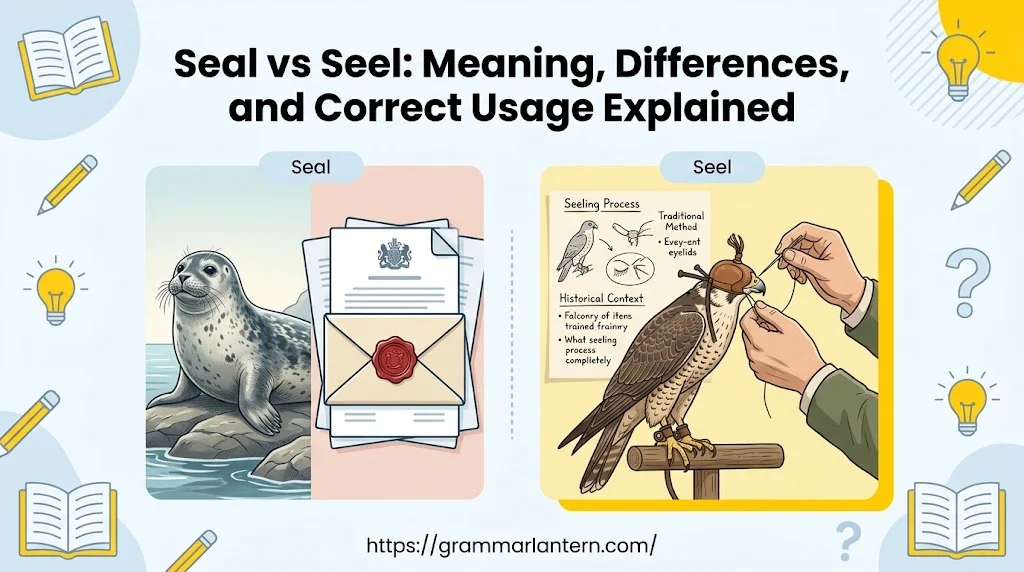
Main Differences
Although these words sound identical, their meanings are completely different.
| Feature | Seal | Seel |
| Pronunciation | Same as seel | Same as seal |
| Word type | Noun and verb | Verb |
| Commonness | Very common | Extremely rare |
| Meaning | Close, secure, authenticate, marine animal | Close a bird’s eyelids in falconry |
| Modern usage | Everyday communication | Mostly historical or technical writing |
The biggest difference is context.
If you are writing about packages, agreements, animals, documents, or protection, you almost certainly need seal.
If you are writing about medieval falconry, historical training methods, or old texts, seel may be correct.
Why Do People Confuse?
They Sound the Same
The biggest reason for confusion is pronunciation.
Seal and seel are homophones, which means they have the same sound but different meanings and spellings.
Other examples of homophones include:
- Two / too / to
- There / their / they’re
- Right / write
When people hear these words spoken, they cannot know which spelling is correct without understanding the meaning.
Different Historical Origins
Even though they sound alike today, seal and seel developed from different linguistic backgrounds.
The word seal has roots connected with ideas of closing, marking, and securing.
The word seel developed through older falconry terminology.
Their similar pronunciation is simply a coincidence.
Spell Check Does Not Always Help
Many people rely on grammar tools and spell checkers. However, software may not recognize the difference because both words are technically correct.
For example:
❌ “Please seel the package before shipping.”
A spell checker may accept this sentence because seel exists as a word.
The problem is not spelling. The problem is meaning.
Common Mistakes
Mistake 1: Using Seel When You Mean Close
Incorrect:
Please seel the box before delivery.
Correct:
Please seal the box before delivery.
The box needs to be closed securely, so seal is the correct choice.
Mistake 2: Using Seal for Falconry Terms
Incorrect:
The ancient falconer sealed the hawk’s eyes.
Correct:
The ancient falconer seel’d the hawk’s eyes.
When discussing the historical falconry technique, seel is the correct word.
Mistake 3: Assuming Rare Words Are Wrong
Some uncommon words are still valid English words.
A word does not become incorrect simply because people rarely use it. Language contains thousands of specialized terms that appear only in specific fields.
For example:
- Doctors use medical terminology.
- Lawyers use legal terminology.
- Historians use older vocabulary.
Seel belongs to that category.
Seal vs Seel vs Ceil: Understanding Similar Words
Many people also confuse seal, seel, and ceil because all three sound similar.
However, they have completely different meanings.
| Word | Meaning | Example |
| Seal | Close, secure, official mark, marine animal | “Seal the envelope carefully.” |
| Seel | Close a bird’s eyelids in falconry | “The text described seeling a falcon.” |
| Ceil | A mathematical function that rounds numbers upward | “The ceil function rounds 4.2 up to 5.” |
What Does Ceil Mean?
Unlike seal and seel, ceil is mainly used in mathematics.
The ceiling function takes a number and rounds it upward to the nearest whole number.
Examples:
- Ceil(3.2) = 4
- Ceil(7.8) = 8
The word is connected to the idea of reaching the next level or “ceiling.”
How to Remember the Difference
Simple memory tricks can help you choose the correct spelling.
Remember Seal Means Secure
Think:
Seal = Secure
Both words start with “S” and relate to closing or protecting something.
Examples:
- Seal a package.
- Seal a contract.
- Seal a container.
Remember Seel Relates to Eyes
Think:
Seel = Seeing
Although the spelling is different, connect it with a bird’s eyes in historical falconry.
Remember Ceil Means Up
Think:
Ceiling = Up
The mathematical ceiling function moves numbers upward.
Read More: Kook vs Gook: Meaning, Difference and Usage
FAQs
1. What Is the Difference Between Seal and Seel?
Seal is a common modern English word that can refer to a marine animal or the act of closing something securely. Seel is a rare, old word that means to sew shut the eyes of a bird of prey.
2. Is Seel a Correct English Word?
Yes, seel is a real English word, but it is rarely used today. You’ll mainly find it in older texts or specialized discussions.
3. Is It Seal or Seel an Envelope?
The correct phrase is seal an envelope. Here, seal means to close or secure the envelope.
4. Do Seal and Seel Sound the Same?
Yes. Seal and seel are homophones because they have the same pronunciation but different spellings and meanings.
5. Why Do People Confuse Seal and Seel?
People often confuse them because they sound identical when spoken. Since seel is rarely used in modern writing, choosing the correct spelling can be difficult.
6. What Does Seal Mean?
Seal has several meanings. It can refer to a marine animal, closing something securely, or an official mark used to authenticate a document.
7. What Does Seel Mean?
Seel is an old verb associated with falconry. It means to sew or close the eyes of a bird of prey.
8. Is Seel Commonly Used in Modern English?
No. Seel is uncommon in everyday English. Most people encounter seal much more often in conversations, documents, and professional writing.
9. How Can I Remember Seal vs Seel?
Think of seal as the everyday word. You can seal an envelope, seal a container, or see a seal at the beach. Seel has a much narrower, historical meaning.
10. Which Spelling Should I Use in Professional Writing?
Use seal when you mean to close, secure, or refer to the marine animal. Because seel is archaic and specialized, using it incorrectly can reduce clarity.
Conclusion
Understanding seal vs seel becomes much easier once you remember that these words may sound alike but do not share the same meaning. Seal is the familiar choice in modern English, whether you’re talking about a marine animal or closing something securely. Seel, in contrast, is an uncommon historical term connected with sewing shut the eyes of a bird of prey.
When you’re writing an email, article, academic paper, or everyday sentence, choosing the right spelling keeps your message clear and professional. If you’re unsure, check the meaning before choosing the word. In most modern situations, seal will be the correct choice, while seel should be reserved for its specific historical meaning.




[…] Read More: Seal vs Seel: Meaning, Differences, and Correct Usage Explained […]