
Rung or Rang may look confusing at first, but the difference becomes clear when you understand how the verb conjugation of ring works. Unlike a regular verb such as print, ring is an irregular verb that doesn’t follow a predictable pattern. With print, you can say I print, you printed, and they have printed. The present tense, simple past, and past participle follow a simple pattern.
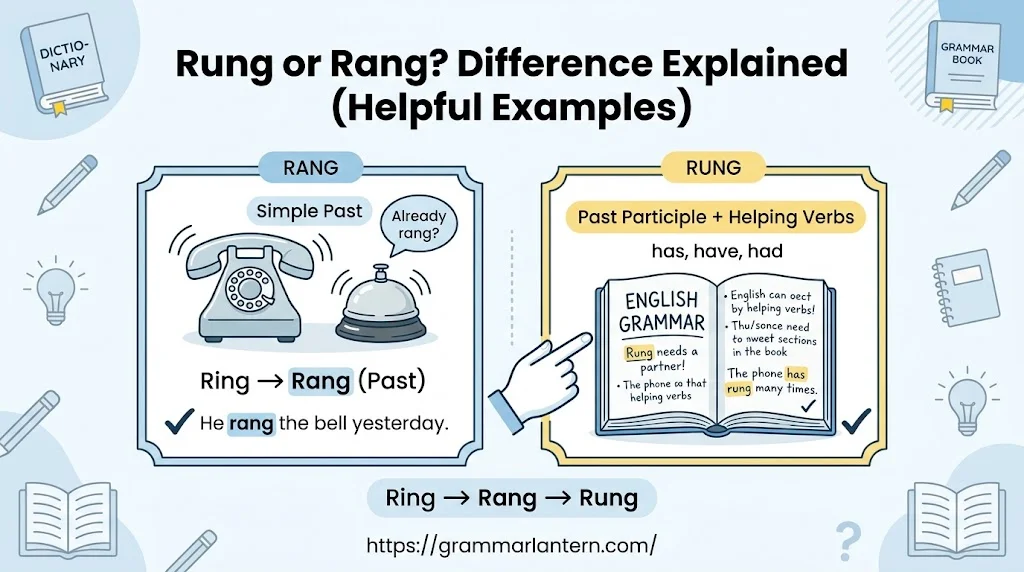
With ring, the same verb has two past tense forms: rang and rung. Rang is the simple past, while rung is the past participle. For example, “The bell rang loudly” describes something that happened in the past. However, “The bell has rung” uses the participle form. The correct choice depends on the tense and the structure of the sentence.
In my experience, learners remember this distinction more easily when they connect each form with its grammatical role. The verb conjugates differently depending on how you use it, and this can change the meaning. Once you understand the pattern, you can interact with English sentences more confidently and choose the correct form without hesitation.
Quick Answer
Rang is the simple past tense of ring.
The phone rang at midnight.
Rung is the past participle of ring.
The phone has rung three times.
So, the basic pattern is:
| Verb form | Word | Example |
| Base form | ring | I ring the bell every morning. |
| Simple past | rang | I rang the bell yesterday. |
| Past participle | rung | I have rung the bell already. |
A useful shortcut is to look at the word before the verb.
- I rang the bell. → Simple past
- I have rung the bell. → Present perfect
- I had rung the bell. → Past perfect
- Did you ring the bell? → Base form after did
The most important rule is simple:
Use “rang” for the simple past and “rung” as the past participle.
Is “Rang” a Word?
Yes. Rang is a standard English word and the simple past form of ring.
Use rang when you describe an action that happened in the past. You don’t normally need a helping verb before it.
For example:
- The telephone rang at six o’clock.
- Sarah rang the doorbell.
- The school bell rang before lunch.
- Someone rang me yesterday.
- The alarm rang during the night.
Notice the structure. The action happened in the past, and rang carries the past-tense meaning by itself.
“Rang” for a Completed Past Action
When you tell someone what happened yesterday, last night, or at another finished time, rang is usually the right choice.
The doorbell rang at 8:00 p.m.
The sentence tells us about a completed event. There’s no need for has, have, or had.
Compare these examples:
- The bell rang five minutes ago.
- My phone rang while I was driving.
- She rang the office yesterday.
- The alarm rang at 7:00 a.m.
Here, rang functions as the main past-tense verb.
Is “Rung” a Word?
Yes. Rung is also a standard English word. However, its grammatical job differs from rang.
Rung is the past participle of ring. In perfect tenses, it normally appears with a helping verb such as has, have, or had.
For example:
- She has rung the bell.
- I have rung the number twice.
- They had rung the alarm before the firefighters arrived.
- The phone has rung several times.
The word rung doesn’t usually work as the simple past form.
For example:
❌ I rung the bell yesterday.
In standard US English, the preferred form is:
✅ I rang the bell yesterday.
The difference becomes much easier once you identify the tense.
The Main Difference
The central difference between rang and rung is grammatical rather than semantic. Both come from the same verb, ring, but they appear in different structures.
| Word | Grammatical role | Typical structure | Example |
| ring | Base form | Present / after do, does, did | Did you ring the bell? |
| rang | Simple past | Subject + rang | She rang the bell. |
| rung | Past participle | Have/has/had + rung | She has rung the bell. |
Think of the three forms as a small family:
ring → rang → rung
Each form has a specific job.
Why “I Rang” Is Correct
In a simple past sentence, the verb itself shows that the action happened in the past.
I rang the doorbell.
You don’t need another verb to carry the past tense.
Why “I Have Rung” Is Correct
In a present perfect sentence, have carries the auxiliary function while rung supplies the past participle.
I have rung the doorbell.
The structure is different, so the verb form changes.
Ring, Rang, Rung: The Three Forms
Understanding the complete verb pattern makes rung vs. rang much easier.
Ring — Present Tense
Ring is the base form of the verb.
You use it for present-tense statements and after certain auxiliary verbs.
Examples include:
- I ring the bell every morning.
- They ring the office when they need help.
- Does the phone ring often?
- Did she ring you?
- Please ring the bell.
The last three examples are especially useful because auxiliary verbs can affect which form follows them.
Rang — Simple Past
Rang is the simple past form.
Use it when an action happened in the past.
- The bell rang.
- She rang me last night.
- The alarm rang at dawn.
- He rang the doorbell twice.
A specific past-time expression often makes this especially clear.
The phone rang at 10:30 last night.
Rung — Past Participle
Rung is the past participle.
It appears in perfect constructions:
- has rung
- have rung
- had rung
It can also appear in passive constructions:
- was rung
- were rung
- has been rung
For example:
The bell has rung three times.
And:
The bell was rung before the ceremony began.
The grammatical structures differ, but rung remains the required participle.
Read More: Trama vs Trauma: Correct Spelling, Meaning, and Usage Explained
When to Use “Rang”
Use “Rang” for a Finished Past Action
When the sentence simply tells you that something happened in the past, use rang.
Consider this sentence:
The telephone rang while I was cooking.
The ringing happened in the past. Rang therefore works as the simple past form.
Other examples include:
- The alarm rang before sunrise.
- The doorbell rang during dinner.
- My phone rang three times.
- The school bell rang at noon.
The key isn’t whether the action lasted one second or several minutes. The key is the grammatical tense.
“Rang” With Phones, Bells, and Alarms
The verb ring commonly describes sounds produced by telephones, bells, alarms, and similar objects.
For example:
The alarm rang at 6:00 a.m.
You can also use ring for making a telephone call, especially in informal English.
She rang me after work.
Here, rang means that she called the person.
This use is common in British English. In US English, called is generally more common in everyday speech when referring to making a telephone call.
“Rang” in Questions and Negative Sentences
This is where many learners make a common mistake.
After did or didn’t, use the base form ring, not rang.
Correct:
Did the phone ring?
Incorrect:
Did the phone rang?
Why? The auxiliary did already marks the sentence as past tense. The main verb returns to its base form.
The same rule applies to negative sentences:
The phone didn’t ring.
Not:
❌ The phone didn’t rang.
This pattern applies to many irregular verbs, not just ring.
When to Use “Rung”
Use “Rung” With Have, Has, or Had
When ring appears in a perfect tense, use rung.
Examples:
- I have rung the bell.
- She has rung the office.
- They have rung the alarm.
- He had rung the doorbell before I arrived.
The pattern is easy to recognize:
have/has/had + rung
For example:
She has rung the bell.
The sentence connects a past action with a present situation.
“Rung” in Passive Constructions
Rung also appears in passive structures.
Consider:
Someone rang the bell.
This is active because someone performs the action.
Now compare:
The bell was rung.
This is passive because the sentence focuses on the bell rather than the person who performed the action.
Other examples include:
- The alarm was rung before the meeting.
- The bell had been rung several times.
- The warning bell was rung by the guard.
This gives rung another important grammatical role beyond perfect tenses.
“Rung” in Questions and Negative Sentences
The same principle applies when you form questions or negative statements using perfect tenses.
Correct:
Have you rung the bell?
Correct:
She hasn’t rung me yet.
Correct:
Had the alarm rung before you left?
These sentences use rung because the structure requires a past participle.
In Different Sentence Patterns
The easiest way to choose between these forms is to examine the sentence structure.
Without a Helping Verb
When you describe a straightforward past event, use rang.
The bell rang.
She rang the doorbell.
My phone rang during the meeting.
With “Did” or “Didn’t”
After did or didn’t, use ring.
Did the bell ring?
The phone didn’t ring.
Why did she ring you?
The rule is:
did + ring
Not:
did + rang
And not:
did + rung
With “Has,” “Have,” or “Had”
Use rung after these perfect-tense auxiliaries.
She has rung the bell.
We have rung the number twice.
They had rung before we arrived.
The pattern is:
has/have/had + rung
With “Was,” “Were,” or “Been”
When the sentence uses a passive construction, rung can appear with forms of be.
The bell was rung.
The bells were rung before the event.
The alarm had been rung.
Here, rung works as the past participle in a passive construction.
Common Mistakes
These mistakes usually happen because English irregular verbs don’t follow one universal pattern.
“I Have Rang” vs. “I Have Rung”
The correct form is:
I have rung the bell.
Not:
❌ I have rang the bell.
Why? Have requires the past participle, and the past participle of ring is rung.
Remember:
have + rung
“I Rang the Bell” vs. “I Rung the Bell”
For simple past, use rang:
I rang the bell.
Not:
❌ I rung the bell.
The word rung needs a grammatical structure that calls for the past participle.
“Did You Rang?” vs. “Did You Ring?”
The correct sentence is:
Did you ring the bell?
The incorrect version is:
❌ Did you rang the bell?
The reason is simple. Did already establishes the past tense, so the main verb stays in its base form.
This gives you the useful pattern:
Did + subject + ring
“The Bell Has Rang” vs. “The Bell Has Rung”
The correct version is:
The bell has rung.
Not:
❌ The bell has rang.
The word has signals a perfect construction, so you need the past participle rung.
Side-by-Side Examples
| Incorrect | Correct | Reason |
| I have rang the bell. | I have rung the bell. | Have requires the past participle. |
| She rung the bell yesterday. | She rang the bell yesterday. | Simple past uses rang. |
| Did he rang the phone? | Did he ring the phone? | Did takes the base form. |
| The alarm has rang. | The alarm has rung. | Has requires the past participle. |
| They had rang the bell. | They had rung the bell. | Had requires the past participle. |
| The phone didn’t rang. | The phone didn’t ring. | Didn’t takes the base form. |
These examples reveal an important pattern. Don’t choose the verb form based only on whether the event happened in the past. Look at the structure around the verb.
Rung and Rang With Different Meanings of “Ring”
The verb ring has several related meanings. Fortunately, its irregular forms remain the same.
Ringing a Bell or Alarm
The most familiar meaning involves producing a ringing sound.
The church bell rang at noon.
The alarm has rung three times.
Did the bell ring?
The grammatical form changes, but the verb remains the same.
Ringing a Person
Ring someone can mean call someone by telephone, especially in British usage.
She rang her sister yesterday.
In American English, called is often more natural:
She called her sister yesterday.
However, the grammar of ring itself remains unchanged when this meaning is used.
Ringing Around Something
Ring can also mean forming or placing something around another thing.
For example:
Tall trees ring the lake.
Its past form is still rang:
Tall trees rang the lake.
However, this meaning is less common in everyday conversation. Context usually makes the intended meaning clear.
How to Remember
Use the Simple Memory Rule
Remember this three-part sequence:
Ring → Rang → Rung
Then attach one grammatical label to the last two:
- Ring = base form
- Rang = simple past
- Rung = past participle
That small sequence solves most rung or rang questions.
Look for the Helping Verb
If you see has, have, or had, think rung.
She has rung.
They have rung.
He had rung.
If you see did or didn’t, think ring.
Did she ring?
She didn’t ring.
For a direct past statement, think rang.
She rang.
Use a Quick Grammar Test
When you’re unsure, ask yourself:
Is this a simple past sentence?
If yes, use rang.
Does the sentence use has, have, or had?
If yes, use rung.
Does the sentence use did or didn’t?
If yes, use ring.
This quick check works surprisingly well.
Read More: Present vs Presant: Which Spelling Is Correct?
Rung vs. Rang in American English
In standard US English, the basic conjugation remains:
ring → rang → rung
The main difference from some other varieties of English often involves the vocabulary used around telephone calls rather than the verb forms themselves.
For example, American speakers commonly say:
I called her yesterday.
British speakers may commonly say:
I rang her yesterday.
Both expressions communicate the idea of making a telephone call. However, when ring is used, its standard irregular forms remain rang and rung.
It’s also worth remembering that pronunciation doesn’t determine grammatical form. The spelling may look short and simple, but each form has a specific grammatical function.
Practice: Choose Ring, Rang, or Rung
Fill in each blank with ring, rang, or rung.
- The phone ______ at midnight.
- Have you ______ the doorbell?
- Did the alarm ______ this morning?
- She ______ me yesterday.
- The bell has ______ three times.
- We had ______ the bell before the ceremony began.
- The telephone didn’t ______.
- I ______ the office last Friday.
- Does the school bell ______ at noon?
- The warning bell was ______ before the doors opened.
Answer Key
| Sentence | Answer | Reason |
| The phone ______ at midnight. | rang | Simple past |
| Have you ______ the doorbell? | rung | Have + past participle |
| Did the alarm ______ this morning? | ring | Did + base form |
| She ______ me yesterday. | rang | Simple past |
| The bell has ______ three times. | rung | Has + past participle |
| We had ______ the bell before the ceremony. | rung | Had + past participle |
| The telephone didn’t ______. | ring | Didn’t + base form |
| I ______ the office last Friday. | rang | Simple past |
| Does the school bell ______ at noon? | ring | Does + base form |
| The warning bell was ______. | rung | Passive construction |
One useful pattern stands out from these examples. Auxiliary verbs control the form that follows them. Once you recognize that pattern, choosing between ring, rang, and rung becomes much less confusing.
FAQs
1. Is “rang” or “rung” the past tense of “ring”?
Rang is the simple past tense of ring. For example, “The phone rang this morning.”
2. What is the past participle of “ring”?
Rung is the past participle of ring. You normally use it with helping verbs such as has, have, or had.
3. Is “rung” a past tense word?
Yes, but more precisely, rung is the past participle of ring, not the simple past tense.
4. Is “I rang the bell” correct?
Yes. “I rang the bell” is grammatically correct because rang is the simple past form of ring.
5. Is “I have rang the bell” correct?
No. You should say, “I have rung the bell.” The verb have requires the past participle rung.
6. Can I say “the phone rung”?
Not in standard English when you’re using the simple past. Say, “The phone rang.”
7. What are the three forms of “ring”?
The three main forms are ring (present), rang (simple past), and rung (past participle).
8. Why is “ring” an irregular verb?
Ring is irregular because its past forms don’t follow the usual -ed pattern used by regular verbs.
9. What is the easiest way to remember “rang” and “rung”?
Remember this simple pattern: ring → rang → rung. Use rang for the simple past and rung after has, have, or had.
10. Which is correct: “the bell rang” or “the bell rung”?
“The bell rang” is correct when you’re describing a completed action in the simple past. “The bell has rung” is correct when using the past participle.
Conclusion
Knowing the difference between rang and rung doesn’t have to be difficult. Rang is the simple past form, while rung is the past participle. Once you connect each word with its grammatical role, the difference becomes much easier to remember.
A useful pattern to keep in mind is ring → rang → rung. Use rang for a simple past action, such as “The phone rang,” and rung with helping verbs, such as “The phone has rung.” With a little practice, you’ll be able to choose the right form naturally.

Muhammad Haroon is the voice behind many of the clear, practical grammar guides you’ll find on Grammar Lantern. With a strong background in content writing and a genuine love for the English language, Haroon specializes in breaking down intimidating grammar topics into simple, digestible lessons. His goal is simple: to empower readers to write with confidence and clarity. Whether he’s explaining tricky tenses or demystifying punctuation, Haroon approaches each topic with patience, precision, and a touch of warmth—because he knows that learning grammar is a journey, not a race.



[…] Read More: Rung or Rang? Difference Explained with Helpful Examples […]