
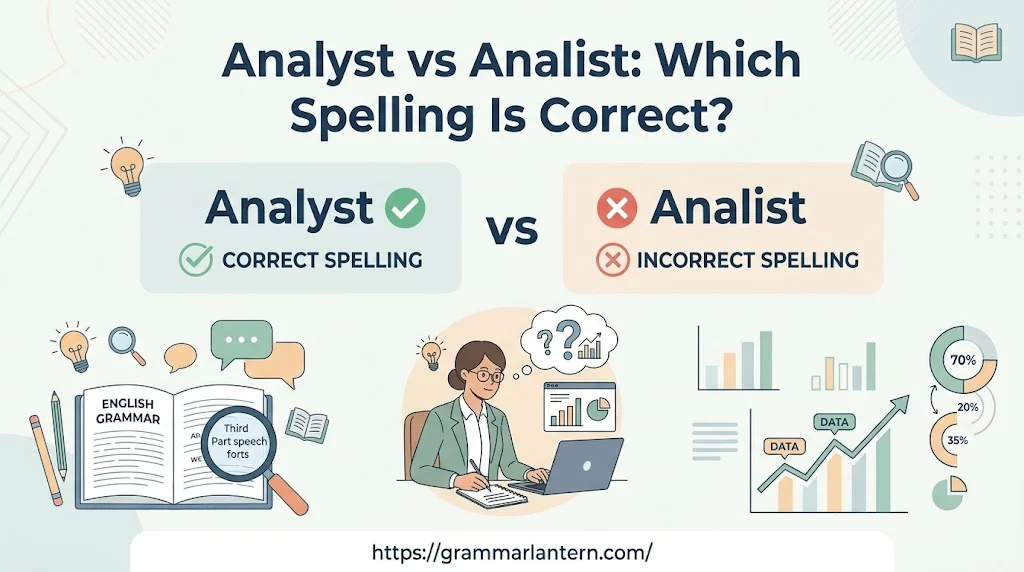
Analyst vs Analist can confuse readers because these homophones sound similar, but only analyst is the proper term in standard English. Both forms may appear familiar when you hear them spoken, but their spelling is different in writing. When I work on writing and editing, I often see people use analist when they actually mean analyst. The correct word is important because it helps readers understand the meaning without confusion.
An analyst is someone who examines data, provides analysis, and offers useful insight about a specific topic. The role can involve studying information, identifying patterns, and explaining what the findings mean. The word is connected to analyze, which means to parse a subject or object into separate parts. By looking at these parts, an analyst can examine different elements at a closer level and develop a clearer understanding of the information.
In this article, we can explore why analyst is the accepted form and why analist should generally be avoided in formal writing. Using the correct spelling consistently makes sentences more clear and accurate. This matters when the particular subject involves business, research, finance, or another professional field. Once you remember that analyst is the standard spelling, it becomes much easier to choose the right term whenever you need it.
Quick Answer
The correct spelling is analyst. ✅
Analist is an incorrect spelling and should not be used in standard English. ❌
An analyst is a person who studies information carefully to understand problems, discover trends, or make informed decisions.
Examples:
- ✅ The financial analyst reviewed the company’s earnings report.
- ✅ The data analyst found important patterns in customer behavior.
- ❌ The financial analist reviewed the company’s earnings report.
A simple way to remember it:
Analysis → Analyst
The person who performs an analysis is an analyst.
What Does Analyst Mean?
The word analyst refers to someone who examines information in a detailed and organized way. Analysts collect facts, interpret data, and use their findings to explain situations or suggest solutions.
An analyst does not simply look at information. They study it carefully to find meaning.
For example, a business may collect thousands of customer reviews. A data analyst examines those reviews to discover what customers like, what problems they experience, and what changes could improve the product.
In simple terms:
An analyst turns information into useful knowledge.
Analysts often perform tasks such as:
- Collecting data
- Studying trends
- Comparing information
- Identifying risks
- Creating reports
- Making recommendations
- Supporting decision-making
Their work helps organizations make smarter choices.
Read More: Uncollectible vs Uncollectable: Meaning and Differences
Why Is Analyst the Correct Spelling?
The spelling analyst comes from the word analysis.
The connection is simple:
| Word | Meaning |
| Analysis | The process of examining something carefully |
| Analyst | A person who performs analysis |
For example:
- The analysis showed that sales increased.
- The analyst explained why sales increased.
The ending -yst in analyst comes from the Greek-based structure of the word. English adopted the spelling through words related to analysis and scientific examination.
Although analist may look logical because many professions end in -ist, it does not follow the accepted spelling pattern for this word.
Compare these examples:
| Correct Word | Incorrect Pattern |
| Analyst | Analist |
| Scientist | Scientyst |
| Specialist | Specialyst |
English has many spelling patterns that must be learned through usage rather than pronunciation alone.
Main Difference
There is no real difference in meaning because analist is not a standard English word.
| Word | Correct Spelling | Meaning |
| Analyst | ✅ Yes | A person who studies information and provides insights |
| Analist | ❌ No | A common spelling mistake |
If you are writing a professional document, always choose analyst.
This applies to:
- Job applications
- Business reports
- Research papers
- News articles
- Presentations
- Academic assignments
A spelling mistake can distract readers from your message, even when your ideas are strong.
Why Do People Confuse?
The confusion happens for several reasons.
The Pronunciation Can Be Misleading
When people hear the word analyst, they usually hear something close to:
“AN-uh-list”
Because the sound resembles words ending in -ist, many writers naturally spell it as analist.
However, pronunciation does not always reveal spelling.
For example:
- Psychology is pronounced without the “p” sound.
- Knife begins with a silent “k.”
- Analyst contains a “y” spelling that does not stand out in speech.
Many English Words Use the -ist Ending
English has many words ending in -ist, including:
- Artist
- Dentist
- Scientist
- Journalist
- Specialist
- Economist
Because of this pattern, some people assume analist should be correct.
However, analyst is an exception that follows its own spelling history.
People Write Based on Sound
A common spelling mistake happens when writers spell words exactly as they hear them.
For example:
Incorrect:
The market analist predicted changes.
Correct:
The market analyst predicted changes.
The pronunciation may sound similar, but only one spelling is accepted.
Different Types of Analysts
The word analyst appears in many professional fields. Although their industries differ, all analysts share one important skill: they study information to find useful answers.
Financial Analyst
A financial analyst studies financial information, investments, markets, and company performance.
They may analyze:
- Revenue reports
- Stock performance
- Economic trends
- Business expenses
- Investment opportunities
Example:
A financial analyst reviews a company’s financial statements before investors make decisions.
Data Analyst
A data analyst works with numbers and information collected from different sources.
Their job often includes:
- Cleaning data
- Finding patterns
- Creating charts
- Explaining trends
For example, an online store may hire a data analyst to understand why certain products sell better than others.
Business Analyst
A business analyst focuses on improving company operations.
They examine:
- Business processes
- Customer needs
- Workplace systems
- Project requirements
Example:
A business analyst helps a company reduce wasted time by improving its workflow.
Security Analyst
A security analyst protects digital systems from threats.
Their responsibilities may include:
- Monitoring networks
- Finding vulnerabilities
- Investigating suspicious activity
With increasing cyber threats, security analysts play an important role in protecting organizations.
Political Analyst
A political analyst studies elections, government decisions, and political trends.
They often explain:
- Voting patterns
- Policy changes
- Public opinion
Media organizations frequently use political analysts to help audiences understand complex events.
Analyst vs Analysis: What Is the Difference?
Many people confuse these two related words.
The difference is simple:
Analysis = the process
Analyst = the person
Examples:
- The analysis revealed important information.
- The analyst explained the results.
Think of it like cooking:
- A recipe is the process.
- A chef is the person who performs the process.
In the same way:
- Analysis is the examination.
- Analyst is the person doing the examination.
Analyst vs Scientist: Are They the Same?
Although analysts and scientists both study information, their roles are different.
| Analyst | Scientist |
| Studies existing information | Often creates new knowledge through experiments |
| Finds patterns and insights | Tests theories and discovers facts |
| Common in business and technology | Common in research and laboratories |
A scientist may conduct an experiment to test a theory. An analyst may examine the results of that experiment to understand trends.
Analyst vs Specialist: What Is the Difference?
These words describe different professional roles.
A specialist focuses on a specific area of expertise.
An analyst focuses on examining information.
Examples:
- A cybersecurity specialist protects computer systems.
- A cybersecurity analyst studies security data and identifies threats.
Sometimes one person can be both. For example, a healthcare analyst may specialize in medical data.
Common Mistakes
Many spelling mistakes happen because people rely on pronunciation.
Here are some common examples:
1.❌ The company hired a market analist.
✅ The company hired a market analyst.
2.❌ She works as a financial analist.
✅ She works as a financial analyst.
3.❌ The political analist discussed the election results.
✅ The political analyst discussed the election results.
Using the correct spelling creates a more professional impression.
How to Remember the Correct Spelling
A simple memory trick can help:
An analyst performs analysis.
The spelling connection:
Analysis + t = Analyst
You can also remember this sentence:
“An analyst analyzes.”
Both words begin with analys-, which makes the spelling easier to recall.
Examples of Analyst in Sentences
Here are examples showing how to use analyst correctly:
- The financial analyst predicted changes in the market.
- The data analyst discovered unusual customer behavior.
- The sports analyst explained the team’s strategy.
- The business analyst recommended improvements.
- The security analyst detected a possible cyber threat.
- The political analyst discussed election trends.
These examples show that analyst works across many different industries.
Is Analist Ever Correct?
No. In modern standard English, analist is considered a spelling error.
You may occasionally see it online because people make spelling mistakes. However, dictionaries and professional writing standards recognize analyst as the correct form.
When writing formally, always use:
✅ Analyst
Avoid:
❌ Analist
Read More: Kook vs Gook: Meaning, Difference and Usage
FAQs
1. Is “analyst” or “analist” correct?
Analyst is the correct spelling in standard English. Analist is generally considered a misspelling.
2. Why do people confuse analyst and analist?
The two words can sound very similar when spoken, which makes them easy to confuse. However, only analyst is the standard written form.
3. What does analyst mean?
An analyst is someone who examines data, performs analysis, and provides insight about a particular subject or field.
4. Is analist a real English word?
Analist is not the standard spelling used in modern English for this meaning. In most formal writing, you should use analyst.
5. How do you spell analyst correctly?
The correct spelling is analyst, with a y before the final “st”: A-N-A-L-Y-S-T.
6. Can I use analist in casual writing?
You may encounter analist in informal chats or online writing, but it is still better to use analyst if you want grammatically correct and professional writing.
7. What is the plural of analyst?
The plural form is analysts. For example, “Several analysts reviewed the financial data.”
8. Is analyst used in professional fields?
Yes. Analyst is widely used in fields such as finance, business, research, technology, marketing, and data analysis.
9. Are analyst and analist homophones?
They can be pronounced similarly in some varieties of English, which is one reason people confuse their spelling. The standard written form is analyst.
10. Which spelling should I use in formal writing?
Always choose analyst in formal writing, academic work, professional communication, reports, and articles. It is the recognized standard spelling.
Conclusion
The difference between analyst and analist is simple once you remember the correct spelling. Analyst is the standard English word for someone who examines information, performs analysis, and provides useful insights. Although analist may appear in casual conversations or online spaces, it should not replace the accepted spelling.
If you are writing an academic paper, business report, professional email, or article, use analyst with confidence. A small spelling choice can make your writing look more polished and credible, especially when you are discussing data, research, finance, or other areas that require clear communication.

Muhammad Haroon is the voice behind many of the clear, practical grammar guides you’ll find on Grammar Lantern. With a strong background in content writing and a genuine love for the English language, Haroon specializes in breaking down intimidating grammar topics into simple, digestible lessons. His goal is simple: to empower readers to write with confidence and clarity. Whether he’s explaining tricky tenses or demystifying punctuation, Haroon approaches each topic with patience, precision, and a touch of warmth—because he knows that learning grammar is a journey, not a race.



[…] Read More: Analyst vs Analist: Which Spelling Is Correct? […]