The English language has many words that sound similar, but they do not always share the same meaning or spelling. A common example is Useful vs Usefull, a pair that often confuses learners and even experienced writers. At first glance, both versions may look acceptable, yet only one follows the rules of standard English.
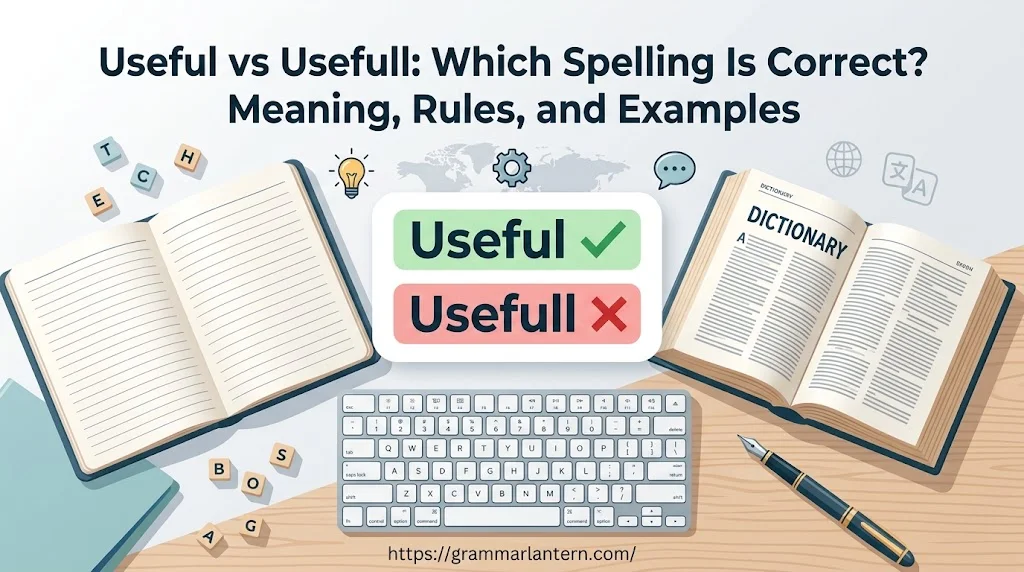
From my experience editing grammar content, this mistake appears often because people naturally assume that adding two l letters looks right. In reality, the correct spelling is useful, while usefull is the incorrect spelling. The proper word recognized in standard English is useful, and the correct way to spell it is with only one l.
The word useful means having a practical and beneficial use. It describes something that serves a purpose, solves a problem, or provides value in everyday life. Although some learners believe both forms are interchangeable, they are not accepted as equal in English dictionaries, style guides, or professional writing.
Following the standard rules of the language will help you remember the correct spelling every time. Doing so will avoid writing usefull by mistake and improve both formal and everyday communication. Paying attention to small spelling details like this can make your writing clearer, more accurate, and more professional.
Quick Answer
Useful is the correct spelling.
Usefull is incorrect and should not be used in standard English.
| Word | Correct Spelling | Meaning | Example |
| Useful | ✅ Yes | Something that provides help, value, or benefit | This guide is useful for beginners. |
| Usefull | ❌ No | Incorrect spelling | Avoid writing “usefull” in formal writing. |
The reason is simple: use + ful = useful.
The suffix -ful only contains one L, even though the standalone word full contains two.
What Is the Correct Spelling?
The correct spelling is useful.
The word describes something that helps someone, solves a problem, or provides practical value. It can describe objects, information, skills, ideas, advice, and even experiences.
Examples:
- This dictionary is useful for learning new vocabulary.
- The training session provided useful information.
- Her advice was extremely useful during the project.
The spelling usefull is a common mistake, but it is not accepted in standard English dictionaries.
Why Do People Write Usefull Instead of Useful?
The mistake usually happens because people connect the word with full.
For example:
- Full → containing as much as possible
- Useful → providing value or help
Since full has two Ls, writers sometimes assume:
use + full = usefull
But English spelling rules treat -ful differently from the word full.
The correct formation is:
Use + ful = Useful
Not:
Use + full = Usefull
Why Does Useful Have One L?
The answer comes from understanding suffixes.
A suffix is a group of letters added to the end of a word to change its meaning. The suffix -ful means:
- Full of
- Having the quality of
- Providing something
When -ful works as a suffix, it normally has only one L.
Examples:
| Base Word | Correct Form | Incorrect Form |
| Help | Helpful | Helpfull |
| Care | Careful | Carefull |
| Beauty | Beautiful | Beautifull |
| Hope | Hopeful | Hopefull |
| Use | Useful | Usefull |
This pattern appears in hundreds of English words.
A helpful way to remember it:
“Full” has two Ls when it stands alone. “-ful” has one L when it joins another word.
Useful Meaning and Definition
The word useful is an adjective that means something has practical value or helps achieve a goal.
According to standard English usage, something is useful when it makes a task easier, provides information, or creates a positive result.
For example:
- A calculator is useful when solving math problems.
- A map is useful when exploring a new city.
- Communication skills are useful in almost every career.
The word does not only describe physical objects. It can also describe:
- Knowledge
- Advice
- Skills
- Information
- Methods
- Experiences
Examples of Useful in Different Situations
Technology
- Smartphones are useful tools for communication.
- This software is useful for managing business tasks.
Education
- Taking notes is a useful learning strategy.
- Practice tests are useful before exams.
Workplace
- Time management is a useful professional skill.
- The meeting provided useful ideas for the project.
Read More: Bright vs Brite: Which Spelling Is Correct?
How to Use Useful Correctly in Sentences
Because useful is an adjective, it describes a noun.
The basic structure is:
Useful + noun
Examples:
- Useful information
- Useful advice
- Useful tool
- Useful method
- Useful skill
Useful for + Noun or Verb-ing
This is one of the most common sentence patterns.
Examples:
- This website is useful for students.
- Exercise is useful for improving your health.
- A planner is useful for organizing daily tasks.
Useful to + Person
Use this structure when something benefits someone.
Examples:
- This information is useful to new employees.
- The instructions were useful to the team.
Useful in + Situation
Use this structure when something helps in a specific situation.
Examples:
- These skills are useful in the workplace.
- This technique is useful in emergency situations.
Understanding the Difference
Although useful and full look similar, they have different meanings and functions.
| Word | Type | Meaning | Example |
| Full | Adjective | Containing as much as possible | The bottle is full. |
| Useful | Adjective | Providing help or value | This bottle is useful for camping. |
The word full describes quantity.
The word useful describes usefulness or purpose.
Compare these examples:
- The bag is full of books.
- The bag is useful for carrying books.
The first sentence explains the amount. The second explains the purpose.
Common Mistakes
Small spelling mistakes can change how professional your writing looks. Here are some frequent errors.
Mistake: Writing Usefull
Incorrect:
This website provides usefull information.
Correct:
This website provides useful information.
The extra L does not belong because -ful already has the correct spelling.
Mistake: Writing Other -Full Words Incorrectly
The same mistake appears in many other words.
Incorrect:
- Wonderfull
- Beautifull
- Peacefull
- Hopefull
- Carefull
Correct:
- Wonderful
- Beautiful
- Peaceful
- Hopeful
- Careful
Mistake: Confusing Useful and Helpful
These words are close in meaning but not always interchangeable.
| Word | Meaning | Example |
| Useful | Provides practical value | This tool is useful for editing videos. |
| Helpful | Provides assistance or support | My teacher was helpful. |
A calculator is useful because it performs a task.
A person can be helpful because they provide support.
Useful Synonyms and Related Words
Using different words can make your writing more interesting. Depending on the context, you can replace useful with several alternatives.
| Synonym | Meaning | Example |
| Helpful | Gives assistance | Her feedback was helpful. |
| Practical | Works well in real situations | These are practical solutions. |
| Valuable | Has importance or worth | His experience is valuable. |
| Beneficial | Creates a positive effect | Exercise is beneficial for health. |
| Effective | Produces the desired result | This method is effective. |
However, these words are not always exact replacements.
For example:
- A hammer is useful for building.
- A teacher is helpful when explaining difficult topics.
- A skill can be valuable because it improves career opportunities.
Is Useful Spelled the Same in American and British English?
Yes. Both American and British English use the spelling:
Useful
There is no difference between the two versions.
Some English words have different spellings depending on the country:
| American English | British English |
| Color | Colour |
| Traveling | Travelling |
| Center | Centre |
But useful remains the same everywhere.
How to Remember the Correct Spelling
A simple memory trick can prevent this mistake forever:
Remember that -ful is only one L.
Think about these examples:
- Helpful
- Useful
- Careful
- Beautiful
- Wonderful
All of them use one L.
Another trick:
“A useful word is not full of extra letters.”
This small reminder can help you avoid adding unnecessary letters.
Real-Life Examples in Writing
Understanding the word becomes easier when you see how people use it naturally.
Example in Education
Online learning platforms provide useful resources for students who want to improve their skills.
Here, useful describes resources that provide educational value.
Example in Business
Customer feedback is useful because it helps companies improve their products.
Here, useful describes information that creates a practical benefit.
Example in Daily Conversation
That’s a useful tip. I’ll try it next time.
Here, the word describes advice that can help someone.
Read More: Plushie or Plushy: Which Spelling Is Correct?
FAQs
1. Which spelling is correct: Useful or Usefull?
The correct spelling is useful. Usefull is a misspelling and is not accepted in standard English.
2. Why do people write “usefull” instead of “useful”?
Many people mistakenly add an extra l because other English words end with double letters. However, useful always has only one l.
3. What does the word “useful” mean?
Useful means something is practical, helpful, or beneficial for a particular purpose.
4. Is “usefull” found in English dictionaries?
No. Reputable English dictionaries list useful as the correct spelling, while usefull is considered incorrect.
5. Can I use “usefull” in formal writing?
No. You should always use useful in essays, emails, business documents, and academic writing.
6. How can I remember the correct spelling of useful?
Remember that the word ends with only one l. Thinking of “full of use” may seem logical, but the correct spelling remains useful.
7. Are Useful and Usefull interchangeable?
No. Only useful is a valid English word. Usefull should not be used.
8. Is “useful” an adjective?
Yes. Useful is an adjective that describes something that has value or serves a helpful purpose.
9. Do native English speakers ever write “usefull”?
Yes, it can happen as a typing or spelling mistake, but it is still considered incorrect and is usually corrected.
10. Why is correct spelling important?
Correct spelling improves clarity, makes your writing look more professional, and helps readers understand your message without confusion.
Conclusion
Choosing between Useful vs Usefull is simple once you know the spelling rule. Useful is the only correct form in standard English, while usefull is a common spelling mistake that should be avoided. Learning this small difference can improve both your confidence and your writing accuracy.
Whenever you are unsure, remember that useful always ends with a single l. Using the correct spelling in everyday conversations, emails, school assignments, and professional writing will help you communicate more clearly and leave a better impression on your readers.

For Shafiq ur Rehman, writing is an art form and grammar is the toolbox that makes it beautiful. As a dedicated content writer at Grammar Lantern, Shafiq approaches every topic like an architect carefully laying down strong foundations of understanding before adding the finer details. He loves diving into the trickiest grammar points and resurfacing with simple, bite-sized takeaways that anyone can grasp. When he’s not crafting articles, you’ll likely find him strategizing over a game of chess, exploring dusty local bookshops, or quietly jotting down poetic observations in his notebook.
[…] Read More: Useful vs Usefull: Which Spelling Is Correct? […]