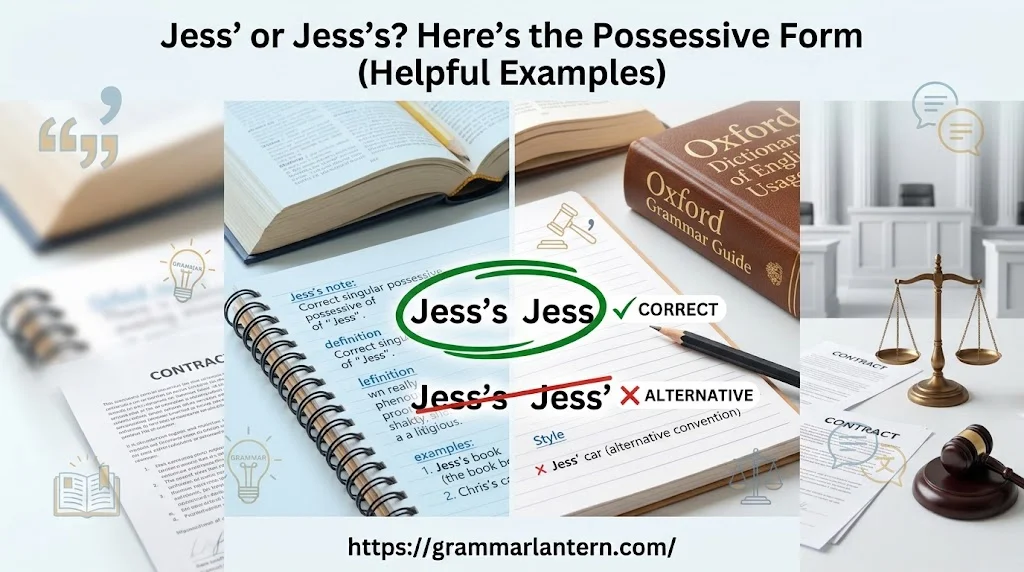
Jess’ or Jess’s can both show possession, but Jess’s is often the clearer possessive form for the singular name Jess. Both versions are grammatical and acceptable, although different style guides may prefer different forms. Some guides permit omitting the final s after the apostrophe, while others prefer Jess’s. The best choice usually depends on your preferred style and consistent English grammar.
The possessive of Jess works like other possessive nouns, and using apostrophe s can make the possessive construction easier to understand. In everyday writing, Jess’s remains a common and widely accepted option. For example, “That is Jess’s book” clearly shows that the book belongs to Jess. The same general issue appears with other singular names ending in s.
When a name ending in S creates questions about spelling, punctuation, or English usage, follow one style consistently. You can keep the S and add an apostrophe, or use ’s, depending on your chosen style guide. Understanding these possessive forms makes correct usage easier and helps you choose the right version for your writing.
Quick Answer
Jess’s is the safest default when you’re writing in general American English and no specific style guide tells you otherwise.
For example:
- Jess’s phone is on the table.
- I borrowed Jess’s notebook.
- That’s Jess’s jacket.
- We went to Jess’s house.
Jess’ can also be found in edited writing because some style conventions form the possessive of certain names ending in s with an apostrophe alone.
The important point is that both forms can represent the same possessive relationship:
| Form | Meaning | Example |
| Jess’s | Possessive form of singular Jess | Jess’s book |
| Jess’ | Alternative possessive style | Jess’ book |
| Jess | The name itself | Jess called me. |
| Jesses | Plural of Jess | Two Jesses arrived. |
| Jesses’ | Possessive plural | The two Jesses’ cars were parked outside. |
If you’re simply writing an essay, email, blog post, or everyday message without a house style, Jess’s is an easy and consistent choice.
Jess’s: The Standard Singular Possessive Form
The basic possessive rule is simple: when a singular noun shows possession, add an apostrophe and s.
Consider these examples:
- the teacher’s desk
- the girl’s backpack
- the dog’s collar
- Jess’s backpack
The same pattern applies even when the singular name already ends in s.
That gives you:
Jess + ’s = Jess’s
This rule may look slightly strange at first. After all, you’re putting another s after a name that already ends in s. English grammar doesn’t mind the double appearance.
For example:
Jess’s answer surprised everyone.
Here, Jess’s tells you that the answer belongs to or is associated with Jess.
The possessive relationship doesn’t have to mean literal ownership. That’s an important detail. A person can possess an object, but a name in possessive form can also show association, authorship, responsibility, connection, or relationship.
Compare these:
- Jess’s car — the car associated with Jess
- Jess’s opinion — the opinion expressed by Jess
- Jess’s brother — the brother related to Jess
- Jess’s decision — the decision made by Jess
- Jess’s birthday — the birthday associated with Jess
So, “possessive” doesn’t always mean someone physically owns something.
How to Form Jess’s Correctly
The construction is straightforward:
Jess + apostrophe + s = Jess’s
You don’t remove the final s from Jess.
Examples of Jess’s
- Jess’s phone
- Jess’s computer
- Jess’s desk
- Jess’s car
- Jess’s dog
- Jess’s mother
- Jess’s idea
- Jess’s project
- Jess’s birthday
- Jess’s favorite book
Now put those phrases into complete sentences:
- Jess’s phone keeps ringing.
- I left my keys on Jess’s desk.
- Jess’s dog loves chasing tennis balls.
- The teacher praised Jess’s project.
- We celebrated at Jess’s house.
- I agreed with Jess’s suggestion.
The grammar remains the same regardless of what follows the possessive form.
Read More: Comment vs Coment: Correct Spelling, Meaning, and Usage Guide
Why Does Jess’s Have an Extra S?
The second s isn’t there because Jess suddenly became plural.
Instead, it marks the possessive ending.
This distinction matters because Jess remains a singular proper noun.
Think about the difference:
- Jess = one person’s name
- Jess’s = something associated with one Jess
- Jesses = more than one person named Jess
- Jesses’ = something associated with multiple people named Jess
The spelling may look crowded, but each form performs a different grammatical job.
Is Jess’ Correct?
Yes, Jess’ can be a legitimate possessive spelling under a convention that uses an apostrophe alone after a name ending in s.
For example:
- Jess’ car
- Jess’ office
- Jess’ idea
- Jess’ brother
- Jess’ decision
The important caveat is that this isn’t the preferred approach in every style system.
That means Jess’ shouldn’t automatically be labeled “wrong.” Instead, ask which style convention governs the writing.
What’s the Difference?
The meaning is essentially the same when both forms are used as singular possessives.
The difference lies mainly in style and convention.
| Feature | Jess’s | Jess’ |
| Shows possession | Yes | Yes |
| Refers to one Jess | Yes | Yes |
| Uses apostrophe | Yes | Yes |
| Adds another s | Yes | No |
| Used in Chicago style | Yes | Not preferred for singular names |
| Used in some alternative styles | Yes | Yes |
| Good general default | Yes | Depends on style |
This is why grammar discussions sometimes become confusing. One source may say Jess’s is correct while another accepts Jess’.
They aren’t necessarily contradicting each other. They may simply be following different editorial rules.
When Should You Use Jess’s?
In ordinary writing, Jess’s is the practical choice when you don’t have a required style guide.
It’s especially useful in:
- school assignments
- general blog posts
- personal writing
- emails
- business communication
- general websites
- informal articles
- most everyday writing
For example:
Jess’s presentation starts at nine.
The construction is immediately recognizable. The reader doesn’t have to wonder whether the apostrophe-only version follows a particular editorial convention.
A Simple Rule to Remember
When Jess means one person and you’re showing possession, use:
Jess’s + noun
For example:
Jess’s notebook
Not:
Jess notebook
And, unless your style guide specifically calls for it, don’t switch between Jess’s and Jess’ throughout the same piece.
Consistency is the quiet hero of good editing.
When Might You See Jess’?
You may encounter Jess’ in publications, books, websites, or documents that follow an apostrophe-only convention for certain names ending in s.
The form has a long history in English style.
Interestingly, Chicago itself once had more complicated rules for names ending in s. Earlier editions distinguished between names based partly on syllable count and other features. Chicago later changed its approach and now uses ’s for singular personal names.
So if you’ve seen older examples such as Harris’ or Moses’, you’re not imagining them. Historical style conventions differed from modern Chicago practice.
That’s a useful lesson: English punctuation rules aren’t frozen in amber.
Editorial standards change over time.
Jess’s or Jess’ for a School Assignment?
If your teacher or professor gives you a style guide, follow it.
That rule takes priority over a general preference.
For example, an instructor might require:
- MLA
- APA
- Chicago
- a school-specific style guide
- a department-specific editorial guide
If no style has been specified, Jess’s is a straightforward choice for a singular possessive.
Consider:
Jess’s research paper received excellent feedback.
It’s clear, standard, and easy to read.
The bigger mistake would be using one form in one paragraph and another form later without a reason.
Keep Your Style Consistent
Suppose an article contains these sentences:
Jess’s office is upstairs.
I left Jess’ folder on the desk.
The reader can understand both sentences. However, the inconsistent style looks accidental.
A cleaner approach is:
Jess’s office is upstairs.
I left Jess’s folder on the desk.
Or, if a publication requires the apostrophe-only convention, use that convention consistently.
Jess’s or Jess’ in Formal Writing?
Neither spelling is automatically “informal.”
The real question is which editorial system you’re following.
That makes Jess’s a strong choice for formal writing when no other house style applies.
However, professional publications can establish their own conventions. The Associated Press, for example, maintains its own continuously updated style system for journalists and other professional writers. Its current print edition is the 58th edition, with online guidance updated throughout the year.
So formal writing doesn’t mean “always use Jess’s.” It means follow the applicable editorial standard.
Why Names Ending in S Create So Much Confusion
The confusion comes from the collision of several different grammatical forms.
Consider Jess.
At first glance, the final s can make the word look plural. But it isn’t.
Jess is simply a singular proper name.
That’s different from a regular plural noun such as books.
Compare:
- one book
- two books
- one Jess
- two Jesses
When you make Jess plural, you normally add es because the name already ends in s.
Therefore:
Jess → Jesses
Then, if the plural group owns or is associated with something:
Jesses → Jesses’
For example:
The two Jesses’ schedules overlapped.
That’s different from:
Jess’s schedule overlapped with mine.
The first sentence refers to multiple people. The second refers to one person.
Jess vs. Jess’s vs. Jess’
These three forms are easy to confuse, but their jobs are different.
Jess
Use Jess when you’re simply referring to the person.
Jess called this morning.
Here, no possession exists.
Jess’s
Use Jess’s as the singular possessive form under the ’s convention.
Jess’s phone is ringing.
The phone is associated with Jess.
Jess’
Use Jess’ when following a style convention that forms the possessive with an apostrophe alone.
Jess’ phone is ringing.
The meaning remains clear.
The spelling difference is editorial rather than a change in who owns the phone.
Jess’s and Pronunciation
Spelling and pronunciation are closely related here.
When you write Jess’s, the possessive ending is normally pronounced rather than silently ignored. In ordinary speech, the ending adds an extra /ɪz/ sound after the final /s/ sound of the name.
That means the written ’s isn’t merely decorative punctuation. It reflects a spoken grammatical ending.
For example:
Jess’s idea was brilliant.
The possessive ending helps signal the grammatical relationship between Jess and the idea.
This is one reason Jess’s can feel more natural to many readers. The spelling makes the grammatical ending visible.
By contrast, Jess’ can look shorter on the page while representing the same possessive relationship in a different editorial convention.
What About Names Like James?
The same issue appears with James, Chris, Charles, and many other names ending in s.
Under the ’s convention:
- James’s car
- Chris’s book
- Charles’s house
- Lucas’s phone
- Alexis’s idea
The rule doesn’t suddenly change because the name is familiar.
Chicago explicitly recommends forms such as James’s and Iris’s for singular names ending in s.
James’ vs. James’s
You may also see:
James’ car
That’s the apostrophe-only convention.
And you may see:
James’s car
That’s the ’s convention.
Again, don’t confuse a style difference with a difference in meaning.
What About Chris’ or Chris’s?
Both forms may appear in published English.
Under a ’s system:
Chris’s presentation starts tomorrow.
Under an apostrophe-only system:
Chris’ presentation starts tomorrow.
If you’re writing without a specified style guide, Chris’s gives you a simple pattern that matches Jess’s, James’s, and other singular names ending in s.
The same principle applies to:
- Lucas’s
- Alexis’s
- Charles’s
- Dennis’s
- Ross’s
Common Mistakes
Writing Jesss
This form drops the apostrophe:
Jesss book
That’s incorrect.
The apostrophe marks the possessive relationship.
Use:
Jess’s book
Writing Jesses When You Mean Possession
Jesses normally represents the plural of the name, not the singular possessive.
Compare:
Two Jesses joined the meeting.
Here, there are two people named Jess.
But:
Jess’s meeting starts at noon.
Here, one person’s meeting is being discussed.
Mixing Jess’ and Jess’s
There’s no grammatical need to alternate randomly.
If you choose Jess’s, keep using it unless the publication’s style requires something else.
Treating Jess Like a Plural Noun
The final s in Jess doesn’t make the name plural.
This is a common visual trap.
Jess is one person.
Jesses refers to more than one person named Jess.
That distinction controls the possessive form.
Jess’s vs. Jesses’ vs. Jess’
Here’s the whole system at a glance:
| Form | Grammatical role | Example |
| Jess | Singular name | Jess arrived. |
| Jess’s | Singular possessive | Jess’s coat is blue. |
| Jess’ | Singular possessive under an apostrophe-only convention | Jess’ coat is blue. |
| Jesses | Plural name | Two Jesses arrived. |
| Jesses’ | Plural possessive | The Jesses’ coats are blue. |
This table gives you the key distinction: singular and plural are separate from possessive marking.
The apostrophe tells you something about possession or another noun relationship. The number of people determines whether you’re dealing with Jess or Jesses.
A Useful Case Study: One Jess vs. Two Jesses
Imagine a workplace has two employees named Jess.
You might write:
Jess’s laptop is on the conference table.
This refers to one specific Jess.
Now suppose both employees left their laptops there:
The two Jesses’ laptops are on the conference table.
Notice what changed.
First, Jess became Jesses because there are two people.
Then the apostrophe moved to the end of the plural form:
Jesses + ’ = Jesses’
That’s the standard pattern for a plural possessive ending in s.
The distinction becomes even clearer in a sentence such as:
Jess’s laptop has a cracked screen, but the two Jesses’ laptops are being replaced.
One Jess. Then two Jesses.
Once you separate number from possession, the spelling becomes much easier.
What Do Major Style Guides Say?
Style guides don’t always use identical rules. That’s why a quick internet search can produce apparently conflicting answers.
Chicago Manual of Style
Chicago currently uses ’s for singular personal names ending in s. It specifically states that forms such as Harris’s and James’s follow its current rule.
Australian Government Style Manual
The Australian Government Style Manual also says to use an apostrophe plus s with personal names, even when the name already ends in s. Its examples include Burns’s, James’s, and Louis’s.
Associated Press Stylebook
The Associated Press maintains a separate editorial system for journalists and professional communicators. Its online guidance is updated throughout the year, so writers working under AP style should consult the current AP guidance rather than assume that another style guide’s rule automatically applies.
The practical lesson is simple:
Style guides are rulebooks, not universal laws of English.
If your editor says to follow a particular guide, follow that guide.
A Quick Decision Guide for Jess’ or Jess’s
When you’re stuck, use this checklist:
- Are you talking about one person named Jess? Use the singular form Jess.
- Are you showing possession or association? Add a possessive ending.
- Does your style guide use ’s for singular names ending in s? Write Jess’s.
- Does your publication use the apostrophe-only convention? Write Jess’.
- Are you talking about multiple people named Jess? Write Jesses.
- Do multiple Jesses possess something? Write Jesses’.
- Has no style guide been specified? Jess’s is a clear general default.
- Are you writing professionally? Check the publication’s house style before making a final choice.
Read More: Gradual vs. Insidious: Understanding the Real Difference
FAQs
1. Is Jess’ grammatically correct?
Yes. Jess’ is grammatically acceptable under style guides that allow an apostrophe without adding another s to singular names ending in s.
2. Is Jess’s grammatically correct?
Yes. Jess’s is also grammatically correct and is widely used for showing the possessive form of the singular name Jess.
3. Which is more common, Jess’ or Jess’s?
Jess’s is commonly used because it clearly shows possession and follows the general rule of adding ’s to a singular noun or name.
4. Should I write Jess’ book or Jess’s book?
You can use either form, depending on the style guide you follow. Jess’s book is often the clearer choice in general writing.
5. Do all names ending in S use Jess’s?
Not necessarily. Different style guides have different rules for singular names ending in s. Some recommend ’s, while others allow only an apostrophe.
6. Does Jess’ mean something different from Jess’s?
No. Both forms can express the same possessive meaning. The difference is mainly a matter of style and punctuation.
7. Is Jess a singular name?
Yes. Jess is normally treated as a singular name, even though it ends in the letter s.
8. Can I use Jess’s in formal writing?
Yes. Jess’s is acceptable in formal writing when it follows the style guide you are using. Consistency matters more than switching between forms.
9. How do I make Jess plural?
If you mean more than one person named Jess, the plural is generally Jesses. The possessive form would then be written according to the plural possessive rule.
10. What is the safest choice for everyday English?
For most everyday writing, Jess’s is a clear and familiar choice. However, if your school, workplace, or publication follows a specific style guide, follow its preferred rule.
Conclusion
Both Jess’ and Jess’s can correctly show possession. The main difference comes from style preferences rather than meaning. Some style guides allow Jess’, while others recommend Jess’s for a singular name ending in s.
If you aren’t following a specific style guide, Jess’s is a clear choice for everyday English. The most important thing is to understand the possessive form, apply the chosen rule consistently, and avoid switching between styles without a reason.

Muhammad Haroon is the voice behind many of the clear, practical grammar guides you’ll find on Grammar Lantern. With a strong background in content writing and a genuine love for the English language, Haroon specializes in breaking down intimidating grammar topics into simple, digestible lessons. His goal is simple: to empower readers to write with confidence and clarity. Whether he’s explaining tricky tenses or demystifying punctuation, Haroon approaches each topic with patience, precision, and a touch of warmth—because he knows that learning grammar is a journey, not a race.