
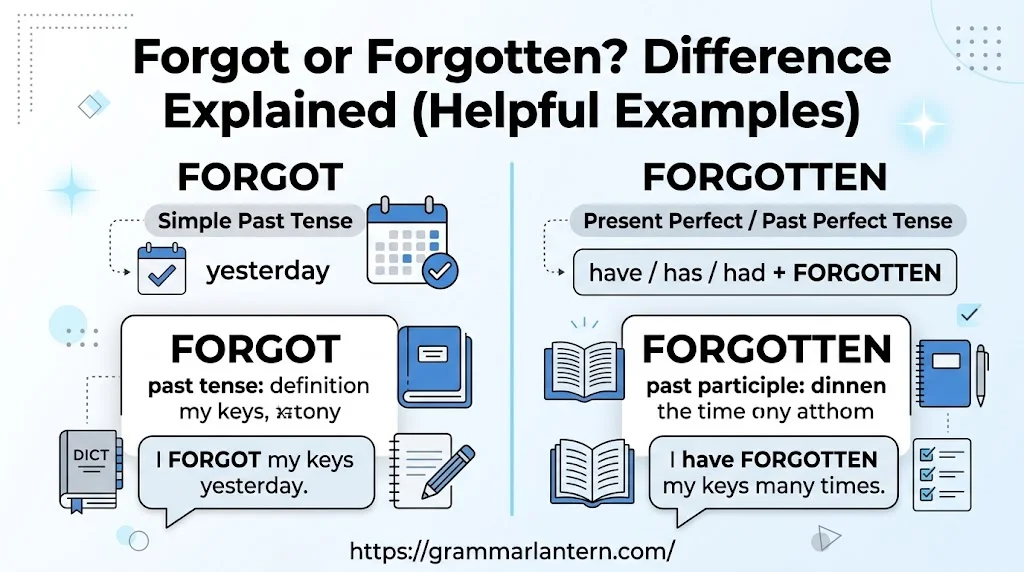
Forgot or Forgotten can be confusing because both words come from the irregular verb forget, but they have different grammatical roles. Forgot is the simple past form, so you use it when an action happened in the past. For example, “I forgot my wallet yesterday.” It can work as the main verb without a helping verb.
Forgotten is the past participle form of forget. You usually use it with auxiliary verbs or helping verbs such as have, has, or had. For example, “She has forgotten the appointment.” Understanding this verb structure makes it easier to choose the correct form instead of guessing based only on when the action happened.
When writing or speaking, remembering this simple grammar rule can help you avoid common mistakes. Think of forgot as the past tense and forgotten as the past participle. Practicing these verb forms in different sentence structures will make your English sound more natural, clear, and accurate.
Quick Answer
Forgot is the simple past tense of forget. Forgotten is the past participle of forget.
| Word | Grammatical form | Common use | Example |
| forget | Base form | Present tense, infinitives, commands | “Don’t forget your keys.” |
| forgot | Simple past | A completed past action | “I forgot my keys yesterday.” |
| forgotten | Past participle | Perfect tenses and some adjective uses | “I have forgotten my keys.” |
The basic verb forms are:
forget → forgot → forgotten
The easiest rule to remember is this:
Use “forgot” for simple past. Use “forgotten” after forms of “have” when forming a perfect tense.
For example:
- I forgot her name. ✓
- I have forgotten her name. ✓
- I had forgotten her name. ✓
- I have forgot her name. ✗ in standard English
- I did forgotten her name. ✗
However, grammar isn’t only about memorizing a three-word sequence. The surrounding words matter, too.
What Is the Difference Between Forgot and Forgotten?
The main difference between forgot and forgotten is grammatical rather than lexical. Both describe failing to remember something, but they appear in different verb structures.
Forgot functions as the simple past form:
“She forgot her appointment.”
The action happened in the past, and the sentence uses no auxiliary verb to create a perfect tense.
Forgotten, on the other hand, is the past participle:
“She has forgotten her appointment.”
Here, has acts as the auxiliary verb, while forgotten completes the present perfect construction.
That distinction is important because English irregular verbs don’t always follow a predictable pattern. Regular verbs usually add -ed, as in walk → walked → walked. The verb forget doesn’t follow that pattern.
The Three Main Forms of Forget
| Form | Word | Typical grammatical role |
| Base form | forget | Present tense, infinitives, commands |
| Past tense | forgot | Simple past |
| Past participle | forgotten | Perfect tenses and passive constructions |
| -ing form | forgetting | Continuous tenses |
Examples make the difference clearer:
- “I often forget names.”
- “I forgot your name yesterday.”
- “I have forgotten your name.”
- “I am forgetting names more often.”
Notice how the surrounding grammar changes the verb form.
When to Use “Forgot”
Forgot describes something that happened in the past. It is the form you need when you’re using the simple past tense of forget.
Forgot for a Completed Past Action
Use forgot when you describe a past event, especially when the sentence refers to a finished time.
For example:
- “I forgot my wallet yesterday.”
- “She forgot the meeting last Monday.”
- “We forgot where we parked.”
- “He forgot his keys this morning.”
- “They forgot about the deadline.”
Words such as yesterday, last week, last night, and two days ago often point toward the simple past.
Consider this example:
“I forgot my umbrella yesterday.”
The sentence focuses on a past event. The forgetting happened yesterday.
Read More: Shaky vs Shakey: Which Spelling Is Correct?
Forgot With “To” + Verb
One of the most common structures is:
forgot + to + verb
This means someone failed to remember to perform an action.
Examples:
- “I forgot to call my mother.”
- “She forgot to lock the door.”
- “He forgot to bring his passport.”
- “We forgot to buy milk.”
- “They forgot to submit the form.”
This structure can describe something that should have happened but didn’t.
For instance, if someone intended to send an email but never sent it because they didn’t remember, you could say:
“I forgot to send the email.”
The important idea is that the person failed to remember the action before it was supposed to happen.
Forgot With a Noun
Forgot can also take a noun directly as its object.
Examples include:
- “I forgot my password.”
- “She forgot her appointment.”
- “He forgot the address.”
- “We forgot the tickets.”
- “They forgot his birthday.”
Here, the object tells you what the person failed to remember.
Forgot With Question Words
You can use forgot before words such as what, where, when, why, who, and how.
Examples:
- “I forgot where I parked.”
- “She forgot why she called.”
- “He forgot how the machine worked.”
- “We forgot when the event started.”
- “They forgot what the teacher said.”
The word forgot remains the simple past form because the main event occurred in the past.
When to Use “Forgotten”
Forgotten is the past participle of forget. You usually need an auxiliary verb before it when you use it as part of a perfect tense.
The most common combinations are:
- have forgotten
- has forgotten
- had forgotten
- will have forgotten
Forgotten With “Have” or “Has”
Use have forgotten or has forgotten to form the present perfect tense.
Examples:
- “I have forgotten his name.”
- “She has forgotten her password.”
- “We have forgotten the instructions.”
- “He has forgotten where he put the keys.”
- “They have forgotten about the appointment.”
The present perfect often connects a past event to the present situation.
For example:
“I have forgotten my password.”
The sentence doesn’t simply report a finished historical event. It can also imply a present consequence: the password isn’t remembered now.
That connection helps explain why present perfect and simple past can feel slightly different.
Compare:
“I forgot my password yesterday.”
This gives a specific past event.
“I have forgotten my password.”
This emphasizes the current result.
Forgotten With “Had”
Use had forgotten to form the past perfect.
The past perfect places one past event before another past event.
For example:
“I had forgotten the appointment before my friend reminded me.”
There are two past events:
- Forgetting the appointment happened first.
- The friend reminded the speaker later.
The word had signals that earlier relationship.
More examples:
- “She had forgotten his name before he introduced himself.”
- “We had forgotten the address when we left the office.”
- “He had forgotten the password before the meeting started.”
Forgotten With “Will Have”
The future perfect can also use forgotten:
“By next year, they will have forgotten the incident.”
The structure is:
will have + past participle
Because forgotten is the past participle, it fits naturally into this construction.
Can “Forgotten” Be an Adjective?
Yes. Forgotten can also function as an adjective when it describes a person, place, thing, idea, or event that people no longer remember or notice.
Consider:
“They discovered a forgotten village.”
Here, forgotten describes the village. It doesn’t function as the main verb.
Other examples include:
- “a forgotten tradition”
- “a forgotten password”
- “a forgotten notebook”
- “a forgotten corner of the library”
- “a forgotten chapter of history”
This use can sometimes blur the line between grammar and meaning. The word still comes from the verb forget, but its role in the sentence has changed.
Compare these two sentences:
“She has forgotten the story.”
Here, forgotten forms the present perfect verb phrase.
“She found a forgotten story.”
Here, forgotten describes the story.
The word looks the same. The grammatical function is different.
Forgot vs. Forgotten in Different Tenses
Looking at the larger tense system makes the distinction much easier.
| Tense | Correct structure | Example |
| Simple present | forget/forgets | “I forget names easily.” |
| Simple past | forgot | “I forgot his name.” |
| Present perfect | have/has + forgotten | “I have forgotten his name.” |
| Past perfect | had + forgotten | “I had forgotten his name.” |
| Future perfect | will have + forgotten | “I will have forgotten his name.” |
| Present continuous | am/is/are + forgetting | “I am forgetting names.” |
| Past continuous | was/were + forgetting | “I was forgetting things.” |
A useful shortcut is to look for the auxiliary verb.
If the sentence uses did for a past question or negative statement, use forget, not forgotten.
If the sentence uses have, has, or had as a perfect-tense auxiliary, use forgotten.
Forgot vs. Forgotten in Questions
Questions often expose mistakes because auxiliary verbs change the structure.
“Did You Forget?” Is Correct
When you use did, the main verb returns to its base form.
Therefore:
“Did you forget your keys?”
is correct.
You shouldn’t say:
“Did you forgot your keys?” ✗
You also shouldn’t say:
“Did you forgotten your keys?” ✗
The reason is straightforward. Did already carries the past tense, so the main verb stays in its base form.
The pattern is:
Did + subject + base verb?
Examples:
- “Did you forget the meeting?”
- “Did she forget her phone?”
- “Did they forget the address?”
- “Did he forget to call?”
“Have You Forgotten?” Is Also Correct
When you use the present perfect, the pattern changes:
Have/Has + subject + past participle?
Therefore:
“Have you forgotten your password?”
is correct.
Other examples:
- “Have you forgotten my name?”
- “Has she forgotten the appointment?”
- “Have they forgotten the rules?”
- “Has he forgotten where we met?”
The auxiliary determines the form.
Read More: Safeness vs. Safetiness: Which Word Is Correct?
In Negative Sentences
Negative sentences follow the same grammatical principles.
“Didn’t Forget”
Use didn’t + base verb for a simple past negative.
Correct:
“I didn’t forget your birthday.”
Incorrect:
“I didn’t forgot your birthday.”
Also incorrect:
“I didn’t forgotten your birthday.”
The word didn’t already marks the sentence as past tense. The main verb therefore stays as forget.
More examples:
- “She didn’t forget the appointment.”
- “We didn’t forget to call.”
- “He didn’t forget your instructions.”
“Haven’t Forgotten”
For the present perfect negative, use:
haven’t/hasn’t + forgotten
Examples:
- “I haven’t forgotten you.”
- “She hasn’t forgotten the password.”
- “We haven’t forgotten the agreement.”
- “He hasn’t forgotten what happened.”
The difference can be subtle but meaningful.
“I didn’t forget.”
This usually refers to a particular past situation.
“I haven’t forgotten.”
This often emphasizes that the memory still exists now.
“I Forgot” vs. “I Have Forgotten”
These sentences can both be grammatically correct, but context often determines which one sounds more natural.
“I Forgot”
Use I forgot when you focus on a past event.
“I forgot my wallet at home this morning.”
The sentence places the event in a finished past time.
“I Have Forgotten”
Use I have forgotten when the past action has a present connection.
“I have forgotten my wallet.”
The current situation matters. The wallet is still missing, and that affects what happens now.
Consider another pair:
| Sentence | Main focus |
| “I forgot his name yesterday.” | A specific past event |
| “I have forgotten his name.” | The current state of not remembering |
| “She forgot the appointment last week.” | A finished past event |
| “She has forgotten the appointment.” | The present result or relevance |
This doesn’t mean present perfect can never appear with a time reference. Rather, certain finished-time expressions naturally favor the simple past.
Common Mistakes
Several errors appear repeatedly because English learners try to apply the forms mechanically.
Mistake: “I Have Forgot”
Incorrect: “I have forgot his name.”
Correct: “I have forgotten his name.”
The present perfect requires:
have/has + past participle
Since forgotten is the past participle, it belongs after have or has in standard English.
Mistake: “Did You Forgot?”
Incorrect: “Did you forgot the meeting?”
Correct: “Did you forget the meeting?”
After did, use the base form.
This rule applies to other irregular verbs too:
- “Did you go?” not “Did you went?”
- “Did she see it?” not “Did she saw it?”
- “Did he take it?” not “Did he took it?”
- “Did they forget?” not “Did they forgot?”
Mistake: “I Didn’t Forgot”
Incorrect: “I didn’t forgot.”
Correct: “I didn’t forget.”
Again, didn’t carries the past tense.
Mistake: “I Had Forgot”
Incorrect: “I had forgot the address.”
Correct: “I had forgotten the address.”
The past perfect requires:
had + past participle
Therefore, had forgotten is the standard form.
“Forgot to Do” vs. “Forgot Doing”
This distinction deserves special attention because changing the structure can change the meaning.
Forgot to Do Something
Forget to + verb usually means you failed to remember an action that should have happened.
“I forgot to lock the door.”
The speaker didn’t remember to perform the action.
Other examples:
- “She forgot to reply.”
- “He forgot to charge his phone.”
- “We forgot to bring the documents.”
Forgot Doing Something
Forget + -ing can refer to losing the memory of a past experience or action.
For example:
“I forgot meeting him.”
This can mean the speaker had met him but no longer remembered that meeting.
The distinction becomes clearer with a familiar example:
“I forgot to call Sarah.”
The call never happened.
“I forgot calling Sarah.”
The sentence suggests that the call happened, but the speaker doesn’t remember it.
That’s a small grammatical change with a surprisingly large difference in meaning.
A Simple Case Study: Choosing the Right Form
Imagine someone arrives at work without their laptop.
They might say:
“I forgot my laptop.”
The speaker describes a past mistake.
Later, a coworker asks whether they still remember the password to their account. The speaker might answer:
“I have forgotten my password.”
Now the present situation matters. The person can’t remember it at the moment.
Later, the coworker reminds them that they wrote the password down earlier. The speaker could say:
“I had forgotten that I saved it in my notebook.”
Here, the past perfect places the forgetting before another past discovery or reminder.
The three forms fit different time relationships:
- forgot → simple past event
- have forgotten → past event connected to the present
- had forgotten → earlier past event before another past event
A Practical Decision Guide
When you’re unsure, don’t guess based on which word sounds familiar. Look at the sentence structure.
Ask these questions:
- Is the sentence in the simple past? → Use forgot.
- Does did or didn’t appear? → Use forget.
- Does have or has form a perfect tense? → Use forgotten.
- Does had form the past perfect? → Use forgotten.
- Does will have form the future perfect? → Use forgotten.
- Does forgotten describe a noun? → It may be functioning as an adjective.
Quick Comparison
| If you see… | Use… | Example |
| yesterday/last week + past event | forgot | “I forgot yesterday.” |
| did | forget | “Did you forget?” |
| didn’t | forget | “I didn’t forget.” |
| have | forgotten | “I have forgotten.” |
| has | forgotten | “She has forgotten.” |
| had | forgotten | “They had forgotten.” |
| will have | forgotten | “He will have forgotten.” |
| noun description | forgotten | “a forgotten tradition” |
FAQs
1. Is “forgot” or “forgotten” correct?
Both forgot and forgotten are correct, but they have different grammatical uses. Forgot is the simple past, while forgotten is the past participle.
2. What is the past tense of forget?
The simple past tense of forget is forgot. For example, “I forgot your name.”
3. What is the past participle of forget?
The past participle of forget is forgotten. For example, “I have forgotten your name.”
4. Can I say “I have forgot”?
In standard English, you should say “I have forgotten.” The verb have requires the past participle form.
5. Can “forgot” be used without a helping verb?
Yes. Forgot can act as the main verb in a simple past sentence, such as “She forgot her password.”
6. Can “forgotten” stand alone?
Usually, forgotten is used with a helping verb such as have, has, or had. For example, “He has forgotten the address.”
7. Is “I forgot” grammatically correct?
Yes. “I forgot” is completely correct when describing something that happened in the past.
8. Is “I have forgotten” correct?
Yes. “I have forgotten” is the present perfect form and uses forgotten as the past participle.
9. What are the three main forms of forget?
The main forms are forget, forgot, and forgotten. You may also see forgetting as the -ing form.
10. What is an easy way to remember forgot vs. forgotten?
Remember forgot = simple past and forgotten = past participle. If you see have, has, or had, you will normally need forgotten.
Conclusion
Understanding forgot or forgotten becomes much easier when you focus on their grammatical roles. Use forgot as the simple past form when describing a completed action in the past. Use forgotten as the past participle, usually after have, has, or had.
A simple way to remember the difference is to connect forgot with the past tense and forgotten with the past participle. Once you practice this pattern in everyday sentences, choosing the right form will become much more natural.

For Shafiq ur Rehman, writing is an art form and grammar is the toolbox that makes it beautiful. As a dedicated content writer at Grammar Lantern, Shafiq approaches every topic like an architect carefully laying down strong foundations of understanding before adding the finer details. He loves diving into the trickiest grammar points and resurfacing with simple, bite-sized takeaways that anyone can grasp. When he’s not crafting articles, you’ll likely find him strategizing over a game of chess, exploring dusty local bookshops, or quietly jotting down poetic observations in his notebook.


[…] Read More: Forgot or Forgotten? Difference Explained with Helpful Examples […]