Understanding Agencies or Agency’s or Agencies’ can make your writing clearer and more professional. Agencies is the plural form of agency, so you use it when referring to two or more organizations. For example, “Several agencies attended the meeting.” This form does not show ownership. It commonly appears in business communication, reports, emails, and professional documents where multiple organizations are involved.
Agency’s is the singular possessive form, meaning something belongs to one agency. For example, “The agency’s schedule changed unexpectedly.” The apostrophe and s show that one agency owns or is connected to something. In contrast, agencies’ is the plural possessive form. You use it when something belongs to or relates to multiple agencies, as in “The agencies’ representatives met to discuss the project.”
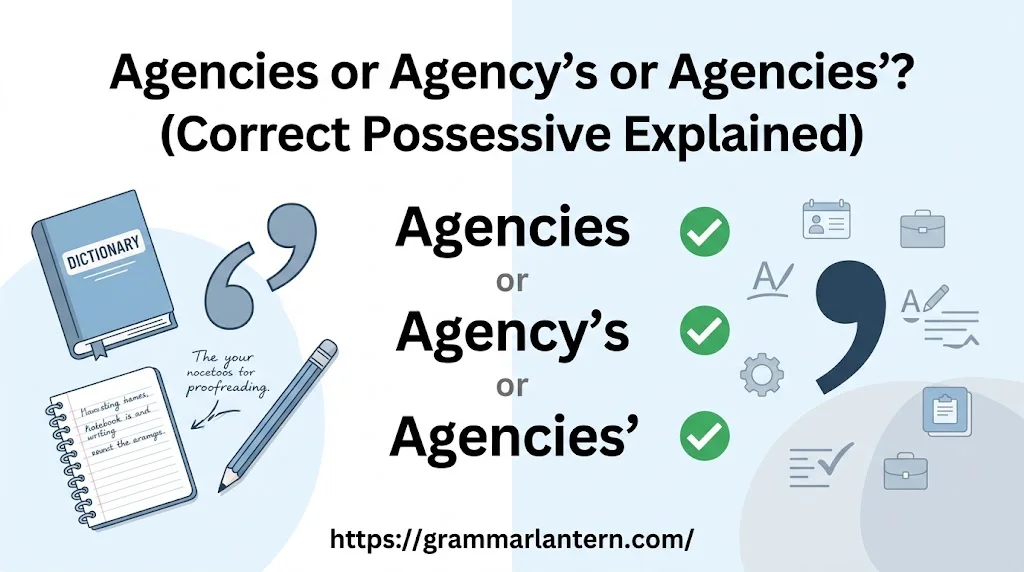
Choosing between these forms depends on whether you mean one organization, several organizations, or ownership. In project management, scheduling, meetings, calendar planning, and online booking, this distinction helps maintain consistency and avoid confusion. Remember: agencies means more than one, agency’s means belonging to one, and agencies’ means belonging to several.
Quick Answer
Here’s the simplest way to remember the difference:
| Form | Meaning | Grammatical Use | Example |
| agency | One agency | Singular noun | The agency hired a designer. |
| agencies | More than one agency | Plural noun | Several agencies submitted proposals. |
| agency’s | Something belonging to one agency | Singular possessive | The agency’s office is downtown. |
| agencies’ | Something belonging to several agencies | Plural possessive | The agencies’ offices are downtown. |
| agencies’s | Generally not the standard form | Incorrect plural possessive | The agencies’ offices are correct. |
So, remember this quick rule:
Agencies = plural. Agency’s = one agency’s possession. Agencies’ = multiple agencies’ possession.
The apostrophe tells you that you’re dealing with possession or association. Its position tells you whether the noun is singular or plural.
Agencies: The Correct Plural of Agency
Agencies is simply the plural form of agency. It means two or more agencies.
There is no possessive meaning in the word itself. You don’t need an apostrophe because you’re only showing that the noun refers to multiple organizations, groups, or institutions.
For example:
- The company works with several agencies.
- Government agencies released new reports.
- Three advertising agencies submitted proposals.
- Employment agencies helped workers find jobs.
- Travel agencies often arrange flights and hotels.
The spelling changes from agency to agencies because agency ends in a consonant followed by y. When you form the plural, the y changes to i, followed by es.
So:
agency → agencies
This same spelling pattern appears in many English words:
- company → companies
- policy → policies
- industry → industries
- strategy → strategies
- responsibility → responsibilities
When Should You Use “Agencies”?
Use agencies when you can replace the word with two or more agencies without changing the meaning.
Consider this sentence:
Several agencies participated in the investigation.
You could say:
Several government organizations participated in the investigation.
The word simply identifies multiple agencies. No possession exists, so no apostrophe belongs there.
A common mistake is writing agency’s when you mean the plural. That’s incorrect.
Incorrect: Several agency’s attended the meeting.
Correct: Several agencies attended the meeting.
The apostrophe isn’t a decoration. It has a grammatical job.
Read More: Icicle vs. Icycle: Which Spelling Is Correct? Explained
Agency’s: The Singular Possessive Form
Agency’s is the singular possessive form of agency. It normally means that something belongs to, relates to, or is associated with one agency.
The basic pattern is:
one agency + ’s = agency’s
For example:
- the agency’s website
- the agency’s director
- the agency’s decision
- the agency’s employees
- the agency’s headquarters
- the agency’s contract
- the agency’s reputation
Look at this sentence:
The agency’s website contains detailed information.
The website belongs to or is associated with one agency.
Now compare it with:
The agencies’ websites contain detailed information.
That sentence refers to multiple agencies and their websites.
The difference comes down to the number of agencies involved.
How to Recognize “Agency’s”
Try asking:
Does one agency have, own, control, produce, or relate to the following noun?
If the answer is yes, agency’s is usually the form you need.
For example:
The agency’s report was published yesterday.
Ask: Whose report?
The agency’s report.
One agency produced or owns the report.
Another example:
The agency’s employees attended the conference.
Ask: Whose employees?
The employees belong to or work for one agency.
This simple question works surprisingly well: “Whose?”
If the answer is one agency, use agency’s.
Agency’s Can Also Be a Contraction
There’s another important use of agency’s. The same spelling can function as a contraction of agency is or, in some contexts, agency has.
For example:
The agency’s expanding rapidly.
Here, agency’s means:
The agency is expanding rapidly.
That’s different from:
The agency’s new office opens tomorrow.
In this sentence, agency’s shows possession or association. The office belongs to or is connected with the agency.
Context usually makes the meaning clear.
Compare:
- The agency’s growing. → The agency is growing.
- The agency’s growth is impressive. → The growth of the agency is impressive.
The first is a contraction. The second is possessive.
This distinction matters because agency’s doesn’t always mean ownership. Sometimes it simply shortens agency is.
Agencies’: The Plural Possessive Form
Now we reach the form that causes the most trouble: agencies’.
Agencies’ is the plural possessive form of agencies. It shows that something belongs to, comes from, or is associated with multiple agencies.
The construction works like this:
agencies + apostrophe = agencies’
Notice that you don’t add another s after the apostrophe.
Examples include:
- the agencies’ policies
- the agencies’ offices
- the agencies’ employees
- the agencies’ reports
- the agencies’ decisions
- the agencies’ clients
- the agencies’ responsibilities
Consider this sentence:
The agencies’ representatives met yesterday.
The representatives came from several agencies.
Compare that with:
The agency’s representative met yesterday.
Only one agency is involved.
That small apostrophe changes the number of agencies from one to several.
Why Does the Apostrophe Come After the S?
English generally forms the possessive of a regular plural noun ending in s by adding only an apostrophe.
For example:
- employees → employees’
- companies → companies’
- schools → schools’
- agencies → agencies’
Therefore:
agency → agency’s
but:
agencies → agencies’
You don’t normally write agencies’s.
The existing plural s already shows that the noun is plural. The apostrophe simply signals possession.
Agencies’s: Is This Correct?
For standard English, agencies’s is generally not the correct plural possessive form.
The correct form is:
agencies’
Why? Because agencies is already a regular plural noun ending in s.
The normal pattern is:
regular plural ending in s + apostrophe
For example:
- companies → companies’
- teachers → teachers’
- students → students’
- agencies → agencies’
So:
Incorrect: The agencies’s policies differ.
Correct: The agencies’ policies differ.
Adding ’s after an already plural agencies creates an unnecessary extra s.
A Simple Way to Remember It
Think of the apostrophe as a marker that gets placed after the plural s.
Agency
↓
Agencies
↓
Agencies’
You don’t need another s.
The spelling may look unusual at first, but the rule is straightforward.
The Key Difference
The easiest way to understand these forms is to compare them directly.
| Word | Number | Possessive? | Example | Meaning |
| agency | One | No | The agency opened. | One agency |
| agencies | More than one | No | The agencies opened. | Multiple agencies |
| agency’s | One | Yes | The agency’s office opened. | Office of one agency |
| agencies’ | More than one | Yes | The agencies’ offices opened. | Offices of multiple agencies |
Here’s another useful comparison:
The agency changed its policy.
One agency changed one policy.
The agency’s policy changed.
One agency has a policy, and that policy changed.
The agencies changed their policies.
Multiple agencies changed their policies.
The agencies’ policies changed.
Multiple agencies have policies, and those policies changed.
The words its and their can also help you identify the number.
If its works, you may need the singular possessive agency’s.
If their works, you may need the plural possessive agencies’.
How to Choose the Correct Form
When you’re unsure about agencies or agency’s or agencies’, don’t stare at the apostrophe and hope inspiration strikes. Use a three-step test.
Ask Whether You Mean One or More Than One
First, identify the number.
If you mean one:
agency
If you mean multiple:
agencies
Ask Whether You Are Showing Possession
Next, ask whether the agency has, owns, controls, produces, or relates to something.
If there’s no possessive relationship, use:
agency or agencies
If there is a possessive relationship, use:
agency’s or agencies’
Check the Apostrophe Position
Finally, look at where the apostrophe sits.
agency’s → apostrophe before the s
agencies’ → apostrophe after the existing plural s
This gives you a reliable formula:
One + possession = agency’s
Several + possession = agencies’
Common Mistakes
These forms often get mixed up in everyday writing. Here are the most common errors.
Using Agency’s as the Plural
Incorrect: Several agency’s offer this service.
Correct: Several agencies offer this service.
The sentence talks about several agencies. No possession exists.
Read More: Wheaten vs. Wheat: What’s the Difference? A Complete Guide
Using Agencies When Possession Is Needed
Incorrect: The agencies policy has changed.
Correct: The agency’s policy has changed.
If you’re talking about one agency’s policy, the possessive apostrophe is necessary.
Using Agencies’s
Incorrect: The agencies’s representatives arrived.
Correct: The agencies’ representatives arrived.
The noun is already plural. Add only the apostrophe.
Putting the Apostrophe Before the S
Incorrect: The agency’s representatives arrived.
This sentence isn’t necessarily wrong. It depends on whether one agency is intended.
However, if several agencies are involved:
Correct: The agencies’ representatives arrived.
The placement changes with the number of agencies.
Real-World Examples of Agency’s and Agencies’
Possessive forms appear constantly in professional writing.
Consider advertising:
The agency’s campaign increased brand awareness.
One advertising agency created the campaign.
Now imagine several firms:
The agencies’ campaigns targeted different audiences.
Multiple agencies created multiple campaigns.
The same distinction appears in government:
The agency’s report was released Monday.
One agency issued the report.
The agencies’ reports were reviewed by the committee.
Several agencies produced reports.
It also appears in employment:
The agency’s recruiters contacted several candidates.
One agency has the recruiters.
The agencies’ recruiters attended the career fair.
Recruiters from several agencies attended.
The pattern stays the same regardless of the industry.
Case Study: One Agency vs. Multiple Agencies
Imagine a business owner hires one marketing firm.
The correct sentence is:
The agency’s strategy focuses on social media.
There’s one agency. Therefore, the singular possessive agency’s works.
Now imagine the business owner hires three marketing firms.
The sentence becomes:
The agencies’ strategies focus on different platforms.
Now several agencies are involved. Therefore, the plural possessive agencies’ is correct.
Notice something else: strategies is plural because there are multiple strategies.
You can therefore have two plural forms in one sentence:
The agencies’ strategies were different.
Here:
- agencies’ = plural possessive
- strategies = plural noun
Those two grammatical ideas are separate.
Agency’s vs. Agencies’ With Singular and Plural Objects
A useful detail often gets overlooked: the noun after the possessive doesn’t have to be plural.
For example:
The agencies’ director met with the minister.
Grammatically, this can mean multiple agencies share one director or are collectively associated with that director.
Likewise:
The agencies’ office was renovated.
This could describe an office shared by several agencies.
So don’t assume that agencies’ must always be followed by a plural noun.
The apostrophe tells you about the relationship between the agencies and the following noun. It doesn’t automatically determine whether that following noun is singular or plural.
Compare:
- The agencies’ office.
- The agencies’ offices.
- The agencies’ director.
- The agencies’ directors.
Context determines the exact meaning.
Why Apostrophes Matter in Formal Writing
A missing or misplaced apostrophe can make a sentence ambiguous.
Consider:
The agencies policy changed.
A reader may understand the intended meaning from context, but the grammar is incomplete.
Now compare:
The agency’s policy changed.
One agency’s policy changed.
And:
The agencies’ policies changed.
Multiple agencies’ policies changed.
The punctuation isn’t merely cosmetic. It carries information.
In business documents, contracts, reports, proposals, and academic writing, that distinction can matter considerably. A single apostrophe can tell your reader whether an idea belongs to one organization or several.
A Quick Memory Trick
Here’s an easy trick:
Look at the word before the apostrophe.
If you see:
agency’s
The word is singular before the apostrophe.
If you see:
agencies’
The word is already plural before the apostrophe.
Think of the apostrophe as a little signpost.
Agency’s → one agency owns or relates to something.
Agencies’ → several agencies own or relate to something.
Another useful test is to replace the possessive with of.
The agency’s website
= The website of the agency
The agencies’ websites
= The websites of the agencies
If the of version refers to one agency, use agency’s. If it refers to several, use agencies’.
Practical Examples
Here are several examples to reinforce the distinction.
| Sentence | Correct Form | Why |
| Several agencies attended the event. | agencies | Multiple agencies, no possession |
| The agency’s website is easy to use. | agency’s | One agency’s website |
| The agencies’ websites are easy to use. | agencies’ | Multiple agencies’ websites |
| Government agencies issued statements. | agencies | Plural noun |
| The agency’s statement was brief. | agency’s | One agency’s statement |
| The agencies’ statements differed. | agencies’ | Statements from multiple agencies |
| Two agencies signed the agreement. | agencies | Multiple agencies |
| The agency’s director signed it. | agency’s | One agency’s director |
| The agencies’ directors signed it. | agencies’ | Directors associated with multiple agencies |
FAQs
1. What is the plural of agency?
The plural of agency is agencies. For example, “Several agencies participated in the campaign.”
2. What does agency’s mean?
Agency’s is the singular possessive form of agency. It shows that something belongs to one agency, such as “The agency’s office is downtown.”
3. What does agencies’ mean?
Agencies’ is the plural possessive form. It shows that something belongs to multiple agencies, as in “The agencies’ policies were reviewed.”
4. Is agencies’ grammatically correct?
Yes. Agencies’ is correct when you need to show possession or association involving two or more agencies.
5. Is agency’s plural?
No. Agency’s is not plural. It is the possessive form of the singular noun agency.
6. Should I write agencies or agency’s?
Use agencies when referring to multiple organizations. Use agency’s when referring to something belonging to one agency.
7. When should I use agencies’?
Use agencies’ when something belongs to or is associated with multiple agencies. For example, “The agencies’ representatives attended the meeting.”
8. What is the difference between agencies and agencies’?
Agencies simply refers to multiple organizations, while agencies’ indicates possession or association with multiple organizations.
9. Is agency’s always possessive?
Yes. Agency’s normally indicates possession or association with one agency. It can also appear in contractions in other contexts, but that usage is uncommon for this noun.
10. How can I remember the difference?
Think of the apostrophe as a sign of possession. Agencies = several agencies, agency’s = something belonging to one agency, and agencies’ = something belonging to several agencies.
Conclusion
Knowing the difference between agencies, agency’s, and agencies’ makes your writing more accurate and easier to understand. The key is to identify whether you are talking about multiple organizations, something connected to one agency, or something connected to several agencies.
Remember the simple pattern: agencies is plural, agency’s is singular possessive, and agencies’ is plural possessive. Once you recognize whether possession is involved and how many agencies you mean, choosing the correct form becomes straightforward.

For Shafiq ur Rehman, writing is an art form and grammar is the toolbox that makes it beautiful. As a dedicated content writer at Grammar Lantern, Shafiq approaches every topic like an architect carefully laying down strong foundations of understanding before adding the finer details. He loves diving into the trickiest grammar points and resurfacing with simple, bite-sized takeaways that anyone can grasp. When he’s not crafting articles, you’ll likely find him strategizing over a game of chess, exploring dusty local bookshops, or quietly jotting down poetic observations in his notebook.
[…] Read More: Agencies or Agency’s or Agencies’? Correct Possessive Explained […]