Wheaten vs. Wheat can confuse English language learners because these words sound similar but have different meanings. This confusion often appears in writing and speaking, especially when you need to select the proper word for a sentence. Although both terms relate to the same basic subject, they don’t serve exactly the same purpose.
Wheat is a type of cereal grain that people use for many different products. When you are talking about the actual grain, wheat is the correct choice. The word wheaten, however, usually describes something made from wheat or something that contains wheat. Keeping this simple distinction in mind can make everyday word choices much easier.
For example, bread and other baked goods may be described as wheaten when they are made with wheat flour. Flour produced from the grain is widely used for baking, giving people a practical way to see how the two terms work together. In ordinary usage, wheaten focuses more on the product or material, while wheat names the grain itself.
Wheat also has other purposes beyond baking. It can be used for animal feed and biofuel, which shows why wheat has a broader range of uses. Once you understand this distinction, these similar-looking terms become easier to use accurately in both everyday and formal English.
Quick Answer
The simplest way to remember the difference is this:
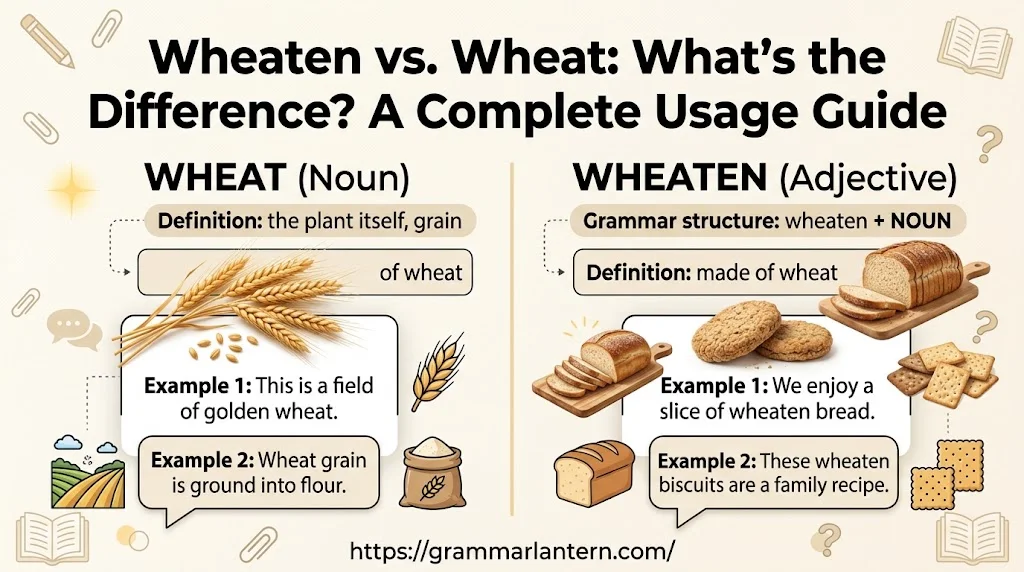
- Wheat is a noun. It refers to the cereal grain or the plant that produces it.
- Wheaten is an adjective. It describes something made from, containing, or relating to wheat.
| Word | Part of Speech | Meaning | Example |
| Wheat | Noun | A cereal grain | Farmers harvested wheat in July. |
| Wheaten | Adjective | Made from or relating to wheat | She baked fresh wheaten bread. |
Quick rule: If you’re naming the grain, use wheat. If you’re describing another noun, wheaten may be appropriate.
At a Glance
| Feature | Wheat | Wheaten |
| Part of speech | Noun | Adjective |
| Refers to | The grain or plant | Something made from wheat |
| Modern US usage | Very common | Rare |
| Modern UK usage | Very common | More common than in the US |
| Example | Wheat grows across the Midwest. | Wheaten biscuits are popular in Ireland. |
What Does “Wheat” Mean?
Wheat is one of the world’s oldest cultivated cereal grains. It belongs to the Triticum genus and serves as a staple food for billions of people.
The word functions almost exclusively as a noun. It can refer to:
- The plant
- The harvested grain
- The crop
- Wheat-based products in general
Origin of the Word
The English word wheat comes from Old English hwǣte, which traces back to Germanic roots meaning white or bright. Historically, it referred to the light-colored grain used to make bread.
Common Uses of “Wheat”
You’ll encounter wheat in many contexts.
Agriculture
Farmers plant wheat during specific growing seasons depending on the climate.
Example:
- Wheat is one of Kansas’s largest agricultural products.
- This year’s wheat crop exceeded expectations.
Read More: Symptomatology vs Symptomology: Which Word Is Correct?
Food Production
Many everyday foods begin with wheat.
Examples include:
- Bread
- Pasta
- Flour
- Breakfast cereal
- Crackers
- Noodles
- Tortillas
Nutrition
Nutrition labels often mention wheat because it contains gluten.
Examples:
- Contains wheat.
- Whole wheat provides dietary fiber.
- Wheat is rich in carbohydrates and several B vitamins.
Trade and Economics
Global wheat production influences food prices around the world.
Examples:
- Wheat exports increased this year.
- International wheat prices rose after poor harvests.
What Does “Wheaten” Mean?
Unlike wheat, wheaten isn’t the name of anything. Instead, it’s an adjective.
It describes something that:
- Is made from wheat
- Contains wheat
- Has characteristics associated with wheat
Common Examples
- Wheaten bread
- Wheaten flour
- Wheaten biscuits
- Wheaten loaf
- Wheaten scones
Notice that wheaten always modifies another noun.
Why It’s an Adjective
Adjectives answer questions like:
- What kind?
- Which type?
- What is it made from?
For example:
- wheaten bread
- wheaten crackers
Here, wheaten tells you what kind of bread or crackers you’re discussing.
The Main Difference
Although the words share the same root, they play different grammatical roles.
| Wheat | Wheaten |
| Names the grain | Describes something made from the grain |
| Noun | Adjective |
| Can stand alone | Usually cannot stand alone |
| Extremely common | Less common |
Consider these examples.
✅ The farmer planted wheat.
✅ She bought wheaten bread.
Now compare them.
❌ The farmer planted wheaten.
❌ She bought wheat (unless referring to the grain itself).
The second sentence only works if you’re literally purchasing wheat kernels.
Wheaten vs. Wheat in Everyday English
Most people encounter these words while shopping, cooking, or reading ingredient lists.
In Cooking
Recipes almost always use wheat flour rather than wheaten flour in American English.
Examples:
- Wheat flour
- Whole wheat flour
- Wheat starch
- Wheat germ
In Baking
Traditional Irish recipes often use wheaten bread.
American recipes usually say:
- Wheat bread
- Whole wheat bread
Both describe bread made primarily from wheat, but regional preference differs.
In Grocery Stores
Look around any supermarket.
You’ll probably find:
- Whole wheat pasta
- Wheat crackers
- Wheat tortillas
You’ll rarely see wheaten on American packaging.
In Farming
Agricultural writing almost always uses wheat because it’s discussing the crop itself.
Examples:
- Winter wheat
- Spring wheat
- Wheat harvest
- Wheat acreage
In Nutrition
Dietitians often discuss wheat when explaining:
- Gluten
- Fiber
- Whole grains
- Food allergies
- Carbohydrates
Can Wheat Be Used as an Adjective?
Interestingly, English often allows nouns to modify other nouns.
This explains why phrases like these sound perfectly natural:
- Wheat bread
- Wheat flour
- Wheat starch
- Wheat bran
- Wheat germ
- Wheat noodles
Here, wheat functions as a noun modifier, sometimes called an attributive noun.
That is why American English often prefers wheat bread instead of wheaten bread.
Why English Prefers the Noun Form
Modern English frequently places nouns before other nouns.
Examples include:
- Chicken soup
- Stone wall
- Cotton shirt
- Apple pie
- Coffee cup
Likewise:
- Wheat bread
This construction sounds shorter and more natural to many speakers.
Is “Wheaten” Common in American English?
Not particularly.
American English strongly favors wheat in everyday conversation.
British English still uses wheaten more often, especially in traditional baking.
Regional Differences
| Region | Preferred Expression |
| United States | Wheat bread |
| Canada | Wheat bread |
| England | Wheat bread (more common) |
| Ireland | Wheaten bread is widely used |
| Northern Ireland | Wheaten bread is especially common |
Why Americans Prefer “Wheat”
American English generally favors shorter noun modifiers.
Compare these:
- Wheat bread ✅
- Wheaten bread ✔ (understood but less common)
Neither is incorrect. One is simply more common depending on where you live.
Common Collocations
Learning common word pairings makes your English sound more natural.
Common Phrases with Wheat
- Wheat flour
- Wheat field
- Wheat grain
- Wheat bran
- Wheat germ
- Whole wheat
- Wheat harvest
- Wheat production
- Wheat crop
- Wheat allergy
Common Phrases with Wheaten
- Wheaten bread
- Wheaten loaf
- Wheaten biscuits
- Wheaten crackers
- Wheaten scones
Examples in Real Sentences
Correct Uses of Wheat
- Wheat prices climbed after the drought.
- Farmers harvested wheat earlier than expected.
- Whole wheat bread contains more fiber than white bread.
- The company exports wheat to several countries.
- Wheat is grown on every inhabited continent except Antarctica.
Correct Uses of Wheaten
- She served homemade wheaten bread with soup.
- The bakery specializes in traditional wheaten loaves.
- We enjoyed fresh wheaten biscuits with tea.
- He prefers dense wheaten bread over white bread.
- The café offers toasted wheaten scones every morning.
Common Mistakes and How to Avoid Them
Many learners mix these words because they look nearly identical.
Mistake: Using Wheaten as a Noun
❌ I bought wheaten.
✅ I bought wheat.
Mistake: Replacing Wheat Everywhere
❌ Wheat biscuits tasted delicious.
This sentence may sound awkward depending on the intended meaning.
Better:
✅ Wheaten biscuits tasted delicious.
Mistake: Assuming They’re Always Interchangeable
They’re related, but they’re not synonyms.
One names the grain.
The other describes products made from it.
Memory Trick
Here’s an easy way to remember the difference.
Wheat ends simply because it’s the thing.
Wheaten ends with -en, which helps it describe something else.
Think about this pair:
- Gold → Golden
- Wood → Wooden
- Wool → Woolen
- Wheat → Wheaten
Although English doesn’t always follow identical patterns, this comparison makes the relationship easier to remember.
Wheat vs. Wheaten in Popular Food Names
| Food | Preferred Name |
| Bread | Wheat bread (US), Wheaten bread (Ireland) |
| Flour | Wheat flour |
| Crackers | Wheaten crackers |
| Biscuits | Wheaten biscuits |
| Pasta | Whole wheat pasta |
| Bran | Wheat bran |
| Germ | Wheat germ |
| Tortillas | Whole wheat tortillas |
Practical Case Study
Imagine two travelers.
One visits a bakery in New York.
The menu reads:
- Whole wheat bread
Another visits a bakery in Belfast.
The menu offers:
- Traditional wheaten bread
Both customers receive bread made primarily from wheat. The difference lies in regional language preferences rather than the ingredients themselves.
This example highlights an important point:
Language often reflects local tradition as much as grammar.
Interesting Facts About Wheat
- Wheat has been cultivated for more than 10,000 years.
- It ranks among the world’s most widely grown cereal crops.
- Thousands of wheat varieties exist worldwide.
- Whole wheat contains the bran, germ, and endosperm.
- Refined white flour removes much of the bran and germ during processing.
- Wheat plays a major role in foods across Europe, Asia, North America, and the Middle East.
Quick Comparison Diagram
Wheat
│
Names the grain
│
┌───────┴────────┐
│ │
Wheat flour Wheat field
│
Used to make
│
Wheaten bread
biscuits
Wheaten loaf
Read More: Forbade or Forbidden? Past Tense of “Forbid” Explained
FAQs
1. Is “wheaten” a correct word?
Yes, wheaten is a correct English word. It generally describes something made from or containing wheat.
2. Is “wheat” a noun?
Yes. Wheat is a noun that refers to a cereal grain commonly used to make flour and various food products.
3. What is the main difference between wheaten and wheat?
Wheat refers to the grain itself, while wheaten usually describes something made from wheat or containing wheat.
4. Can I use “wheaten” to describe bread?
Yes. Wheaten can describe bread or other baked products made with wheat. However, everyday English often uses phrases such as “wheat bread” instead.
5. Is “wheaten bread” grammatically correct?
Yes, wheaten bread is grammatically possible. It describes bread associated with or made from wheat.
6. Does “wheaten” mean the same as “wheat”?
No. Although the two words are closely related, they aren’t interchangeable in every sentence. Wheat names the grain, while wheaten works as a descriptive adjective.
7. Which word should I use for the cereal grain?
Use wheat when you mean the actual cereal grain. For example, “Wheat is grown in many parts of the world.”
8. Which word is more common in everyday English?
Wheat is much more common in everyday English. You will frequently see it in phrases such as wheat flour, wheat bread, and wheat grain.
9. Can wheaten describe something that contains wheat?
Yes. Wheaten can describe something that contains wheat or is made using wheat-based ingredients.
10. How can I remember the difference between wheaten and wheat?
A simple way to remember it is: wheat is the grain, while wheaten describes something related to, made from, or containing wheat.
Conclusion
Understanding wheaten vs. wheat becomes much easier once you focus on what each word describes. Wheat refers directly to the cereal grain, while wheaten is generally used to describe something made from or containing wheat. Although the words look and sound similar, their grammatical roles and meanings aren’t exactly the same.
In everyday English, wheat is the more common choice, particularly when discussing the grain, flour, food, or agricultural products. Wheaten has a more descriptive use and may appear in contexts involving products made from wheat. Knowing this small difference can help you choose the right word and write more clearly.




[…] Read More: Wheaten vs. Wheat: What’s the Difference? A Complete Guide […]