If you’re confused about son and están, you’re facing a common challenge in Spanish grammar because both forms can mean “are” in English. Son vs. Están in Spanish becomes easier when you understand the difference between ser and estar and the contexts where each Spanish verb belongs. Son is the third person plural present tense form of ser, while están is the third-person plural present-tense form of estar.
These verb forms have slightly different meanings. Ser usually describes identity, characteristics, or lasting qualities, while estar commonly describes location, conditions, or temporary states. This grammar rule can help Spanish learners differentiate both forms and make the right verb choice instead of choosing the word that simply sounds right.
Once you explore the forms of ser, forms of estar, and their Spanish verb conjugation, the rule starts to feel natural. The guide is simple: use each form correctly according to the situation. The reasoning becomes clearer when you remember that son and están are forms of the verb “to be” in the Spanish language, but their correct usage, meaning, and contexts are different.
Quick Answer
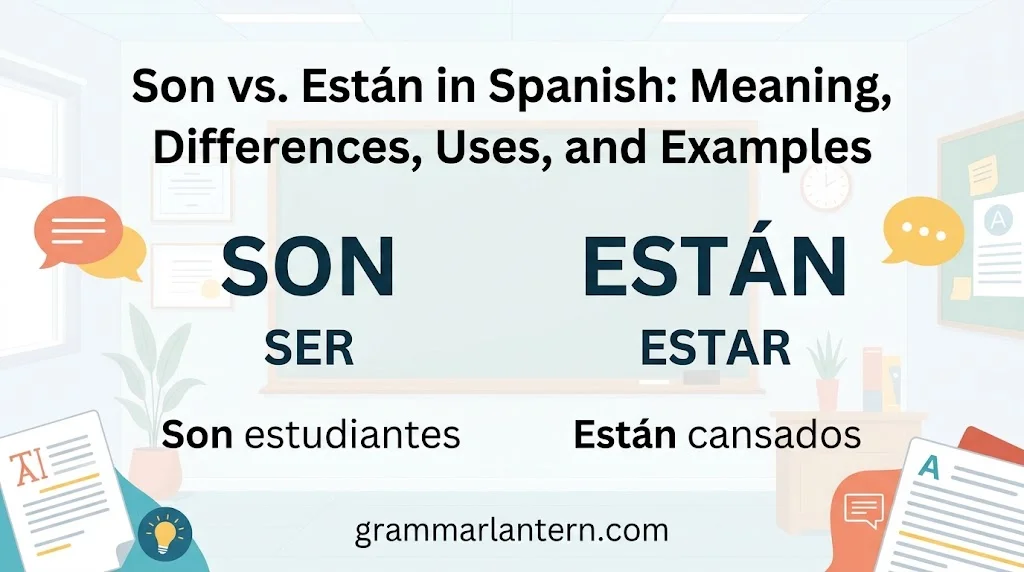
Son is the third-person plural present-tense form of ser. You use it with ellos, ellas, and ustedes for identity, characteristics, origin, occupation, relationships, time, and several other functions.
Están is the third-person plural present-tense form of estar. You use it with ellos, ellas, and ustedes for location, conditions, states, positions, and actions in progress.
| Word | Verb | Pronouns | Main uses | Example |
| son | ser | ellos, ellas, ustedes | Identity, origin, characteristics, occupation, time | Son médicos. |
| están | estar | ellos, ellas, ustedes | Location, condition, position, ongoing action | Están cansados. |
A useful starting point is this:
Son tells you what someone or something is. Están often tells you where or how someone or something is.
That’s a useful shortcut, but it isn’t a complete rule. The sections below explain where it works and where it doesn’t.
What Does “Son” Mean in Spanish?
Son comes from the irregular verb ser, which means “to be.” According to the Royal Spanish Academy’s conjugation reference, son is the present indicative form used with ellos, ellas, and ustedes.
For example:
- Ellos son profesores. — They are teachers.
- Ellas son mis hermanas. — They are my sisters.
- Ustedes son muy amables. — You are very kind.
The word itself doesn’t always translate into exactly the same English phrase. Its meaning depends on the information that follows it.
Son for Identity
Use son when you’re identifying people or things.
- Ellos son mis vecinos. — They are my neighbors.
- Son estudiantes. — They are students.
- Ellas son mis amigas. — They are my friends.
Here, ser connects the subject with its identity or category.
Son for Characteristics
Use son to describe characteristics that define or identify a person, object, or group.
- Los edificios son altos. — The buildings are tall.
- Mis hermanos son inteligentes. — My brothers are intelligent.
- Las calles son estrechas. — The streets are narrow.
This doesn’t mean the characteristic must last forever. A building can be demolished. A person can change. The important point is that you’re presenting the characteristic as a description of what the subject is like.
Son for Origin and Nationality
Spanish normally uses ser to express origin and nationality.
- Ellos son de España. — They are from Spain.
- Ellas son mexicanas. — They are Mexican.
- Mis amigos son de Colombia. — My friends are from Colombia.
Notice the difference between origin and location:
- Son de España. — They are from Spain.
- Están en España. — They are in Spain.
The first sentence tells you where they’re from. The second tells you where they are now.
Son for Occupations and Roles
Use son for professions, jobs, roles, and classifications.
- Ellos son médicos. — They are doctors.
- Ellas son ingenieras. — They are engineers.
- Ustedes son profesores. — You are teachers.
An occupation might change over time, yet Spanish still uses ser. That’s one reason the simple “permanent versus temporary” rule can mislead learners.
Son for Relationships
Use son when describing relationships.
- Ellos son hermanos. — They are brothers.
- Ellas son primas. — They are cousins.
- Son mis padres. — They are my parents.
The verb identifies the relationship rather than describing a temporary condition.
Son for Time
Spanish uses ser to tell the time.
- Son las tres. — It is three o’clock.
- Son las ocho. — It is eight o’clock.
- Son las diez de la mañana. — It is ten in the morning.
This is an especially useful example because time changes constantly. Yet Spanish uses son, not están.
Son for Material, Ownership, and Purpose
Ser also appears in several constructions that beginners may overlook.
For example:
- Los anillos son de oro. — The rings are made of gold.
- Estos libros son de Ana. — These books belong to Ana.
- Las herramientas son para profesionales. — The tools are for professionals.
SpanishDictionary’s entry for ser also lists uses involving characteristics, origin, purpose, and related meanings.
Son for Events
Here’s another important distinction:
- La fiesta es en mi casa. — The party is at my house.
- La reunión es mañana. — The meeting is tomorrow.
Spanish commonly uses ser to identify the time or place of an event.
That’s different from locating a person or object:
- Los invitados están en mi casa. — The guests are at my house.
- Las llaves están en la cocina. — The keys are in the kitchen.
The event itself uses ser. The location of the people or objects uses estar.
Read More: Forgot or Forgotten? Difference Explained with Helpful Examples
What Does “Están” Mean in Spanish?
Están comes from estar. It is the present-tense form used with ellos, ellas, and ustedes. The RAE conjugation table lists están as the third-person plural present form of estar.
Examples include:
- Ellos están aquí. — They are here.
- Ellas están cansadas. — They are tired.
- Ustedes están listos. — You are ready.
The accent matters. Están is the standard spelling. Writing estan without the accent is incorrect in standard Spanish.
Están for Location
One of the clearest uses of estar is location.
- Ellos están en casa. — They are at home.
- Ellas están en Madrid. — They are in Madrid.
- Los libros están sobre la mesa. — The books are on the table.
- Las llaves están en mi bolso. — The keys are in my bag.
The RAE describes estar as a verb used to express states and also gives examples involving being in a particular place or situation.
Compare:
Ellos son de Madrid.
They are from Madrid.
Ellos están en Madrid.
They are in Madrid.
The first sentence expresses origin. The second expresses current location.
Están for Physical Conditions
Use estar for many physical conditions.
- Ellos están enfermos. — They are sick.
- Ellas están cansadas. — They are tired.
- Los niños están dormidos. — The children are asleep.
- Los estudiantes están ocupados. — The students are busy.
The focus is on the condition or state in which the subject currently finds itself.
Están for Emotions
Spanish commonly uses estar with adjectives describing current emotional states.
- Ellos están felices. — They are happy.
- Ellas están tristes. — They are sad.
- Están preocupados. — They are worried.
- Están emocionadas. — They are excited.
These sentences don’t necessarily say anything about someone’s personality. They describe how the person feels.
Están for Position
Estar also describes physical position.
- Ellos están sentados. — They are sitting.
- Ellas están de pie. — They are standing.
- Los niños están acostados. — The children are lying down.
The verb focuses on the subject’s current position or state.
Están for Actions in Progress
One of the most useful structures for Spanish learners is:
estar + gerund
This construction expresses an action in progress.
- Ellos están estudiando. — They are studying.
- Ellas están trabajando. — They are working.
- Están comiendo. — They are eating.
- Están hablando. — They are talking.
So están doesn’t merely mean “they are.” It can also serve as the auxiliary verb in a progressive construction.
Side-by-Side Examples
The easiest way to internalize the difference is to put the two verbs next to each other.
| Spanish sentence | English meaning | Why? |
| Ellos son estudiantes. | They are students. | Identity or role |
| Ellos están cansados. | They are tired. | Current condition |
| Ellas son españolas. | They are Spanish. | Nationality |
| Ellas están en España. | They are in Spain. | Location |
| Son las cinco. | It is five o’clock. | Time |
| Ellos están trabajando. | They are working. | Action in progress |
| Las casas son grandes. | The houses are large. | Characteristic |
| Las puertas están abiertas. | The doors are open. | Current state |
The English translation doesn’t always reveal the distinction. That’s the trap.
When you see “are” in English, don’t immediately reach for son. First ask what the sentence actually expresses.
Son vs. Están Conjugation: Ser and Estar
Learning the complete present-tense forms helps put son and están into context.
| Pronoun | Ser | Estar |
| yo | soy | estoy |
| tú | eres | estás |
| él / ella / usted | es | está |
| nosotros / nosotras | somos | estamos |
| vosotros / vosotras | sois | estáis |
| ellos / ellas / ustedes | son | están |
The RAE’s official conjugation reference confirms these present-tense forms for both verbs.
Two details are worth remembering:
- Son belongs to ser.
- Están belongs to estar.
Also, ustedes uses the same verb form as ellos and ellas:
- Ustedes son estudiantes.
- Ustedes están aquí.
In much of Latin America, ustedes is the normal plural form of “you.” In Spain, vosotros/vosotras is commonly used in informal situations.
Why “Permanent vs. Temporary” Isn’t Enough
The permanent versus temporary rule isn’t useless. It’s simply incomplete.
It can give beginners a rough starting point:
- Ser often describes identity or defining characteristics.
- Estar often describes a state, condition, or location.
However, real Spanish doesn’t fit neatly into two boxes.
Consider these examples.
“Madrid Está en España”
Madrid está en España.
Madrid’s location isn’t temporary. Yet Spanish uses estar because the sentence expresses location.
“Son las Tres”
Son las tres.
Three o’clock lasts only a moment. Still, Spanish uses ser because Spanish tells time with ser.
“Soy Estudiante”
Soy estudiante.
A student can graduate and stop being a student. Nevertheless, the occupation or role uses ser.
“Están Muertos”
Están muertos.
Death is permanent. Spanish still uses estar here because the expression presents a state or resulting condition.
These examples show why memorizing a single slogan can eventually lead you into a grammatical dead end.
The better approach is to learn the function of the verb.
Adjectives: Meaning Can Change
Some adjectives become especially interesting when you switch between ser and estar.
The adjective stays the same. The meaning changes.
Aburrido
- Él es aburrido. — He is boring.
- Él está aburrido. — He is bored.
This is one of the classic examples.
Es aburrido describes the person’s character or effect on others.
Está aburrido describes his current emotional state.
Listo
- Ella es lista. — She is smart.
- Ella está lista. — She is ready.
One little verb changes the meaning dramatically.
Verde
- La hierba es verde. — The grass is green.
- El plátano está verde. — The banana is unripe.
In the second sentence, estar verde can describe a fruit that hasn’t ripened yet.
Bueno
Context can also change the interpretation of bueno.
- Él es bueno. — He is good/kind.
- La comida está buena. — The food tastes good/is good.
The distinction isn’t simply about whether something lasts forever. The verb helps frame what the speaker means.
Seguro
- Él es seguro. — He is confident or secure, depending on context.
- El edificio está seguro. — The building is safe.
With adjectives like these, context matters enormously. Rather than translating word-for-word, pay attention to the combination of verb + adjective.
Everyday Examples
Seeing these verbs in ordinary situations makes the distinction much easier to remember.
1. Talking About People
- Son mis amigos. — They are my friends.
- Están en el parque. — They are in the park.
- Son muy amables. — They are very kind.
- Están cansados. — They are tired.
2. Talking About Objects
- Los teléfonos son nuevos. — The phones are new.
- Los teléfonos están en la caja. — The phones are in the box.
- Las ventanas son grandes. — The windows are large.
- Las ventanas están cerradas. — The windows are closed.
3. Talking About Places
- Son restaurantes mexicanos. — They are Mexican restaurants.
- Están cerca del hotel. — They are near the hotel.
4. Talking About Events
- Las reuniones son los lunes. — The meetings are on Mondays.
- La reunión es en la oficina. — The meeting is at the office.
The pattern becomes clearer when you stop translating “are” and start identifying the purpose of the Spanish verb.
Common Mistakes
English speakers often make the same mistakes because English doesn’t force them to distinguish between ser and estar.
Mistake 1: Translating Every “Are” as Son
❌ Ellos son en casa.
✅ Ellos están en casa.
Why? The sentence describes location.
Mistake 2: Using Están for Occupations
❌ Ellos están médicos.
✅ Ellos son médicos.
The sentence identifies their profession.
Mistake 3: Using Están for Nationality
❌ Ellas están mexicanas.
✅ Ellas son mexicanas.
Nationality and origin normally use ser.
Mistake 4: Thinking Temporary Always Means Estar
❌ Están las tres.
✅ Son las tres.
Time uses ser.
Mistake 5: Thinking Permanent Always Means Ser
❌ Son muertos.
In the ordinary meaning of “they are dead,” standard Spanish uses:
✅ Están muertos.
The sentence presents death as a state or resulting condition.
Mistake 6: Forgetting the Accent
❌ estan
✅ están
The accent belongs on the final syllable because están is stressed on the final syllable.
How to Choose
When you’re unsure, don’t guess based solely on the English word “are.” Walk through this quick process.
Step 1: Identify the subject.
If the subject is ellos, ellas, or ustedes, both son and están are grammatically possible forms.
Step 2: Ask what you’re expressing.
Use son for things such as:
- Identity
- Classification
- Origin
- Nationality
- Occupation
- Relationships
- Characteristics
- Time
- Material
- Ownership
- Purpose
- Certain event descriptions
Use están for things such as:
- Location
- Physical condition
- Emotional state
- Position
- Current condition
- Resulting state
- Actions in progress
Step 3: Check whether the verb changes the meaning.
Consider:
- Son aburridos. — They are boring.
- Están aburridos. — They are bored.
If the meaning changes, don’t rely on a simple translation.
Step 4: Forget the permanent/temporary shortcut when it stops working.
Instead, ask:
Am I identifying or describing what something is, or am I describing where, how, or in what state it is?
That question will usually lead you in the right direction.
Son vs. Están vs. Hay: Three Words English Learners Often Mix Up
There’s another Spanish word worth adding to the picture: hay.
English uses “there are”, while Spanish uses hay.
Compare:
- Son estudiantes. — They are students.
- Están en la escuela. — They are at school.
- Hay estudiantes en la escuela. — There are students at the school.
These sentences describe three different ideas:
| Spanish | Meaning | Function |
| son | are | Identity or classification |
| están | are | Location or state |
| hay | there are | Existence or presence |
For example:
Los libros son nuevos.
The books are new.
Los libros están sobre la mesa.
The books are on the table.
Hay libros sobre la mesa.
There are books on the table.
That distinction is extremely useful in everyday Spanish.
A Practical Case Study: One Group, Three Different Ideas
Imagine three friends arrive at a café.
You want to describe who they are:
Son estudiantes.
They are students.
Now you want to say where they are:
Están en el café.
They are at the café.
Finally, you want to mention that other people are present:
Hay otros clientes en el café.
There are other customers at the café.
Nothing mysterious is happening. Each verb answers a different question.
| Question | Spanish answer | Verb |
| What are they? | Son estudiantes. | ser |
| Where are they? | Están en el café. | estar |
| Who is present? | Hay otros clientes. | haber |
This is a much stronger mental model than memorizing “permanent versus temporary.”
Quick Reference Chart
Keep this table handy when you’re writing or speaking Spanish.
| Meaning | Use | Example |
| They are teachers | son | Son profesores. |
| They are from Spain | son | Son de España. |
| They are Spanish | son | Son españoles. |
| They are friendly | son | Son amables. |
| It is three o’clock | son | Son las tres. |
| They are brothers | son | Son hermanos. |
| They are at home | están | Están en casa. |
| They are tired | están | Están cansados. |
| They are happy | están | Están felices. |
| They are sitting | están | Están sentados. |
| They are studying | están | Están estudiando. |
| They are on the table | están | Están sobre la mesa. |
Practice Quiz
Fill in each blank with son or están.
- Mis hermanos ___ estudiantes.
- Los niños ___ en el jardín.
- Ellas ___ muy inteligentes.
- ___ las seis de la tarde.
- Mis padres ___ cansados.
- Los libros ___ sobre la mesa.
- Ellos ___ de Argentina.
- Los estudiantes ___ estudiando.
- Mis amigos ___ médicos.
- Las ventanas ___ abiertas.
- Ellas ___ mis primas.
- Los invitados ___ en la sala.
Answer Key
- son — Mis hermanos son estudiantes.
This identifies their role. - están — Los niños están en el jardín.
This expresses location. - son — Ellas son muy inteligentes.
This describes a characteristic. - son — Son las seis de la tarde.
Spanish uses ser for time. - están — Mis padres están cansados.
This describes their current condition. - están — Los libros están sobre la mesa.
This gives their location. - son — Ellos son de Argentina.
This expresses origin. - están — Los estudiantes están estudiando.
Estar + gerund expresses an action in progress. - son — Mis amigos son médicos.
This identifies their profession. - están — Las ventanas están abiertas.
This describes their current state. - son — Ellas son mis primas.
This identifies a family relationship. - están — Los invitados están en la sala.
This expresses location.
Read More: Jess’ or Jess’s? Here’s the Possessive Form and Helpful Examples
FAQs
1. What is the main difference between son and están?
Son comes from ser, while están comes from estar. Both can translate as “are,” but they describe different ideas. Son usually refers to identity or characteristics, while están often describes location, conditions, or temporary states.
2. When should I use son in Spanish?
Use son when talking about identity, professions, characteristics, nationality, or other qualities that define someone or something. For example, “Ellos son profesores” means “They are teachers.”
3. When should I use están?
Use están when describing where people or things are or how they are at a particular moment. For example, “Ellos están en casa” means “They are at home.”
4. Are son and están both forms of “to be”?
Yes. They are forms of two Spanish verbs that can translate as “to be.” Son is a form of ser, and están is a form of estar.
5. Why do Spanish learners confuse son and están?
The confusion happens because English uses one verb, “are,” for both situations. Spanish makes a distinction between ser and estar, so you need to consider the context before choosing the correct form.
6. Can están describe a temporary condition?
Yes. Están commonly describes temporary conditions or situations. For example, “Ellos están cansados” means “They are tired.”
7. Can son describe characteristics?
Yes. Son can describe characteristics or qualities. For example, “Ellos son amables” means “They are kind.”
8. Is son the third-person plural form of ser?
Yes. Son is the present-tense, third-person plural form of ser. It is used with ellos, ellas, and ustedes.
9. Is están the third-person plural form of estar?
Yes. Están is the present-tense, third-person plural form of estar. It is also used with ellos, ellas, and ustedes.
10. What is the easiest way to remember son vs. están?
Think about what you want to describe. If you’re talking about what someone or something is, son is often the right choice. If you’re talking about where or how someone or something is, están is usually more appropriate.
Conclusion
Learning son vs. están becomes much easier once you stop treating both words as simple translations of “are.” Son comes from ser and commonly expresses identity, characteristics, or defining qualities. Están comes from estar and often expresses location, conditions, or temporary situations. The context gives you the clue you need.
With regular practice, these two forms will start to feel more natural. Pay attention to what the sentence is actually describing, then choose ser or estar accordingly. A few simple examples and repeated practice can turn this common Spanish grammar challenge into a much easier rule to remember.

Muhammad Haroon is the voice behind many of the clear, practical grammar guides you’ll find on Grammar Lantern. With a strong background in content writing and a genuine love for the English language, Haroon specializes in breaking down intimidating grammar topics into simple, digestible lessons. His goal is simple: to empower readers to write with confidence and clarity. Whether he’s explaining tricky tenses or demystifying punctuation, Haroon approaches each topic with patience, precision, and a touch of warmth—because he knows that learning grammar is a journey, not a race.



[…] Read More: Son vs. Están in Spanish: Meaning, Differences, and Examples […]
[…] Read More: Son vs. Están in Spanish: Meaning, Differences, and Examples […]