Really vs. Realy is a common spelling mistake when you type quickly, especially if you confuse the missing l in realy with correct really in writing. English learners, ESL learners, native speakers, and fast typists are occasionally likely to misspell common words because of fast typing and unpredictable English spelling rules. This single-letter confusion makes realy and really look similar, so you may wonder which form is correct.
The good news is that the answer is completely clear-cut: really has the correct spelling for standard English writing, while realy is an error. This mistake can appear in emails, essays, and professional writing, where even a small mistake may affect clarity and credibility. A useful guide is to learn the pattern and remember that really needs the extra l.
The grammar rules are simple, and remembering this spelling detail can help you avoid the common spelling mistake in the future. If you’ve paused and wondered, “which is correct realy or really?” or thought realy looks right, choose really. The word means truly or very, and you should pronounce it correctly while practicing pronunciation. Real-world examples and regular writing practice can make the correct form easier to remember.
Once you know why the mistake happens and keeps happening, these practical tips can help you eliminate the confusion and never mix them up again. Even if this issue appears every single day, the pattern is easy to remember.
Quick Answer
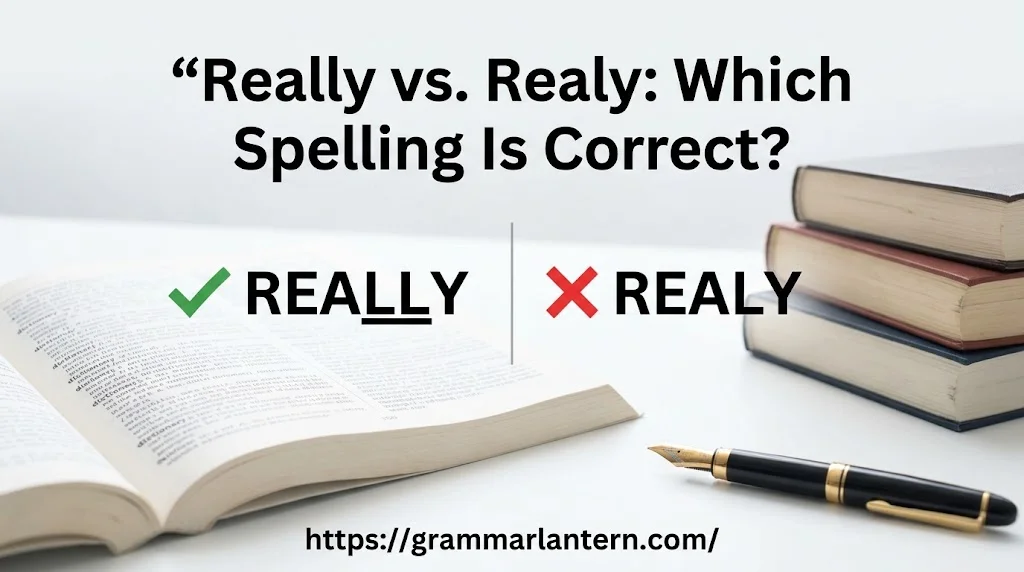
Really is the correct spelling.
Realy is an incorrect spelling and should not be used in standard English.
| Spelling | Correct? | Meaning |
| Really | ✅ Yes | Truly, actually, or very/very much, depending on context |
| Realy | ❌ No | Misspelling of really |
The easiest way to remember it is to look at the base word:
real + ly = really
The word real already ends in l. When -ly is added, the result is really, with two consecutive Ls.
Correct: I really enjoyed the movie.
Incorrect: I realy enjoyed the movie.
Why Is “Really” the Correct Spelling?
The spelling becomes clearer when you look at the word’s structure.
Really is formed from the adjective real and the suffix -ly. The suffix changes the adjective into an adverb.
- real → adjective
- really → adverb
For example:
- “That is a real problem.”
- “That problem really matters.”
In the first sentence, real describes the noun problem. In the second, really modifies the verb matters by adding emphasis.
The important spelling point is that real ends with an L. Adding -ly gives us:
real + ly → really
It does not become realy.
This is why realy isn’t an alternative spelling or a less common version of the word. It’s simply a spelling mistake.
The Double-L Pattern
A useful visual trick is to focus on the middle of the word:
RE A L L Y
The two Ls sit together before the final Y.
If you’re writing quickly, don’t rely only on pronunciation. Instead, connect the spelling to the base word:
REAL → REALLY
That connection gives you a much stronger memory cue than simply trying to memorize six letters.
What Does “Really” Mean?
Although the spelling question is simple, really has several important uses. Its meaning changes slightly according to the sentence and the speaker’s intention.
Major dictionaries describe really as an adverb that can express truth, emphasis, certainty, surprise, interest, or a softer form of disagreement. It can also work as a short conversational response.
Really Means “Truly” or “Actually”
One of the most important uses of really is to indicate what is true or what actually happened.
Consider:
“What really happened?”
Here, really asks about the actual facts rather than an assumption, rumor, or appearance.
Other examples include:
- “I want to know what really happened.”
- “She wasn’t really angry.”
- “Do you really believe that?”
- “That’s what he really wanted.”
- “They don’t really know the answer.”
In these sentences, really is closely related to words such as actually, truly, or in fact.
However, the exact replacement depends on context. English speakers don’t treat these words as perfectly interchangeable.
Really Means “Very” or “Very Much”
Another extremely common use is to intensify an adjective or adverb.
For example:
“The food was really good.”
Here, really means something like very.
You can also say:
- “It’s really cold outside.”
- “She is really talented.”
- “That was a really difficult exam.”
- “He runs really fast.”
- “The apartment is really small.”
Cambridge Dictionary specifically identifies this use of really as meaning very or very much, while Oxford lists its use for emphasizing adjectives and adverbs.
Really Can Emphasize a Verb
The word doesn’t only modify adjectives.
It can also emphasize an action or opinion:
“I really enjoyed the concert.”
Here, really emphasizes enjoyed.
Compare:
- “I enjoyed the concert.”
- “I really enjoyed the concert.”
The second sentence expresses stronger personal feeling.
More examples:
- “I really like this book.”
- “She really wants the job.”
- “We really need to leave.”
- “He really understands the problem.”
- “They really appreciate your help.”
The word adds force without changing the basic meaning of the sentence.
Read More: Shaky vs Shakey: Which Spelling Is Correct?
How to Use “Really” in a Sentence
Because really can perform several jobs, its position can change depending on what you want to emphasize.
Really Before an Adjective
This is one of the most familiar patterns.
Structure:
really + adjective
Examples:
- “The movie was really interesting.”
- “This coffee is really strong.”
- “She is really kind.”
- “That sounds really difficult.”
Here, really increases the intensity of the adjective.
Really Before an Adverb
You can also place really before another adverb.
Structure:
really + adverb
Examples:
- “She speaks really clearly.”
- “He drives really carefully.”
- “The team performed really well.”
- “They moved really quickly.”
In each case, really strengthens the adverb that follows it.
Really Before a Verb
The position changes when really emphasizes a verb.
Examples:
- “I really like this restaurant.”
- “She really wants to succeed.”
- “We really need your help.”
- “He really enjoyed the trip.”
Notice that really normally appears before the main verb in these examples.
Really in Questions
Questions often use really to express doubt, surprise, or a request for confirmation.
For example:
“Do you really mean that?”
The speaker isn’t simply asking whether the person said something. The speaker wants to know whether the statement is genuinely meant.
Other examples include:
- “Are you really leaving tomorrow?”
- “Did he really say that?”
- “Do you really think that’s a good idea?”
- “Is that really necessary?”
The emotional tone can range from neutral curiosity to disbelief.
“Really?” as a Standalone Expression
One of the most interesting features of really is that it can appear by itself in conversation.
Imagine this exchange:
“I’m moving to New York next month.”
“Really?”
The second speaker isn’t using really to modify a verb or adjective. Instead, Really? signals interest, surprise, or a request for confirmation.
Cambridge and Oxford both recognize this conversational use. Depending on context and intonation, really? can communicate curiosity, disbelief, surprise, or even annoyance.
Compare:
- “Really?” — genuine interest
- “Really?” — surprise
- “Really?” — skepticism
- “Really.” — possible annoyance or disapproval
The written word stays the same. Tone does much of the work.
Really in Negative Sentences
Here’s where really gets especially interesting.
In negative sentences, it can sometimes soften what you’re saying.
For example:
“I don’t really agree.”
This sounds less blunt than:
“I don’t agree.”
The first sentence can suggest polite disagreement or partial disagreement. The second sounds more direct.
Consider these examples:
- “I don’t really understand.”
- “It doesn’t really matter.”
- “I don’t really know.”
- “I’m not really interested.”
- “We don’t really need it.”
This doesn’t mean really always weakens a negative sentence. Its position matters.
Compare:
“I don’t really know.”
with:
“I really don’t know.”
The first can suggest uncertainty or limited knowledge. The second strongly emphasizes the speaker’s lack of knowledge.
That small difference shows why word placement matters.
Common Examples
The easiest way to spot the error is to compare the two spellings directly.
| Incorrect | Correct |
| I realy like this song. | I really like this song. |
| She is realy talented. | She is really talented. |
| Are you realy serious? | Are you really serious? |
| I realy appreciate your help. | I really appreciate your help. |
| Did you realy say that? | Did you really say that? |
| This is realy important. | This is really important. |
| He realy enjoyed the trip. | He really enjoyed the trip. |
| The test was realy difficult. | The test was really difficult. |
The correction is always the same: replace realy with really.
Why Do People Spell “Really” as “Realy”?
The mistake is understandable because realy looks visually plausible.
When someone writes quickly, the two Ls in really can be easy to overlook. The pronunciation also doesn’t force the writer to consciously notice both letters.
Typing makes this even easier to do. A person may know perfectly well that really is spelled with two Ls yet accidentally leave one out.
This is a classic example of a typographical spelling error, not a meaningful grammatical variation.
The mistake can also happen because English spelling doesn’t always map neatly onto pronunciation. Written English contains many words whose letters aren’t pronounced exactly as they appear.
That’s why a useful spelling strategy is to remember the word’s structure instead of relying entirely on its sound.
Real + ly = really.
Once that pattern becomes familiar, realy starts to look obviously incomplete.
A Simple Memory Trick
Here’s the most practical way to remember the spelling:
Remember “REAL” Before “LY”
Start with:
REAL
Then add:
LY
The result is:
REALLY
You can also memorize the visual pattern:
REA + LLY
The key is the LL.
Another quick test works well when proofreading:
Does the word contain the complete base REAL?
If the answer is no, check the spelling.
Compare:
- ❌ RE A L Y
- ✅ RE A L L Y
That second L is small but essential.
Is “Realy” Ever Correct?
For standard English, no.
If you’re trying to express meanings such as truly, actually, very, or very much, the standard spelling is really.
For example:
“I really want to go.”
Not:
“I realy want to go.”
Likewise:
“That was really impressive.”
Not:
“That was realy impressive.”
A username, brand name, fictional character, or deliberately stylized name could theoretically contain realy. Such a special use wouldn’t make realy the standard spelling of the English adverb.
In ordinary writing, use really.
Is “Really” Formal or Informal?
Really works in both everyday and professional English.
You can use it naturally in conversation:
“I really enjoyed the show.”
You can also use it in an email:
“I really appreciate your assistance.”
It can appear in professional communication, articles, reports, and other forms of writing when its meaning fits the context.
However, correct doesn’t always mean best stylistic choice.
In formal or academic writing, repeated use of really can sometimes make writing less precise.
For example:
“The results were really important.”
Depending on the context, a more precise description might be:
“The results were statistically significant.”
The second sentence communicates specific information instead of relying on a general intensifier.
So don’t avoid really simply because it can sound conversational. Use it when it expresses exactly what you mean.
Really vs. Very: Are They the Same?
Really and very overlap, but they aren’t identical.
Compare:
- “The room is very cold.”
- “The room is really cold.”
Both sentences intensify cold. In ordinary conversation, either can work.
But really has uses that very doesn’t share.
You can say:
“What really happened?”
You can’t naturally replace really with very:
“What very happened?” ❌
Likewise:
“Do you really mean it?”
The word really communicates whether something is genuine or true.
Very doesn’t perform that function.
A useful distinction is:
| Word | Common role | Example |
| Really | Truth, emphasis, intensity, surprise | “Did you really see it?” |
| Very | Intensity | “It was very cold.” |
| Actually | Fact or correction | “I actually saw it.” |
| Truly | Sincerity or truth | “I truly appreciate it.” |
These words can overlap in some sentences, but their meanings aren’t interchangeable in every situation.
Really vs. Actually vs. Truly
The three words can sometimes express similar ideas, yet each carries its own flavor.
Really
Really is broad and extremely common.
“I really enjoyed the event.”
It can express strong feeling, emphasis, or sincerity.
Actually
Actually often highlights a fact that differs from an assumption or expectation.
“I actually finished the project yesterday.”
The speaker may be correcting someone’s assumption.
Truly
Truly often emphasizes sincerity, authenticity, or genuine feeling.
“I truly appreciate your kindness.”
It can sound slightly more deliberate or emphatic than really.
Understanding these differences helps you choose the word that fits your intended meaning rather than simply swapping synonyms.
Pronunciation of “Really”
The pronunciation of really varies somewhat across English accents.
Cambridge gives pronunciations including approximately /ˈriː.ə.li/ in American English and /ˈrɪə.li/ in British English. Oxford also lists more than one pronunciation.
In everyday speech, the word can sound compressed. That variation can make the spelling less obvious to learners.
Still, pronunciation doesn’t change the written form.
Whether the word sounds closer to ree-uh-lee or a shorter conversational version, the standard spelling remains:
really
The spelling contains two Ls.
Common Mistakes to Avoid
The main error is obvious once you know what to look for.
Mistake: Writing “Realy”
❌ “I realy like this idea.”
Correction: Write “Really”
✅ “I really like this idea.”
Mistake: Removing an L While Typing
Because really is a common word, writers sometimes type it quickly and accidentally omit a letter.
Proofreading tip: Search your document for realy before submitting it.
This is particularly useful for:
- school assignments
- resumes
- cover letters
- professional emails
- website content
- blog posts
- reports
- social media captions
A quick search can catch the error in seconds.
Mini Case Study: How One Letter Changes a Polished Sentence
Imagine that a student writes this sentence in an assignment:
“The documentary was realy informative.”
The meaning remains understandable. Most readers will know exactly what the writer intended.
However, the spelling is still incorrect.
The polished version is:
“The documentary was really informative.”
Now the sentence follows standard English spelling conventions.
This distinction matters because understandable and correct aren’t always the same thing. A reader may understand a typo without accepting it as standard usage.
The same principle applies to professional writing. A single spelling error probably won’t destroy an otherwise excellent document. Repeated errors, however, can make the writing look rushed or poorly edited.
Read More: Litigious vs. Litiginous: Correct Spelling, Meaning, and Differences
FAQs
1. Is “realy” a correct English word?
No. Realy is a misspelling. The correct spelling is really, with two l’s before the final y.
2. Which is correct: “really” or “realy”?
Really is correct in standard English. Realy is an incorrect spelling that usually happens because someone types too quickly.
3. Why do people spell “really” as “realy”?
The mistake often happens because really contains repeated letters. When typing quickly, people may accidentally leave out one l.
4. Is “realy” acceptable in professional writing?
No. You should use really in emails, essays, reports, applications, and other forms of professional writing.
5. How do you remember the spelling of “really”?
A simple trick is to remember that really has two l’s: real + ly = really. Checking for the two l’s can help you avoid the mistake.
6. What does “really” mean?
Really can mean “truly,” “actually,” or “very,” depending on the sentence. For example, “She is really happy” means she is very happy.
7. How do you pronounce “really”?
Really is commonly pronounced /ˈriːəli/ or /ˈrɪəli/, depending on the speaker and accent. The pronunciation can vary slightly in everyday speech.
8. Is “realy” a typo or a spelling mistake?
Realy is generally a spelling mistake or typo caused by accidentally leaving out one l from really.
9. Can native English speakers make this mistake?
Yes. Native speakers can also type realy, especially when writing quickly. It’s a common typing error rather than a sign that someone doesn’t understand English.
10. How can I stop writing “realy”?
Practice writing really, slow down when proofreading, and remember the two l’s. A quick spelling check can also catch the error before you submit your writing.
Conclusion
The difference between really and realy comes down to one small but important letter. Really is the correct spelling, while realy is a common misspelling that often happens during fast typing. Once you remember that really contains two l’s, the difference becomes much easier to spot.
Whether you’re writing an email, completing an essay, or creating professional content, taking a moment to check the spelling can improve clarity and credibility. Keep the correct form in mind, practice it regularly, and you’ll be much less likely to make the same mistake again.