Many people accidentally type tittle when writing quickly because the two words look very similar, but Title vs. Tittle shows that they are not the same word and have completely different meanings. In English grammar and vocabulary, title is the common English word for the name of a book, article, movie, lesson, piece of work, book name, article name, or school assignment. It can also mean a job position, person’s rank, or heading.
Title is a real word used far more often in everyday English, while tittle creates common confusion because of its similar spelling, pronunciation, and sound. In my experience with writing and editing, this is a frequent issue among English language learners, students, writers, and editors, especially when English spelling leads to spelling mistakes. The single extra letter can make the word look wrong, so checking the difference, meaning, word meaning, usage rules, and real contexts helps you choose correctly.
Tittle is also a real word, but it has an uncommon meaning and a specific meaning in linguistics and typography. It means a small mark or dot, especially the mark over a lowercase i or j. This distinction explains why the terms have different uses despite their visual overlap. Understanding these differences can improve grammar accuracy, writing clarity, vocabulary skills, and reading comprehension, while also strengthening your understanding of English language structure and language structure.
Title and tittle may sound similar in normal speech, but their parts of speech, origins, and practical roles differ. American English, British English, and British usage can also provide useful context when studying pronunciation and usage. When referring to a name, heading, or piece of work, title is the correct word. Practical examples make the distinction easier to remember and help prevent common English mistakes involving punctuation marks, punctuation usage, and everyday English grammar.
Quick Answer
Title and tittle are both real English words, but they have different meanings.
| Word | Meaning | Common example |
| Title | The name of a book, movie, article, song, artwork, or similar work | What is the title of the novel? |
| Title | A rank, position, designation, or honorific | Her title is Professor. |
| Title | A championship | The team won the league title. |
| Title | A legal right or evidence of ownership | The buyer received the property title. |
| Tittle | A small mark in writing or printing | The tittle over the i was missing. |
| Tittle | A very small amount or part | There wasn’t a tittle of evidence. |
The easiest way to remember the difference is:
A title names or identifies something. A tittle is tiny.
What Does “Title” Mean?
Title has several established meanings, which explains why you’ll see it in many different contexts.
At its most familiar, a title is the name given to a written, filmed, musical, or artistic work.
Title as the Name of a Book, Movie, or Article
When you ask someone, “What’s the title?” you’re usually asking for the name of something.
For example:
- The title of the book is Pride and Prejudice.
- I can’t remember the title of that movie.
- She changed the title of her article before publishing it.
- The song’s title appears on the album cover.
- What’s the title of your research paper?
In these sentences, tittle would be incorrect.
You wouldn’t write:
What is the tittle of your book?
The correct version is:
What is the title of your book?
This is the most important distinction for everyday writing.
Title as a Heading
Title can also refer to a heading or identifying label.
For instance:
- The title of Chapter 3 is “The Turning Point.”
- The report has a clear title.
- The title appears at the top of the document.
However, title and heading aren’t always interchangeable. A title often identifies the overall work or a major division, while a heading commonly labels a particular section within a document.
Title as a Rank or Designation
The word title also describes a person’s official position, rank, honor, or designation.
Examples include:
- Her job title is marketing director.
- His official title is Chief Executive Officer.
- Dr. Patel used her professional title on the document.
- The king’s title reflected his position and authority.
This meaning appears frequently in workplaces, government, academia, sports, and formal social settings.
Title as a Championship
Sports provide another familiar use.
A title can mean a championship or the status associated with winning one.
For example:
- The team defended its league title.
- She won the world title.
- The boxer lost his heavyweight title.
- They are competing for the national title.
Here again, tittle doesn’t work.
The difference is especially easy to see in a phrase such as title match. A title match is a contest involving a championship.
Title in Law and Property
In legal contexts, title can refer to a person’s right to own or possess property.
For example:
- The company holds title to the land.
- The buyer received the property title.
- The attorney reviewed the title documents.
- The seller must provide clear title.
This is a specialized meaning, but it’s an important one.
What Does “Tittle” Mean?
Now we get to the unusual word.
Tittle is a legitimate English word. It’s not simply a typo for title.
Today, tittle has two main meanings.
Tittle as a Small Mark in Writing
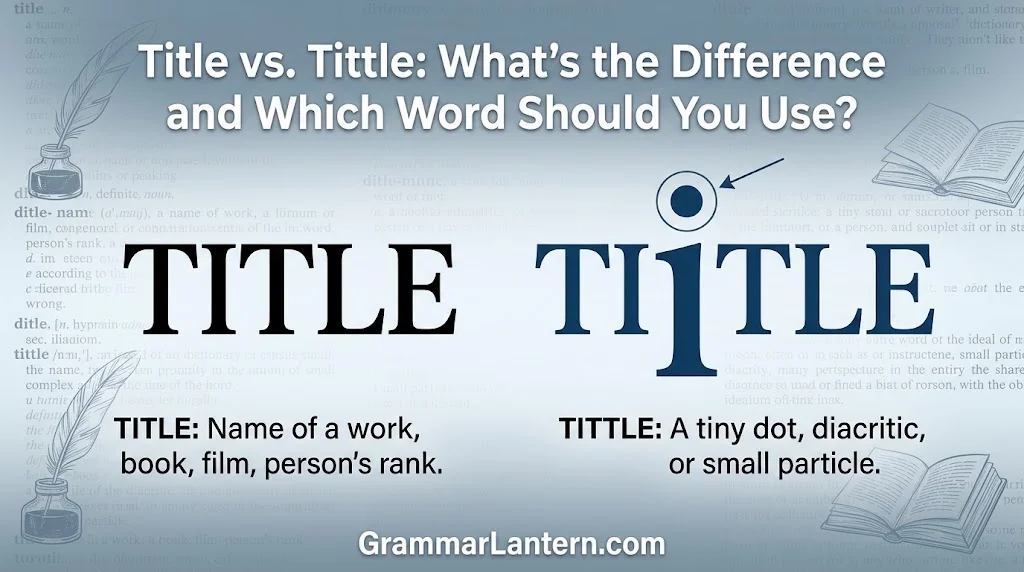
A tittle is a small mark used in writing or printing.
The most familiar example is the dot above a lowercase i or j.
Look closely:
i
The small dot above the letter is a tittle.
The same applies to:
j
The dot above the lowercase j can also be called a tittle.
The word can therefore appear in discussions about:
- Typography
- Handwriting
- Printing
- Diacritical marks
- Letterforms
- Calligraphy
- Linguistics
For example:
The tittle above the lowercase i was unusually large.
That’s a perfectly legitimate use of tittle.
Still, there’s an important practical point: most people simply call it a dot. “Tittle” is a more specialized term.
Read More: Icicle vs. Icycle: Which Spelling Is Correct? Explained
Tittle as a Very Small Amount
Tittle has another meaning: a very small amount, part, or quantity.
For example:
There wasn’t a tittle of evidence to support the accusation.
This meaning is considerably less common in modern everyday American English.
You might encounter this usage in formal, literary, historical, or deliberately old-fashioned writing.
Common alternatives include:
- bit
- speck
- particle
- trace
- scrap
- small amount
- tiny fraction
So while tittle is correct, “There wasn’t a shred of evidence” will usually sound more natural in contemporary writing.
The Key Differences
The easiest way to understand the distinction is to compare the words by meaning, pronunciation, and usage.
| Feature | Title | Tittle |
| Main meaning | Name, designation, heading, championship, or legal ownership | Small mark or tiny amount |
| Commonness | Very common | Uncommon |
| Book or movie name | Yes | No |
| Job designation | Yes | No |
| Sports championship | Yes | No |
| Legal ownership | Yes | No |
| Dot over i or j | No | Yes |
| Very small amount | No | Yes |
| Everyday writing | Very common | Rare |
| Pronunciation | /ˈtaɪ.t̬əl/ in US English | /ˈtɪt̬.əl/ in US English |
The pronunciation difference matters, too. Title begins with the long i sound heard in time, while tittle begins with the short i sound heard in sit.
Examples
Seeing the words in real sentences makes the difference much easier to remember.
Correct Examples With “Title”
- What is the title of this book?
- The movie has an unusual title.
- She gave her article a short, descriptive title.
- His official job title is senior editor.
- The team won the league title last season.
- The lawyer examined the property’s title.
- The chapter title appears above the opening paragraph.
Correct Examples With “Tittle”
- The tittle above the lowercase i is barely visible.
- The printer reproduced every tittle accurately.
- The font designer adjusted the shape of the tittle.
- There wasn’t a tittle of evidence against him.
- She examined every jot and tittle of the document.
Incorrect vs. Correct Examples
| Incorrect | Correct | Explanation |
| What is the tittle of the book? | What is the title of the book? | A book has a title, not a tittle. |
| The movie has an interesting tittle. | The movie has an interesting title. | Title means the name of a movie. |
| She won the championship tittle. | She won the championship title. | A championship is a title. |
| The title above the i is missing. | The tittle above the i is missing. | A small mark can be a tittle. |
| There wasn’t a title of evidence. | There wasn’t a tittle of evidence. | Tittle can mean a tiny amount. |
Is “Tittle” a Misspelling of “Title”?
Not necessarily.
That’s one of the most important points in the title vs. tittle debate.
If someone writes tittle when they mean the name of a book, they’ve made a spelling mistake. However, tittle itself isn’t a spelling mistake. It has a dictionary definition and a long history in English.
Consider these two sentences:
What is the title of the article?
Here, title is correct.
The tittle above the i is clearly visible.
Here, tittle is correct.
The spelling changes because the meaning changes.
It’s similar to other pairs of words that look alike but serve completely different purposes. The surrounding context tells you which word belongs.
Why Do People Confuse?
The confusion is understandable.
First, the words differ by only one letter. Title has one t, while tittle has two. When you’re typing quickly, that extra consonant can slip in without much warning.
Second, the words have a historical connection. Merriam-Webster traces tittle through Middle English titel to Medieval Latin titulus, while title also traces back through Middle English and Anglo-French to Latin titulus.
That shared history helps explain why the words look so similar.
There’s also a practical reason. Title appears constantly in modern English. You see it in books, websites, forms, movies, job descriptions, sports coverage, and legal documents. Tittle is much less familiar.
As a result, someone who knows the word title but rarely encounters tittle may easily assume that the latter is just a typo.
It isn’t.
“Jot and Tittle”: A Phrase You May Have Seen
One of the best-known places you’ll encounter tittle is the expression jot and tittle.
The phrase means every tiny detail or the smallest part of something.
For example:
The editor checked every jot and tittle of the manuscript.
In modern language, that could mean:
The editor checked every tiny detail of the manuscript.
The expression helps preserve a word that otherwise doesn’t appear very often in ordinary conversation.
What Does “Jot” Mean?
Jot can mean a very small amount.
So jot and tittle combines two words associated with something extremely small.
Think of it as:
jot + tittle = every tiny bit
That’s why the phrase works so well when someone wants to emphasize complete attention to detail.
Title vs. Heading: Are They the Same?
Not always.
A title identifies a work or major division. A heading generally labels a particular section of text.
For example:
Title:
The Complete Guide to Urban Gardening
Heading:
Choosing the Right Soil
The first identifies the overall article or book. The second identifies a section within it.
There can be overlap, though. A chapter can have a title, and people sometimes use heading and title loosely in everyday conversation.
For professional writing, keeping the distinction clear makes your structure easier to understand.
Tittle vs. Dot: Are They the Same Thing?
In ordinary conversation, you’d almost always say dot.
For example:
- Don’t forget the dot over the i.
- The dot above the j is missing.
In typography or linguistic discussion, however, tittle provides a more specific technical term.
A tittle can refer to a small mark attached to or positioned around a letter. Cambridge describes it broadly as a small written or printed mark above, below, or attached to a letter.
So these statements can both work:
The dot over the i is missing.
The tittle over the i is missing.
The first is ordinary everyday English. The second is more specialized.
A Simple Case Study: Choosing the Right Word
Imagine you’re proofreading a publishing company’s website.
The draft contains this sentence:
The tittle of our new novel is The Silent Garden.
At first glance, the error is easy to miss. The two words look almost identical.
But the context gives the answer immediately.
The sentence refers to the name of a novel. Therefore, the correct sentence is:
The title of our new novel is The Silent Garden.
Now imagine a different sentence:
The designer increased the size of the tittle above the lowercase i.
Here, tittle is appropriate because the sentence discusses a tiny typographic mark.
The lesson is simple: don’t choose between the words based only on how they look. Choose based on what you mean.
How to Remember the Difference
A short memory trick can save you from the mistake.
Think “Title = Name”
If you’re naming something, choose title.
- Book → title
- Movie → title
- Song → title
- Article → title
- Chapter → title
- Job → title
- Championship → title
Think “Tittle = Tiny”
If you’re talking about something tiny, choose tittle.
- Tiny mark → tittle
- Dot over i → tittle
- Dot over j → tittle
- Very small amount → tittle
The mnemonic is almost too simple:
Title names. Tittle is tiny.
That single distinction handles most everyday cases.
Read More: Agencies or Agency’s or Agencies’? Correct Possessive Explained
FAQs
1. What is the difference between title and tittle?
Title refers to a name, heading, rank, or position. Tittle means a small mark or dot, such as the dot above a lowercase i or j.
2. Is tittle a real English word?
Yes. Tittle is a real English word, but it has a specific meaning and appears much less often than title.
3. When should I use title?
Use title when talking about the name of a book, article, movie, lesson, assignment, or other piece of work. It can also refer to a person’s rank or job position.
4. When should I use tittle?
Use tittle when referring to a small mark or dot in writing, especially the dot above a lowercase i or j.
5. Why do people confuse title and tittle?
People often confuse them because they look and sound very similar. A single extra letter changes the meaning completely.
6. Is title more common than tittle?
Yes. Title is extremely common in everyday English, while tittle is relatively uncommon and mainly appears in discussions of writing, typography, and language.
7. Is tittle used differently in British and American English?
The basic meaning of tittle remains the same in both varieties. Title also has the same core meanings in American and British English.
8. Can title be used for a person’s rank?
Yes. Title can describe a person’s rank, position, or formal designation, such as a professional or official title.
9. Is tittle related to punctuation?
It can be discussed alongside punctuation and writing marks, but a tittle specifically refers to a small mark or dot, particularly over i or j.
10. What is an easy way to remember title vs. tittle?
Think of title as the name of something, such as a book or article. Think of tittle as the tiny dot over an i or j.
Conclusion
Although title and tittle look almost identical, they have completely different meanings. Title is the word you’ll use when referring to a book, article, movie, heading, assignment, rank, or position. Tittle, on the other hand, describes a small mark or dot used in writing.
The easiest way to avoid this common mistake is to focus on the meaning rather than the spelling alone. If you’re naming something, choose title. If you’re talking about a tiny mark over a letter, tittle is the correct choice.

[…] Read More: Title vs. Tittle: What’s the Difference? […]