Healthcare vs. Health Care can seem confusing, but both correct forms work in modern writing, depending on style, meaning, and context. Health care is traditionally written as two words, while healthcare is the established one-word form. Both can describe the system of medical services, the entire industry, or services offered by professionals, including med spas.
Your choice may depend on the broad term you need in the UK or the United States (US). In recent years, both forms have appeared in different publications, depending on the audience, publication, and style guide. The major dictionaries recognize each form as an alternative, while different style guides may prefer one form over the other.
Healthcare is often written as one word, while health care remains common as two words. This issue becomes easier when you compare similar terms such as acute care, acutecare, medical care, and medicalcare.
In my experience, this is a useful diagnostic check for English grammar because these nuances help you choose the right words without using them interchangeably when they don’t mean the same thing. Using the wrong context can make professional writing sound amateur, even when your vocabulary includes terms such as stethoscope and healthful.
Quick Answer
Both “healthcare” and “health care” are correct.
- Health care is the traditional two-word form.
- Healthcare is the established one-word form.
- Health-care is a hyphenated form that can appear when health care functions as a compound modifier.
- The basic meaning of healthcare and health care substantially overlaps.
- Your style guide should determine which form you use when a specific style is required.
- If no style guide applies, choose one accepted form and use it consistently.
The most important point is this: the spelling doesn’t automatically change the meaning.
You may see healthcare used more often for the broader medical field or industry. Meanwhile, health care may appear frequently when writers discuss medical services or treatment. However, that difference isn’t a universal grammatical rule.
In other words, don’t treat the space between health and care as if it creates two completely different concepts.
What Does “Health Care” Mean?
Health care refers broadly to services and practices intended to maintain, improve, or restore people’s health.
That includes much more than visiting a doctor.
For example, health care can involve:
- Preventive services
- Medical examinations
- Diagnosis
- Treatment
- Surgery
- Rehabilitation
- Dental care
- Mental health services
- Nursing care
- Prescription treatment
- Chronic disease management
- Emergency medical services
Consider this sentence:
“Everyone should have access to affordable health care.”
Here, health care refers broadly to medical services and treatment.
The phrase can also describe the larger system through which those services are delivered. A discussion about health care costs, for example, might cover physician fees, hospital expenses, insurance payments, prescription drugs, medical equipment, and other related spending.
The context does most of the work.
Health Care Can Refer to Services
In many sentences, health care refers directly to services provided to patients.
For example:
- “The clinic provides primary health care.”
- “Children need access to quality health care.”
- “The program expands health care services in rural areas.”
- “Preventive health care can help detect certain conditions early.”
Here, the phrase focuses on care itself.
Health Care Can Also Refer to a System
The expression can also describe an organized system of providers, facilities, policies, and services.
For example:
“The country is reviewing its health care system.”
In this sentence, health care isn’t referring to one doctor’s appointment. It describes a much broader network.
That distinction comes from context rather than spelling.
Read More: Bachelor vs Batchelor: Which Spelling Is Correct?
What Does “Healthcare” Mean?
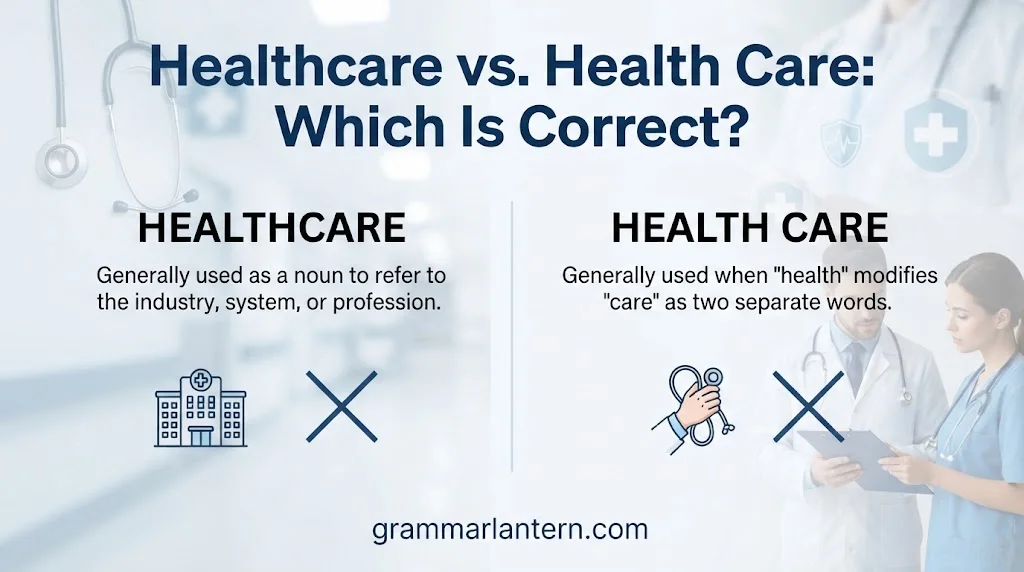
Healthcare has essentially the same core meaning as health care.
The main difference is that the two words have been closed into a single compound.
Writers commonly use healthcare when discussing:
- The healthcare industry
- Healthcare systems
- Healthcare technology
- Healthcare policy
- Healthcare administration
- Healthcare workers
- Healthcare providers
- Healthcare organizations
- Healthcare education
For example:
- “She works in healthcare.”
- “Healthcare technology is developing quickly.”
- “The healthcare system needs more nurses.”
- “Healthcare workers often face demanding schedules.”
- “Healthcare policy affects millions of people.”
These examples don’t prove that healthcare has a completely different definition from health care. They show how the one-word form commonly appears in modern writing.
Is There a Real Difference?
Here’s where many explanations become unnecessarily complicated.
You may encounter the claim that health care means actual medical treatment, while healthcare means the industry or business surrounding medicine.
That distinction can describe a usage tendency, but it isn’t a universal grammatical rule.
Both forms can refer to:
- Medical treatment
- Patient services
- Healthcare professionals
- Hospitals and clinics
- Medical systems
- Healthcare policy
- Healthcare technology
- The broader medical field
Compare these examples:
| Sentence | Meaning |
| “Access to health care matters.” | Access to medical services matters. |
| “Access to healthcare matters.” | Essentially the same meaning. |
| “She works in health care.” | She works in the medical field. |
| “She works in healthcare.” | Essentially the same meaning. |
| “Healthcare policy is changing.” | Policy concerning the medical field is changing. |
| “Health care policy is changing.” | Essentially the same idea under a different spelling convention. |
The spelling changes. The underlying concept doesn’t suddenly transform.
Why Do People Think the Meanings Differ?
The confusion comes partly from common word combinations.
Healthcare frequently appears in phrases such as:
- healthcare industry
- healthcare sector
- healthcare technology
- healthcare administration
- healthcare policy
- healthcare system
Meanwhile, health care has traditionally appeared in expressions such as:
- health care services
- health care access
- health care costs
- health care coverage
- health care delivery
These patterns can create the impression that each form has a separate meaning.
In reality, English often develops preferred combinations without creating strict grammatical boundaries. Think of the distinction as a usage pattern, not a hard rule.
Healthcare vs. Health Care as a Noun
Both forms can function as nouns.
Health Care as a Noun
Consider these examples:
- “Health care is expensive.”
- “She needs better health care.”
- “The country is investing in health care.”
- “Access to health care remains a concern.”
- “Affordable health care benefits entire communities.”
Here, health care acts as a noun phrase.
Healthcare as a Noun
The closed form works in the same basic way:
- “Healthcare is expensive.”
- “She works in healthcare.”
- “The healthcare sector is growing.”
- “Access to healthcare remains a concern.”
- “Healthcare plays an important role in modern society.”
The grammatical function remains essentially the same.
The spelling changes, but the noun still refers to medical care or the broader field surrounding it.
As a Modifier
Things get slightly more complicated when the phrase modifies another noun.
Consider:
healthcare industry
Here, healthcare modifies industry.
Now compare:
health care industry
This version also appears in English.
A traditional style may instead use:
health-care industry
Why?
Because a hyphen can show that two or more words work together as a compound modifier.
The important point is that these forms don’t represent three different industries.
They’re different editorial treatments of the same underlying phrase.
Common Modifier Examples
| Form | Example |
| Healthcare | healthcare industry |
| Healthcare | healthcare provider |
| Healthcare | healthcare technology |
| Health care | health care services |
| Health care | health care policy |
| Health-care | health-care services |
The preferred form depends on the writing style you’re following.
When Should “Health-Care” Be Hyphenated?
The hyphenated form health-care deserves special attention.
A hyphen can connect words that work together as a compound modifier before another noun.
For example:
health-care provider
Here, health-care works together to describe the type of provider.
Likewise:
health-care services
The phrase describes services related to health care.
However, hyphenation isn’t something you should add automatically.
If your chosen style treats healthcare as one word, you don’t need to write health-care simply because the word comes before another noun.
For example:
“The hospital expanded its healthcare services.”
That’s perfectly natural under a one-word style.
A style that retains the open form may instead use:
“The hospital expanded its health-care services.”
Both patterns can be valid under different editorial conventions.
Why Hyphens Matter
Hyphens can make relationships between words easier to understand.
Consider:
“The hospital introduced a new health-care program.”
The hyphen signals that health-care works as a combined modifier for program.
Still, modern English doesn’t require every compound to carry a hyphen forever. Many compounds gradually become closed words as usage develops.
That’s part of the reason you’ll encounter healthcare, health care, and sometimes health-care.
What Changed in AP Style in 2026?
One of the biggest recent developments in the healthcare vs. health care debate happened in 2026.
For years, the Associated Press style convention used health care as two words. In April 2026, it changed its recommendation and adopted healthcare as one word.
That change reflects the growing use of the closed form in modern American English.
The current AP Stylebook is the 58th edition, covering the 2026–2028 period.
For writers who follow AP style, the practical answer is now straightforward:
Use healthcare.
This is particularly relevant to journalists, editors, digital publishers, communications professionals, and organizations that use AP style.
Does the 2026 Change Make “Health Care” Wrong?
No.
This is an important distinction.
A style guide establishes a preferred editorial convention. It doesn’t suddenly make every alternative form grammatically incorrect.
Think of it like a road sign changing the preferred route. The other road doesn’t disappear.
Health care remains an established form of American English.
Writers may still use it when their publication, institution, journal, or organization prefers the open form.
That’s why you’ll continue to see both spellings in professional writing.
Case Study: Different Publications, Different Preferences
The current debate offers a useful lesson for anyone who writes professionally.
Different organizations can make different style choices even when both forms are accepted.
| Writing environment | Preferred form |
| Current AP-style writing | healthcare |
| Organizations following AP conventions | healthcare |
| Publications retaining the traditional open form | health care |
| Chicago-style writing | health care |
| General writing without a required guide | Either, used consistently |
This doesn’t mean one organization understands grammar better than another.
It means style guides make editorial decisions.
That’s common in professional writing. Publications routinely differ over capitalization, abbreviations, punctuation, spelling, and compound words.
The smartest approach isn’t to declare one form universally correct. It’s to identify the style you’re expected to follow.
Healthcare vs. Health Care in American English
American English accepts both forms.
However, healthcare has become increasingly prominent in professional, corporate, governmental, and digital writing.
The 2026 shift toward healthcare in AP style strengthens that trend.
You’ll frequently see the closed form in phrases such as:
- healthcare industry
- healthcare provider
- healthcare system
- healthcare policy
- healthcare technology
- healthcare administration
- healthcare professional
- healthcare worker
- healthcare organization
- healthcare management
At the same time, health care remains common in academic, institutional, and traditional editorial writing.
So if you’re writing in American English, you’re not facing a simple right-versus-wrong decision.
You’re choosing between accepted conventions.
Which Form Should You Use?
The best choice depends on where your writing will appear.
If You’re Following AP Style
Use:
healthcare
This is the current preferred form for AP-style writing.
For example:
“The healthcare industry is experiencing rapid technological change.”
If You’re Following Chicago Style
Use:
health care
For example:
“Access to health care remains an important issue.”
The key is not to mix conventions randomly.
If You’re Writing an Academic Paper
Check the required style guide first.
Your university, professor, journal, or publisher may require a particular editorial system.
Depending on the assignment, you might need to follow:
- APA
- Chicago
- MLA
- AMA
- A university-specific style guide
- A journal’s house style
Don’t assume that the newest-looking spelling is automatically the right choice.
Academic writing rewards consistency and adherence to instructions.
If You’re Writing for a Company
Follow the company’s house style.
This matters when producing:
- Website content
- Brand copy
- Press releases
- Annual reports
- Internal documentation
- Product descriptions
- Marketing materials
- Healthcare content
- Corporate communications
If a company consistently uses healthcare, don’t switch to health care halfway through the same article.
A consistent style looks intentional.
An inconsistent style looks like several editors grabbed the same paragraph at different times.
Common Examples
Both forms appear naturally in everyday and professional writing.
| Phrase | Example |
| healthcare industry | The healthcare industry is adopting new technologies. |
| healthcare system | The healthcare system faces staffing challenges. |
| healthcare provider | Contact your healthcare provider with questions. |
| healthcare workers | Healthcare workers often handle demanding workloads. |
| healthcare policy | The proposal could affect healthcare policy. |
| health care services | The clinic provides basic health care services. |
| health care access | Rural communities may face limited health care access. |
| health care costs | Rising health care costs concern many families. |
| health-care services | Some writing styles prefer health-care services. |
Notice something important.
The subject doesn’t suddenly change because one version contains a space.
The meaning remains closely related.
Common Mistakes
Saying “Healthcare” Is Always Wrong
That claim is outdated.
Healthcare is an established one-word form and is now the preferred spelling in some major style systems.
Saying “Health Care” Is Always Wrong
That’s equally inaccurate.
Health care remains an established and widely used form.
Claiming the Two Forms Always Have Different Meanings
This is one of the most common oversimplifications.
You might notice that healthcare appears frequently in industry-related phrases. You might also see health care in discussions about services and treatment.
That doesn’t create a fixed grammatical boundary.
Mixing Forms Without a Reason
Consider:
“The healthcare system provides health care services through healthcare providers.”
Nothing in that sentence makes the grammar automatically wrong.
However, if an article consistently uses health care, suddenly switching to healthcare can look careless.
Choose a convention and stay with it.
Adding Hyphens Everywhere
Don’t assume that health-care is simply a more formal version of health care.
Hyphenation depends on how the phrase functions in the sentence and which style you’re following.
If you use the closed form:
“healthcare services”
If your style retains the open form and calls for a compound modifier:
“health-care services”
Don’t add a hyphen just because the phrase appears before another noun.
A Simple Decision Guide
When you’re stuck between healthcare vs. health care, use this five-step approach:
First, check the required style guide.
If you’re writing for a publication, university, employer, or client, find out what style they follow.
Second, check the house style.
Some organizations have their own preferences that override general conventions.
Third, choose an accepted form if no style guide applies.
You can use healthcare or health care.
Fourth, stay consistent.
Don’t alternate between the forms without a reason.
Fifth, handle hyphenation separately.
The question of whether to write health-care depends on the construction and style.
This method is much more reliable than memorizing a supposed rule that says one spelling is always right.
Side-by-Side Comparison
| Feature | Healthcare | Health care |
| Spelling | One word | Two words |
| Accepted in American English | Yes | Yes |
| Basic meaning | Medical care or the broader medical field | Medical care or the broader medical field |
| Established usage | Yes | Yes |
| Traditional form | No | Yes |
| Current AP preference | Yes | No |
| Chicago preference | No | Yes |
| Can appear in professional writing | Yes | Yes |
| Can describe medical services | Yes | Yes |
| Can describe the broader field | Yes | Yes |
| Requires a universal meaning distinction | No | No |
The table highlights the central point:
Spelling preference and meaning aren’t the same thing.
Is “Healthcare Industry” or “Health Care Industry” Correct?
Both forms can be correct.
If you’re following current AP style, use:
healthcare industry
If your style retains the open form, use:
health care industry
A style that follows traditional hyphenation rules may also use:
health-care industry
The important factor is the editorial system you’re following.
Don’t invent a meaning difference simply to justify one spelling.
Is “Healthcare Provider” or “Health Care Provider” Correct?
Again, all three forms can appear depending on style:
1. “Talk to your healthcare provider.”
2. “Talk to your health care provider.”
3. “Talk to your health-care provider.”
The reader understands the intended meaning in each case.
The spelling convention changes.
The professional providing medical care doesn’t.
What About “Mental Health Care” and “Mental Healthcare”?
This phrase deserves special attention because adding mental creates another compound.
Mental health care is often a clear and natural construction because mental health already functions as a familiar unit.
For example:
“The program provides mental health care for veterans.”
Here, mental health describes the type of health, while care identifies the service.
That structure can make mental health care especially easy to read.
However, you’ll also encounter mental healthcare, particularly in writing that consistently uses the closed form.
The important lesson is to consider the entire phrase rather than mechanically replacing every occurrence of health care with healthcare.
Compound words are a bit like puzzle pieces. Sometimes closing them together makes the picture cleaner. Sometimes keeping the pieces separate improves readability.
In Formal Writing
Neither form automatically makes your writing more formal.
What matters more is accuracy, consistency, clarity, and adherence to the required style.
Use healthcare when:
- Your publication follows AP style.
- Your organization specifies the one-word form.
- Your institution’s style guide uses it.
- You’re continuing an established document’s spelling.
- Your audience expects the closed form.
Use health care when:
- Your publication prefers the traditional form.
- Your institution specifies the open form.
- Your journal uses it consistently.
- You’re following a style system that recommends it.
The golden rule is simple:
Don’t switch spelling merely to make your writing look more sophisticated.
A consistent article using healthcare is better than an article that randomly alternates between healthcare, health care, and health-care.
Read More: Title vs. Tittle: What’s the Difference?
FAQs
1. Is “healthcare” or “health care” correct?
Both healthcare and health care are correct. The choice usually depends on the writing style, context, and style guide you follow.
2. What is the main difference between healthcare and health care?
The main difference is usually spelling and usage. Health care is written as two words, while healthcare is written as one word.
3. Should I write healthcare as one word?
Yes, healthcare is widely accepted as a one-word form. It’s especially common in modern American English and professional writing.
4. Should I use health care in formal writing?
You can. Health care is still a standard and correct form, particularly when a publication or style guide prefers the two-word spelling.
5. Is healthcare one word in American English?
Yes. Healthcare is commonly used as one word in American English, especially when referring to the industry or broader system.
6. Can healthcare and health care be used interchangeably?
In many situations, yes. However, your choice can depend on the context, sentence structure, and preferred writing style.
7. Which is better for professional writing?
Neither form is automatically better. The best choice is the one that matches your audience, publication, organization, or chosen style guide.
8. Is “healthcare industry” correct?
Yes. Healthcare industry is a common phrase used to describe the broad industry that provides medical services and related support.
9. Is “health care services” correct?
Yes. Health care services is grammatically correct and commonly used when referring to medical services provided to patients.
10. How can I remember the difference?
Think of healthcare as a broad industry or system and health care as the care or services people receive. This simple distinction can help you choose the form more confidently.
Conclusion
Healthcare and health care are both accepted forms, so choosing between them doesn’t have to be confusing. The one-word form is common in modern writing, while the two-word form remains widely used. Your best choice often depends on the context, audience, and style you’re following.
When you’re unsure, look at how similar terms are written in the same publication or document. More importantly, stay consistent throughout your writing. Once you understand the small difference in style and usage, choosing between healthcare and health care becomes much easier.




[…] Read More: Healthcare vs. Health Care: Which Is Correct? […]