A single letter can completely change the meaning of a word, and Stub vs. Stab shows this clearly. Although they look and sound somewhat similar, they describe very different actions and ideas. A stab means piercing, thrusting, or using a sharp object to pierce, poke, or thrust something. A stub, however, often means accidentally hitting your toe against something, such as a table.
The difference becomes easier to remember when you connect each word with its physical action. For example, an attacker may stab a target, while someone may have stubbed a toe. These are completely different actions. This distinction helps you choose the right word in writing, especially when describing physical events or giving clear examples.
Both words can also function as nouns. A stab can mean a thrust or an attempt, while a stub can mean a short remaining piece after most of something has been removed. A small preliminary version can also be called a stub. Keeping these meanings separate helps prevent confusion when the words appear in different sentences.
Quick Difference
The easiest way to understand stub vs. stab is to compare their core meanings.
| Word | Pronunciation | Main meaning | Example |
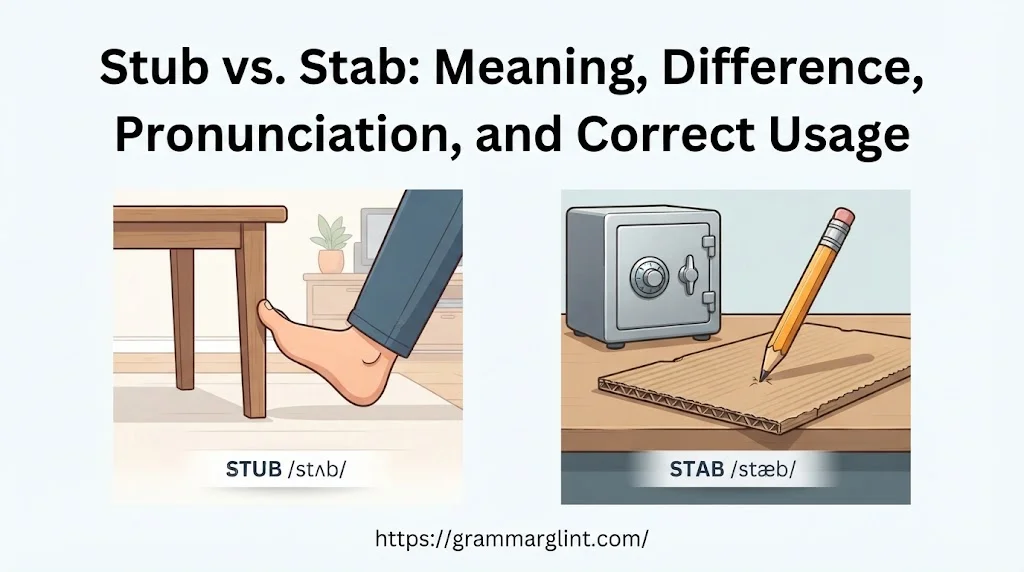
| Stub | /stʌb/ | To hit a toe against something hard or a short piece left behind | I stubbed my toe on the table. |
| Stab | /stæb/ | To thrust or push something pointed into something | He stabbed the cardboard with a pencil. |
The pronunciation also separates them.
Stub uses the /ʌ/ sound found in words such as cup, sun, and luck.
Stab uses the /æ/ sound found in words such as cat, hat, and black.
So although stub and stab share the same beginning and ending sounds, their middle vowels are different.
The basic rule
Use stub when you’re talking about:
- Accidentally hitting your toe against something hard
- A short piece left after something has been used or removed
- A ticket stub
- A pay stub
- A pencil stub
- Stubbing out a cigarette
Use stab when you’re talking about:
- Pushing a sharp object into something
- Making a forceful thrusting movement
- A stab wound
- A sudden sharp sensation
- An attempt, as in take a stab at something
- Betrayal, as in stab someone in the back
The context usually gives you the answer.
What Does “Stub” Mean?
Stub works as both a noun and a verb. Its meanings may look unrelated at first, but they share an idea of something short, remaining, or being struck.
As a noun, a stub is usually a small part that remains after the larger part has been used, torn away, cut off, or removed.
As a verb, stub commonly appears in the phrase stub your toe.
Stub as a Verb
When you stub your toe, you accidentally hit your toe against something hard.
For example:
- I stubbed my toe on the coffee table.
- She stubbed her toe against the door.
- He stubbed his toe on the stairs.
- I always stub my little toe on that chair.
- She stubbed her toe while walking through the dark room.
The action doesn’t require a sharp object.
That’s the crucial point.
If your toe hits a table leg, you stub it. If a pointed object pierces your toe, you may stab it.
The two situations can both hurt. The physical actions are different.
What Does “Stub Your Toe” Mean?
Stub your toe means to hurt your toe by accidentally hitting it against a hard object.
Imagine walking barefoot through your bedroom. You turn toward the door and your little toe catches the corner of the bed frame.
That painful moment is a classic example of stubbing your toe.
You might say:
I stubbed my toe on the bed frame.
The phrase normally describes an accidental collision.
Common objects that can cause someone to stub a toe include:
- Table legs
- Chair legs
- Bed frames
- Door frames
- Steps
- Rocks
- Furniture corners
- Boxes
- Walls
The object doesn’t have to be sharp. It simply needs to create a hard impact against the toe.
Read More: Labeler vs. Labeller: Which Spelling Is Correct?
Stub as a Noun
As a noun, stub often means the small part left after the main portion has been used.
Think about a pencil you’ve sharpened repeatedly. Eventually, only a short piece remains.
That’s a pencil stub.
The same idea applies to other objects.
| Expression | Meaning |
| Pencil stub | A short piece of pencil left after much of it has been used |
| Ticket stub | The portion of a ticket retained as a record or keepsake |
| Pay stub | A document showing information about wages or salary |
| Check stub | The retained part of a check that records the transaction |
| Cigarette stub | The short remaining end of a cigarette |
| Branch stub | A short section of a branch remaining after cutting |
For example:
She kept the ticket stub from her first concert.
Here, stub has nothing to do with hitting a toe. It refers to the small portion of the ticket that remains.
The Core Idea Behind the Noun “Stub”
A useful mental picture is a short leftover piece.
Imagine a long pencil becoming shorter with every use. Eventually, you have a stub.
Imagine a ticket being torn at the entrance. You keep the stub.
Imagine a cigarette after most of it has burned. The remaining piece is a stub.
In each case, something larger has been reduced to a smaller remaining portion.
“Stub Out” as a Phrasal Verb
Stub out is another established use of stub.
It means to extinguish something, especially a cigarette, by crushing or pressing its burning end against a surface.
For example:
- He stubbed out his cigarette in the ashtray.
- Please stub out the cigarette before leaving.
- She stubbed out the cigarette and walked away.
Don’t confuse stub out with stub your toe.
They use the same verb but express different actions.
What Does “Stab” Mean?
Stab also functions as both a verb and a noun.
Its central literal meaning involves a sharp or forceful thrust. A person can stab something with a pointed object such as a knife, fork, pencil, or tool.
The word doesn’t always describe an attack.
For example:
She stabbed the potato with a fork.
That sentence describes a normal cooking action. No person is being attacked.
Stab as a Verb
The most familiar meaning of stab is to push a sharp object into something.
Examples include:
- He stabbed the cardboard with a pencil.
- She stabbed the potato with a fork.
- The gardener stabbed the soil with a small tool.
- He stabbed at the target with a stick.
- The bird stabbed at the ground with its beak.
The important idea is thrusting or pushing into something.
Does “Stab” Always Mean to Injure Someone?
No.
Although stab often appears in discussions of injuries, the word has broader uses.
You can stab:
- Food with a fork
- Soil with a tool
- Cardboard with a pencil
- A target with a pointed object
- The air with your finger
- Something repeatedly with a sharp object
For example:
The speaker stabbed the air with his finger to emphasize his point.
No weapon is necessary in that sentence.
The movement itself can be enough to justify the verb.
Stab as a Noun
As a noun, stab can refer to the act of stabbing or an injury produced by that action.
For example:
- The patient had a stab wound.
- The police report described a stab injury.
- The victim suffered several stab wounds.
However, stab also has figurative meanings.
You can have:
- A stab of pain
- A stab of guilt
- A stab of jealousy
- A stab of regret
- A stab of fear
In these expressions, nobody is physically stabbing anything.
The word creates an image of a feeling that arrives suddenly and sharply.
For example:
She felt a sudden stab of guilt when she remembered his warning.
The guilt is compared to something sharp that suddenly pierces the mind or emotions.
Key Differences
The difference becomes clearer when you separate the words by meaning, pronunciation, and grammar.
Difference in Meaning
Stub usually involves either:
- Accidentally striking a toe or foot
- A short part left behind
Stab usually involves:
- A sharp or forceful thrust
- Piercing with a pointed object
- A sharp sensation
- An attempt
These aren’t interchangeable meanings.
Difference in Pronunciation
The words have different vowel sounds.
| Word | IPA | Comparable vowel |
| Stub | /stʌb/ | cup, sun, luck |
| Stab | /stæb/ | cat, hat, black |
Say them slowly:
stub
stab
The beginning st- stays the same. The ending -b stays the same. The vowel changes.
That one vowel is enough to change both the sound and the meaning.
Difference in Spelling
The spelling difference is simple:
STUB
STAB
The only difference is the middle vowel.
That makes these words easy to mistype, especially when you’re writing quickly.
A useful visual trick is:
STUB → U → bump your toe
STAB → A → sharp action
The memory trick doesn’t explain every dictionary meaning, but it can help you avoid the most common mistake.
Difference in Word Forms
Both verbs follow regular spelling patterns when they take -ed and -ing.
| Base verb | Past tense | -ing form |
| stub | stubbed | stubbing |
| stab | stabbed | stabbing |
Examples:
- I stubbed my toe.
- She is stubbing out the cigarette.
- He stabbed the cardboard.
- They were stabbing at the soil.
The doubled b is important in both forms.
“Stubbed My Toe” vs. “Stabbed My Toe”
This is where the difference between the two words becomes especially important.
“I Stubbed My Toe”
I stubbed my toe means your toe accidentally hit something hard.
Example:
I stubbed my toe on the corner of the table.
The movement is essentially:
toe → hard object
The toe collides with the object.
“I Stabbed My Toe”
I stabbed my toe suggests that a pointed object entered or pierced the toe.
The movement is different:
pointed object → toe
For example:
I accidentally stabbed my toe with a sharp gardening tool.
That’s a completely different accident.
Side-by-Side Comparison
| Sentence | What happened? |
| I stubbed my toe on the table. | The toe hit the table. |
| I stubbed my toe on the bed frame. | The toe accidentally struck the frame. |
| I stabbed my toe with a tool. | A pointed object pierced the toe. |
| I stabbed my toe with a pencil. | A pointed pencil entered the toe. |
So if you’re describing the ordinary experience of walking into furniture, stubbed is the word you want.
Common Mistakes
These words are easy to confuse because their spelling is so similar.
“I Stabbed My Toe on the Table”
If you mean your toe accidentally hit the table, this wording gives the wrong impression.
Better:
I stubbed my toe on the table.
The word stubbed tells the reader that the toe collided with a hard object.
“I Stubbed the Cardboard With a Pencil”
If you mean that you pushed the pointed pencil into the cardboard, stabbed is more appropriate.
Better:
I stabbed the cardboard with a pencil.
The pencil creates a pointed thrusting action.
“I Stubbed My Toe With a Knife”
This sounds unusual because the verb doesn’t match the likely action.
If the knife actually pierced the toe, stabbed would communicate the event more clearly.
I stabbed my toe with a knife.
If the knife wasn’t involved in the contact and the toe simply struck something hard, then stubbed would be appropriate.
The Main Problem: Similar Spelling
The problem isn’t grammar alone.
It’s meaning.
A sentence can be grammatically correct while using the wrong word for the intended event.
That’s why replacing stub with stab isn’t a harmless spelling mistake. It can change the entire image in the reader’s mind.
Examples in Sentences
Seeing both words in real sentences makes the distinction easier to remember.
Examples With “Stub”
- I stubbed my toe on the coffee table.
- She stubbed her toe against the door.
- He found a pencil stub in the drawer.
- She saved every ticket stub from the concert.
- The employee checked her pay stub.
- He threw the cigarette stub into the trash.
- I stubbed my toe while getting out of bed.
- The branch ended in a short stub after pruning.
- She found an old check stub in the folder.
- He stubbed out the cigarette before entering the building.
Examples With “Stab”
- He stabbed the cardboard with a pencil.
- She stabbed the potato with a fork.
- The gardener stabbed the soil with a narrow tool.
- The bird stabbed at the ground.
- He felt a stab of regret.
- She experienced a sudden stab of pain.
- I’ll take a stab at the puzzle.
- He stabbed at the paper repeatedly.
- Her comment felt like a stab of betrayal.
- The doctor treated the patient’s stab wound.
Notice how different the vocabulary around each word tends to be.
In Figurative Expressions
The two words become even more interesting when they move beyond literal physical actions.
“Stub Your Toe”
The literal expression means to accidentally hit your toe against something hard.
Example:
I stubbed my toe on the chair leg.
The expression can also be used metaphorically in some contexts to describe encountering a minor problem or setback. However, the literal meaning remains the standard everyday use.
“Stub Out”
Stub out means to extinguish a cigarette or similar smoking material by crushing its burning end.
Example:
He stubbed out the cigarette before walking inside.
This meaning has no connection with stabbing.
“Take a Stab at Something”
Take a stab at something means to try or attempt it.
For example:
I’ll take a stab at answering the question.
Here, stab is completely figurative.
The phrase suggests making an attempt without guaranteeing success.
You might say:
- I’ll take a stab at fixing the computer.
- She took a stab at writing the report.
- He took a stab at solving the puzzle.
- Let’s take a stab at answering the final question.
“A Stab of Pain”
A stab of pain describes a sudden, sharp sensation.
Example:
He felt a stab of pain in his shoulder.
The word creates a vivid comparison between physical pain and a sharp thrust.
“A Stab of Guilt”
A stab of guilt describes a sudden emotional feeling of guilt.
Example:
She felt a stab of guilt after ignoring his message.
Again, the meaning is figurative.
“Stab Someone in the Back”
Stab someone in the back means to betray someone.
For example:
He felt that his business partner had stabbed him in the back.
The expression uses the physical image of an unexpected attack to describe betrayal.
Stub vs. Stab: Context Is the Best Clue
Sometimes you don’t need to memorize a long definition.
Just look at the words around the blank.
Consider this sentence:
I ___ my toe on the bed.
What happened?
The toe hit the bed.
The answer is:
I stubbed my toe on the bed.
Now consider:
He ___ the cardboard with a pencil.
What happened?
A pointed pencil was pushed into the cardboard.
The answer is:
He stabbed the cardboard with a pencil.
Words That Often Point Toward “Stub”
Look for words such as:
- Toe
- Foot
- Table
- Chair
- Bed
- Step
- Corner
- Accidentally
- Hard
- Ticket
- Pencil
- Pay
- Check
These don’t guarantee that stub is correct, but they provide useful context.
Words That Often Point Toward “Stab”
Look for words such as:
- Knife
- Pencil
- Fork
- Sharp
- Pointed
- Pierce
- Thrust
- Wound
- Pain
- Attempt
- Betrayal
Again, context decides the final choice.
A Practical Case Study: Two Similar Accidents
Imagine two people describing what happened in a workshop.
Case One: The Table
Alex walks across the room and accidentally hits his toe against a metal table leg.
He says:
“I stubbed my toe.”
That’s the natural expression.
The table doesn’t pierce his toe. His toe simply collides with the hard surface.
Case Two: The Tool
Sam drops a pointed tool and accidentally steps onto it.
He says:
“I stabbed my foot.”
Now the description changes because a pointed object enters the foot.
Why the distinction matters
1.Both situations involve pain.
2.Both can happen accidentally.
3.Both involve the foot.
Yet stub and stab remain different because they describe different physical actions.
This is a good example of why vocabulary depends on what actually happened, not simply on which word sounds close.
Grammar of “Stub”
Simple Present
- I stub my toe easily.
- She stubs her toe on that chair often.
Simple Past
- I stubbed my toe yesterday.
- He stubbed his toe on the step.
Present Progressive
- She is stubbing out the cigarette.
Noun
- I kept the ticket stub.
- He sharpened the pencil until only a stub remained.
The word changes grammatical function depending on context.
Grammar of “Stab”
Simple Present
- He stabs the cardboard with the pencil.
- The bird stabs at the soil.
Simple Past
- She stabbed the potato with a fork.
- He stabbed the cardboard with a pencil.
Present Progressive
- The bird is stabbing at the ground.
Noun
- The patient suffered a stab wound.
- She felt a stab of pain.
- I’ll take a stab at the answer.
The noun has a surprisingly broad range of uses.
Stubbed vs. Stabbed: Spelling Guide
Writers sometimes know which word they want but still hesitate over its past-tense spelling.
The correct forms are:
- stub → stubbed
- stab → stabbed
Both words double the final b.
Examples
Correct:
- I stubbed my toe.
- She stubbed out the cigarette.
- He stabbed the cardboard.
- They stabbed at the target.
Incorrect spellings include:
- stubed
- stabed
- stubbbed
- stabbbed
The standard forms contain two b’s:
stubbed
stabbed
Can “Stab” Be Used Without a Knife?
Yes.
A knife is one common example, but it isn’t required.
1.You can stab food with a fork.
2.You can stab soil with a tool.
3.You can stab at the air with your finger.
4.You can stab cardboard with a pencil.
The central idea is the thrusting or jabbing movement.
That broader meaning explains why stab appears in ordinary situations that have nothing to do with violence.
Can “Stub” Mean More Than Hitting Your Toe?
Yes.
The toe-related use is probably the first meaning many people learn, but stub has several noun uses.
You can have:
- A ticket stub
- A pay stub
- A check stub
- A pencil stub
- A cigarette stub
- A branch stub
The common thread is often a short remaining part.
There’s also the verb stub out, which means to extinguish a cigarette by pressing its burning end against something.
So learning stub only as “hit your toe” leaves out a large part of its everyday usage.
Easy Way to Remember
When two words look nearly identical, a simple mental association can prevent mistakes.
Remember “Stub = Toe”
Think:
Stub → toe → table
You walk into the table.
Your toe hurts.
You stubbed it.
Remember “Stab = Sharp”
Think:
Stab → sharp → thrust
A pointed object moves into something.
You stab it.
One-line memory rule
You stub your toe against something hard, but you stab something with a pointed object.
That rule handles the most common stub vs. stab confusion.
Comparison Chart
| Feature | Stub | Stab |
| Pronunciation | /stʌb/ | /stæb/ |
| Main physical action | Accidental impact | Sharp or forceful thrust |
| Common body phrase | Stub your toe | Stab someone/something |
| Noun meaning | Short remaining piece | Thrust, wound, sharp sensation, attempt |
| Common object | Table, chair, step | Knife, fork, pencil, pointed tool |
| Common figurative use | Limited | Many established expressions |
| Past tense | Stubbed | Stabbed |
| -ing form | Stubbing | Stabbing |
| Common phrase | Stub your toe | Take a stab at it |
| Example | I stubbed my toe. | He stabbed the cardboard. |
Which Word Should You Use?
When you’re writing and hesitate between stub and stab, ask what the sentence actually describes.
Choose “stub” if:
Your toe accidentally hits a hard object.
I stubbed my toe on the chair.
You’re talking about a short remaining piece.
I found a pencil stub in the drawer.
You’re referring to a retained ticket section.
She saved the ticket stub.
You’re talking about a wage record.
I need my latest pay stub.
You’re extinguishing a cigarette.
He stubbed out the cigarette.
Choose “stab” if:
A pointed object moves into something.
She stabbed the cardboard with a pencil.
You’re describing a thrusting movement.
He stabbed at the target.
You’re describing a wound.
The patient had a stab wound.
You’re describing a sudden sharp feeling.
She felt a stab of pain.
You’re describing an attempt.
I’ll take a stab at the problem.
You’re describing betrayal figuratively.
He felt that his friend had stabbed him in the back.
Read More: 27 Best Replies to “I Don’t Care” Witty & Clever
FAQS
1. What is the difference between stab and stub?
Stab usually means to pierce or thrust something with a sharp object. Stub commonly means hitting your toe against something or referring to a short remaining piece.
2. Is stab a verb or a noun?
Stab can be both. As a verb, it means to pierce or thrust. As a noun, it can mean a thrust or an attempt.
3. Is stub a verb or a noun?
Stub can also work as both a verb and a noun. You can stub your toe, or you can refer to a short remaining piece as a stub.
4. What does stub your toe mean?
To stub your toe means to accidentally hit your toe against something, such as furniture, a wall, or a table.
5. What does stab mean?
Stab means to pierce or thrust something with a pointed or sharp object. It can describe a physical action or an attempt.
6. Can stub describe a piece of something?
Yes. A stub can describe a short piece that remains after most of something has been removed, cut, or used.
7. Can stab mean an attempt?
Yes. In informal usage, a stab at something can mean an attempt to do or achieve something.
8. Why are stab and stub confusing?
They have similar spellings and sounds, with only one vowel separating them. Their meanings, however, are quite different.
9. What is a stub version?
A stub version is a small or incomplete preliminary version of something. It may provide a basic structure before more details are added.
10. How can I remember stab vs. stub?
Think of stab as something sharp that pierces. Think of stub as accidentally hitting your toe or a short piece left behind.
Conclusion
Stab and stub may look almost like twins on the page, but their meanings take very different paths. Stab focuses on piercing, thrusting, or making an attempt, while stub often relates to hitting your toe or describing something short that remains.
Once you connect each word with its main action or meaning, the distinction becomes much easier to remember. When writing, take a quick moment to consider whether you mean a sharp thrust, an accidental hit, a remaining piece, or a preliminary version. That small check can help you choose the correct word with confidence.

For Shafiq ur Rehman, writing is an art form and grammar is the toolbox that makes it beautiful. As a dedicated content writer at Grammar Lantern, Shafiq approaches every topic like an architect carefully laying down strong foundations of understanding before adding the finer details. He loves diving into the trickiest grammar points and resurfacing with simple, bite-sized takeaways that anyone can grasp. When he’s not crafting articles, you’ll likely find him strategizing over a game of chess, exploring dusty local bookshops, or quietly jotting down poetic observations in his notebook.