The Labeler vs. Labeller difference is mainly about regional English spelling rather than meaning. Both forms are valid, but American English usually prefers labeler, while British English commonly uses labeller. These regional differences can confuse writers, students, and professionals, especially when they switch between American English and British English. Both words can describe a person, machine, or device that labels something or applies labels. In my experience, remembering the intended audience makes this spelling difference much easier to handle.
Your choice also depends on your writing context and preferred spelling style. For business documents, academic papers, blogs, emails, formal writing, and software content, consistency is important. A U.S. audience will generally expect the American spelling labeler, while a British audience may expect labeller. The same regional pattern can appear in the United States, United Kingdom, Australia, and Canada, although local usage may vary.
Using one version consistently improves clarity, accuracy, and professional writing. Mixing regional spelling styles can make content appear inconsistent or unprofessional, particularly in business, manufacturing, and packaging contexts. Understanding these English conventions and grammar rules helps you choose the correct spelling for your readers.
Quick Answer
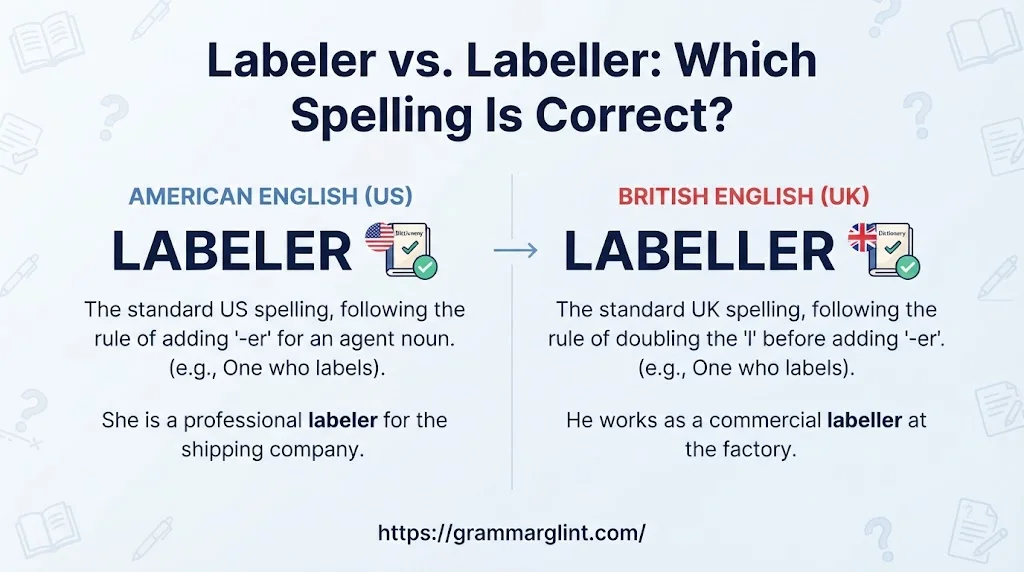
Labeler and labeller are both correct spellings. The preferred choice depends mainly on the variety of English you’re using.
| Word | Main English variety | Meaning |
| Labeler | American English | A person or machine that labels something |
| Labeller | British English | A person or machine that labels something |
| Labeling | American English | The act or process of applying or assigning labels |
| Labelling | British English | The act or process of applying or assigning labels |
| Labeled | American English | Having a label or having been identified with a label |
| Labelled | British English | Having a label or having been identified with a label |
So, if you’re writing for an American audience, labeler is usually the better choice. If you’re following British English, labeller fits the spelling system.
The important point is that neither word has a completely different definition. The extra l reflects a regional spelling preference rather than a change in meaning.
What Does Labeler Mean?
A labeler is a noun that refers to someone or something that labels an item.
The word comes from the verb label, which means to attach a label to something or identify something with a particular name, category, description, or classification.
For example:
The labeler checked every package before it left the warehouse.
Here, labeler could refer to a person performing the task.
The word can also describe equipment:
The factory installed an automatic labeler for its new packaging line.
In this sentence, labeler refers to a machine that applies labels to products.
That distinction matters because people sometimes assume that labeler can refer only to a human. In modern workplace and manufacturing contexts, the word can describe either a person or a device depending on the surrounding context.
Common Uses of Labeler
You may encounter labeler in several different fields:
- Manufacturing: A machine that applies labels to products.
- Warehousing: A worker who labels boxes, containers, or inventory.
- Retail: Someone who attaches product or price labels.
- Data science: A person who assigns categories or annotations to data.
- Research: Someone who classifies or marks information.
- Packaging: Equipment that places labels on bottles, cans, boxes, or other products.
- Organization: A person who identifies and categorizes items.
The meaning remains connected to the same basic action: labeling something.
What Does Labeller Mean?
Labeller has essentially the same meaning as labeler. The main difference is spelling.
The double l makes labeller the form commonly associated with British English.
For example:
The labeller applies labels to each bottle automatically.
Or:
The warehouse hired another labeller during the busy season.
In both cases, the word can describe a person or a machine.
The spelling doesn’t change the underlying action. A labeller still labels something.
This is why treating labeler and labeller as two completely different words can create unnecessary confusion. Think of them as regional versions of the same noun.
Read More: Kickoff vs. Kick-Off vs. Kick Off: Which One Is Correct?
In American and British English
The clearest way to understand labeler vs. labeller is to look at the spelling family around the word.
American English generally uses:
- labeler
- labeling
- labeled
British English generally uses:
- labeller
- labelling
- labelled
Here’s the pattern in action:
| American English | British English |
| label | label |
| labeler | labeller |
| labeling | labelling |
| labeled | labelled |
Notice something important: the difference doesn’t appear in the base word label. Both varieties spell that word the same way.
The variation appears when certain suffixes are added.
Why Does the Extra L Appear?
British English often doubles the final consonant in words such as label before certain endings. American English usually doesn’t follow the same pattern in these forms.
That’s why you see:
British English:
label → labelled → labelling → labeller
American English:
label → labeled → labeling → labeler
This doesn’t mean every English word follows one simple doubling rule. English spelling has plenty of historical quirks. Instead, it’s better to learn the established spelling pattern for this particular word family.
Which One Should You Use?
The best choice depends on who will read your writing and which English variety you’re following.
If you’re writing an article for readers in the United States, use labeler.
If you’re writing for readers who expect British English, use labeller.
Use “Labeler” When Writing American English
Choose labeler when:
- Your audience is primarily American.
- You’re following US spelling conventions.
- You’re writing for an American company.
- Your academic or professional style guide uses American English.
- Your surrounding text already uses forms such as labeled and labeling.
For example:
The packaging company purchased a high-speed labeler.
That sentence fits naturally into American English.
Use “Labeller” When Writing British English
Choose labeller when:
- Your audience is primarily British.
- You’re following British spelling conventions.
- Your organization uses British English.
- Your document already uses labelled and labelling.
- You want consistent British spelling throughout your work.
For example:
The packaging company purchased a high-speed labeller.
The meaning hasn’t changed. Only the spelling convention has.
The Golden Rule: Stay Consistent
Consistency matters more than trying to decide which spelling is somehow “better.”
Imagine an article that begins with:
The labeller applies labels to every package.
A few paragraphs later, it says:
The labeling process takes several minutes.
That creates a mixed spelling style.
A cleaner American version would use:
The labeler applies labels to every package.
The labeling process takes several minutes.
A cleaner British version would use:
The labeller applies labels to every package.
The labelling process takes several minutes.
Consistency makes writing look intentional and polished.
Examples
Examples make the distinction much easier to remember. The following sentences show how each form works in context.
American English Examples With Labeler
- The labeler attached a barcode to every box.
- The factory replaced its old labeler with an automated model.
- The warehouse worker operated the labeler throughout the shift.
- A damaged labeler delayed the packaging process.
- The company bought a faster labeler for its production line.
- Each labeler must follow the company’s packaging standards.
- The technician repaired the automatic labeler.
- The data labeler classified thousands of images for the project.
These examples show why context matters. A labeler doesn’t necessarily mean a particular type of machine.
British English Examples With Labeller
- The labeller attached a barcode to every box.
- The factory replaced its old labeller with an automated model.
- The warehouse worker operated the labeller throughout the shift.
- A damaged labeller delayed the packaging process.
- The company bought a faster labeller for its production line.
- Each labeller must follow the company’s packaging standards.
- The technician repaired the automatic labeller.
- The data labeller classified thousands of images for the project.
The sentences have the same meaning. The spelling simply follows a different regional convention.
Side-by-Side Examples
| American English | British English |
| The labeler is running normally. | The labeller is running normally. |
| We need a new labeler. | We need a new labeller. |
| The labeler applies product stickers. | The labeller applies product stickers. |
| The technician fixed the labeler. | The technician fixed the labeller. |
| The company upgraded its labeler. | The company upgraded its labeller. |
The key takeaway is simple: the meaning stays the same while the spelling changes.
Labeler as a Person vs. Labeler as a Machine
One interesting feature of labeler is that the word can describe both a person and a machine.
Context usually tells you which meaning applies.
Labeler as a Person
A person can be called a labeler when their job involves applying or assigning labels.
For example:
The product labeler checked each package before shipment.
The surrounding words suggest that labeler refers to a worker.
The same idea appears in fields that involve classification. A person who assigns categories or annotations to information may also be described as a labeler.
For example:
Each data labeler reviewed the images before submitting the results.
Here, the person isn’t sticking physical stickers onto images. Instead, the person is assigning categories or annotations.
Labeler as a Machine
In manufacturing and packaging, labeler can refer to equipment.
For example:
The automatic labeler applies adhesive labels to bottles.
You can usually identify this meaning from words such as:
- automatic
- machine
- equipment
- conveyor
- packaging
- maintenance
- operator
- production line
- speed
- settings
The same distinction works with labeller in British English.
The automatic labeller applies adhesive labels to bottles.
So don’t assume that the spelling tells you whether the word describes a person or a machine. Context does that job.
Labeler, Labeling, and Labeled: Keep the Spelling Consistent
The word labeler doesn’t exist in isolation. It’s part of a larger spelling family.
This family creates many of the questions people have about the word.
American English Spelling
American English commonly uses:
- label
- labels
- labeled
- labeling
- labeler
For example:
The worker labeled the boxes before labeling the remaining packages.
The new labeler can process hundreds of packages.
British English Spelling
British English commonly uses:
- label
- labels
- labelled
- labelling
- labeller
For example:
The worker labelled the boxes before labelling the remaining packages.
The new labeller can process hundreds of packages.
The spelling pattern is consistent within each variety.
Why Consistency Matters in Professional Writing
Suppose you’re writing a technical manual for an American company. You use labeler in the equipment specifications. Later, you write labeller in the maintenance instructions.
Readers will probably understand both. Still, the inconsistency can make the document look poorly edited.
The same problem can appear in:
- Academic papers
- Business reports
- Product descriptions
- Technical manuals
- Website content
- Training materials
- User guides
- Marketing copy
A consistent spelling system creates a smoother reading experience.
In Different Industries
The distinction becomes even more useful when you look at real-world contexts.
Manufacturing
In manufacturing, a labeler or labeller can be a machine that applies labels to products.
A packaging line might use a machine to place labels on:
- Bottles
- Jars
- Cans
- Boxes
- Cartons
- Containers
For example:
The automated labeler places each label in the same position.
In British English, the same sentence would normally use labeller.
Warehousing
Warehouses often need workers to identify packages, inventory, shelves, or shipping containers.
For example:
The warehouse labeler prepares packages for shipment.
Here, the word can refer to a worker rather than equipment.
Data Science and Machine Learning
The term data labeler has a specialized modern use.
Data labeling involves assigning meaningful information to raw data so that it can be used for training or analysis.
For example, a person might identify:
- Objects in photographs
- Sentiment in text
- Speech categories
- Document types
- Images of specific items
- Relevant sections of a dataset
A data labeler therefore doesn’t necessarily work with physical labels.
For example:
The data labeler marked each image according to the project’s classification rules.
In British English, data labeller follows the same regional spelling pattern.
Retail
Retail businesses also use labeling for:
- Prices
- Product information
- Barcodes
- Shelf identification
- Inventory tracking
- Shipping information
A labeler may refer to a person performing the task or a device used to automate it.
Case Study: Choosing the Right Spelling for a Global Website
Imagine a company sells packaging equipment in both the United States and the United Kingdom.
Its US website says:
Our automatic labelers apply product labels quickly and accurately.
Its UK website says:
Our automatic labellers apply product labels quickly and accurately.
Neither version needs a different technical definition. The company simply adapts the spelling to its audience.
Now imagine that the UK page uses labeller, labelling, and labelled while the US page uses labeler, labeling, and labeled.
That’s a sensible localization strategy.
The lesson is useful beyond this one word: regional spelling should support the audience rather than create unnecessary confusion.
Common Mistakes
Several mistakes appear repeatedly when people encounter these words.
Mistake 1: Thinking One Spelling Is Always Wrong
It’s easy to see labeller and assume someone added an unnecessary letter.
That’s not correct.
Labeller is an established British English spelling.
Likewise, labeler isn’t simply a misspelled version of labeller. It’s the standard American form.
Read More: Point of View: Meaning, Types, and How to Choose the Right One
Mistake 2: Assuming the Words Have Different Meanings
They don’t normally represent different concepts.
The distinction is primarily regional spelling.
Labeler ≈ labeller
The context determines whether the noun refers to a person, machine, or someone involved in classification.
Mistake 3: Mixing Regional Forms
Using labeler, labelling, and labelled in the same document can produce an inconsistent style.
Pick one convention and stick with it.
Mistake 4: Choosing Based Only on Appearance
Some writers think the shorter spelling must be more correct.
Others assume the doubled consonant looks more formal.
Neither approach works.
English spelling isn’t a beauty contest. The better choice depends on the variety of English you’re using.
Mistake 5: Confusing the Noun With the Verb
Labeler and labeller are nouns.
The related verb is label.
The related forms include:
- label
- labels
- labeled/labellled
- labeling/labelling
The forms serve different grammatical roles.
Is “Labeller” Correct in American English?
Yes, labeller is an established spelling, but labeler is the form generally preferred in standard American English.
If you’re writing specifically for a US audience, labeler will usually look more natural.
For example:
The company installed a new labeler.
That fits American spelling conventions.
Using labeller in an American document isn’t likely to make the meaning unclear. However, it can make the text look as though it follows British spelling.
That’s why professional writers usually consider the document’s overall style rather than evaluating each word separately.
Is “Labeler” Correct in British English?
Labeler is understandable in British English, but labeller is the conventional British spelling.
If your document consistently follows British English, use:
The company installed a new labeller.
This keeps the word aligned with related forms such as labelling and labelled.
Again, the issue isn’t whether readers can understand the word. They can. The issue is whether the spelling matches the style you’re using.
A Simple Memory Trick
If you regularly switch between American and British English, one small trick can help.
Think of the spelling families as two sets:
American:
labeler → labeling → labeled
British:
labeller → labelling → labelled
The British set carries the extra l into the related forms.
Once you remember that pattern, you don’t have to memorize every word separately.
Are “Labeler” and “Labeller” Pronounced Differently?
Generally, no meaningful pronunciation difference separates labeler and labeller.
The additional written l doesn’t normally create a separate pronunciation.
Both forms are built from label plus the noun-forming ending -er.
That means the spelling difference is much more important in writing than in everyday speech.
This explains why the confusion often appears when someone sees the word written down. You may know exactly what someone means when they say it. The uncertainty only appears when you have to type it.
Grammar and Word Formation
Both words function as nouns.
The -er ending commonly forms nouns that describe someone or something associated with an action.
For example:
- teach → teacher
- drive → driver
- print → printer
- label → labeler
In British spelling, the final l gets doubled in this particular formation:
- label → labeller
The same spelling difference appears with the -ing and -ed forms.
| Base word | American English | British English |
| label | label | label |
| + er | labeler | labeller |
| + ing | labeling | labelling |
| + ed | labeled | labelled |
This table captures the whole issue in one glance.
Quick Comparison
| Question | Answer |
| Are both spellings valid? | Yes |
| Do they have different meanings? | No, not normally |
| Which is preferred in American English? | Labeler |
| Which is preferred in British English? | Labeller |
| Can either word describe a person? | Yes |
| Can either word describe a machine? | Yes |
| Is the difference mainly spelling? | Yes |
| Should both forms be mixed randomly? | No |
| Is “labeling” American English? | Yes |
| Is “labelling” British English? | Yes |
| Is “labeled” American English? | Yes |
| Is “labelled” British English? | Yes |
FAQs
1. Is labeler or labeller correct?
Both labeler and labeller are correct spellings. Labeler is preferred in American English, while labeller is more common in British English.
2. What is the difference between labeler and labeller?
There is no major difference in meaning. Both words refer to a person, machine, or device that labels something. The main difference is regional spelling.
3. Is labeler American English?
Yes. Labeler is the standard spelling in American English and is commonly used in U.S. writing.
4. Is labeller British English?
Yes. Labeller is the more common form in British English and follows the spelling pattern used in many British words.
5. Which spelling should I use for a U.S. audience?
Use labeler when writing for a U.S. audience. It matches standard American spelling conventions.
6. Which spelling should I use for a British audience?
Use labeller for a British audience. It follows the more typical British spelling convention.
7. Are labeler and labeller different in meaning?
No. They have the same basic meaning. The difference is primarily related to regional spelling and writing conventions.
8. Can a machine be called a labeler?
Yes. A labeler can refer to a machine or device that applies labels to products, packages, containers, or other items.
9. Is labeller used outside the United Kingdom?
Yes. Labeller can also appear in countries and regions that commonly follow British English, including Australia and Canada.
10. How can I remember labeler vs. labeller?
A simple way to remember them is American English = labeler and British English = labeller. Choose the form that matches your audience and keep your spelling consistent.
Conclusion
Labeler and labeller are both accepted forms, so the choice depends mainly on the variety of English you are using. Labeler is standard in American English, while labeller is more typical of British English and related spelling conventions. Both forms describe someone or something that applies labels.
When writing for a specific audience, consistency is more important than treating one spelling as universally correct. Choose labeler for American English and labeller for British English, then use that spelling consistently throughout your writing.

Muhammad Haroon is the voice behind many of the clear, practical grammar guides you’ll find on Grammar Lantern. With a strong background in content writing and a genuine love for the English language, Haroon specializes in breaking down intimidating grammar topics into simple, digestible lessons. His goal is simple: to empower readers to write with confidence and clarity. Whether he’s explaining tricky tenses or demystifying punctuation, Haroon approaches each topic with patience, precision, and a touch of warmth—because he knows that learning grammar is a journey, not a race.