
Many English learners and native speakers get confused about Bachelor’s Degree or Bachelors Degree. Although the two forms look similar, only one is correct when referring to an academic qualification. A small detail like an apostrophe can make a big difference in your grammar and writing. Whether you are preparing a resume, completing a job application, or writing an academic document, choosing the right form helps you communicate clearly and professionally.
The confusion often comes from the difference between bachelors and bachelor’s. The word bachelors usually refers to unmarried men, while bachelor’s shows possession. When discussing an academic qualification, bachelor’s degree is the standard form in American English. Understanding this distinction helps you avoid common spelling mistakes and improve your professional writing.
In this article, you will learn the difference between Bachelor’s Degree or Bachelors Degree, explore the correct capitalization rules, and discover how to use the term in sentences. You will also find practical examples for resumes, academic writing, and everyday communication. By the end, you will know how to choose the correct form confidently and avoid this common grammar mistake.
Quick Answer
Bachelor’s degree is the correct standard form. Bachelors degree is incorrect in standard American English because it omits the apostrophe.
The apostrophe belongs between the r and the final s in bachelor’s.
| Form | Correct or incorrect? | Explanation |
| Bachelor’s degree | Correct | Standard expression for the academic qualification |
| Bachelors degree | Incorrect | Missing apostrophe |
| Bachelors’ degree | Incorrect for the general expression | Uses a plural possessive form unnecessarily |
| Bachelor degree | Not the standard general form | The conventional American English expression is bachelor’s degree |
| Bachelor’s degrees | Correct | Standard plural form |
| Bachelor of Science | Correct | Formal degree title |
Example: She earned a bachelor’s degree in psychology.
Incorrect example: She earned a bachelors degree in psychology.
Remember this simple rule: use bachelor’s degree when referring to the qualification generally. When you name a specific formal degree, such as Bachelor of Science, follow the official title and its capitalization.
Why Is Bachelor’s Degree Correct?
The expression bachelor’s degree follows a conventional possessive construction in English. The apostrophe indicates a grammatical relationship between the word bachelor and the academic qualification.
In everyday writing, this form is well established in American English. Dictionaries, academic institutions, and professional writing guides commonly use bachelor’s degree when referring to the qualification in general.
The Grammar Behind the Apostrophe
An apostrophe can show possession or a relationship between two nouns. In bachelor’s degree, the word bachelor’s modifies degree and forms the familiar name of an academic qualification.
Compare these examples:
- A bachelor’s degree: An undergraduate academic qualification.
- A bachelor’s diploma: A diploma associated with a bachelor’s qualification.
- A bachelor’s thesis: A thesis written as part of a bachelor’s program, where that term is used by the institution.
The apostrophe is part of the conventional expression. You don’t need to invent a different grammatical explanation every time you use it.
Consider this sentence: “Jordan completed a bachelor’s degree in business administration.”
Here, bachelor’s degree identifies Jordan’s qualification. The apostrophe belongs in the standard expression even though the sentence doesn’t describe ownership in the ordinary sense of possessing a physical object.
English includes many established expressions whose grammatical forms reflect historical usage. That’s one reason you should learn the standard spelling rather than trying to remove apostrophes whenever literal ownership isn’t involved.
Why Bachelors Degree Is Incorrect
The word bachelors is the ordinary plural of bachelor. It can refer to multiple unmarried men or, in relevant contexts, multiple people described as bachelors. However, that plural form doesn’t replace bachelor’s in the standard expression for an academic qualification.
Compare the following sentences:
- Correct: Three students earned a bachelor’s degree last year.
- Incorrect: Three students earned a bachelors degree last year.
- Correct: The university invited several bachelors to the social event.
- Correct: The university offers several bachelor’s degree programs.
Notice that bachelors works as a plural noun in the social example. In the academic examples, however, bachelor’s degree remains the conventional expression.
A useful way to remember the difference is to consider what the sentence means. If you’re discussing an academic qualification, use bachelor’s degree. If you’re referring to multiple people called bachelors, use bachelors without an apostrophe.
Is Bachelor’s Degree Capitalized?
The phrase bachelor’s degree normally stays lowercase in the middle of a sentence. Capitalization depends on whether you’re using a general description or the formal name of a specific qualification.
This distinction matters in essays, resumes, university applications, and professional biographies.
When to Use Lowercase Bachelor’s Degree
Use lowercase when you’re referring to a bachelor’s degree in general. The phrase describes a type of academic qualification rather than naming one particular degree title.
Examples include:
- She plans to earn a bachelor’s degree in chemistry.
- He completed his bachelor’s degree in 2024.
- A bachelor’s degree can prepare graduates for many professional careers.
- My sister is working toward a bachelor’s degree in education.
- The position requires a bachelor’s degree or equivalent experience.
In each sentence, the phrase describes the qualification generally. It doesn’t function as the official title of a particular degree.
You also don’t need to capitalize the word degree simply because the qualification is important. Importance doesn’t determine capitalization in standard English.
When to Capitalize Formal Degree Titles
Capitalize the principal words in a formal degree title when the title is written out as an official name.
Examples include:
- Bachelor of Arts
- Bachelor of Science
- Bachelor of Fine Arts
- Bachelor of Business Administration
- Bachelor of Engineering
These titles identify particular degree types. The capitalization distinguishes them from generic descriptions such as a bachelor’s degree in engineering.
Compare these examples:
| General description | Formal degree title |
| She earned a bachelor’s degree in history. | She earned a Bachelor of Arts in History. |
| He completed a bachelor’s degree in biology. | He completed a Bachelor of Science in Biology. |
| Maya is pursuing a bachelor’s degree in fine arts. | Maya is pursuing a Bachelor of Fine Arts. |
Capitalization practices can vary slightly between institutions and style guides, particularly for the names of academic subjects. When a university provides an official degree title, use its published wording in formal documents.
The key distinction is straightforward: capitalize the formal degree title, but generally lowercase the phrase bachelor’s degree.
Bachelor’s Degree vs. Bachelor Degree vs. Bachelors Degree
These three forms may look similar, but they don’t have the same status in standard American English. Understanding the differences helps you avoid spelling errors in academic and professional writing.
| Expression | Usage | Recommendation |
| Bachelor’s degree | Standard expression | Use this form |
| Bachelor degree | Less standard in general American English | Prefer bachelor’s degree |
| Bachelors degree | Missing the apostrophe | Avoid this form |
| Bachelors’ degree | Plural possessive construction | Avoid it for the general qualification |
Is Bachelor Degree Grammatically Correct?
The expression bachelor degree appears in some international contexts and institutional wording. However, bachelor’s degree is the conventional choice in standard American English.
For example, write:
- She holds a bachelor’s degree in accounting.
- The employer requires a bachelor’s degree in computer science.
- He hopes to complete his bachelor’s degree next spring.
Avoid dropping the apostrophe simply because the phrase still seems understandable. Standard spelling helps readers recognize the expression immediately.
You might encounter bachelor degree on a website written for an international audience. That doesn’t mean it’s the preferred form for a Grammar Lantern article written in American English.
Read More: Sponser or Sponsor: Which Spelling Is Correct?
Why Bachelors Degree Is Not the Same as Bachelor’s Degree
The apostrophe changes the grammatical form of the expression. Bachelors is plural, while bachelor’s is the conventional possessive form used in the academic term.
For example:
- Bachelors: The organization welcomed several eligible bachelors.
- Bachelor’s degree: Elena earned a bachelor’s degree in economics.
- Bachelor’s degrees: The college offers several bachelor’s degrees.
These distinctions are useful because spell-checking software doesn’t always catch grammatical errors. A program may recognize bachelors as a valid word without recognizing that it doesn’t fit the sentence.
What Is the Correct Plural of Bachelor’s Degree?
The correct plural is bachelor’s degrees. You keep the apostrophe in bachelor’s and make degree plural by adding s.
This rule often confuses writers because they assume that a plural qualification requires changing bachelor’s to bachelors. That isn’t how the standard expression works.
Bachelor’s Degrees: Correct Examples
Use bachelor’s degrees when discussing multiple qualifications.
Examples:
- The university offers bachelor’s degrees in business, biology, and history.
- Both candidates have bachelor’s degrees in engineering.
- The college introduced three new bachelor’s degree programs.
- Employers may require bachelor’s degrees for certain positions.
Notice that the apostrophe remains in place. The plural marker appears on degrees, the noun that identifies the qualifications.
In formal writing, you can also rephrase a sentence to avoid awkward repetition. For example, instead of writing, “The school offers several bachelor’s degrees in different fields,” you could write, “The school offers several undergraduate degree programs.”
Both versions work, but the second may read more smoothly when the precise degree type isn’t important.
Is Bachelors’ Degree Ever Correct?
The form bachelors’ degree uses a plural possessive apostrophe. In theory, a plural possessive can indicate that something belongs to or is associated with multiple people. However, this is not the standard expression for the academic qualification.
For example:
- Correct: The students earned bachelor’s degrees.
- Incorrect for the intended meaning: The students earned bachelors’ degrees.
When multiple students each hold a qualification, the standard expression is bachelor’s degrees. You don’t need to make bachelor plural because you’re talking about multiple students.
This is an important distinction: the number of people in a sentence doesn’t automatically determine the grammatical number of every noun.

How to Use Bachelor’s Degree in a Sentence
The easiest way to master the expression is to see it in realistic contexts. Whether you’re writing an academic essay, a professional biography, or a casual message, the same basic spelling rule applies.
Examples of Bachelor’s Degree in Everyday Writing
Here are several examples that demonstrate the correct expression.
1.In education:
- My cousin is pursuing a bachelor’s degree in mathematics.
- She earned her bachelor’s degree from a public university.
- A bachelor’s degree is often required for entry-level positions in certain fields.
- He plans to complete his bachelor’s degree before applying to graduate school.
2.In professional writing:
- The position requires a bachelor’s degree in accounting.
- Applicants should have a bachelor’s degree or equivalent experience.
- She listed her bachelor’s degree under the education section of her resume.
- The candidate earned a bachelor’s degree in information technology.
3.In personal statements:
- Earning a bachelor’s degree helped me build a strong foundation in research.
- My goal is to complete a bachelor’s degree in environmental science.
- After earning a bachelor’s degree, I plan to pursue further study.
Each example uses bachelor’s degree as a general description. The phrase stays lowercase unless it begins a sentence or appears in a context that calls for capitalization.
Using Bachelor’s Degree With a Field of Study
You can follow bachelor’s degree with the word in and the name of the field.
For example:
- A bachelor’s degree in English
- A bachelor’s degree in business administration
- A bachelor’s degree in psychology
- A bachelor’s degree in mechanical engineering
- A bachelor’s degree in nursing
In ordinary prose, the field of study usually stays lowercase unless it contains a proper noun or appears in an official title.
For instance, write “a bachelor’s degree in English” because English is the name of a language. By contrast, “a bachelor’s degree in biology” generally uses lowercase biology.
A Practical Example: Correcting a Resume Entry
Imagine that a job applicant writes the following education entry:
Bachelors Degree in Business Administration, Westlake University
The meaning is clear, but the spelling and formatting need improvement. A more polished version would be:
Bachelor’s Degree in Business Administration
Westlake University
If the applicant’s official qualification is a Bachelor of Business Administration, an even more precise entry would be:
Bachelor of Business Administration
Westlake University
The second version identifies the formal degree title rather than using a generic description. Applicants should always verify their actual degree name before listing it.
The lesson is simple: correct spelling matters, but accurate degree information matters just as much.
Bachelor’s Degree vs. Bachelor of Arts vs. Bachelor of Science
Although these expressions are related, they aren’t interchangeable in every situation. One describes a broad category of qualification, while the others identify specific degree types.
What Does Bachelor’s Degree Mean?
A bachelor’s degree is an undergraduate academic qualification awarded by a college or university after a prescribed course of study. The exact requirements depend on the country, institution, and program.
In the United States, many bachelor’s programs traditionally require about four years of full-time study. However, the actual time needed varies by institution, course load, transfer credits, and program requirements.
The term bachelor’s degree doesn’t identify a single field. It can refer to qualifications in business, science, humanities, technology, education, and many other areas.
What Does Bachelor of Arts Mean?
A Bachelor of Arts (BA) is a specific type of bachelor’s degree. Many BA programs emphasize humanities, languages, social sciences, or liberal arts, although the subjects available depend on the university.
For example, a student might earn a Bachelor of Arts in English or history. Some institutions also award BA degrees in fields that other universities offer through different degree types.
Therefore, don’t assume that every English, psychology, or business program awards a BA. Always check the official degree designation.
What Does Bachelor of Science Mean?
A Bachelor of Science (BS or B.S.) is another specific type of bachelor’s degree. Programs often emphasize scientific, technical, quantitative, or applied coursework, although the distinction varies by institution.
For example, a university might award a Bachelor of Science in biology, computer science, or mathematics. Another institution may structure a similar subject differently.
Use the formal title when you know the exact qualification. If you only need a broad description, bachelor’s degree is usually sufficient.
| Term | Meaning | Example |
| Bachelor’s degree | General category of undergraduate qualification | She earned a bachelor’s degree. |
| Bachelor of Arts | Specific degree type | She earned a Bachelor of Arts in English. |
| Bachelor of Science | Specific degree type | He earned a Bachelor of Science in Biology. |
| Bachelor of Business Administration | Specific degree type | She earned a Bachelor of Business Administration. |
The most important rule is accuracy. Don’t substitute a BA or BS title unless it matches the degree the institution actually awarded.
How to Write Bachelor’s Degree on a Resume or Application
Your resume should communicate your qualifications clearly and professionally. Using the correct degree name makes your education section easier to understand and helps avoid unnecessary confusion.
Correct Formatting for a Resume
If you’re describing the qualification generally, use bachelor’s degree. If you know the official degree title, list that title instead.
Here are a few examples:
General description:
- Bachelor’s degree in marketing
- Bachelor’s degree in psychology
- Bachelor’s degree in information technology
Formal degree title:
- Bachelor of Arts in Communication
- Bachelor of Science in Computer Science
- Bachelor of Business Administration
A resume entry might look like this:
Education
Bachelor of Science in Biology
Westlake University | 2022–2026
If your university awards a Bachelor of Arts in Biology instead, use that exact title. The example above is a formatting illustration, not a claim about a specific institution’s programs.
You don’t need to write a long explanation of the qualification. A clear degree title, institution name, and relevant dates are usually enough.
Common Resume Mistakes to Avoid
Watch out for these frequent errors:
- Bachelors degree: Use bachelor’s degree instead.
- Bachelor’s of Science: Write Bachelor of Science. The word bachelor already forms part of the official title.
- Bachelor Of Science: Avoid unnecessary capitalization of every word unless a specific format requires it.
- Bachelor’s Degree in Biology: In ordinary prose, lowercase the generic phrase. Resume headings and design conventions may use title case for visual consistency.
- An inaccurate degree title: Don’t claim a BA or BS unless your institution awarded that qualification.
Consistency also matters. If you list formal degree titles for several qualifications, follow the same formatting pattern throughout the document.
Bachelor’s Degree vs. Master’s Degree: Do the Same Rules Apply?
Yes. The general expressions bachelor’s degree and master’s degree follow the same apostrophe pattern.
Both terms use an apostrophe before the final s. However, their formal degree titles follow a different capitalization pattern.
Compare these examples:
- She earned a bachelor’s degree in chemistry.
- He earned a master’s degree in chemistry.
- She earned a Bachelor of Science in chemistry.
- He earned a Master of Science in chemistry.
The first two examples use general descriptions. The last two use formal degree titles.
What About Associate Degree?
American English generally uses associate degree, without an apostrophe. This differs from bachelor’s degree and master’s degree.
For example:
- She earned an associate degree in nursing.
- He completed a bachelor’s degree in economics.
- They both earned master’s degrees in education.
Don’t assume every academic qualification follows the same apostrophe rule. Learn the conventional form for each degree type and use it consistently.
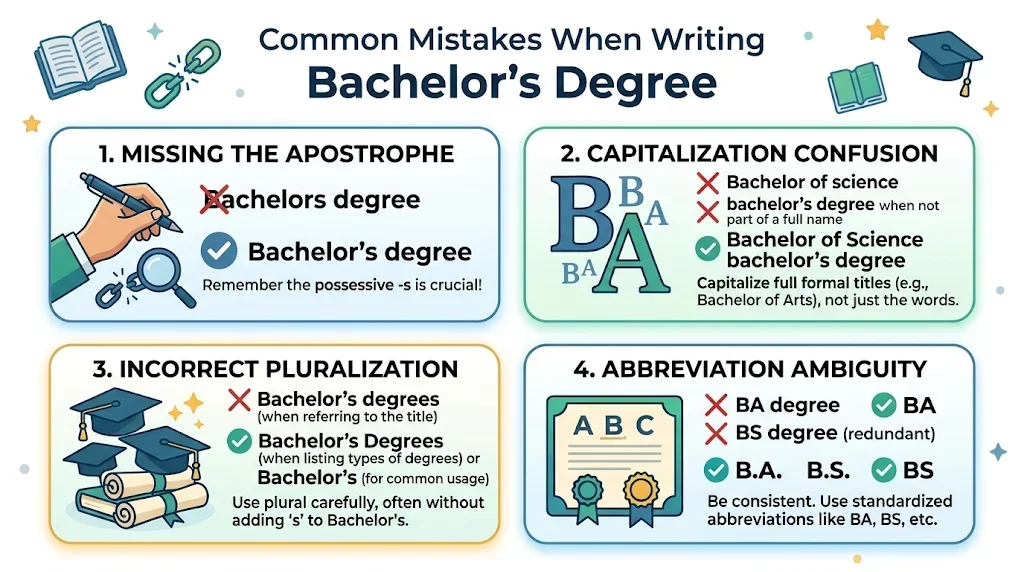
Common Mistakes When Writing Bachelor’s Degree
Small spelling and capitalization errors can make otherwise strong writing look careless. Fortunately, most mistakes involving bachelor’s degree are easy to correct once you understand the basic rules.
Here are the errors worth watching for.
| Incorrect form | Correct form | Reason |
| Bachelors degree | Bachelor’s degree | The standard expression requires an apostrophe. |
| Bachelors’ degree | Bachelor’s degree | The plural possessive isn’t appropriate for the general qualification. |
| Bachelor’s of Science | Bachelor of Science | The formal title doesn’t use the possessive form. |
| A Bachelor’s Degree in Biology | A bachelor’s degree in biology | Lowercase the general description in ordinary prose. |
| Bachelor of science | Bachelor of Science | Capitalize the formal degree title. |
| Two bachelor’s degree | Two bachelor’s degrees | The plural noun must agree with the quantity. |
| Three bachelor’s degrees program | Three bachelor’s degree programs | The compound modifier takes the singular form here. |
Mistake: Adding an Apostrophe to the Wrong Word
A common error is writing Bachelor’s of Science. The apostrophe doesn’t belong in the formal title Bachelor of Science.
Use the following distinction:
- General description: She holds a bachelor’s degree in science.
- Formal title: She holds a Bachelor of Science.
The first describes the qualification broadly. The second names a particular type of degree.
Mistake: Confusing Degree Names With Fields of Study
Writers sometimes capitalize every academic subject after the word in. However, ordinary field names generally stay lowercase.
For example:
- Correct: a bachelor’s degree in mathematics
- Correct: a bachelor’s degree in psychology
- Correct: a bachelor’s degree in English
- Incorrect in ordinary prose: a bachelor’s degree in Psychology
The exception is a proper noun, such as English, or a formal title that follows the institution’s official wording.
Mistake: Forgetting the Plural
If you’re referring to more than one qualification, remember to pluralize degree.
For example:
- One bachelor’s degree
- Two bachelor’s degrees
- Several bachelor’s degree programs
The last example uses degree in the singular because it modifies programs. This is a common pattern in English: nouns used as modifiers often remain singular even when the main noun is plural.
Read More: 23 Best Replies to “It Is What It Is” Witty and Clever
FAQs
1. Is it bachelor’s degree or bachelors degree?
Bachelor’s degree is correct when referring to an academic qualification. The apostrophe shows possession. For example, “She earned a bachelor’s degree in nursing.”
2. Why does bachelor’s degree need an apostrophe?
The apostrophe indicates a possessive form. In bachelor’s degree, it connects the degree to the academic level of a bachelor. Without the apostrophe, the phrase is not standard English.
3. Should I capitalize bachelor’s degree?
Generally, no. Use lowercase when referring to a degree in general, such as “He has a bachelor’s degree.” Capitalize official degree names, such as Bachelor of Arts or Bachelor of Science.
4. Is bachelors ever correct without an apostrophe?
Yes. Bachelors is the plural form of bachelor and usually refers to two or more unmarried men. However, it is incorrect in the standard phrase “bachelors degree.”
5. Is bachelor’s degree correct on a resume?
Yes. You can write bachelor’s degree on your resume when describing your education. For example, “Bachelor’s degree in Computer Science.” You can also use the official degree name if appropriate.
6. What is the plural of bachelor’s degree?
The plural is bachelor’s degrees. The apostrophe remains because each degree is associated with the academic level of a bachelor. For example, “The university offers several bachelor’s degrees.”
7. Is it Bachelor’s Degree or Bachelor of Science?
Both forms can be correct in different contexts. Bachelor’s degree is a general term, while Bachelor of Science is the formal name of a specific degree. Official degree names are capitalized.
8. Is bachelor degree correct without the apostrophe and s?
In standard American English, bachelor’s degree is the preferred form. “Bachelor degree” is generally considered nonstandard in this context. Use the possessive form in academic and professional writing.
9. How do you write bachelor’s degree in a sentence?
Write it in lowercase unless it begins a sentence or appears in a context requiring capitalization. For example, “I earned a bachelor’s degree in English.” This is the standard form in ordinary writing.
10. Is it bachelor’s or bachelors when talking about education?
Use bachelor’s when referring to an academic qualification. For example, “She is pursuing a bachelor’s degree in psychology.” Use bachelors only when the plural noun is intended, not as a substitute for the possessive form.
Conclusion
Choosing between bachelor’s degree and bachelors degree is simple once you understand the role of the apostrophe. In standard American English, bachelor’s degree is the correct form when referring to an academic qualification. The apostrophe shows possession, while bachelors is generally the plural of bachelor and has a different meaning.
Remember to use lowercase for general references, such as “a bachelor’s degree,” and capitalize official degree names, such as Bachelor of Arts. Whether you are updating your resume, completing a job application, or writing an academic document, using the correct form makes your writing clearer and more professional.

For Shafiq ur Rehman, writing is an art form and grammar is the toolbox that makes it beautiful. As a dedicated content writer at Grammar Lantern, Shafiq approaches every topic like an architect carefully laying down strong foundations of understanding before adding the finer details. He loves diving into the trickiest grammar points and resurfacing with simple, bite-sized takeaways that anyone can grasp. When he’s not crafting articles, you’ll likely find him strategizing over a game of chess, exploring dusty local bookshops, or quietly jotting down poetic observations in his notebook.