The correct spelling is sugar, not Suggar or Suger. These incorrect forms are common spelling mistakes in English. Sugar is a valid word that refers to the sweet substance added to food and drinks. It works as both a noun and a verb. As a noun, sugar is something you might add to tea or coffee. As a verb, it means to add sugar to food or another substance. Learning the correct spelling helps improve your English vocabulary and everyday writing.
The confusion often comes from pronunciation. Although sugar begins with the letter s, its first sound resembles the “sh” sound. This pronunciation difference may lead people to guess alternative spellings. However, English spelling does not always match pronunciation exactly.
To avoid this common spelling error, remember the correct form: sugar. Practicing the word in sentences can improve spelling accuracy and help you recognize it in both spoken and written English.
Quick Answer
Sugar is the correct spelling in standard English. Suggar is a misspelling when referring to the sweet substance.
The word sugar contains five letters: S-U-G-A-R. It has only one g, and its spelling stays the same in both American and British English.
Here’s a quick comparison:
| Feature | Suggar | Sugar |
| Correct spelling | No | Yes |
| Number of letters | Six | Five |
| Number of g’s | Two | One |
| Standard English usage | Misspelling | Correct spelling |
| Meaning | Not the standard spelling of the intended word | A sweet substance used in food and drinks |
| Example | Please add suggar. | Please add sugar. |
Remember this simple rule: Write sugar with one g, not two.
What Does Sugar Mean?
The word sugar commonly refers to a sweet substance used to add sweetness to foods and beverages. It also has broader meanings in science, cooking, everyday conversation, and certain expressions.
Understanding how the word works in different contexts makes it easier to recognize and use correctly.
Sugar as a Noun
In everyday English, sugar is primarily a noun. It refers to a sweet substance, especially the kind people commonly add to coffee, tea, cereal, and baked goods.
Table sugar is usually sucrose, a carbohydrate made from glucose and fructose. Manufacturers commonly obtain it from sugarcane or sugar beets.
However, the word sugar can refer to different sugars depending on the context. Glucose, fructose, and lactose are examples of sugars found in foods.
Consider these sentences:
- I added a teaspoon of sugar to my coffee.
- The recipe requires two cups of sugar.
- Fresh fruit contains naturally occurring sugar.
- Please check the sugar content before buying the drink.
- She prefers her tea without sugar.
In each example, sugar names a substance or refers to the amount of that substance.
Notice that the spelling never changes to suggar. The number of g’s remains the same regardless of how much sugar you use or where you use it.
Sugar as a Verb
Although people most often use sugar as a noun, it can also function as a verb. As a verb, it means to add sugar to something.
For example:
- She likes to sugar her strawberries before serving them.
- The baker will sugar the pastry after it cools.
- You can sugar the fruit lightly if you want extra sweetness.
The word also appears in the expression sugarcoat, which means to make something unpleasant sound more acceptable than it really is.
For instance, consider this sentence:
“He didn’t sugarcoat the truth.”
This means he spoke honestly rather than making the truth seem less unpleasant.
These different uses demonstrate why learning the correct spelling matters. Whether you’re describing an ingredient or an action, the standard spelling remains sugar.
Sugar as a Term of Endearment
In informal conversation, people sometimes use sugar as an affectionate term for another person. The expression can sound warm, playful, or familiar, depending on the speaker and situation.
For example:
- “Thank you, sugar,” she said kindly.
- “Come here, sugar. I have something to show you.”
This use is more common in certain regions and social settings than others. It may sound natural among family members or close friends but overly familiar in a professional conversation.
The important point is that sugar keeps its standard spelling even when it expresses affection rather than referring to food.
What Is the Difference?
The difference between suggar and sugar comes down to one extra letter. Although that may seem insignificant, correct spelling helps readers understand your intended meaning without distraction.
Let’s examine the two forms more closely.
The Correct Spelling of Sugar
The standard spelling is:
S-U-G-A-R
The word contains five letters:
- S — the first letter
- U — the second letter
- G — the third letter
- A — the fourth letter
- R — the fifth and final letter
There is no second g between the first g and the letter a.
For example, write:
- Brown sugar
- White sugar
- Powdered sugar
- Sugar substitute
- Sugar content
All these expressions use the same spelling of sugar.
Read More: Buses or Bus’s or Bus’? Correct Possessive Explained
Why Suggar Is Incorrect
The spelling suggar contains six letters because it repeats the letter g. Standard English doesn’t recognize this form as an alternative spelling of the sweet substance.
Writers may produce the mistake because they type too quickly, remember the word incorrectly, or assume that the consonant should be doubled.
However, adding a letter doesn’t automatically create a valid spelling variation. English words follow established spelling conventions, and sugar is the accepted form.
Compare these sentences:
Incorrect: I need some suggar for my tea.
Correct: I need some sugar for my tea.
Incorrect: The cake contains too much suggar.
Correct: The cake contains too much sugar.
The intended meaning is easy to understand in both incorrect sentences. Nevertheless, the correct spelling makes the writing more polished and appropriate for school, work, and publication.
Why Do People Confuse?
Spelling mistakes often happen when a familiar word doesn’t look quite the way someone expects. Since suggar and sugar differ by only one letter, it’s easy to overlook the error while typing.
Several factors can contribute to this confusion.
Typing Too Quickly
Fast typing can lead to repeated letters, missing letters, or accidental substitutions. Sometimes, your fingers move faster than your attention.
For example, you might intend to write “Please buy sugar” but accidentally type “Please buy suggar.” If you don’t reread the message, the error may remain unnoticed.
This is especially common when writing quickly on a phone, where autocorrect may not always identify the intended correction.
A practical solution: Read your writing once before sending it. Pay special attention to words that contain repeated consonants or unfamiliar letter combinations.
Remembering the Word Incorrectly
People don’t always remember the exact spelling of a word, even when they use it regularly. You might recognize sugar immediately when reading it but hesitate when spelling it from memory.
This happens because recognizing a familiar word and reproducing its spelling are different tasks.
For example, someone might remember that the word contains the letters s, u, g, a, and r but mistakenly add another g. The result looks plausible at first glance, even though it’s incorrect.
Repeated exposure to the correct form can strengthen your memory. Reading recipes, ingredient labels, and everyday sentences containing sugar helps reinforce the standard spelling.
Confusion About English Spelling Rules
English spelling can be unpredictable. Some words double consonants when adding endings, while others retain a single consonant.
Consider these examples:
- Run → running: The final consonant doubles when the suffix is added.
- Big → bigger: The final g doubles in the comparative form.
- Sugar → sugar: The original spelling contains only one g.
The word bigger might make a doubled g look familiar, but that doesn’t mean every word containing g follows the same pattern.
The key is to learn each word’s accepted spelling rather than applying one spelling rule to every situation.
How to Spell Sugar Correctly
The easiest way to spell sugar correctly is to remember its five letters and practice using it in familiar sentences.
Write the word slowly the first few times: S-U-G-A-R. Once the sequence becomes familiar, you’ll be less likely to add an unnecessary letter.
An Easy Trick to Remember Sugar
Use this simple reminder:
Sugar has one g, and that’s enough.
You can also connect the word to familiar expressions you already know, such as sugar bowl, sugar cookie, and sugar-free drink.
Here are a few practical ways to reinforce the spelling:
- Write sugar five times while looking at the correct spelling.
- Use the word in three original sentences.
- Check the spelling when writing a grocery list or recipe.
- Read the ingredient labels on common food products.
- Correct suggar whenever you notice it in your own writing.
You don’t need to spend hours memorizing a five-letter word. A little focused practice is usually enough to make the correct spelling feel natural.
Learn Sugar Through Common Word Combinations
Learning words in phrases can be more useful than memorizing them in isolation. When you remember the word as part of a familiar expression, you also learn how it appears in everyday writing.
| Word or phrase | Example sentence |
| Brown sugar | Brown sugar gives the cookies a rich flavor. |
| White sugar | The recipe calls for one cup of white sugar. |
| Powdered sugar | Sprinkle powdered sugar over the cake. |
| Sugar-free | She bought a sugar-free beverage. |
| Sugar content | Check the sugar content on the label. |
| Sugar substitute | Honey is sometimes used as a sugar substitute in recipes. |
Each phrase reinforces the same spelling. No extra g is needed.
Correct and Incorrect Examples
Examples make spelling rules easier to apply. Instead of simply memorizing that sugar is correct, look at how the word appears in realistic sentences.
The following comparisons show how to correct the mistake in different situations.
| Incorrect sentence | Correct sentence |
| Please pass the suggar. | Please pass the sugar. |
| I need suggar for this cake. | I need sugar for this cake. |
| How much suggar should I add? | How much sugar should I add? |
| She drinks tea without suggar. | She drinks tea without sugar. |
| The recipe requires one cup of suggar. | The recipe requires one cup of sugar. |
| This drink contains too much suggar. | This drink contains too much sugar. |
| We ran out of suggar yesterday. | We ran out of sugar yesterday. |
| Add a little suggar to the mixture. | Add a little sugar to the mixture. |
Notice that correcting the mistake requires changing only one letter. You don’t need to rewrite the sentence or change its meaning.
Sugar in Everyday Sentences
Here are additional examples showing how sugar works in different contexts.
1.In cooking: “Add two tablespoons of sugar to the mixture before stirring.”
2.In conversation: “Would you like sugar in your coffee?”
3.In shopping: “I need to buy a bag of sugar from the grocery store.”
4.In nutrition: “The nutrition label lists the amount of sugar per serving.”
5.In baking: “The recipe uses brown sugar to add sweetness and moisture.”
6.In informal speech: “Don’t worry, sugar. Everything will be fine.”
These examples show that the correct spelling remains unchanged across different meanings and situations.
A Practical Case Study: Correcting a Recipe
Imagine you’re preparing a recipe for a food blog. Your ingredient list reads:
- 2 cups of flour
- 1 cup of suggar
- 2 eggs
- 1 teaspoon of vanilla extract
The extra g might seem harmless because readers can probably understand what you mean. However, publishing the recipe with that mistake makes the content look less carefully edited.
The corrected ingredient list should read:
- 2 cups of flour
- 1 cup of sugar
- 2 eggs
- 1 teaspoon of vanilla extract
This small correction improves the quality of the recipe without changing its ingredients or instructions.
The same principle applies to emails, school assignments, product descriptions, and social media posts. Correct spelling helps readers focus on your message rather than noticing avoidable errors.
Is Suggar Ever a Correct Word?
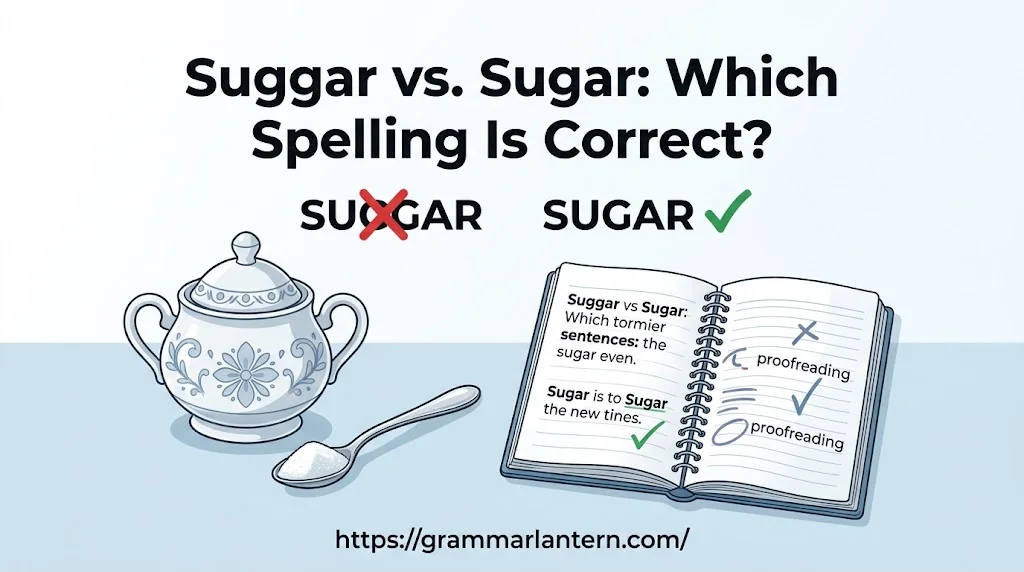
In standard English, suggar is not the correct spelling of the sweet substance. If you’re writing about an ingredient, a recipe, or sugar content, use sugar.
However, unusual spellings can appear in specific naming contexts. A person might use Suggar as a username, a fictional name, or a deliberately chosen brand name. Such a choice doesn’t make it the standard spelling of the ordinary English word.
Context matters here.
For example, if a fictional character is named Suggar, you should preserve that character’s name when writing about them. If you’re asking someone to add a sweet ingredient to coffee, however, the correct word is sugar.
Use sugar in:
- School assignments and examinations
- Professional emails and reports
- Recipes and cooking instructions
- Blog posts and website content
- Product descriptions and ingredient lists
- Everyday messages and conversations
Unless you’re reproducing a deliberate name or stylized spelling, there’s no reason to use suggar instead of sugar.
In American and British English
Some English words have different accepted spellings in American and British English. For instance, American English generally uses color, while British English commonly uses colour.
The difference between suggar and sugar doesn’t follow that pattern.
Sugar is the standard spelling in both American and British English. Neither variety adds a second g.
| American English | British English |
| Sugar | Sugar |
| Brown sugar | Brown sugar |
| Sugar-free | Sugar-free |
| Sugar content | Sugar content |
This consistency makes the word straightforward to use, regardless of which variety of English you follow.
If you’re writing for an American audience, use sugar. If you’re writing for a British audience, use sugar as well.
There is no regional spelling choice to consider.
Common Spelling Mistakes
Although suggar is the main spelling mistake discussed here, other incorrect forms can appear in writing. These errors may result from typing mistakes, pronunciation confusion, or uncertainty about the word’s letter sequence.
Here are some examples.
| Incorrect spelling | Correct spelling |
| Suggar | Sugar |
| Suger | Sugar |
| Sugarr | Sugar |
| Shugar | Sugar |
Each incorrect form differs from the standard spelling in a particular way.
- Suggar adds an extra g.
- Suger replaces the letter a with e.
- Sugarr adds an extra r.
- Shugar uses h where the standard spelling has no h.
These forms aren’t standard alternatives when referring to the sweet substance.
How to Avoid These Spelling Mistakes
You can prevent many spelling errors by checking the word’s exact letter sequence before publishing or submitting your writing.
Try these simple habits:
- Memorize the correct form: Sugar contains five letters.
- Watch repeated consonants: Don’t add a second g or r.
- Use spell-check tools: A spelling checker may flag incorrect forms.
- Proofread carefully: Read the sentence again before sending it.
- Practice with phrases: Remember expressions such as brown sugar and sugar bowl.
Spell-check tools are helpful, but they aren’t perfect. A careful review remains useful, especially when a typo appears in a heading or an important ingredient list.
Read More: 8 Words for Someone Who Follows the Rules
FAQs
1. Is it Suggar or Sugar?
Sugar is the correct spelling. Suggar is a misspelling and should not be used in standard English.
2. Is Suger a correct English word?
No, Suger is an incorrect spelling of sugar. Use sugar when referring to the sweet substance added to food and drinks.
3. Why do people confuse Suggar and Sugar?
People may confuse these spellings because of the word’s pronunciation. The first sound resembles “sh,” which can make the spelling less obvious.
4. What does sugar mean?
Sugar is a sweet substance commonly used in foods, desserts, tea, and coffee to add sweetness.
5. Is sugar a noun or a verb?
Sugar can function as both a noun and a verb. As a noun, it names a sweet substance. As a verb, it means to add sugar to something.
6. How do you use sugar in a sentence?
You can write, “I added a teaspoon of sugar to my tea.” Here, sugar refers to the substance used to sweeten the drink.
7. Is Suggar acceptable in informal writing?
Suggar is still a misspelling, even in informal writing. Use sugar to keep your messages and other written communication accurate.
8. What is the plural form of sugar?
Sugar is generally an uncountable noun, so it usually has no plural form. However, sugars can refer to different types of sugar in scientific or technical contexts.
9. How can I remember the correct spelling of sugar?
Practice writing sugar in short sentences and check its spelling when proofreading. Regular practice can help you remember the correct form.
10. Does sugar have the same spelling in American and British English?
Yes, sugar is spelled the same way in American and British English. The spelling does not change between these varieties of English.
Conclusion
When comparing Suggar vs. Sugar, remember that sugar is the correct spelling in standard English. Suggar and Suger are misspellings that you should avoid in formal and informal writing. Although the pronunciation may cause confusion, learning the correct spelling makes your communication clearer.
To improve your spelling accuracy, practice using sugar in everyday sentences and proofread your writing before sharing it. Remembering this simple rule will help you avoid common spelling mistakes and build confidence in your English vocabulary.