Auxiliary vs. Auxillary: Which Spelling Is Correct? is a common question for English learners and writers. Although these similar words sound alike, only auxiliary is the correct spelling. It means providing additional help, extra support, or supplementary assistance. For example, an auxiliary worker provides extra help, while an auxiliary power supply offers additional power when needed. In contrast, auxillary is a misspelling, not a separate word with a different meaning.
A simple way to remember the correct word is to notice the extra letter i in auxiliary. Understanding the auxiliary definition and auxiliary meaning can improve your English vocabulary and writing skills. Whether you’re studying grammar, practicing English, or preparing an important document, accurate spelling matters.
During proofreading, watch for spelling mistakes and other writing errors. Choosing the proper spelling improves grammatical accuracy, spelling accuracy, and correct usage in written communication. Remember, auxiliary is correct, while auxillary is incorrect. This simple distinction will help you avoid confusion and strengthen your everyday writing.
Quick Answer
Auxiliary is the correct spelling in standard American English. Auxillary is an incorrect spelling of the same intended word, not a standard alternative with a different meaning.
| Word | Correct or incorrect? | Meaning |
| Auxiliary | Correct | Providing additional help, support, or assistance |
| Auxillary | Incorrect | A common misspelling of auxiliary |
Correct: The hospital hired auxiliary staff to support its medical team.
Incorrect: The hospital hired auxillary staff to support its medical team.
The main difference lies in the letters near the end of the word. The correct spelling is a-u-x-i-l-i-a-r-y. Remember the complete sequence rather than relying on how the word sounds.
When you need this word in an essay, email, report, or workplace document, choose auxiliary every time.
What Does Auxiliary Mean?
The word auxiliary describes something that provides extra help, support, or assistance. It often refers to a person, service, piece of equipment, or group that supports a main person or system.
For example, a hospital might employ auxiliary staff to help its primary medical team. A building might have an auxiliary power supply that supports essential equipment when the main supply fails.
The word can function as both an adjective and a noun. Its exact meaning depends on how you use it in a sentence.
Auxiliary as an Adjective
As an adjective, auxiliary describes something that supplements or supports a primary function. It suggests that a person or thing provides additional assistance rather than serving as the main component.
Consider these examples:
- The hospital installed an auxiliary power system to support essential equipment.
- Our school hired auxiliary staff for the annual examination.
- The technician checked the auxiliary battery before starting the machine.
- The organization created an auxiliary fund for emergency expenses.
- The company uses auxiliary equipment to support its production line.
In each sentence, auxiliary describes something that serves a supporting role. The word doesn’t necessarily mean that the item is unimportant. An auxiliary system may become essential when the main system fails.
For instance, backup power might sit unused for months. During an outage, however, that auxiliary system can keep critical equipment running.
Auxiliary as a Noun
Auxiliary can also function as a noun. In this role, it refers to a person, group, or organization that provides additional assistance.
The noun appears in organizational, military, and volunteer settings. Its precise meaning depends on the context.
Examples include:
- The hospital auxiliary organized a fundraising event.
- The military auxiliary supported the main force.
- A local auxiliary helped coordinate the community’s relief efforts.
- Several auxiliaries volunteered to assist the organization.
Notice that the noun doesn’t always refer to an individual. It can describe a supporting group or organizational unit.
The plural form is auxiliaries. For example, “The organization invited several auxiliaries to its annual meeting.”
Auxiliary in English Grammar
In English grammar, an auxiliary verb is a helping verb that works with a main verb to express grammatical information or form a particular construction.
The primary auxiliary verbs are be, have, and do. Their forms include am, is, are, was, were, has, have, had, does, and did.
For example:
- She is working on her assignment.
- They have completed the project.
- Do you understand the instructions?
- He did not attend the meeting.
- We were waiting for the bus.
The bolded words function as auxiliary verbs in these sentences. They help form continuous tenses, perfect constructions, questions, or negative statements.
Modal auxiliary verbs include can, could, may, might, must, shall, should, will, and would. They express ideas such as ability, possibility, permission, obligation, and intention.
Consider this example: “You should check the spelling before submitting your report.”
Here, should is a modal auxiliary that expresses advice.
The grammatical term follows the same spelling rule. Write auxiliary verb, never auxillary verb, in standard English.
Read More: Rules for Writing Out Numbers: A Complete Guide With Examples
What Does Auxillary Mean?
Auxillary is a common misspelling of auxiliary. In standard contemporary English, it isn’t an accepted alternative spelling for the intended meaning.
Writers may produce this error because they remember the general shape of the word but misplace its letters. The mistake can appear in informal messages, unedited documents, online searches, and even professional drafts.
Consider these corrections:
- Incorrect: The company installed an auxillary power supply.
- Correct: The company installed an auxiliary power supply.
Another example:
- Incorrect: She works as an auxillary nurse.
- Correct: She works in an auxiliary nursing role.
The second correction illustrates an important point: although auxiliary is spelled correctly, the most appropriate job title may vary by country, employer, and healthcare system. Correct spelling doesn’t automatically make every job title universally accurate.
If you encounter auxillary in a document, check the context. In most cases, the writer intends to use auxiliary.
There is no need to treat the two forms as words with separate definitions. For ordinary standard English writing, use auxiliary.
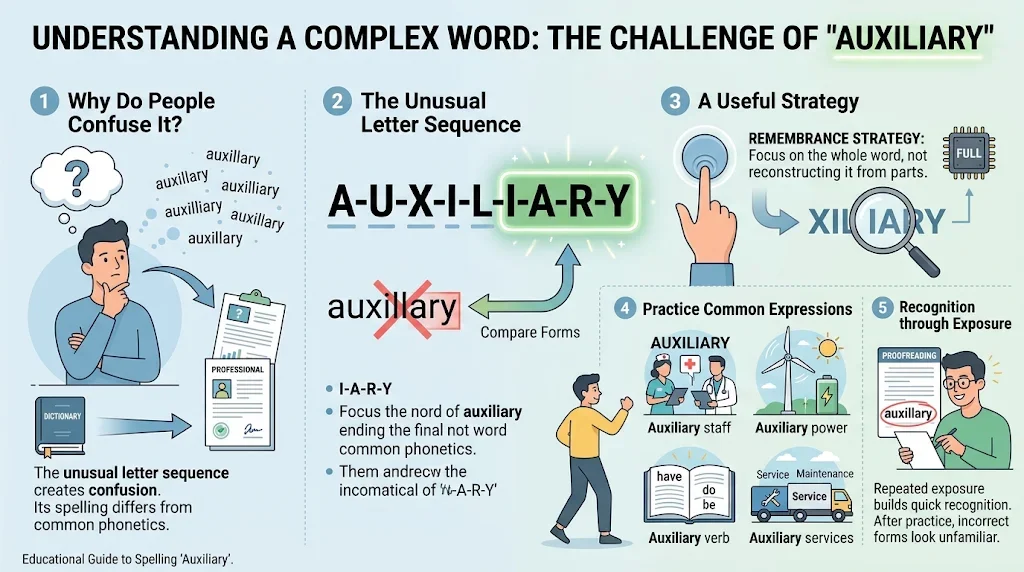
Why Do People Confuse?
The confusion usually comes from the word’s unusual letter sequence. Although auxiliary appears in dictionaries and professional writing, its spelling doesn’t always match what people expect when they hear it.
The Unusual Letter Sequence in Auxiliary
Look closely at the correct spelling:
A-U-X-I-L-I-A-R-Y
The final part contains the sequence I-A-R-Y. In auxillary, writers often replace this sequence with a more familiar-looking arrangement that drops the second i.
Compare the two forms:
- Correct: auxiliary
- Incorrect: auxillary
A useful strategy is to remember the full word instead of trying to reconstruct it from memory. The middle letters matter just as much as the beginning and ending.
You can also practice writing a few common expressions:
- Auxiliary staff
- Auxiliary power
- Auxiliary verb
- Auxiliary services
Repeated exposure to the correct spelling helps you recognize it more quickly. After a while, auxillary should look unfamiliar whenever you proofread your work.
Why Pronunciation Can Be Misleading
Pronunciation can contribute to spelling mistakes because people don’t always hear every syllable clearly. Unstressed sounds often blend together during ordinary conversation.
In American English, dictionaries commonly represent the pronunciation of auxiliary as approximately /ɑɡˈzɪl.i.er.i/. The exact pronunciation varies by accent.
The important point is that pronunciation alone may not help you remember every letter. Even if you can say the word correctly, you might still type it incorrectly.
For accurate writing, combine pronunciation with visual recognition. Read the word, write it, and use it in a complete sentence.
How to Spell Auxiliary Correctly
The easiest way to avoid this mistake is to learn the correct spelling as a complete unit.
Auxiliary = A-U-X-I-L-I-A-R-Y
Don’t remove the second i. Don’t substitute an a for it. The standard spelling includes both letters in their proper positions.
A Simple Trick to Remember Auxiliary
Try this practical memory technique:
- Write auxiliary three times.
- Underline the letters ILI in the middle.
- Read the phrase “auxiliary support” aloud.
- Write one original sentence using the word.
- Check your spelling before moving to the next task.
For example: “The building has an auxiliary generator for emergencies.”
The sentence connects the word with a clear meaning. You’re not simply memorizing letters; you’re learning how the word works in context.
Another helpful trick is to associate auxiliary with the idea of extra assistance. Think of an auxiliary system as a helper waiting in the wings. It supports the main system when needed.
However, don’t rely on the memory trick alone. If you’re writing something important, check the spelling with a trusted dictionary or a reliable spell-checking tool.
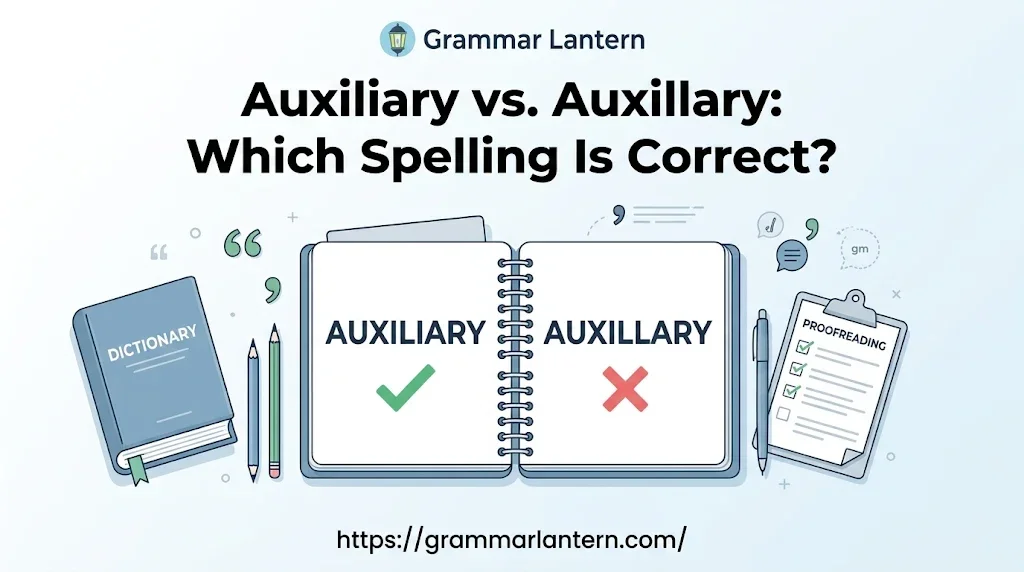
Common Auxiliary Spelling Mistakes
The most common mistake discussed here is auxillary. Writers may also create other errors when typing unfamiliar words or rearranging letters.
Use this table to check your writing:
| Incorrect or doubtful form | Correct form |
| Auxillary staff | Auxiliary staff |
| Auxillary power | Auxiliary power |
| Auxillary verb | Auxiliary verb |
| Auxillary services | Auxiliary services |
| Auxillary equipment | Auxiliary equipment |
The expressions in the right column use the standard spelling. The left column shows the common misspelling in context.
A practical proofreading tip: search your document for auxillary before submitting it. A quick search can catch every occurrence without requiring you to reread the entire document.
Examples in Sentences
Examples make the distinction easier to remember because they show how the word appears in real writing situations.
Correct Examples Using Auxiliary
Here are seven sentences that demonstrate the correct spelling across different contexts.
- The hospital installed an auxiliary power supply to support essential equipment during an outage.
- The school hired auxiliary staff to supervise students during the examination.
- The technician tested the auxiliary battery before starting the machine.
- The community’s auxiliary organization raised money for local families.
- In the sentence “She has finished her work,” has functions as an auxiliary verb.
- The military auxiliary provided logistical support to the main force.
- The boat uses an auxiliary engine when the wind isn’t strong enough.
Each example uses auxiliary to describe support, additional equipment, a supporting group, or a grammatical function.
Notice that the word’s meaning changes slightly with the context. An auxiliary engine supports a boat’s main means of propulsion, while an auxiliary verb helps form a grammatical construction.
The spelling remains the same in every case.
Incorrect Examples Using Auxillary
The following examples show mistakes that writers should correct.
Incorrect: The school hired auxillary staff.
Correct: The school hired auxiliary staff.
Incorrect: Please check the auxillary power supply.
Correct: Please check the auxiliary power supply.
Incorrect: Has is an auxillary verb in this sentence.
Correct: Has is an auxiliary verb in this sentence.
These corrections don’t require changes to the sentence structure. You only need to replace the misspelled word with the standard form.
That simplicity makes this error easy to fix once you recognize it. The challenge is catching the mistake before someone else reads your work.
A Short Editing Case Study
Imagine that a student writes the following paragraph in an assignment:
“The hospital purchased an auxillary generator. It also hired auxillary workers to help during busy shifts. The teacher asked us to identify the auxillary verb in the final sentence.”
The paragraph contains three instances of the same spelling mistake. A quick review produces this corrected version:
“The hospital purchased an auxiliary generator. It also hired auxiliary workers to help during busy shifts. The teacher asked us to identify the auxiliary verb in the final sentence.”
The lesson is straightforward: one spelling error can appear repeatedly when you rely on the same incorrect form. Correcting it throughout the document improves consistency and makes the writing more professional.
In Different Contexts
The word auxiliary appears in several fields. Learning these common expressions helps you recognize the correct spelling more naturally.
Auxiliary in Healthcare and Education
Hospitals, clinics, and educational institutions often use auxiliary to describe supporting staff, services, or resources.
Examples include:
- Auxiliary staff supporting a hospital’s main team
- Auxiliary services that help an institution operate
- An auxiliary organization that raises funds for a school
- Additional support staff helping during a busy period
The exact meaning depends on the institution. An auxiliary employee may have different duties, qualifications, and responsibilities from a registered professional.
For this reason, don’t assume that auxiliary nurse or another occupational title means the same thing everywhere. Use the official job title when describing a particular position.
The spelling rule, however, doesn’t change. Write auxiliary in every standard expression.
Auxiliary in Technology and Engineering
Technical writing uses auxiliary to describe equipment or systems that supplement a primary component.
Common examples include:
- Auxiliary power: An additional power source that supports a system.
- Auxiliary battery: A secondary battery used for supporting electrical functions.
- Auxiliary input: An additional input connection on compatible equipment.
- Auxiliary equipment: Devices that help a primary machine or process operate.
- Auxiliary engine: An engine that supplements a vessel’s primary propulsion arrangement.
Consider a building with an emergency generator. The generator may remain idle during normal operation, but it can supply power when the main source fails.
In that situation, auxiliary describes the generator’s supporting role. It doesn’t necessarily mean the equipment is optional or unimportant.
Technical documents should use the correct spelling because errors can distract readers and make instructions appear less reliable.
Auxiliary in Military and Organizational Settings
The word can also describe a supporting military force or an organization associated with a larger group.
For example, an auxiliary force may provide logistical assistance, transportation, or other support. The precise responsibilities depend on the organization and its operating structure.
Outside military settings, a community group may have an auxiliary that organizes fundraising events or supports a larger institution.
Here are two examples:
- The military auxiliary helped transport supplies.
- The hospital auxiliary organized a community fundraiser.
Both sentences use the same spelling, although the organizations perform different functions.
Auxiliary in Everyday and Professional Writing
You might also encounter the word in reports, maintenance instructions, business correspondence, and equipment manuals.
For example:
- “Please use the auxiliary entrance during construction.”
- “The technician inspected the auxiliary circuit.”
- “Our team arranged auxiliary support for the event.”
- “The vehicle has an auxiliary charging connection.”
When writing about a specific product or technical system, check the manufacturer’s terminology. A phrase may have a precise technical meaning beyond the general definition of auxiliary.
Regardless of the field, auxillary remains the wrong spelling for the intended standard English word.
Key Differences at a Glance
If you need a quick way to distinguish these spellings, focus on correctness, meaning, and usage.
| Feature | Auxiliary | Auxillary |
| Spelling status | Correct | Incorrect in standard English |
| Meaning | Providing additional help or support | No separate standard meaning for the intended word |
| Part of speech | Noun or adjective; also used in grammatical terms | Misspelling |
| Common expressions | Auxiliary staff, auxiliary power, auxiliary verb | Incorrect versions of these expressions |
| Use in academic writing | Appropriate | Should be corrected |
| Use in professional documents | Appropriate | Should be corrected |
| Plural form | Auxiliaries | Not a standard plural form |
The distinction is simple: auxiliary is the correct word, and auxillary is a misspelling.
Remember that auxiliary doesn’t always mean a backup that remains unused. It can describe any person, service, or system that provides additional support.
How to Choose the Right Word Every Time
When you’re unsure whether to write auxiliary or auxillary, follow these practical steps.
- Check the spelling: Confirm that the word contains the correct sequence of letters.
- Consider the meaning: If you mean additional assistance or a helping verb, auxiliary is likely the word you need.
- Read the sentence aloud: This can help you notice awkward wording, although it won’t always reveal a spelling error.
- Use a dictionary: Look up unfamiliar words instead of relying entirely on memory.
- Proofread repeated terms: Search your document for auxillary to find accidental repetitions.
- Check technical terminology: If you’re writing about a particular device, job title, or system, verify the exact term.
These habits work for more than this single word. They can also help you catch errors in other unfamiliar spellings.
Read More: 5 Good Synonyms for Having Mixed Feelings Meaning Explained
FAQs
1. Is auxiliary or auxillary correct?
Auxiliary is the correct spelling. Auxillary is a common misspelling and should be avoided in formal and informal writing.
2. What does auxiliary mean?
Auxiliary means providing extra help, support, or assistance. For example, an auxiliary power source provides additional electricity when needed.
3. Why do people misspell auxiliary as auxillary?
People often write auxillary because they pronounce the word incorrectly or confuse its vowel pattern. Remembering the correct spelling can help prevent this mistake.
4. Is auxillary a real English word?
No. Auxillary is not the standard spelling of an English word. Use auxiliary instead.
5. How do you pronounce auxiliary?
Auxiliary is commonly pronounced awg-ZIL-yuh-ree or awg-ZIL-yuh-ree, depending on the speaker’s accent.
6. What is an example of auxiliary in a sentence?
Here is an example: “The hospital hired auxiliary staff to help during the busy season.”
7. What are some synonyms for auxiliary?
Common synonyms include additional, supplementary, supporting, extra, and backup. The best choice depends on the sentence.
8. What does auxiliary staff mean?
Auxiliary staff are people who provide extra assistance to an organization or its main workforce. They may help with administrative tasks, patient care, or daily operations.
9. Is auxiliary used in grammar?
Yes. In grammar, an auxiliary verb helps the main verb express tense, mood, voice, or questions. Examples include be, have, do, and modal verbs such as can and will.
10. How can I remember the spelling of auxiliary?
Remember that auxiliary contains an i before the final ary sound. Practice writing it in phrases such as auxiliary verb, auxiliary staff, and auxiliary power.
Conclusion
Choosing between auxiliary and auxillary is simple once you remember the correct spelling. Auxiliary is the standard English word, meaning extra help, support, or assistance. Auxillary is a misspelling, so avoid using it in your writing.
To improve your spelling, practice using auxiliary in everyday sentences and check your work when proofreading. Whether you’re writing about auxiliary verbs, auxiliary staff, or auxiliary power, using the correct spelling makes your writing clearer and more professional.