Have you ever stopped while reading a sentence and wondered what “As In” Meaning and Correct Use actually means? This short expression is common in everyday conversations, emails, and academic writing, but its function can sometimes be confusing. Understanding as in can improve your English usage, strengthen your grammar skills, and help you express ideas more clearly and naturally.
The phrase as in is commonly used to clarify, specify, or provide an example of something previously mentioned. It can be useful in casual conversations as well as business communication, meetings, reports, and formal writing. Using it correctly helps readers and listeners understand exactly what you mean and prevents unnecessary confusion.
In this guide, you will learn the meaning of as in, how to use it correctly, and which common mistakes to avoid. You will also find practical examples from everyday conversations, workplace communication, scheduling, and other real-life situations. By the end, you will be able to use as in confidently and accurately.
What Does “As In” Mean?
The phrase “as in” generally means “in the sense of,” “meaning,” or “specifically referring to.”
You use it when you want to clarify what you mean by a word, phrase, description, or idea.
Consider this sentence:
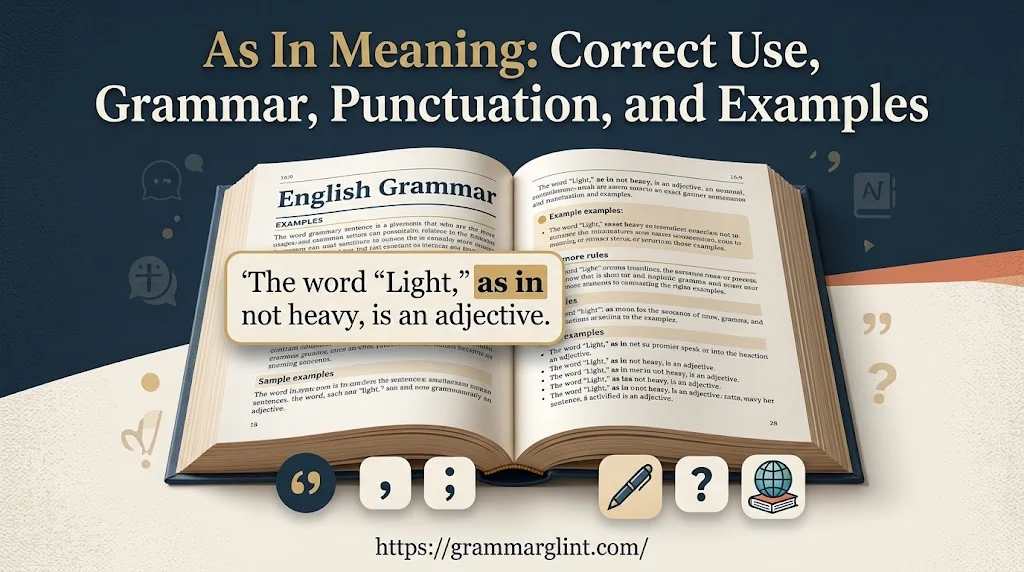
“I mean light, as in not heavy.”
The word light has several meanings. It can describe something that weighs little, something that provides illumination, or something with a pale color. The phrase as in not heavy identifies the intended meaning.
That clarification is the key function of as in.
Basic definition of “as in”
As in is used to:
- clarify the meaning of a word
- identify a particular interpretation
- provide a specific example
- make a broad statement more precise
- confirm what another person means
- introduce an illustration of an idea
- identify a letter using a representative word
The exact meaning depends on the sentence.
For example:
- I mean “bank,” as in the place where you deposit money.
- We need casual clothes, as in jeans and sneakers.
- You said you’re leaving, as in leaving the company?
- That’s expensive, as in more than $1,000.
In each example, as in narrows or explains the preceding idea.
The Core Meaning of “As In”
The easiest way to understand as in is to think of it as a verbal spotlight.
A speaker makes a statement that could have several interpretations. Then as in shines a light on the intended one.
For example:
“She wants a lighter bag, as in one that weighs less.”
The adjective lighter could refer to weight, color, brightness, or even intensity. The phrase after as in removes that uncertainty.
Read More: Incall vs Outcall: Understanding the Difference, Benefits and Costs
Another example:
“He works in media, as in television production.”
The word media covers a huge field. The phrase after as in identifies the specific area under discussion.
This makes as in especially useful when a word carries multiple meanings or when a category feels too broad.
How to Use “As In” to Clarify Meaning
One of the most common uses of as in involves ambiguous words.
English contains many words with multiple meanings. Without additional context, readers may interpret them differently.
The phrase as in lets you remove that ambiguity quickly.
Example with “bank”
Consider:
I mean the bank, as in the financial institution.
Here, bank could mean a financial institution or the land beside a river. The clarification tells readers which meaning applies.
Example with “light”
I mean light, as in not heavy.
The clarification distinguishes light from meanings associated with illumination or color.
Example with “bat”
I mean a bat, as in the animal.
The word bat can refer to an animal or a piece of sports equipment.
Example with “match”
I watched the match, as in the soccer game.
The clarification identifies the intended meaning.
Example with “bow”
He picked up the bow, as in the weapon.
The word bow has multiple meanings and pronunciations. The phrase after as in makes the intended sense unmistakable.
This pattern is particularly useful in conversation because people don’t always have time to provide lengthy explanations.
“As In” to Give a Specific Example
As in can also introduce a concrete example of something previously mentioned.
For instance:
I like outdoor activities, as in hiking and cycling.
The first part gives a broad category: outdoor activities. The phrase after as in gives specific examples.
Another example:
We need natural materials, as in wood and cotton.
The phrase doesn’t necessarily define the entire category. Instead, it illustrates the type of thing being discussed.
You can use this pattern when a broad noun or concept needs immediate context.
Common structures include:
- category + as in + example
- description + as in + example
- general idea + as in + specific instance
Examples:
- She enjoys creative hobbies, as in painting and photography.
- We’re looking for simple meals, as in soup, rice, and grilled vegetables.
- He likes classic cars, as in older Ford and Chevrolet models.
- The company sells outdoor equipment, as in tents and sleeping bags.
The phrase works because the reader can move from the general concept to the concrete example.
“As In” to Make a Statement More Precise
Sometimes a speaker makes a broad statement and then immediately sharpens it.
For example:
He was angry, as in genuinely furious.
The first statement is broad. The second part intensifies and specifies it.
Consider another example:
The trip was expensive, as in several thousand dollars.
The word expensive means different things to different people. Adding a specific amount gives the reader a clearer reference point.
This construction often appears in conversational English.
More examples include:
- It was cold, as in freezing.
- She was tired, as in ready to fall asleep.
- The project is difficult, as in we may need another month.
- He’s successful, as in he owns several companies.
- The building is old, as in more than a century old.
Here, as in introduces information that sharpens the previous statement.
“As In” as a Clarification Question
You may also hear “As in…?” when someone wants clarification.
This use is especially common in conversation.
Imagine someone says:
“I’m moving.”
You might respond:
“As in, moving to another city?”
The phrase asks the speaker to specify what moving means.
Another example:
“I quit my job.”
“As in, you resigned?”
The listener isn’t asking for a dictionary definition. They want to confirm the exact meaning of the statement.
This conversational structure can be extremely efficient.
Common clarification questions
- As in, right now?
- As in permanently?
- As in the entire project?
- As in you don’t want to go?
- As in the red one?
- As in tomorrow morning?
- As in you’re leaving the company?
The tone can range from neutral curiosity to surprise.
For example:
“I’m getting married.”
“As in, you’re getting married next month?”
The second speaker uses as in to confirm a significant detail.
“As In” for Letters and Spelling
Another familiar use appears when people identify letters verbally.
You may hear:
“B as in boy.”
This means the speaker wants to make the letter B unmistakable.
Phone conversations provide a good example. If someone says:
“My name starts with M as in mother.”
they’re using a representative word to distinguish M from similar-sounding letters.
Other examples include:
- A as in apple
- B as in boy
- C as in Charlie
- D as in dog
- M as in mother
- P as in Peter
- T as in tiger
The exact representative word can vary. The purpose remains the same: prevent misunderstanding when communicating letters aloud.
Common “As In” Sentence Patterns
Understanding common patterns makes the phrase much easier to use naturally.
Noun + “as in” + clarification
I mean the bank, as in the financial institution.
I’m talking about a bat, as in the animal.
This structure works especially well with ambiguous nouns.
Adjective + “as in” + explanation
The room is small, as in barely large enough for two people.
The job is demanding, as in you’ll work long hours.
The phrase explains what the adjective means in that particular situation.
Broad category + “as in” + examples
I like winter sports, as in skiing and snowboarding.
We need office supplies, as in paper, folders, and pens.
This structure moves from a general category toward specific examples.
Statement + “as in” + precise clarification
He was late, as in almost an hour late.
The repair was expensive, as in $2,000.
This construction adds precision to an earlier statement.
Read More: As Well vs. Aswell: Complete Grammar Guide
“As in…?” as a standalone question
“She’s leaving.”
“As in today?”
This is natural in conversation and informal communication.
Does “As In” Need Commas?
Punctuation around as in depends on how the phrase functions in the sentence.
There isn’t a universal rule that says you must always put commas before or after as in.
Compare these examples:
I mean light as in not heavy.
I mean light, as in not heavy.
Both constructions can work depending on the writer’s intended structure and rhythm. The comma can make the clarification feel more parenthetical.
When the phrase interrupts the sentence as an aside, commas can clearly separate it:
She wanted something casual, as in jeans and sneakers, rather than a formal dress.
However, punctuation shouldn’t become a mechanical exercise. Look at the role of the phrase within the sentence.
When commas can improve readability
Commas can help when as in introduces an obvious parenthetical clarification.
For example:
He was furious, as in completely out of control.
The comma signals that the following phrase elaborates on furious.
Another example:
We need a larger vehicle, as in a van or an SUV.
The clarification feels naturally separated from the main statement.
When you shouldn’t add commas automatically
Don’t treat as in as a phrase that always requires surrounding punctuation.
For example:
Use materials as in wood and cotton.
This sentence can sound awkward for reasons beyond punctuation. A better construction might be:
Use materials such as wood and cotton.
The problem isn’t simply the comma. The choice of expression matters.
“As In” vs. “For Example”
The phrases “as in” and “for example” sometimes overlap. They aren’t interchangeable in every situation.
For example directly introduces an example.
You can use many materials. For example, wood and cotton work well.
As in often connects the example or clarification more tightly to a preceding word.
I mean natural materials, as in wood and cotton.
The distinction is subtle but useful.
The practical difference
| Expression | Main purpose | Example |
| As in | Clarifies or specifies | I mean light, as in not heavy. |
| For example | Introduces an example | Try an outdoor activity. For example, hiking. |
| Such as | Gives examples within a category | Outdoor activities such as hiking are popular. |
| Meaning | Explains directly | He needs a break, meaning some time away. |
| Specifically | Narrows the focus | I mean specifically the blue version. |
A useful test is simple:
If you’re clarifying what you mean, “as in” often fits. If you’re simply presenting an example, “for example” may work better.
“As In” vs. “Such As”
This distinction causes frequent confusion.
Such as normally introduces examples that belong to a category.
I enjoy fruits such as apples, oranges, and mangoes.
The examples belong to the category fruits.
As in often provides clarification or identifies what a previous statement means.
I mean tropical fruits, as in mangoes and pineapples.
The second sentence has a stronger sense of specification.
Compare these:
She likes sports such as tennis and volleyball.
She wants a sport, as in tennis or volleyball.
The first sentence simply identifies examples. The second sounds more like a clarification of what kind of sport the speaker has in mind.
“As In” vs. “Like”
The word like can also introduce examples or comparisons, which creates another area of confusion.
Consider:
I enjoy sports like tennis and basketball.
Here, like introduces examples or members of a similar category.
Now compare:
I mean sports, as in tennis and basketball.
The second sentence sounds more explicitly clarifying.
There is also a major grammatical difference when like means “similar to.”
He runs like a professional athlete.
This means his running resembles that of a professional athlete.
You can’t simply replace like with as in here.
So while these expressions sometimes overlap when introducing examples, they perform different jobs.
Is “As In” Grammatically Correct?
Yes. “As in” is a standard English expression.
Its correctness depends on how you use it.
For example:
I mean the bank, as in the financial institution.
This is perfectly understandable and natural.
So is:
You said you’re leaving, as in you’re quitting your job?
The second example is conversational. It doesn’t become incorrect simply because it sounds informal.
However, good writing requires more than grammatical correctness. Register matters.
A phrase that sounds natural in conversation may not be the strongest choice for a formal report.
For instance:
The results were bad, as in really bad.
This works in casual conversation.
A formal report might say:
The results were significantly below expectations.
Both communicate a similar idea. The second suits a formal context better.
Is “As In” Formal or Informal?
As in works across several levels of English, but some constructions are more conversational than others.
A sentence such as:
The term “light” can mean low in weight, as in a light suitcase.
can fit comfortably into explanatory writing.
By contrast:
As in, you actually quit?
has a strongly conversational flavor.
That doesn’t make it wrong. It simply makes it less suitable for some formal contexts.
More formal alternatives
Depending on context, you can replace as in with:
- meaning
- specifically
- in the sense of
- that is
- namely
- for example
- such as
Don’t replace as in mechanically, though. Each alternative carries a slightly different meaning.
For example:
I mean “free,” as in without restrictions.
could become:
I mean “free” in the sense of without restrictions.
That version sounds more formal but also more cumbersome.
Sometimes the simple phrase is the better choice.
Common Mistakes With “As In”
Most mistakes involving as in aren’t about the phrase itself. They’re about using it where another expression would communicate the idea more clearly.
Mistake: Treating “as in” as a synonym for “for example” every time
These expressions can overlap, but they don’t always carry the same nuance.
Compare:
I enjoy outdoor activities, such as hiking.
and:
I mean outdoor activities, as in hiking.
The first gives examples. The second sounds like a clarification.
Mistake: Adding commas automatically
Punctuation depends on sentence structure.
Don’t assume every occurrence needs commas.
Instead, ask whether the phrase forms an essential part of the sentence or acts as a parenthetical clarification.
Mistake: Using “as in” when “such as” sounds more natural
For example:
I like fruits as in apples and oranges.
This sounds unnatural to many English speakers.
A better version is:
I like fruits such as apples and oranges.
The phrase such as fits the category-and-example relationship more naturally.
Mistake: Using conversational “as in” constructions in formal writing
Consider:
The company had a bad year, as in really bad.
This may work in a conversation or informal article.
For a formal business report, a more precise sentence would be:
The company experienced a significant decline in annual revenue.
The issue isn’t grammatical correctness. It’s register and precision.
Mistake: Using “as in” without a clear connection
The information following as in should clarify something that came before it.
Weak:
She likes interesting things, as in.
There is no useful clarification.
Better:
She likes unusual hobbies, as in glassblowing and metalworking.
Now the phrase has a clear purpose.
Real-World Examples
Seeing the phrase in different contexts makes its function easier to recognize.
In everyday conversation
“You need a new phone?”
“As in, this one is completely broken.”
“He’s moving.”
“As in, moving out of the country?”
“That restaurant is expensive.”
“As in, $100 per person?”
“She wants something simple.”
“As in jeans and a shirt?”
These examples show how naturally as in works in spoken English.
In workplace communication
We need a faster solution, as in something we can implement this week.
The client wants a shorter report, as in no more than five pages.
The deadline is urgent, as in we need the final version today.
Workplace conversations often involve vague terms such as fast, short, urgent, and large. Adding as in can turn those vague descriptions into measurable expectations.
In academic writing
The study examines social factors, as in education, income, and employment.
However, academic writers may sometimes prefer such as, including, or specifically, depending on the sentence.
For example:
The study examines social factors such as education, income, and employment.
That construction usually sounds more polished in formal academic prose.
In informal online communication
You mean today as in right now?
That’s expensive as in $500?
You’re leaving as in permanently?
Digital communication favors concise clarification. As in works well because it communicates the question without requiring a long explanation.
A Practical Case Study: Why “As In” Prevents Misunderstanding
Imagine a manager tells an employee:
“We need a lighter presentation.”
That statement could mean several things.
Does lighter mean:
- fewer slides?
- simpler language?
- less technical information?
- a brighter visual design?
- less content overall?
The employee might guess.
Instead, the manager could say:
“We need a lighter presentation, as in fewer technical details and fewer slides.”
Now the instruction has a defined meaning.
The phrase doesn’t merely add decoration. It reduces ambiguity.
This illustrates one of the most useful functions of as in: turning an imprecise statement into something the listener can act on.
Another Case Study: Clarifying Ambiguous Words
Suppose someone says:
“I went to the bank.”
If the conversation concerns a river, the listener might wonder whether bank means the edge of the river.
The speaker can clarify:
“I went to the bank, as in the financial institution.”
The phrase immediately resolves the ambiguity.
This pattern works with countless English words:
| Ambiguous word | Clarified example |
| bank | The bank, as in the financial institution. |
| bat | A bat, as in the animal. |
| light | Light, as in not heavy. |
| match | A match, as in a competition. |
| draft | A draft, as in an early version. |
| current | Current, as in happening now. |
| spring | Spring, as in the season. |
| watch | A watch, as in the device you wear. |
The examples demonstrate why context matters so much in English.
“As In” Examples With Different Meanings
Here are additional examples organized by function.
Clarifying meaning
- I mean “cold,” as in freezing.
- I’m talking about the spring, as in the season.
- She wants a light meal, as in something low in calories.
- He means a draft, as in an early version of the document.
Giving specific examples
- We sell sports equipment, as in balls, gloves, and protective gear.
- She enjoys creative hobbies, as in drawing and pottery.
- They need transportation, as in buses or vans.
Adding precision
- The project is large, as in it involves more than 100 employees.
- The delay was serious, as in three hours.
- The room is tiny, as in barely large enough for a desk.
Asking for clarification
- As in tomorrow?
- As in the blue car?
- As in you don’t agree?
- As in permanently?
- As in everyone on the team?
When Should You Use “As In”?
Use as in when the reader or listener might benefit from a more precise interpretation.
It’s particularly helpful when:
- a word has multiple meanings
- a statement feels too broad
- a specific example makes the idea clearer
- someone needs clarification
- you want to identify exactly what you’re referring to
- spoken communication could otherwise cause confusion
Before using it, ask one simple question:
“Does the information after ‘as in’ clarify something that came before it?”
If the answer is yes, the construction may work well.
When Should You Choose Another Expression?
Sometimes another phrase is cleaner.
Use such as when you simply want to list examples:
Bring items such as notebooks and pens.
Use for example when introducing an illustrative case:
Many activities can improve fitness. For example, walking is accessible to most people.
Use meaning when you want a direct explanation:
The deadline is flexible, meaning you can submit it later.
Use specifically when narrowing the focus:
I’m referring specifically to the second section.
Use in the sense of when you need to distinguish a particular interpretation:
The word “free” is used here in the sense of unrestricted.
Choosing the right expression improves both clarity and rhythm.
Quick Comparison of “As In” and Similar Expressions
| Phrase | What it usually does | Example |
| as in | Clarifies or specifies meaning | Light, as in not heavy. |
| such as | Introduces examples | Colors such as blue and green. |
| for example | Introduces an illustrative example | Many tools exist. For example, spreadsheets. |
| meaning | Directly explains something | He needs help, meaning additional support. |
| specifically | Narrows the focus | Specifically, the first paragraph. |
| in the sense of | Identifies a particular interpretation | Free in the sense of unrestricted. |
| namely | Identifies something more precisely | Two people attended, namely Sara and Ali. |
The distinctions aren’t always rigid. Natural English allows some overlap.
Still, knowing the typical function of each expression helps you choose more confidently.
FAQs
1. What does “as in” mean?
As in is used to clarify, specify, or give an example of something that has already been mentioned. It helps make the intended meaning more precise.
2. How do you use “as in” in a sentence?
You can use as in before a specific example or explanation. For example: “I mean the spring season, as in March and April.”
3. Is “as in” grammatically correct?
Yes, as in is grammatically correct when it is used to introduce clarification, specification, or an example. Its meaning depends on the context of the sentence.
4. What is an example of “as in” in everyday English?
A common example is: “Do you mean a date, as in a romantic meeting?” Here, as in clarifies the intended meaning of “date.”
5. Is “as in” formal or informal?
As in can be used in both informal and formal English. However, in highly formal writing, alternatives such as “for example” or “specifically” may sometimes be more appropriate.
6. What is the difference between “as in” and “for example”?
Both can introduce examples, but as in often provides clarification or specifies exactly what someone means. For example is generally used to introduce one or more examples.
7. Can “as in” be used in professional communication?
Yes. As in can be useful in emails, meetings, reports, and workplace discussions when you need to clarify a term or idea. For formal documents, choose the expression that best matches the tone.
8. Is “as in” the same as “such as”?
Not always. Such as normally introduces examples within a category, while as in often clarifies or specifies a particular meaning. For example, “I enjoy fruit such as apples and oranges” differs from “I mean orange, as in the color.”
9. What punctuation should be used with “as in”?
Punctuation depends on how as in is used. If it introduces a short clarification within a sentence, commas may be appropriate, but punctuation is not always required.
10. What are common mistakes with “as in”?
A common mistake is using as in when a different expression, such as for example, such as, or specifically, would be clearer. Always consider whether you are clarifying an idea or simply giving an example.
Conclusion
As in is a small but useful English expression that helps speakers and writers clarify meanings, specify ideas, and introduce examples. Although it may seem simple, understanding its function can make everyday conversations, professional communication, and formal writing more precise and natural. Choosing it appropriately also helps avoid confusion when a word or phrase could have multiple meanings.
Learning how as in differs from expressions such as for example, such as, and specifically can further improve your English skills. With regular practice and attention to context, you can use as in confidently in both spoken and written English while making your communication clearer and more effective.

Muhammad Haroon is the voice behind many of the clear, practical grammar guides you’ll find on Grammar Lantern. With a strong background in content writing and a genuine love for the English language, Haroon specializes in breaking down intimidating grammar topics into simple, digestible lessons. His goal is simple: to empower readers to write with confidence and clarity. Whether he’s explaining tricky tenses or demystifying punctuation, Haroon approaches each topic with patience, precision, and a touch of warmth—because he knows that learning grammar is a journey, not a race.