Heroes or Hero’s or Heroes’ can confuse learners because English has many grammatical rules and unusual spellings. Hero is a noun for a person admired for courage, outstanding achievements, or noble qualities. Its plural form is heroes, not heros. This follows a common rule for some nouns ending in o after a consonant, where we add es. Similar examples include potatoes, tomatoes, and echoes. However, pianos and photos are exceptions.
From my teaching experience, I find that learners understand this linguistic pattern through simple comparisons. Firefighters may be called true heroes when more than one individual performs a heroic act. In contrast, Heros is an incorrect plural form in ordinary standard English. However, Heros is a valid term in ichthyology, the study of fish. It names a genus in the cichlid family found in South America.
This spelling mistake often appears in writing, emails, social media posts, and formal documents. A clear guide, practical usage, and useful examples can improve writing clarity, accuracy, communication, and writing skills. Both versions may appear online and sound identical, but correct typing depends on context, word choice, and established spelling patterns. Regular practice builds stronger habits and reduces writing errors.
Quick Answer
Here’s the simplest way to remember the difference:
| Form | Grammatical function | Meaning | Example |
| heroes | Plural noun | More than one hero | The heroes saved the town. |
| hero’s | Singular possessive | Something belongs to or relates to one hero | The hero’s shield was damaged. |
| heroes’ | Plural possessive | Something belongs to or relates to several heroes | The heroes’ shields were damaged. |
| hero | Singular noun | One hero | The hero entered the building. |
| heros | Incorrect plural | Not the standard plural spelling | ❌ Heros |
The three-second rule
Think of the forms this way:
- Heroes = many heroes
- Hero’s = one hero + possession
- Heroes’ = many heroes + possession
A useful memory trick is:
No apostrophe means plural. Before the “s” means one. After the “s” means many.
That small distinction solves most heroes or hero’s or heroes’ questions.
What Does “Heroes” Mean?
Heroes is the plural form of hero. Use it when you’re talking about two or more heroes without showing possession.
For example:
- The heroes entered the city.
- Several heroes received awards.
- These firefighters became local heroes.
- The story follows three heroes.
- Many historical heroes made lasting contributions.
Notice something important in each example: heroes simply identifies more than one person. It doesn’t show that anything belongs to those people.
Why Is the Plural “Heroes” Instead of “Heros”?
The standard English plural of hero is heroes.
The word ends in o, and its conventional plural form adds -es:
hero → heroes
This pattern also appears in several other common words:
- potato → potatoes
- tomato → tomatoes
- echo → echoes
- veto → vetoes
However, English plural spelling isn’t perfectly predictable for every word ending in o. That’s why it’s useful to learn heroes as the established spelling rather than trying to create the plural from a general rule.
Read More: Cheer vs. Chear: Correct Usage, and Real Examples
“Heroes” Does Not Need an Apostrophe
One of the most common mistakes is adding an apostrophe simply because a word ends in s.
That’s not how English plurals work.
Correct:
The heroes returned home.
Incorrect:
The hero’s returned home.
The second sentence makes hero’s look like a possessive form or a contraction. It doesn’t correctly express the plural noun.
Remember: an apostrophe usually signals possession or contraction. It doesn’t normally make an ordinary noun plural.
What Does “Hero’s” Mean?
Hero’s is the singular possessive form of hero.
It tells the reader that something belongs to, comes from, or relates to one hero.
The formation is simple:
hero + ’s = hero’s
Consider this sentence:
The hero’s sword was missing.
Only one hero possesses or is associated with the sword. Therefore, hero’s is correct.
Other examples include:
- The hero’s courage inspired everyone.
- The hero’s costume was damaged.
- The hero’s decision changed the story.
- The hero’s reputation grew quickly.
- The hero’s journey ended at sunrise.
Possession Doesn’t Always Mean Ownership
This point is worth remembering because English possessives cover more ground than physical ownership.
When you say the hero’s sword, the relationship is easy to see. The sword belongs to the hero.
But consider the hero’s courage.
A person doesn’t physically own courage like a backpack. The possessive simply connects the quality courage with that particular hero.
The same principle applies to:
- the hero’s reputation
- the hero’s childhood
- the hero’s arrival
- the hero’s decision
- the hero’s sacrifice
- the hero’s experience
So, when deciding whether hero’s is correct, don’t ask only, “Does the hero own it?”
Ask instead:
Is this thing, quality, action, or idea connected to one hero?
If the answer is yes, hero’s may be the appropriate possessive form.
What Does “Heroes’” Mean?
Heroes’ is the plural possessive form of heroes.
Use it when multiple heroes possess, share, create, experience, or relate to something.
The formation works like this:
heroes + ’ = heroes’
Notice where the apostrophe goes. It comes after the final s.
For example:
The heroes’ costumes were displayed in the museum.
The sentence refers to costumes associated with multiple heroes. Therefore, heroes’ is correct.
More examples include:
- The heroes’ efforts saved the community.
- The heroes’ names appeared on the memorial.
- The heroes’ stories inspired young readers.
- The heroes’ equipment was stored safely.
- The heroes’ achievements were celebrated.
Why Doesn’t “Heroes” Become “Heroes’s”?
Because heroes is already a plural noun ending in s.
For regular plural nouns that already end in s, English normally forms the possessive by adding only an apostrophe.
Compare:
- teachers → teachers’
- players → players’
- writers → writers’
- students → students’
- heroes → heroes’
Therefore:
heroes → heroes’
Not:
heroes → heroes’s
That distinction is one of the most important rules behind hero’s vs. heroes’.
Complete Comparison
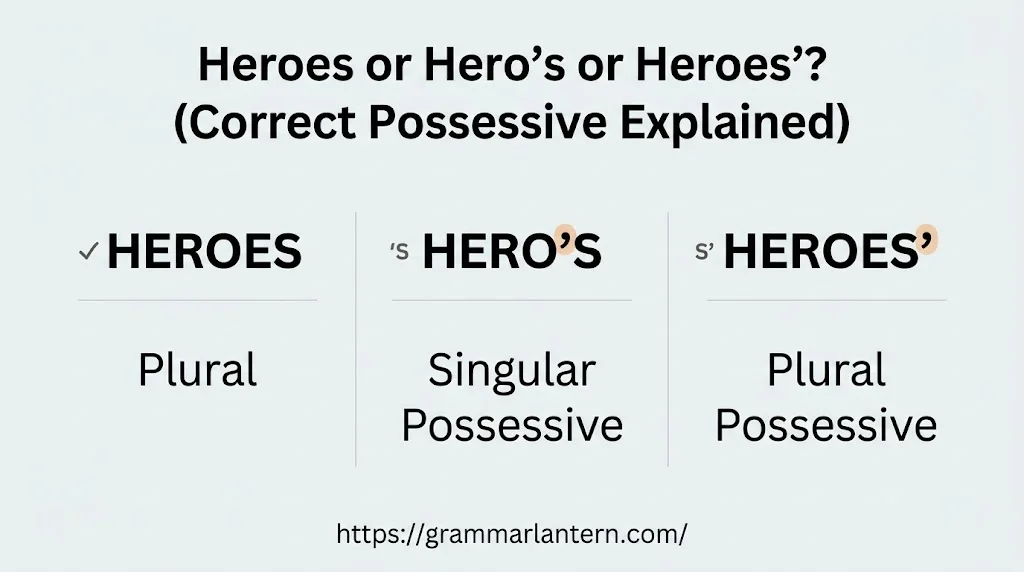
The easiest way to understand all three forms is to compare them side by side.
| Form | Number of heroes | Possessive? | Example |
| hero | One | No | The hero arrived. |
| heroes | More than one | No | The heroes arrived. |
| hero’s | One | Yes | The hero’s car arrived. |
| heroes’ | More than one | Yes | The heroes’ cars arrived. |
This comparison reveals the entire pattern.
1. If you’re simply talking about several heroes, use heroes.
2. If you’re talking about something associated with one hero, use hero’s.
3. If you’re talking about something associated with several heroes, use heroes’.
Hero’s vs. Heroes’: The Most Important Difference
The difference between hero’s and heroes’ comes down to the number of possessors.
Consider these two sentences:
The hero’s costume was torn.
One hero has the costume.
Now compare:
The heroes’ costumes were torn.
Several heroes have the costumes.
The apostrophe moves because the number of possessors changes.
| Singular possessor | Plural possessors |
| the hero’s costume | the heroes’ costumes |
| the hero’s sword | the heroes’ swords |
| the hero’s story | the heroes’ stories |
| the hero’s achievement | the heroes’ achievements |
| the hero’s mission | the heroes’ mission |
This pattern works beyond physical objects. It also applies to ideas, actions, experiences, and shared responsibilities.
A Simple Question Can Solve It
When you’re unsure, ask:
How many heroes are involved?
If the answer is one, use hero’s for possession.
If the answer is more than one, use heroes’ for possession.
For example:
The hero’s decision changed everything.
One hero made the decision.
The heroes’ decision changed everything.
Several heroes made the decision together.
The meaning can change significantly even though the difference is only one apostrophe.
The Apostrophe Rule Behind Hero’s and Heroes’
Understanding the broader apostrophe rule makes this problem much easier.
Singular Possessive: Add ’s
For a singular noun, the standard possessive pattern is:
singular noun + ’s
Examples:
- teacher → teacher’s
- student → student’s
- writer → writer’s
- player → player’s
- hero → hero’s
So:
The writer’s opinion mattered.
The sentence refers to one writer.
Plural Possessive: Add an Apostrophe After the S
When a plural noun already ends in s, place the apostrophe after that s.
Examples:
- teachers → teachers’
- students → students’
- players → players’
- writers → writers’
- heroes → heroes’
So:
The writers’ opinions differed.
The sentence refers to multiple writers.
This is why hero’s and heroes’ aren’t interchangeable. They represent different numbers of possessors.
Common Mistakes
Mistake: Using “Hero’s” as the Plural
Incorrect:
The hero’s fought bravely.
Correct:
The heroes fought bravely.
The writer means multiple heroes. No possession exists, so no apostrophe belongs there.
Mistake: Using “Heroes” for Possession
Incorrect:
The heroes costumes were colorful.
Correct:
The heroes’ costumes were colorful.
The costumes belong to or are associated with multiple heroes. The plural possessive form needs an apostrophe.
Mistake: Writing “Heroes’s”
Incorrect:
The heroes’s costumes were displayed.
Correct:
The heroes’ costumes were displayed.
The plural noun already ends in s, so add only an apostrophe.
Mistake: Writing “Heros”
Incorrect:
The heros saved the village.
Correct:
The heroes saved the village.
Heros isn’t the standard plural spelling of hero.
How to Choose the Correct Form in Seconds
When you’re editing an article or checking an essay, use this quick process.
First, Count the Heroes
Ask whether the sentence refers to:
- One hero → hero
- Two or more heroes → heroes
Next, Check for Possession
Ask whether something belongs to or relates to the hero or heroes.
- One + possession → hero’s
- Many + possession → heroes’
- Many + no possession → heroes
Apply the Formula
One + no possession = hero
The hero arrived.
Many + no possession = heroes
The heroes arrived.
One + possession = hero’s
The hero’s shield broke.
Many + possession = heroes’
The heroes’ shields broke.
This four-part formula works like a small grammatical compass. Once you know the number and relationship, the punctuation becomes much easier.
“Hero’s” Can Also Be a Contraction
There is one useful wrinkle.
Hero’s doesn’t always function as a possessive. In some contexts, ’s can represent is or has.
For example:
The hero’s ready.
This can mean:
The hero is ready.
Likewise:
The hero’s arrived.
In informal English, this can represent:
The hero has arrived.
Context tells you which meaning applies.
Compare that with:
The hero’s shield is broken.
Here, hero’s clearly shows possession or association. You could not replace it with hero is without changing the sentence into nonsense.
A Quick Substitution Test
1. If you’re unsure whether hero’s is possessive, try replacing ’s with is or has.
2. If the sentence still makes sense, it may be a contraction.
3. If it doesn’t, you’re probably looking at a possessive.
The hero’s ready.
→ The hero is ready. ✓
The hero’s shield is heavy.
→ The hero is shield is heavy. ✗
Therefore, the second example uses the possessive form.
Heroes’ Can Show Shared Possession
Plural possession doesn’t always mean every hero owns a separate item.
Sometimes several heroes share responsibility, ownership, or association.
For example:
The heroes’ mission was dangerous.
Here, heroes’ connects the mission with multiple heroes. The mission may belong to the group rather than to each person separately.
Other examples include:
- the heroes’ headquarters
- the heroes’ team
- the heroes’ mission
- the heroes’ strategy
- the heroes’ responsibility
- the heroes’ agreement
The possessive relationship can therefore describe something collective.
Case Study: How One Apostrophe Changes the Meaning
Consider this short example:
The hero’s story inspired the audience.
The story belongs to or concerns one hero.
Now change the sentence:
The heroes’ story inspired the audience.
The story now belongs to or concerns multiple heroes.
Finally:
The heroes told their story.
Here, heroes is simply plural. The sentence doesn’t require an apostrophe because the possessive relationship appears through their.
This example demonstrates an important principle: apostrophes don’t exist merely to make writing look formal. They perform a specific grammatical function.
Examples in Different Contexts
Everyday English
My parents are my heroes.
This sentence identifies more than one person as heroes.
My father is my hero.
This sentence identifies one person.
Fiction and Literature
The hero’s decision changed the ending.
One hero made the decision.
The heroes’ journey tested their friendship.
Multiple heroes shared the journey.
History
The nation honored its heroes.
The word simply refers to multiple people.
The hero’s actions became part of local history.
One hero is associated with those actions.
The heroes’ sacrifices remain part of the community’s history.
Multiple heroes are associated with the sacrifices.
Sports
The players became local heroes.
No possession exists.
The hero’s performance changed the game.
One player is being described.
The heroes’ achievements inspired young athletes.
Multiple people are associated with the achievements.
Practice: Choose the Correct Form
Test the rule with these examples.
Which Form Fits?
- The _____ returned after the battle.
- The _____ courage impressed everyone.
- Several _____ received awards.
- The _____ costumes were displayed.
- The _____ decision changed the story.
- The town honored its _____.
- The _____ achievements inspired future generations.
- The _____ shield was damaged.
Answers
- heroes — more than one hero, no possession.
- hero’s — one hero’s courage.
- heroes — multiple heroes, no possession.
- heroes’ — costumes associated with multiple heroes.
- hero’s — one hero made the decision.
- heroes — multiple people are being identified.
- heroes’ — multiple heroes are associated with the achievements.
- hero’s — one hero is associated with the shield.
The pattern becomes much clearer once you stop focusing on the apostrophe itself.
First determine the number of heroes. Then determine whether possession exists.
Read More: Pentoxide vs Pentaoxide: Correct Scientific Usage Explained
FAQs
1. Is “heroes” the correct plural of “hero”?
Yes. Heroes is the correct plural form of hero in standard English. For example, “The firefighters were praised as heroes.”
2. Is “heros” a correct spelling?
No, heros is not the standard plural spelling of hero. In normal English writing, use heroes instead.
3. What does “hero’s” mean?
Hero’s is the possessive form of hero. It shows that something belongs to one hero, such as “The hero’s courage inspired everyone.”
4. What does “heroes’” mean?
Heroes’ is the possessive form of the plural heroes. It shows that something belongs to multiple heroes, such as “The heroes’ actions saved many lives.”
5. Why does “hero” become “heroes”?
The word hero follows a common English pluralization pattern. We add -es to form heroes, similar to words such as potatoes and tomatoes.
6. Can “Heros” ever be correct?
Yes, but not as the ordinary plural of hero. Heros is also a scientific genus name for certain fish in the cichlid family.
7. What is the difference between “heroes” and “heroes’”?
Heroes simply means more than one hero. Heroes’ shows possession by multiple heroes. For example, “The heroes arrived” versus “The heroes’ bravery was admired.”
8. What is the difference between “hero’s” and “heroes’”?
Hero’s refers to possession by one hero, while heroes’ refers to possession by several heroes.
9. Is “heroes” singular or plural?
Heroes is plural. The singular form is hero, while heroes refers to two or more heroes.
10. How can I remember the correct spelling?
Remember that hero + es = heroes. If you’re writing about more than one heroic person, heroes is the spelling you need.
Conclusion
Choosing between heroes, hero’s, heroes’, and heros becomes much easier once you understand their different functions. Heroes is the standard plural of hero, while hero’s shows possession by one hero. Heroes’ shows possession by multiple heroes. Although Heros can appear as a scientific term, it isn’t the correct plural spelling in ordinary English.
When you’re writing emails, essays, social media posts, or formal documents, use heroes when you mean more than one hero. A simple check can prevent an unnecessary spelling mistake. Once you remember the hero → heroes pattern, this common grammar confusion becomes far easier to avoid.

Muhammad Haroon is the voice behind many of the clear, practical grammar guides you’ll find on Grammar Lantern. With a strong background in content writing and a genuine love for the English language, Haroon specializes in breaking down intimidating grammar topics into simple, digestible lessons. His goal is simple: to empower readers to write with confidence and clarity. Whether he’s explaining tricky tenses or demystifying punctuation, Haroon approaches each topic with patience, precision, and a touch of warmth—because he knows that learning grammar is a journey, not a race.


[…] Read More: Heroes or Hero’s or Heroes’? (Correct Possessive Explained) […]