Indulgent vs Sober explains the difference between two words with related yet different meanings in English. This article and guide explore how each word refers to a unique personality, lifestyle, and behavior, helping people understand their usage in writing, conversation, business, academic, and everyday communication.
Indulgent usually describes allowing yourself or someone else extra pleasure, comfort, and freedom by giving in to desires and cravings while considering the consequences, whereas Sober reflects a serious, calm attitude that values discipline, self-control, restraint, and practicality.
From my experience editing content, I have seen many compare these opposites, although the comparison only fits certain contexts because the ideas also overlap in describing behaviors, personalities, and mindset.
Their significance implies more than drinking alcohol or drugs because each choice reflects emotions, decision-making, habits, appearance, and various aspects of life. To fully learn the difference and differences, study pronunciation, grammar, origins, real-life examples, and meaning.
An indulgent style is often associated with pleasure-seeking, enjoyment, food, material possessions, and spontaneity, while a sober approach may naturally lean toward seriousness, balance, and the healthiest choices. Neither path is automatically good or bad because both represent useful traits depending on the situation.
These approaches appear in many lifestyles, acts, and daily decisions, but common mistakes happen when someone lacks contextually accurate understanding or makes a direct judgment. A simple way to avoid such errors is to remember that both behavior and behaviors can reveal a person’s mindset, and every action carries lasting implications for our lives.
Quick Answer
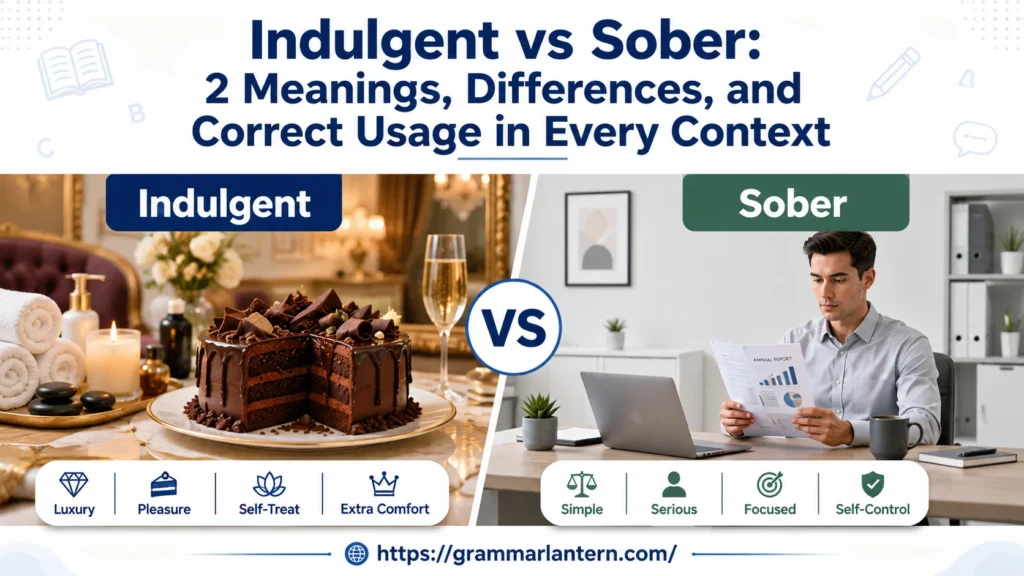
Indulgent describes someone or something that allows pleasure, luxury, generosity, or excess. It can refer to rich foods, permissive parenting, luxurious experiences, or self-gratification.
Sober has two primary meanings. First, it means not under the influence of alcohol or drugs. Second, it describes a person, mood, style, or decision that is serious, restrained, calm, and thoughtful.
Although these words often represent opposite attitudes toward pleasure and restraint, they are not true opposites in every situation. Context determines which meaning applies.
| Feature | Indulgent | Sober |
| Core meaning | Allowing pleasure or excess | Serious, restrained, or free from intoxication |
| Emotional tone | Warm, luxurious, permissive | Calm, thoughtful, disciplined |
| Common contexts | Food, parenting, luxury, behavior | Lifestyle, emotions, writing, decisions |
| Positive use | Treating yourself or others | Showing wisdom and self-control |
| Possible negative use | Excessive or spoiled | Too serious or emotionally distant |
What Does Indulgent Mean?
The word indulgent comes from the idea of giving in to desires rather than resisting them. Sometimes that is perfectly healthy. Other times, it suggests going too far.
Meaning One: Allowing Pleasure or Luxury
This is the most common meaning. An indulgent experience feels rich, enjoyable, and often a little extravagant.
Examples include:
- An indulgent spa weekend
- An indulgent slice of triple chocolate cake
- An indulgent vacation at a luxury resort
- An indulgent shopping trip
In these situations, the word has a mostly positive tone. It suggests treating yourself rather than simply meeting a basic need.
Examples
- She enjoyed an indulgent breakfast with fresh pastries and gourmet coffee.
- The hotel offered an indulgent spa experience overlooking the ocean.
- Sunday became an indulgent day of reading, movies, and desserts.
Meaning Two: Being Too Lenient or Generous
The second meaning focuses on how people treat others.
An indulgent parent, teacher, or manager allows more freedom than usual and may overlook mistakes.
Examples include:
- An indulgent grandparent who buys extra gifts.
- An indulgent teacher who gives repeated deadline extensions.
- An indulgent boss who rarely criticizes employees.
This meaning isn’t always positive. Too much indulgence can prevent people from learning responsibility.
Examples
- His parents were so indulgent that he never learned financial discipline.
- The coach remained indulgent despite repeated mistakes.
- Her grandmother always had an indulgent smile whenever the children visited.
What Does Sober Mean?
The word sober has two completely different meanings, both commonly used in everyday English.
Meaning One: Not Under the Influence of Alcohol or Drugs
This is the literal definition most learners recognize first.
Someone who is sober has not consumed alcohol or drugs that impair judgment.
Examples include:
- Remaining sober after a party
- A sober driver
- A sober lifestyle
- Celebrating years of sobriety
Examples
- Please make sure the designated driver stays sober.
- He has remained sober for five years.
- She chose a sober lifestyle after college.
Meaning Two: Serious, Calm, and Thoughtful
This figurative meaning appears frequently in journalism, business, education, and literature.
- A sober discussion is careful rather than emotional.
2. A sober assessment relies on facts instead of excitement.
3. A sober design avoids flashy decoration.
Examples
- The committee reached a sober conclusion after reviewing the evidence.
- The documentary offered a sober look at climate change.
- His sober tone helped calm the room.
Indulgent vs Sober: Main Differences
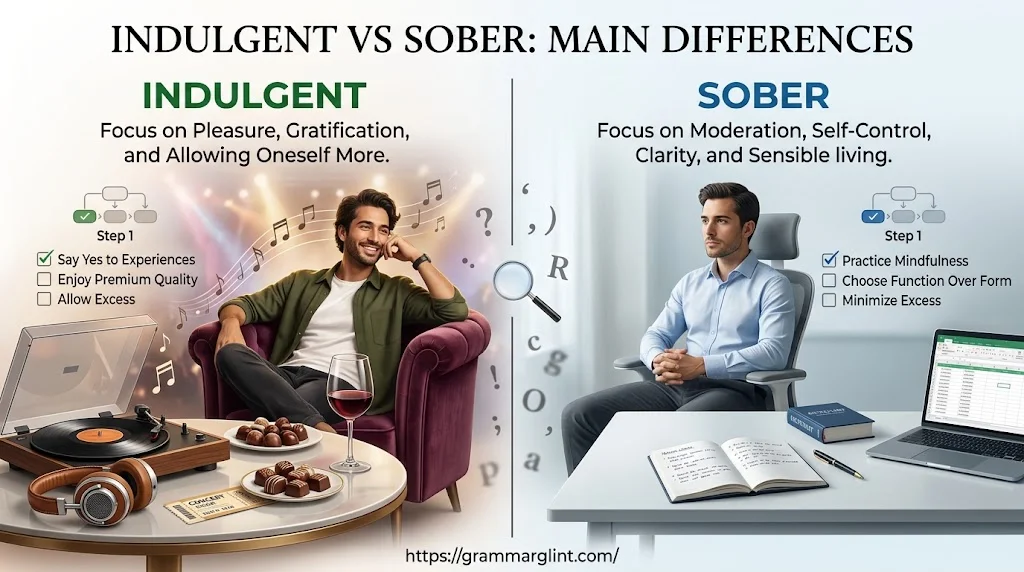
Although these words sometimes seem opposite, they emphasize different qualities.
| Aspect | Indulgent | Sober |
| Focus | Pleasure and generosity | Restraint and seriousness |
| Emotional style | Relaxed and expressive | Controlled and thoughtful |
| Lifestyle | Luxury and enjoyment | Discipline and moderation |
| Writing style | Rich and descriptive | Objective and balanced |
| Appearance | Decorative and lavish | Minimal and understated |
| Decision-making | Emotion-driven at times | Fact-based and measured |
The contrast becomes clear when comparing everyday situations.
- An indulgent dessert contains rich ingredients.
- A sober meal is simple and practical.
- An indulgent vacation focuses on comfort.
- A sober business trip focuses on work.
When Indulgent and Sober Are Opposites
In several situations, these words naturally contrast.
Luxury vs Simplicity
An indulgent hotel suite may include a private pool, gourmet dining, and premium services.
A sober hotel room provides comfort without unnecessary extras.
Pleasure vs Self-Control
An indulgent lifestyle encourages frequent treats.
A sober lifestyle emphasizes moderation and discipline.
Emotional Expression vs Emotional Restraint
An indulgent celebration may feature fireworks, music, and extravagant decorations.
A sober memorial service reflects respect and quiet reflection.
When They Are Not Opposites
Many learners assume these words always oppose one another. They do not.
Consider these examples.
- An indulgent parent is not the opposite of a sober driver because the subjects are completely different.
- An indulgent dessert is not the opposite of a sober speech because one describes food while the other describes communication.
Always compare words within the same context.
Indulgent vs Sober in Writing
Writers frequently choose between these words to shape tone.
Describing People
An indulgent person enjoys giving comfort and forgiveness.
A sober person approaches problems calmly and thoughtfully.
Describing Food
Rich desserts often receive the label indulgent.
Simple soups and balanced meals often reflect a sober approach to eating.
Describing Fashion
An indulgent wardrobe may include bold fabrics, luxury brands, and dramatic accessories.
A sober wardrobe favors clean lines, neutral colors, and timeless designs.
Describing Interior Design
Luxury hotels often feature indulgent interiors filled with marble, velvet, and gold accents.
Modern offices often embrace sober interiors with simple furniture and muted colors.
Describing Writing Style
Indulgent writing often includes vivid descriptions and emotional language.
Sober writing prioritizes clarity, evidence, and logical structure.
Real-Life Examples
Indulgent Examples
- She ordered the restaurant’s most indulgent dessert.
- The resort promised an indulgent escape from daily stress.
- His indulgent parenting style rarely included punishment.
- They enjoyed an indulgent weekend at the beach.
- The novel contained indulgent descriptions of luxury.
- The company rewarded employees with an indulgent retreat.
- The chef created an indulgent menu featuring rich sauces.
- Her indulgent spending habits hurt her savings.
- The vacation felt wonderfully indulgent.
- The grandparents remained delightfully indulgent.
Sober Examples
- Everyone appreciated her sober advice.
- The documentary maintained a sober tone.
- He remained sober throughout the event.
- Investors made sober decisions despite market excitement.
- The article presented a sober analysis.
- She delivered the news in a sober voice.
- The courtroom stayed sober and respectful.
- Their conversation became sober after the announcement.
- His sober lifestyle improved his health.
- The committee reached a sober conclusion.
Common Collocations
Learning common word combinations makes your English sound more natural.
Indulgent Collocations
- indulgent parent
- indulgent lifestyle
- indulgent dessert
- indulgent meal
- indulgent holiday
- indulgent purchase
- indulgent smile
- self-indulgent behavior
- indulgent luxury
- indulgent treat
Sober Collocations
- sober judgment
- sober assessment
- sober reflection
- sober reminder
- sober mood
- sober conversation
- sober style
- sober colors
- sober appearance
- sober lifestyle
Synonyms and Related Words
1. Synonyms of Indulgent
| Word | Best Use |
| Lenient | Parenting and rules |
| Permissive | Discipline |
| Lavish | Luxury |
| Extravagant | Spending |
| Generous | Giving |
| Self-indulgent | Personal pleasure |
2. Synonyms of Sober
| Word | Best Use |
| Serious | Conversations |
| Restrained | Style |
| Thoughtful | Decisions |
| Solemn | Ceremonies |
| Moderate | Lifestyle |
| Clear-headed | Judgment |
Indulgent vs Sober in American English
In American English, indulgent commonly appears in lifestyle magazines, restaurant reviews, parenting articles, and travel writing. It often describes enjoyable experiences that go beyond everyday comfort.
Sober appears frequently in news reporting, healthcare, psychology, finance, and legal writing. While many people first associate it with alcohol, professional writers often use it to describe a calm, objective, or realistic tone.
For example:
- A food critic may praise an indulgent cheesecake.
- A financial analyst may recommend a sober investment strategy.
Understanding these patterns helps you choose the right word naturally.
Common Mistakes to Avoid
Many English learners misuse these words because they focus on only one definition.
Avoid these common errors.
- Thinking sober only refers to alcohol.
- Assuming indulgent always means expensive.
- Treating them as direct opposites in every sentence.
- Ignoring the surrounding context.
- Using indulgent when generous or luxurious would be more accurate.
Case Study: Choosing the Right Word
Imagine two hotel reviews.
Review One
“The resort offered indulgent spa treatments, oversized suites, gourmet dining, and private beach access.”
The focus is luxury and pleasure, so indulgent fits perfectly.
Review Two
“The conference hotel featured a sober design with clean furniture, quiet meeting rooms, and practical amenities.”
The focus is simplicity and professionalism, making sober the better choice.
The context changes everything.
Memorable Quotes
“Moderation is a bitter pill to some, but wisdom often begins where excess ends.”
“Luxury delights the senses, while restraint sharpens judgment.”
These ideas capture the relationship between indulgent and sober without suggesting they are always opposites.
Easy Memory Trick
Remember this simple comparison.
- Indulgent = Giving in to pleasure.
- Sober = Holding back with discipline or seriousness.
Think of an indulgent chocolate cake beside a sober business report. One celebrates enjoyment, while the other values restraint.
Which Word Should You Use?
Choose indulgent when describing:
- Luxury experiences
- Rich food
- Lenient parenting
- Personal treats
- Generous behavior
Choose sober when describing:
- Someone free from alcohol
- Serious conversations
- Professional writing
- Calm decision-making
- Simple designs
- Thoughtful opinions
When you’re unsure, ask yourself one question.
Is the focus on enjoyment or restraint?
The answer usually points you toward the correct word.
Read More: Excel vs Accel: Usage, and Examples Explained
FAQs
1. What is the main difference between indulgent and sober?
An indulgent person tends to seek pleasure, comfort, or enjoyment more freely, while a sober person usually shows self-control, seriousness, and careful judgment.
2. Are indulgent and sober direct opposites?
Not always. They can describe contrasting behaviors, but they are not perfect opposites in every situation because they focus on different qualities.
3. Can someone be both indulgent and sober?
Yes. A person may be indulgent in some areas, such as enjoying good food, while remaining sober and disciplined in work or important decisions.
4. Does sober only mean not drinking alcohol?
No. Besides meaning free from alcohol or drugs, sober can also describe a calm, serious, and thoughtful attitude.
5. Is being indulgent always negative?
No. Moderate indulgence can be healthy and enjoyable. It only becomes a problem when it leads to excess or poor decisions.
6. How is indulgent used in everyday English?
It often describes people, habits, parents, meals, vacations, or lifestyles that allow extra comfort or pleasure.
7. Where is the word sober commonly used?
It appears in conversations about health, driving, behavior, business, education, and writing to describe clear thinking or seriousness.
8. Why do people confuse indulgent and sober?
Both words can describe behavior and personality, so people sometimes compare them without understanding that they express different ideas.
9. Which word is more suitable for formal writing?
Both are suitable in formal English when used correctly. The best choice depends on the meaning you want to express.
10. How can I remember the difference easily?
Think of indulgent as allowing yourself more pleasure, while sober reminds you of self-control, careful thinking, and a balanced attitude.
Conclusion
Understanding Indulgent vs Sober becomes much easier when you focus on the ideas behind each word instead of treating them as simple opposites. Indulgent highlights enjoyment, comfort, and freedom, while sober emphasizes discipline, calm thinking, and responsibility. Both words have valuable uses in everyday English and help describe different personalities, behaviors, and lifestyles.
The best choice depends on the context. By learning their meanings, grammar, and real-life usage, you can avoid common mistakes and communicate more clearly in conversations, academic writing, and professional settings. Knowing when to use each word will make your English sound more natural and precise.

For Shafiq ur Rehman, writing is an art form and grammar is the toolbox that makes it beautiful. As a dedicated content writer at Grammar Lantern, Shafiq approaches every topic like an architect carefully laying down strong foundations of understanding before adding the finer details. He loves diving into the trickiest grammar points and resurfacing with simple, bite-sized takeaways that anyone can grasp. When he’s not crafting articles, you’ll likely find him strategizing over a game of chess, exploring dusty local bookshops, or quietly jotting down poetic observations in his notebook.