Pent vs Pants becomes easy to understand once you know each word has a different meaning, and this guide helps every writer, student, and blogger avoid mistakes with confidence.
From my experience editing articles, blogs, and social media posts, this is a common problem in English writing and grammar. Many people guess because the similar yet different words look like distant cousins. They share four letters, the letter P, related vowels, a final T or TS, and a close sound, which can trip readers.
The first answer is simple, plain, and easy to remember. Pent is an old verb form that means confined, restrained, or locked inside, usually in the phrase pent-up emotions or feelings. Pants are everyday clothing or clothes that covers your legs while you are wearing them. Reading examples correctly will improve learning, understanding, and choosing skills fast, making it easier to choose the right words every time.
Quick Answer: Pent vs Pants Meaning and Difference
The difference is simple:
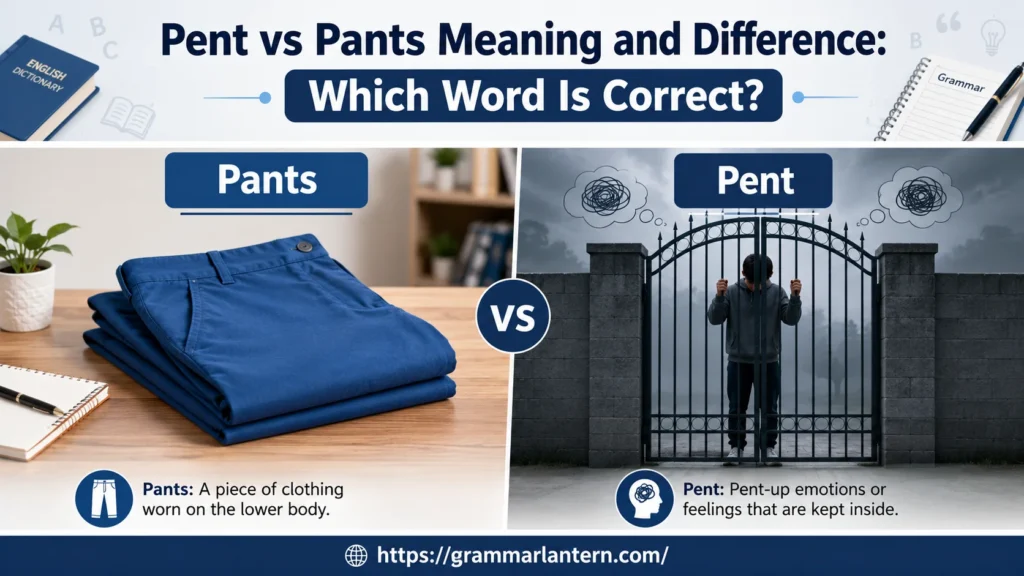
- Pants is a common noun that refers to a piece of clothing.
- Pent is the past tense and past participle of the verb pen, which means to confine or shut in. Today, it most commonly appears in the adjective pent-up, meaning feelings or energy that have been held inside.
You should use pants whenever you are talking about clothing. Use pent only in literary, historical, or formal contexts, or as part of the expression pent-up.
| Word | Meaning | Common Usage |
| Pants | Clothing worn on the lower body | Everyday English |
| Pent | Confined, enclosed, or shut in | Mostly in “pent-up” |
What Does “Pants” Mean?
Pants are garments worn from the waist down, covering each leg separately. In American English, the word refers to what many other English-speaking countries call trousers.
You hear this word every day because it belongs to basic English vocabulary. Whether you’re shopping, getting dressed for work, or talking about fashion, pants is the correct word.
Common Types of Pants
- Dress pants
- Jeans
- Cargo pants
- Sweatpants
- Yoga pants
- Khaki pants
- Linen pants
- Leather pants
Each type serves a different purpose. Dress pants suit formal occasions, while sweatpants offer comfort during exercise or relaxation.
Examples
- I bought new pants for my interview.
- These pants fit perfectly.
- She prefers linen pants during summer.
- My hiking pants have extra pockets.
Interesting Fact
Although pants ends with the letter s, it usually refers to one garment. That’s why English speakers often say “a pair of pants” instead of “a pant.”
What Does “Pent” Mean?
Unlike pants, the word pent is uncommon in everyday conversation.
Pent is the past tense and past participle of the verb pen, meaning to confine, imprison, or enclose someone or something.
For example:
- The animals were pent inside the enclosure.
- Refugees remained pent behind the city walls.
Modern English rarely uses pent by itself. Instead, you’ll most often encounter it in the expression pent-up.
What Does “Pent-Up” Mean?
Pent-up describes emotions, thoughts, energy, or frustration that someone has kept inside instead of expressing.
Common examples include:
- Pent-up anger
- Pent-up frustration
- Pent-up excitement
- Pent-up energy
- Pent-up demand
Examples
- Children released their pent-up energy after school.
- Months of stress created pent-up frustration.
- The audience expressed pent-up excitement after the announcement.
Because this phrase appears frequently in psychology, journalism, business, and everyday writing, many people recognize pent-up even if they’ve never seen pent used alone.
Pent vs Pants: The Main Difference
Although the spellings look similar, these words belong to completely different parts of speech and serve different purposes.
| Feature | Pent | Pants |
| Part of speech | Verb (past participle) or adjective | Noun |
| Meaning | Confined or enclosed | Clothing |
| Frequency | Rare | Extremely common |
| Modern use | Mostly in “pent-up” | Daily conversation |
| Can replace each other? | No | No |
The easiest way to remember the difference is this:
- If you’re talking about clothing, choose pants.
- If you’re talking about held-back emotions or confinement, choose pent.
Many spelling mistakes happen because both words are short, yet their meanings never overlap.
Is “Pent” Ever a Misspelling of “Pants”?
Yes. In casual typing, pent is often an accidental misspelling of pants.
Several factors cause this confusion.
Typing Errors
The letters a and e sit close together on many keyboards, making accidental substitutions common.
Autocorrect
Some devices automatically change words based on previous typing habits or dictionary suggestions.
Fast Typing
When people type quickly, missing a single letter can change the entire meaning.
English Learners
People learning English sometimes confuse similar-looking words because they focus on spelling instead of meaning.
For example:
❌ I bought new pent yesterday.
✅ I bought new pants yesterday.
A single incorrect letter completely changes the sentence.
American English vs British English
One interesting aspect of pants is that its meaning changes depending on where you are.
Pants in American English
In the United States, pants means trousers or any outer garment covering both legs.
Examples:
- Dress pants
- Blue pants
- Casual pants
Americans use this meaning every day.
Pants in British English
In British English, pants usually means underwear.
If you want to refer to outer clothing, you should say trousers instead.
This difference sometimes creates humorous misunderstandings between American and British speakers.
| American English | British English |
| Pants = trousers | Pants = underwear |
| Trousers (less common) | Trousers = outer clothing |
| Underwear = underwear | Pants = underwear |
Example
American:
“I like your new pants.”
British interpretation:
“I like your new underwear.”
Understanding regional English helps you avoid awkward conversations while traveling or communicating internationally.
Read More: Channel vs Chanel: Correct Usage With Examples
When Should You Use “Pants”?
Use pants whenever you’re referring to clothing that covers the body from the waist down. It’s one of the most common words in everyday American English, so you’ll hear it in conversations, advertisements, clothing stores, schools, workplaces, and online shopping.
Whether you’re describing what someone is wearing or buying new clothes, pants is the correct choice.
Use “Pants” in Everyday Conversations
Most casual conversations include clothing vocabulary, making pants a word you’ll use regularly.
Examples:
- I need new pants for work.
- Your pants match your jacket perfectly.
- These pants are much more comfortable than my old ones.
- He packed three pairs of pants for the trip.
Use “Pants” While Shopping
Retail stores and online marketplaces categorize clothing using the word pants.
You’ll often see categories such as:
- Men’s Pants
- Women’s Pants
- Athletic Pants
- Dress Pants
- Casual Pants
- Winter Pants
If you’re shopping in the United States, pants is almost always the correct search term.
Use “Pants” in Professional Writing
Business communication, fashion blogs, and clothing descriptions also use pants naturally.
For example:
- Employees should wear dark-colored dress pants.
- These hiking pants are water-resistant.
- Our collection includes breathable cotton pants for summer.
Common Collocations With “Pants”
Native English speakers naturally combine pants with many adjectives and nouns.
Some of the most common combinations include:
- Dress pants
- Black pants
- Work pants
- Running pants
- Ski pants
- Loose pants
- Tight pants
- Cotton pants
- Waterproof pants
- Pair of pants
Learning these combinations helps your English sound more natural.
When Should You Use “Pent”?
Unlike pants, you’ll rarely use pent in everyday conversation. The word appears mostly in formal writing, literature, historical texts, and fixed expressions.
Today, its most common appearance is in pent-up.
Use “Pent” in Literary Writing
Many classic novels use pent to describe people or animals confined in a limited space.
Examples:
- The prisoners remained pent inside the fortress.
- The sheep were pent behind wooden fences.
- Soldiers were pent within the city walls.
Although these sentences are correct, modern writers usually choose simpler words like confined, trapped, or enclosed.
Use “Pent-Up” for Hidden Emotions
The adjective pent-up remains extremely common.
It describes emotions or energy that someone suppresses for a long period.
Examples include:
- Pent-up anger
- Pent-up stress
- Pent-up anxiety
- Pent-up excitement
- Pent-up creativity
- Pent-up energy
Example sentences:
- Exercise helps release pent-up stress.
- She finally expressed years of pent-up frustration.
- Children often have pent-up energy after sitting in class all day.
Business and Economic Usage
You’ll also encounter pent-up demand in business news.
This phrase describes consumer demand that couldn’t be satisfied earlier but appears later when products become available.
Example:
After supply chains improved, retailers experienced pent-up demand for electronics.
Common Expressions With “Pants”
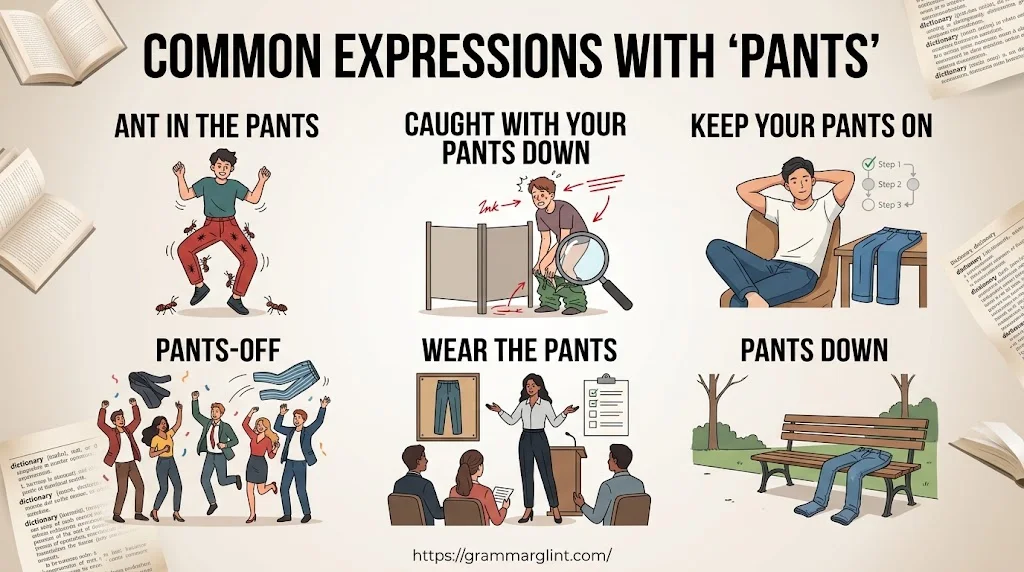
The word pants appears in dozens of everyday expressions.
Here are some of the most common ones.
Pair of Pants
Although it refers to one garment, English treats pants as a plural noun.
Example:
- I bought a new pair of pants yesterday.
Dress Pants
Formal trousers worn for work, weddings, interviews, or business meetings.
Example:
- He wore gray dress pants with a navy blazer.
Sweatpants
Comfortable athletic pants made from soft fabric.
Example:
- I usually wear sweatpants while working from home.
Cargo Pants
Loose-fitting pants with large utility pockets.
Example:
- Cargo pants are popular among hikers.
Yoga Pants
Stretchable athletic pants designed for exercise.
Example:
- She bought new yoga pants before joining the gym.
Pull Up Your Pants
This common phrase literally means adjusting your clothing, but it can also encourage someone to act responsibly.
Example:
- It’s time to pull up your pants and finish the project.
Common Expressions With “Pent”
Although pent rarely appears alone, several fixed expressions remain common.
Pent-Up Anger
Anger that someone has hidden for a long time.
Example:
- Years of unfair treatment created pent-up anger.
Pent-Up Energy
Unused physical energy.
Example:
- The puppy released its pent-up energy by running around the yard.
Pent-Up Frustration
Frustration that has built over time.
Example:
- She finally shared her pent-up frustration with her manager.
Pent-Up Emotions
Feelings someone has been hiding.
Example:
- The heartfelt conversation released years of pent-up emotions.
Pent-Up Demand
An economic term describing delayed consumer demand.
Example:
- Travel companies benefited from pent-up demand after restrictions ended.
Common Mistakes to Avoid
Even advanced English learners occasionally confuse these words.
Here are the mistakes seen most often.
Mistake 1: Using “Pent” for Clothing
❌ I washed my pent yesterday.
✅ I washed my pants yesterday.
Mistake 2: Assuming “Pent” Means Pants
The two words are unrelated despite their similar spelling.
Mistake 3: Forgetting British English Differences
Remember:
- American English: pants = trousers
- British English: pants = underwear
Knowing your audience helps you choose the right word.
Mistake 4: Misusing “Pent-Up”
Incorrect:
❌ My pent shoes are dirty.
Correct:
✅ I have pent-up excitement about the concert.
The expression always refers to emotions, energy, or something that has been restrained—not clothing or physical objects.
Memory Trick to Remember the Difference
Simple memory tricks make confusing words much easier to remember.
Think about the letter A in pants.
- Pants has A for Apparel.
- Pants has A for Attire.
Now think about pent.
- Pent sounds like pen, meaning to confine.
- Pent-up means something is kept inside.
Here’s another easy comparison:
| Word | Memory Trick |
| Pants | A = Apparel |
| Pent | E = Enclosed |
Whenever you’re unsure, ask yourself one question:
Am I talking about clothing or confinement?
If it’s clothing, choose pants. If it’s about something being held inside, use pent.
Real-Life Example Sentences
The best way to master pent vs pants is to see each word in context. Real-world examples help you understand not only the meaning but also how native English speakers naturally use these words.
Examples of “Pants”
These sentences show the everyday use of pants.
Casual Conversation
- I spilled coffee on my pants this morning.
- Those blue pants look great with your shirt.
- Can you help me find my black pants?
- My favorite pants have deep pockets.
Shopping
- These pants are available in five different colors.
- I need a smaller size because these pants are too loose.
- The store has a sale on winter pants.
- She bought two pairs of pants for her vacation.
Workplace
- Employees should wear dress pants during client meetings.
- His navy pants matched the company dress code perfectly.
- Comfortable work pants can improve productivity during long shifts.
Travel
- Pack lightweight pants if you’re visiting a warm climate.
- Waterproof pants are essential for hiking trips.
- Always carry an extra pair of pants during long journeys.
Examples of “Pent”
The word pent appears much less often, but these examples show its correct usage.
Literary Context
- The villagers remained pent inside the castle during the siege.
- The animals were pent behind sturdy wooden gates.
- The soldiers found themselves pent within the city’s walls.
Emotional Context
- Months of uncertainty created pent-up anxiety.
- The children released their pent-up energy at recess.
- Years of silence turned into pent-up resentment.
- The speech gave people a chance to express their pent-up emotions.
Business Context
- Retailers experienced pent-up demand after supply shortages ended.
- The tourism industry benefited from pent-up travel demand following the pandemic.
Side-by-Side Comparison
Notice how different these words are when used correctly.
| Incorrect Sentence | Correct Sentence |
| I bought new pent. | I bought new pants. |
| My pants-up frustration exploded. | My pent-up frustration exploded. |
| These pent are too small. | These pants are too small. |
| He wore pent to the meeting. | He wore pants to the meeting. |
Reading complete sentences like these helps you recognize mistakes instantly.
Similar Word Pairs People Confuse
English contains many words that look alike but carry entirely different meanings. Pent vs pants is just one example.
Pant vs Pants
Although they share the same root, these words have different meanings.
Pant is usually a verb.
Examples:
- I began to pant after running uphill.
- The dog started to pant in the summer heat.
Pants is a noun.
Examples:
- My pants are too long.
- She bought new pants yesterday.
Pants vs Trousers
These words often depend on regional English.
| American English | British English |
| Pants | Trousers |
| Underwear | Pants |
If you’re writing for an international audience, remember this regional difference to avoid confusion.
Jeans vs Pants
Every pair of jeans is a type of pants, but not all pants are jeans.
| Jeans | Pants |
| Made from denim | Made from many fabrics |
| Casual wear | Casual or formal |
| Usually blue | Available in countless styles |
Shorts vs Pants
Both are lower-body garments, but they differ in length.
| Shorts | Pants |
| End above or below the knee | Cover the entire legs |
| Best for warm weather | Suitable year-round |
Pent vs Pent-Up
Many people mistakenly think these terms have identical meanings.
Actually:
- Pent is the original past participle of pen.
- Pent-up is the common adjective people use today.
For example:
- The cattle remained pent behind the fence.
- She finally released her pent-up anger.
You’ll encounter pent-up far more often than pent by itself.
Quick Comparison Table
If you only remember one section of this guide, make it this one.
| Question | Answer |
| Is pants a real English word? | Yes. It’s a common noun for clothing. |
| Is pent a real English word? | Yes. It’s an old past participle of pen. |
| Are they interchangeable? | No. They have unrelated meanings. |
| Which word refers to clothing? | Pants |
| Which word refers to confinement? | Pent |
| Which word appears every day? | Pants |
| Which word appears mostly in formal writing? | Pent |
| Which expression is still common today? | Pent-up |
FAQs
1. What is the difference between Pent and Pants?
Pent means confined, restrained, or kept inside, and it is most commonly used in the phrase “pent-up emotions.” Pants refers to the clothing you wear on your legs. The two words have completely different meanings.
2. Is pent still used in modern English?
Yes, but not very often. Today, pent mostly appears in literary writing or in the expression “pent-up” to describe hidden emotions, energy, or frustration.
3. Is pants singular or plural?
Pants is grammatically plural, even when referring to one item of clothing. You would say, “These pants are comfortable,” not “This pants is comfortable.”
4. What does pent-up mean?
Pent-up describes emotions, energy, or feelings that have been held inside for a long time instead of being expressed.
5. Why do people confuse pent and pants?
They look similar, start with the same letter, and sound somewhat alike when read quickly. However, their meanings and uses are completely unrelated.
6. Can pent be used instead of pants?
No. Pent never refers to clothing. If you are talking about trousers or legwear, the correct word is pants.
7. How can I remember the difference?
Think of pent-up emotions for pent and pants for clothing. One relates to feelings, while the other relates to what you wear.
8. Is pants used differently in British and American English?
Yes. In American English, pants usually means trousers. In British English, pants commonly refers to underwear, while trousers means outer legwear.
9. Can pent be used as a verb?
Historically, yes. It is the past participle of the old verb pen, meaning to confine or shut in. Today, it is rarely used outside expressions like pent-up.
10. Which word should I use in everyday writing?
Use pants whenever you are talking about clothing. Use pent only when referring to something that is confined or restrained, especially in the phrase pent-up.
Conclusion
Understanding Pent vs Pants is easier once you focus on the meaning instead of the spelling. Although the words look similar, they belong in completely different contexts. Pent describes something that is confined or restrained, while pants refers to clothing. Knowing this simple distinction helps you avoid one of the most common vocabulary mix-ups.
Whenever you are unsure, think about the context of your sentence. If it involves emotions or something held inside, pent is probably the right choice. If it is about what someone wears, pants is the correct word. With regular reading and practice, choosing between these two words will soon become second nature.

Muhammad Haroon is the voice behind many of the clear, practical grammar guides you’ll find on Grammar Lantern. With a strong background in content writing and a genuine love for the English language, Haroon specializes in breaking down intimidating grammar topics into simple, digestible lessons. His goal is simple: to empower readers to write with confidence and clarity. Whether he’s explaining tricky tenses or demystifying punctuation, Haroon approaches each topic with patience, precision, and a touch of warmth—because he knows that learning grammar is a journey, not a race.