Pentoxide vs Pentaoxide often confuses readers because both words look almost the same, yet there is an important difference between them. When you read a scientific article, the small variation in spelling can affect the meaning, clarity, and accuracy of the information.
From reviewing chemistry resources over the years, I have noticed that scientists, writers, textbooks, and research papers usually prefer one term over the other based on accepted scientific usage. Understanding these differences makes it easier to recognize the proper form in different situations.
For example, phosphorus pentoxide (P4O10) is a white, crystalline, solid that contains five oxygen atoms combined with one element. It is commonly used as a dehydrating agent because it removes water efficiently in many laboratory and industrial processes.
This compound is one of the best-known examples in chemistry, making it easier to understand how the naming system works and what the term actually mean in real scientific contexts.
Another example is vanadium pentoxide (V2O5), specifically a yellow to orange powder made from a metal element. This compound plays an important role in the production of ceramics and serves as a catalyst in many chemical reactions.
These examples show the practical importance of choosing the right terms, whether you are discussing a general compound or a metal-based material. Using the correct terminology improves clarity and helps readers understand exactly what you mean.
Quick Answer
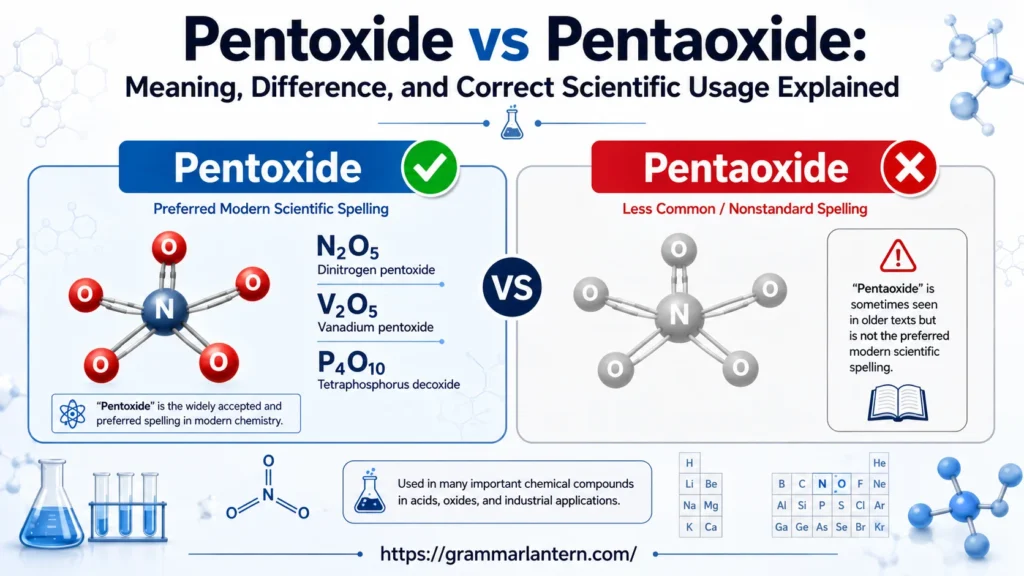
Pentoxide and pentaoxide mean the same thing. Both describe a compound that contains five oxygen atoms combined with another element.
However:
- Pentoxide is the correct and preferred spelling in modern chemistry.
- Pentaoxide is a rare alternative that occasionally appears in historical texts or outdated references.
- Scientific journals, chemistry textbooks, and IUPAC naming conventions overwhelmingly favor pentoxide.
If you’re writing an assignment, research paper, or educational article, always choose pentoxide.
What Does Pentoxide Mean?
The word pentoxide is a chemical name used for compounds containing five oxygen atoms bonded to another element.
The name comes from two Greek-derived parts:
| Word Part | Meaning |
| Pent- | Five |
| Oxide | Oxygen combined with another element |
When these two parts come together, they describe compounds that contain five oxygen atoms in their chemical formula.
Some familiar examples include:
| Compound | Formula | Common Use |
| Dinitrogen pentoxide | N₂O₅ | Nitric acid production |
| Vanadium pentoxide | V₂O₅ | Industrial catalyst |
| Phosphorus pentoxide* | P₄O₁₀ | Powerful drying agent |
*Although commonly called phosphorus pentoxide, its actual molecular formula is P₄O₁₀.
The name tells chemists something important before they even see the formula. It immediately indicates the number of oxygen atoms involved.
What Does Pentaoxide Mean?
Pentaoxide has exactly the same meaning as pentoxide.
It combines:
- Penta = five
- Oxide = oxygen compound
From a purely linguistic perspective, the spelling seems logical. After all, many Greek numerical prefixes end with “a.”
However, chemistry follows pronunciation rules that simplify certain names.
Instead of saying:
penta + oxide = pentaoxide
scientists usually remove the final “a” and write:
pent + oxide = pentoxide
This makes the word easier to pronounce and aligns with modern chemical naming conventions.
Pentoxide vs Pentaoxide: What’s the Difference?
Although the spellings differ slightly, there is no chemical difference whatsoever.
| Feature | Pentoxide | Pentaoxide |
| Meaning | Compound containing five oxygen atoms | Same meaning |
| Chemical formula | Identical | Identical |
| Scientific accuracy | Standard | Rare variant |
| IUPAC preference | Yes | No |
| Modern textbooks | Yes | Rarely |
| Research journals | Yes | Almost never |
| Academic writing | Recommended | Avoid |
The distinction is entirely about standard spelling, not chemistry.
Why Does the “A” Disappear?
Many students assume the missing “a” is arbitrary. It isn’t.
Chemistry uses a pronunciation rule called vowel elision.
When a numerical prefix ends in a vowel and the following word begins with another vowel, one vowel is often dropped to make pronunciation smoother.
Examples include:
| Prefix + Oxide | Correct Form |
| Mono + oxide | Monoxide |
| Tetra + oxide | Tetroxide |
| Penta + oxide | Pentoxide |
| Hepta + oxide | Heptoxide |
Imagine saying these aloud:
- Pentaoxide
- Pentoxide
The second version flows much more naturally.
This pronunciation rule has been used consistently in modern chemical nomenclature for decades.
Is Pentoxide the Official IUPAC Form?
Yes.
Modern chemical names follow recommendations from the International Union of Pure and Applied Chemistry (IUPAC).
Under these conventions:
- Numerical prefixes indicate atom counts.
- Certain vowels may be omitted before oxide.
- Simpler pronunciation takes priority.
- Standardization improves communication across scientific literature.
As a result, pentoxide is the accepted spelling you’ll encounter in:
- University chemistry textbooks
- Peer-reviewed journals
- Laboratory manuals
- Scientific databases
- Educational institutions
If consistency matters, use pentoxide.
Real Examples of Pentoxide Compounds
Dinitrogen Pentoxide (N₂O₅)
Dinitrogen pentoxide is one of the best-known molecular oxides.
Formula
N₂O₅
Properties
- White crystalline solid
- Strong oxidizing agent
- Highly reactive with water
- Acid anhydride of nitric acid
When exposed to moisture, it reacts quickly:
N₂O₅ + H₂O → 2HNO₃
That reaction produces nitric acid, making the compound valuable in industrial chemistry.
Applications
- Nitric acid manufacturing
- Organic synthesis
- Laboratory oxidizing reactions
Vanadium Pentoxide (V₂O₅)
Vanadium pentoxide plays an enormous role in industry.
Formula
V₂O₅
Key facts
- Orange-yellow crystalline solid
- Strong oxidation catalyst
- High melting point
- Excellent catalytic efficiency
Its most famous application is the Contact Process, which produces sulfuric acid.
Without vanadium pentoxide, large-scale sulfuric acid production would be significantly less efficient.
Other applications include:
- Ceramic pigments
- Glass manufacturing
- Batteries
- Catalysts for chemical synthesis
Phosphorus Pentoxide (P₄O₁₀)
This compound often surprises chemistry students.
Although it’s called phosphorus pentoxide, its molecular formula is actually:
P₄O₁₀
Why?
The name remains because of historical naming traditions rather than molecular structure.
Despite the discrepancy, the traditional name continues to appear in textbooks and laboratories worldwide.
Its main uses include:
- Powerful desiccant
- Drying gases
- Organic synthesis
- Dehydrating agent
It reacts aggressively with water.
For that reason, chemists handle it carefully under controlled conditions.
Related Topics: Stich vs. Stitch: Meaning, and Correct Usage Explained
Why Does “Pentaoxide” Still Appear Online?
If pentoxide is the accepted spelling, why does Google still show results for pentaoxide?
Several reasons explain this.
Older Chemistry Books
Many older publications used naming conventions that differed slightly from today’s standards.
Digital archives preserve those spellings.
OCR Scanning Errors
Thousands of printed books have been digitized using Optical Character Recognition (OCR).
Sometimes OCR software incorrectly interprets text, creating spelling variations like “pentaoxide.”
Non-Native English Sources
Many educational websites are translated into English.
During translation, writers sometimes combine prefixes literally instead of following standard English nomenclature.
Content Recycling
Unfortunately, many websites copy older articles without verifying terminology.
That allows outdated spellings to persist online.
Search Engine Behavior
Search engines index historical and modern content alike.
As a result, both spellings remain searchable even though one is preferred.
Understanding Prefixes in Chemical Names
Greek numerical prefixes appear throughout chemistry.
Learning them makes chemical formulas much easier to interpret.
| Prefix | Number |
| Mono | 1 |
| Di | 2 |
| Tri | 3 |
| Tetra | 4 |
| Penta | 5 |
| Hexa | 6 |
| Hepta | 7 |
| Octa | 8 |
| Nona | 9 |
| Deca | 10 |
These prefixes tell you exactly how many atoms are present in a molecular compound.
For example:
- Carbon monoxide = one oxygen
- Carbon dioxide = two oxygen atoms
- Dinitrogen pentoxide = five oxygen atoms
Understanding these prefixes makes chemistry far less intimidating.
Common Mistakes People Make
Several misconceptions continue to circulate.
Thinking They Are Different Chemicals
They are not.
Both spellings refer to the same compounds.
Believing One Represents Oxidation State
The word pentoxide indicates the number of oxygen atoms.
It does not describe oxidation numbers.
Those are separate concepts.
Using Pentaoxide in Academic Writing
Most instructors expect modern nomenclature.
Using pentoxide demonstrates familiarity with accepted scientific standards.
Confusing Traditional and Systematic Names
Chemistry contains many historical names that remain in use.
Examples include:
- Water
- Ammonia
- Phosphorus pentoxide
These names don’t always perfectly match systematic formulas.
Historical usage often explains why.
Read Also: Inflexible vs. Unflexible: Differences, Usage, and Examples
Case Study: Why Standard Names Matter
Imagine two chemistry students submitting laboratory reports.
Student A consistently writes pentoxide.
Student B writes pentaoxide throughout the report.
Both understand the chemistry correctly.
However, Student A follows accepted nomenclature used in scientific literature. Their report aligns with textbook standards and professional expectations.
Student B’s report may still be understandable, but instructors could flag the spelling as outdated or nonstandard.
This simple example highlights why standardized terminology matters in science. It reduces confusion and ensures everyone speaks the same language.
When Should You Use Pentoxide?
Use pentoxide in nearly every situation.
It is appropriate for:
- School assignments
- College laboratory reports
- University research
- Scientific articles
- Educational blogs
- Professional documentation
- Technical manuals
Reserve pentaoxide only when quoting historical documents or discussing older terminology.
Quick Comparison
| Question | Answer |
| Do they mean different compounds? | No |
| Which spelling is correct today? | Pentoxide |
| Which spelling follows modern chemistry? | Pentoxide |
| Does pentaoxide appear online? | Yes |
| Should students use pentoxide? | Absolutely |
| Is pentaoxide obsolete? | Mostly, yes |
FAQs
1. Is Pentoxide or Pentaoxide the correct term?
Both Pentoxide and Pentaoxide are technically correct, but pentoxide is the preferred spelling in modern chemistry and scientific writing. It appears far more often in textbooks, research papers, and academic publications.
2. What is the difference between Pentoxide and Pentaoxide?
The main difference is usage rather than meaning. Both refer to compounds containing five oxygen atoms, but pentoxide is the standard term used by scientists, while pentaoxide is much less common.
3. Why is Pentoxide more common than Pentaoxide?
Scientific naming conventions have simplified many compound names over time. As a result, pentoxide became the accepted form because it is shorter and easier to read while still following chemical naming rules.
4. Is Pentaoxide considered incorrect?
No. Pentaoxide is not incorrect, but it is uncommon in modern scientific literature. Most style guides and chemistry textbooks recommend using pentoxide instead.
5. What does Pentoxide mean?
A pentoxide is a chemical compound that contains five oxygen atoms combined with another element. Examples include phosphorus pentoxide and vanadium pentoxide.
6. What is an example of a Pentoxide compound?
One common example is phosphorus pentoxide (P₄O₁₀), a white crystalline solid widely used as a dehydrating agent in laboratories and industry.
7. What is Vanadium Pentoxide used for?
Vanadium pentoxide (V₂O₅) is used as a catalyst in chemical reactions, in the production of ceramics, batteries, and several industrial manufacturing processes.
8. Can I use Pentoxide and Pentaoxide interchangeably?
In most situations, yes, because they refer to the same type of compound. However, using pentoxide is recommended for academic, scientific, and professional writing.
9. Why do people confuse Pentoxide and Pentaoxide?
The words have similar spellings and pronunciations, making them easy to mix up. Many people also encounter both forms online, which adds to the confusion.
10. Which spelling should students and writers use?
Students, researchers, and writers should generally use pentoxide because it is the standard spelling recognized in modern chemistry, educational materials, and scientific publications.
Conclusion
Understanding Pentoxide vs Pentaoxide is easier once you know that both terms describe compounds containing five oxygen atoms, but pentoxide is the standard form used in modern chemistry. While pentaoxide is still technically acceptable, it appears much less frequently in textbooks, research papers, and scientific writing.
Choosing the correct term improves clarity, accuracy, and professionalism in your writing. Whether you are studying chemistry, preparing academic work, or simply expanding your vocabulary, using pentoxide in most contexts will help you communicate more effectively and follow current scientific conventions.

For Shafiq ur Rehman, writing is an art form and grammar is the toolbox that makes it beautiful. As a dedicated content writer at Grammar Lantern, Shafiq approaches every topic like an architect carefully laying down strong foundations of understanding before adding the finer details. He loves diving into the trickiest grammar points and resurfacing with simple, bite-sized takeaways that anyone can grasp. When he’s not crafting articles, you’ll likely find him strategizing over a game of chess, exploring dusty local bookshops, or quietly jotting down poetic observations in his notebook.