Choosing between My Wife and I, My Wife and Me, and Me and My Wife can feel tricky, even if you’ve used English for years. The easiest way to decide is to look at the sentence and ask who performs the action. If you and your wife perform the action, use My Wife and I because it works as the subject. For example, “My wife and I went to the store” is correct. This small grammar check can make your writing clearer and more natural.
When someone performs an action toward you and your wife, use My Wife and Me because the phrase acts as the object. For example, “He gave my wife and me a gift” is correct. You may also hear Me and My Wife in everyday conversation. Although native speakers commonly use it in casual usage, My Wife and Me is generally preferred in formal writing. A useful trick is to remove “my wife and” and see which pronoun sounds right: “He gave me a gift,” not “He gave I a gift.”
From my experience as a language coach, this simple test helps learners avoid common mistakes without memorizing complicated rules. The same idea applies to emails, essays, speeches, and job applications, where formal usage matters more. In relaxed everyday conversations, people may bend grammar rules or say Me and My Wife, but that doesn’t mean every version works in every situation. Focus on the role of each pronoun, check whether you’re acting or receiving the action, and your writing and speech will sound more natural, precise, and confident.
Quick Answer
Here is the simplest way to remember the difference:
| Expression | Main use | Example |
| My wife and I | Subject | My wife and I went shopping. |
| My wife and me | Object | They invited my wife and me. |
| Me and my wife | Informal expression, especially as a subject | Me and my wife went shopping. |
The key rule is straightforward:
Use “I” when you and your wife perform the action. Use “me” when someone performs an action toward you and your wife.
For example:
- My wife and I went to the restaurant.
- The restaurant manager welcomed my wife and me.
In the first sentence, you and your wife perform the action of going. Therefore, “my wife and I” is correct.
In the second sentence, the manager performs the action of welcoming. You and your wife receive that action. Therefore, “my wife and me” is correct.
As for “me and my wife,” you may hear it frequently in casual speech. However, “my wife and I” is the better choice when the phrase serves as the subject in standard formal English.
“My Wife And I”: When Is It Correct?
Use “My Wife and I” as the Subject
The phrase “my wife and I” is correct when it functions as the subject of a sentence.
A subject performs the action or takes responsibility for the state described by the verb.
Consider these examples:
- My wife and I visited Boston last summer.
- My wife and I enjoy cooking together.
- My wife and I are planning a vacation.
- My wife and I discussed the problem.
- My wife and I watched the movie together.
In each example, my wife and I perform the action.
That makes I the correct pronoun.
A useful way to see this is to remove “my wife and.”
My wife and I went to dinner.
Remove the other person:
I went to dinner.
The sentence still works.
Now try the same thing with me:
My wife and me went to dinner.
Remove the other person:
Me went to dinner.
That doesn’t work in standard English.
This is called the remove-the-other-person test, and it is one of the easiest ways to solve this problem.
Examples of “My Wife and I” as a Subject
My wife and I can appear before many different verbs:
- My wife and I live in Texas.
- My wife and I bought a new car.
- My wife and I agreed on the plan.
- My wife and I visited our friends.
- My wife and I need some advice.
- My wife and I were surprised by the news.
The pattern remains the same.
If the pair performs the action, “my wife and I” is normally the correct choice.
Why “My Wife and I” Is Often Overused
There is an interesting problem with this expression. Because many people learn that “my wife and I” sounds polished, educated, or formal, they sometimes use it everywhere.
That creates sentences such as:
The lawyer spoke with my wife and I.
This sounds formal, but it isn’t grammatically correct in standard English.
The verb phrase “spoke with” does not need a subject pronoun here. The phrase after with functions as an object.
The correct version is:
The lawyer spoke with my wife and me.
Being formal doesn’t mean using I more often. It means choosing the correct form for the grammatical job.
Read More: Challenge vs Challange: Which Spelling Is Correct?
“My Wife And Me”: When Is It Correct?
Use “My Wife and Me” as the Object
“My wife and me” is correct when the phrase functions as an object.
An object receives an action or follows a preposition.
Consider:
The teacher called my wife and me.
Who performed the calling?
The teacher.
Who received the call?
My wife and me.
That makes me correct.
Other examples include:
- They invited my wife and me.
- She helped my wife and me.
- The manager contacted my wife and me.
- He thanked my wife and me.
- The doctor spoke with my wife and me.
- The company offered my wife and me a refund.
“My Wife and Me” After Prepositions
Prepositions provide another strong clue.
Words such as to, for, with, from, between, about, and of often introduce an object.
For example:
- This gift is for my wife and me.
- She spoke to my wife and me.
- The decision was made without my wife and me.
- The conversation was about my wife and me.
- The agreement was between my wife and me.
Notice the particularly common expression:
between my wife and me
Not:
between my wife and I
The word between is a preposition. Therefore, it takes object forms such as me, not subject forms such as I.
The Removal Test for “My Wife and Me”
The same test works here.
Start with:
They invited my wife and me.
Remove “my wife and.”
They invited me.
That works perfectly.
Now try I:
They invited I.
That doesn’t work in standard English.
The test becomes especially useful when a sentence feels complicated.
Instead of guessing, temporarily remove the other person. The correct pronoun often becomes obvious.
“Me And My Wife”: Is It Correct?
Why “Me and My Wife” Sounds Different
“Me and my wife” is common in everyday speech.
You may hear someone say:
Me and my wife went out for dinner.
This construction occurs frequently in informal conversation. However, in standard formal English, the preferred version is:
My wife and I went out for dinner.
The issue isn’t simply the order of the words. The bigger issue is that me is an object pronoun, while the phrase is functioning as the subject.
The standard subject form is I.
Is “Me and My Wife” Grammatically Wrong?
The answer needs some nuance.
In formal and edited English, “me and my wife” is generally not preferred when the phrase acts as the subject.
However, everyday spoken English doesn’t always follow formal written conventions. Native speakers often use “me and my wife” naturally in casual conversation.
For example:
Me and my wife went to the beach yesterday.
You may hear this sentence often in informal speech.
For a professional email, academic paper, formal letter, article, or business document, however, this is the safer choice:
My wife and I went to the beach yesterday.
So the practical rule is simple:
Use “my wife and I” as the subject in standard formal English.
When “Me and My Wife” Works as an Object
There is another important detail.
The sequence “me and my wife” can function as an object:
They invited me and my wife to dinner.
Here, me is an object. Therefore, the pronoun itself is grammatically appropriate.
However, “my wife and me” is generally the more conventional order in polished English:
They invited my wife and me to dinner.
Both versions can occur in speech, but placing the other person first is often preferred in careful writing.
“My Wife and I” vs. “My Wife and Me”
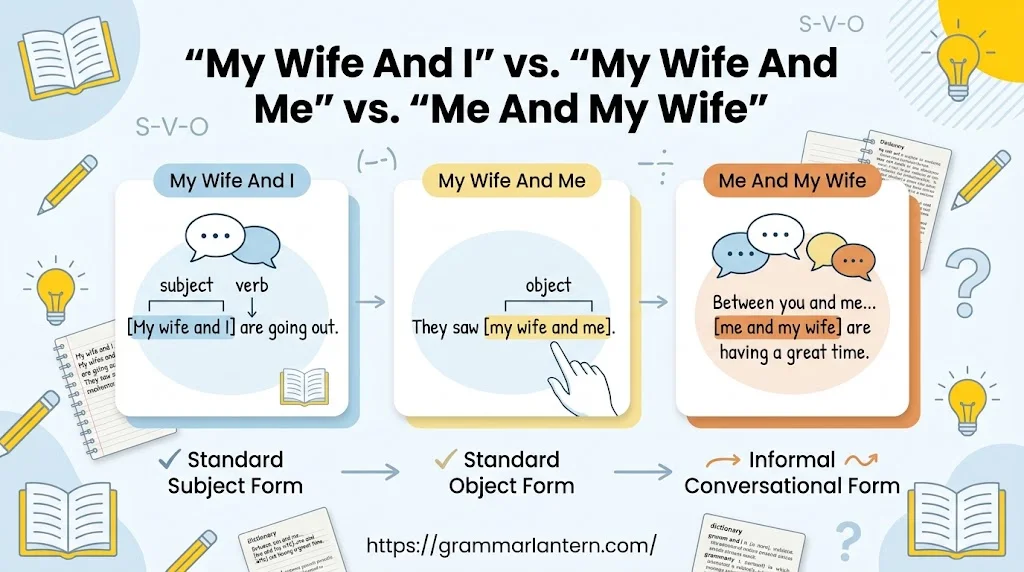
The easiest distinction is subject versus object.
| If the phrase… | Use | Example |
| Performs the action | My wife and I | My wife and I traveled. |
| Receives the action | My wife and me | They called my wife and me. |
| Follows a preposition | My wife and me | She spoke with my wife and me. |
| Acts as an informal subject | Me and my wife may occur in speech | Me and my wife went out. |
| Appears in formal writing as a subject | My wife and I | My wife and I attended the event. |
The important point is that I and me aren’t interchangeable.
They perform different grammatical jobs.
“My Wife and Me” vs. “Me and My Wife”
These two expressions contain the same basic pronouns, but their word order and register differ.
“My Wife and Me”
This form is generally more suitable in polished writing when the phrase is an object.
For example:
The host welcomed my wife and me.
It follows the familiar convention of mentioning the other person before yourself.
“Me and My Wife”
This form is common in casual conversation.
For example:
Me and my wife went fishing.
It sounds conversational and informal. You might hear it in relaxed speech, personal storytelling, or casual dialogue.
However, if you’re writing an article, formal email, business letter, school assignment, or professional document, use:
My wife and I went fishing.
The difference is mainly about grammatical role plus register, not about whether one phrase sounds more sophisticated.
Why Do People Say “My Wife and I” Even When It Is Wrong?
One reason is hypercorrection.
People often learn that expressions such as “my wife and I” sound more polished than expressions containing “me.” Over time, some speakers begin replacing me with I whenever another person appears in the sentence.
That creates mistakes like:
The manager talked to my wife and I.
The speaker may believe I sounds more correct.
It doesn’t.
The correct version is:
The manager talked to my wife and me.
The phrase follows the preposition to, so me is required.
Here’s another example:
The award was given to my wife and I.
The correct version is:
The award was given to my wife and me.
The lesson is worth remembering:
Don’t choose “I” because it sounds formal. Choose it because the grammar requires it.
How to Choose Between “I” and “Me” Quickly
You don’t need to memorize dozens of complicated grammar rules.
Use these steps instead.
Find the Verb
First, identify the main action.
Ask:
Who performs the action?
Example:
My wife and I organized the party.
Who organized it?
My wife and I.
Therefore, I is correct.
Identify the Object
Next, ask who receives the action.
The neighbors thanked my wife and me.
Who performed the thanking?
The neighbors.
Who received the thanks?
My wife and me.
Therefore, me is correct.
Remove the Other Person
This is perhaps the fastest trick.
Take:
My wife and I bought a house.
Remove my wife:
I bought a house.
Correct.
Now:
The realtor called my wife and me.
Remove my wife:
The realtor called me.
Correct.
This little trick cuts through a lot of confusion.
Check for a Preposition
Look for words such as:
- to
- for
- with
- between
- from
- about
- without
If the phrase follows one of these words, me will often be the correct form.
For example:
This is important to my wife and me.
The decision affects my wife and me.
The conversation remained between my wife and me.
Common Mistakes and Their Corrections
Small pronoun mistakes can change the grammatical structure of an otherwise good sentence. Here are some of the most common ones.
| Incorrect or less suitable | Better standard form | Why |
| My wife and me went shopping. | My wife and I went shopping. | The phrase is the subject. |
| They invited my wife and I. | They invited my wife and me. | The phrase is the object. |
| Me and my wife went out. | My wife and I went out. | Formal standard English uses the subject form. |
| She spoke to my wife and I. | She spoke to my wife and me. | “To” takes an object pronoun. |
| Between my wife and I | Between my wife and me | “Between” takes an object pronoun. |
| This gift is for my wife and I. | This gift is for my wife and me. | “For” takes an object pronoun. |
| My wife and I were invited. | My wife and I were invited. | The pair is the grammatical subject. |
“My Wife And I” vs. “My Wife And Me” in Real-Life Situations
Talking About Activities
When you and your wife perform an activity, use “my wife and I.”
1.My wife and I went hiking on Saturday.
2.My wife and I watched a movie last night.
3.My wife and I are learning Spanish.
The pair acts as the subject each time.
Talking About Invitations
When someone invites you and your wife, use “my wife and me.”
They invited my wife and me to the wedding.
The subject is they.
Your wife and you receive the invitation.
Talking About Conversations
This situation often causes mistakes.
Correct:
The counselor spoke with my wife and me.
But:
My wife and I spoke with the counselor.
Both sentences describe a conversation. The pronouns change because the grammatical roles change.
That distinction is the heart of the entire issue.
Talking About Plans
Use “my wife and I” when you and your wife make or carry out the plan.
My wife and I are planning a trip to California.
Use “my wife and me” when someone else discusses, contacts, or helps you.
The travel agent gave my wife and me several options.
The surrounding grammar determines the pronoun.
Special Case: “Between My Wife and Me”
“Between my wife and me” is one of the most frequently misunderstood expressions.
The correct form is:
This is just between my wife and me.
Why?
Because between is a preposition. The pronoun following it functions as an object.
Therefore:
- between me
- between us
- between him
- between her
- between them
Not:
- between I
- between we
- between he
- between she
- between they
A useful example is:
There is a disagreement between my wife and me.
The phrase “my wife and me” doesn’t perform the action. It follows between.
That’s why me belongs there.
Special Case: “My Wife and I” After Linking Verbs
Some sentences become more complicated when a linking verb such as is, was, are, or were appears.
Consider:
It was my wife and I.
This construction is widely heard, especially in formal-sounding speech. However, traditional grammatical analysis often favors:
It was my wife and me.
The issue involves how pronouns function after a linking verb and how modern English handles constructions of this kind.
If the sentence sounds awkward, the easiest solution is often to rewrite it.
For example:
My wife and I were the people responsible for the project.
This version avoids the pronoun problem altogether and makes the meaning clearer.
Clear writing doesn’t always require forcing a sentence into a difficult structure.
Formal vs. Informal Usage
Context matters.
In formal writing, standard grammatical forms should guide your choices.
Formal or Professional Writing
Prefer:
My wife and I attended the meeting.
The organizer contacted my wife and me.
The agreement was between my wife and me.
Neutral Everyday English
The same standard forms work perfectly well:
My wife and I went to the store.
They called my wife and me.
There is no need to make your English less formal simply because you’re having an everyday conversation.
Casual Conversation
You may hear:
Me and my wife went to the store.
This is common in informal speech. Still, if you’re writing carefully, “my wife and I” is the stronger choice when the phrase is the subject.
The important distinction is this:
Conversational usage can differ from formal written English.
Neither should be confused with the other.
Case Study: Choosing the Right Pronoun
Imagine someone writes:
My wife and me went to the bank, and the manager later spoke with my wife and I.
At first glance, the sentence may sound awkward, but the solution becomes simple when each clause is examined separately.
First Clause
My wife and me went to the bank.
Who went?
My wife and me.
The pair performs the action.
Therefore:
My wife and I went to the bank.
Second Clause
The manager later spoke with my wife and I.
Who spoke?
The manager.
Who was spoken to?
My wife and me.
Therefore:
The manager later spoke with my wife and me.
The corrected sentence is:
My wife and I went to the bank, and the manager later spoke with my wife and me.
One sentence contains both forms because the grammatical roles change.
That’s the key insight.
A Simple Rule to Remember
When you’re unsure, remember this:
I does the action. Me receives the action.
Then apply the removal test.
My wife and I → I
My wife and me → me
If the shortened sentence needs I, use my wife and I.
If it needs me, use my wife and me.
For “me and my wife,” ask whether you’re writing formal standard English or speaking casually. As a subject, “my wife and I” is the safer standard choice.
Quick Memory Trick
Think of the pronouns this way:
- I = the doer
- me = the receiver
- my wife and I = subject pair
- my wife and me = object pair
- me and my wife = informal conversational form when used as a subject
It isn’t a perfect shortcut for every unusual sentence, but it works for most everyday situations.
Read More: Some Is vs. Some Are: Is “Some” Singular or Plural?
FAQs
1. Is “My wife and I” grammatically correct?
Yes. Use My wife and I when the phrase acts as the subject and performs the action. For example, “My wife and I went shopping.”
2. When should I use “My wife and me”?
Use My wife and me when the phrase acts as the object of a verb or follows a preposition. For example, “She invited my wife and me.”
3. Is “Me and my wife” wrong?
Not always. Me and my wife is common in casual speech, but My wife and I is usually better when you are the subject. In formal writing, place the other person first and choose the correct pronoun.
4. Can I use “Me and my wife” in formal writing?
It’s better to avoid it in formal writing when you can use a more standard construction. Choose My wife and I or My wife and me based on the role in the sentence.
5. What is the easiest way to choose between “I” and “me”?
Remove the other person from the phrase. If “I” sounds correct alone, use I. If “me” sounds correct, use me. For example, “My wife and I went” becomes “I went.”
6. Should I always put “my wife” before “me”?
In standard English, putting the other person first is generally considered more polite and natural. So, my wife and me sounds better than me and my wife in many situations.
7. Is “My wife and I went to the store” correct?
Yes. My wife and I is the subject because both people perform the action of going.
8. Is “He gave my wife and me a gift” correct?
Yes. My wife and me is the object because the gift was given to both people.
9. Why do native speakers say “Me and my wife”?
People often use Me and my wife in casual conversation because spoken English doesn’t always follow formal grammar conventions. It’s common in everyday speech.
10. Does the choice change the meaning?
Usually, the basic meaning stays the same, but the grammatical role changes. Choosing I or me correctly makes your sentence sound clearer, more polished, and appropriate for the situation.
Conclusion
Choosing between My Wife and I, My Wife and Me, and Me and My Wife becomes much easier when you focus on the role of the pronoun. If you and your wife perform the action, use My Wife and I. If the action happens to you both, use My Wife and Me. This simple subject-and-object test can save you from second-guessing yourself.
Me and My Wife may sound perfectly normal in casual conversation, but formal writing calls for more careful choices. Once you practice these patterns in real sentences, the difference starts to feel natural. You don’t need to memorize a long list of rules. Just identify who is doing the action and who is receiving it, then choose I or me accordingly.

For Shafiq ur Rehman, writing is an art form and grammar is the toolbox that makes it beautiful. As a dedicated content writer at Grammar Lantern, Shafiq approaches every topic like an architect carefully laying down strong foundations of understanding before adding the finer details. He loves diving into the trickiest grammar points and resurfacing with simple, bite-sized takeaways that anyone can grasp. When he’s not crafting articles, you’ll likely find him strategizing over a game of chess, exploring dusty local bookshops, or quietly jotting down poetic observations in his notebook.


[…] Read More: “My Wife And I” vs. “My Wife And Me” vs. “Me And My Wife” […]