Many English learners feel confused when they use the verb sew because sewed and sewn are two different forms. The good news is that the difference is easy to understand. Both describe the same action of joining fabric with a needle and thread. However, this past tense pattern can seem tricky because sew is one of the irregular verbs with an unusual overlap between its forms.
In the case of sew, sewed works as the simple past tense and can also work as the past participle. Sewn, however, only works as the past participle and usually needs an auxiliary verb before it. This simple rule makes the difference much less difficult to remember and helps you use both forms correctly.
In this article, I’ll explain how both forms work in everyday English. For example, “She sewed the dress yesterday” uses the simple past. “She has sewn the dress” uses the past participle.
The Quick Answer
The simplest distinction is this:
- Sew = base form
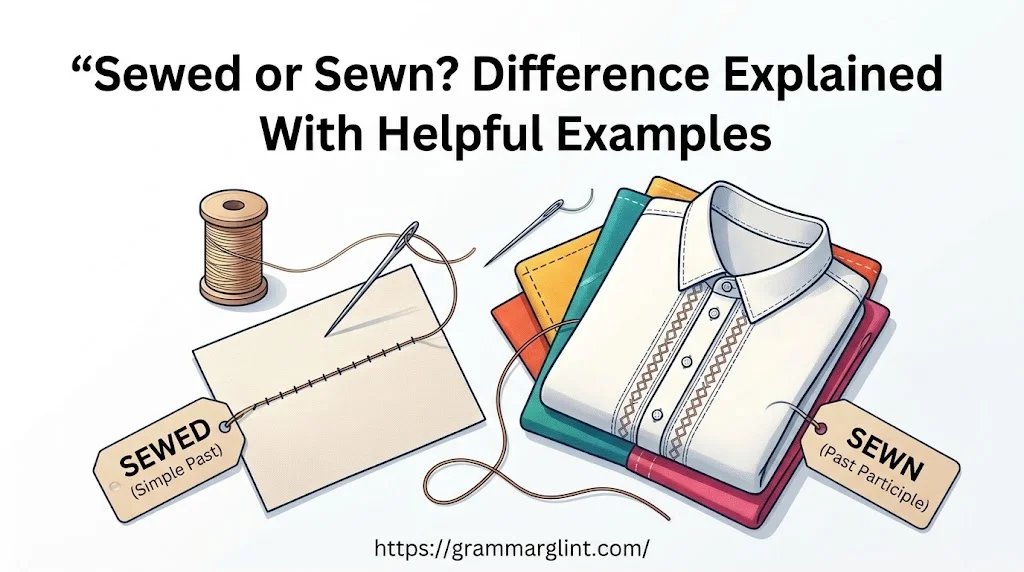
- Sewed = simple past
- Sewn = past participle
- Sewed = can also be used as a past participle
For example:
She sewed the dress yesterday.
Here, sewed describes an action that happened in the past. No helping verb is needed.
Now compare it with:
She has sewn the dress already.
Here, sewn works with the helping verb has. Together, has sewn forms the present perfect.
You can also encounter:
She has sewed the dress already.
This construction isn’t automatically grammatically wrong. Sewed has historically and currently been used as a past participle as well. However, sewn is the more familiar choice in many contexts.
A useful rule is:
Use “sewed” for the simple past. Use “sewn” when you need the past participle.
That rule will cover most situations you encounter.
Sew, Sewed, and Sewn: Understanding the Verb Forms
Before comparing the two forms, it helps to understand the complete set of forms for sew.
| Verb form | Function | Example |
| sew | Base form | I sew my own clothes. |
| sews | Third-person singular present | She sews dresses. |
| sewed | Simple past | She sewed a dress yesterday. |
| sewn | Past participle | She has sewn three dresses. |
| sewing | Present participle/gerund | She is sewing a dress. |
The key distinction lies between sewed and sewn.
The word sewed normally tells you that the sewing happened in the past. It can stand alone as the main verb.
The word sewn, on the other hand, generally needs a helping verb when it functions as a verb. Common helpers include has, have, had, is, are, was, and were.
Consider these examples:
- I sewed the button onto my shirt.
- I have sewn the button onto my shirt.
- The button was sewn onto my shirt.
The action remains essentially the same. What changes is the grammatical construction.
Think of “sewed” as the straightforward past-tense worker and “sewn” as the form that usually needs grammatical support.
That distinction makes the two forms much easier to recognize.
When to Use “Sewed”
“Sewed” as the Simple Past
The most common use of sewed is as the simple past form of sew.
Use it when you’re describing an action that happened in the past. The action may have occurred yesterday, last year, a few minutes ago, or at some unspecified past point.
For example:
- I sewed a button onto my jacket.
- She sewed the torn seam last night.
- My grandmother sewed this quilt.
- He sewed the costume for the play.
- They sewed the pieces together by hand.
Notice something important about these sentences. Sewed doesn’t require another helping verb.
You don’t need to say:
She has sewed the dress yesterday.
Instead, when you’re simply reporting a completed past event, say:
She sewed the dress yesterday.
The word yesterday clearly places the action in the past.
“Sewed” With Specific Past-Time Expressions
Simple past constructions frequently appear with expressions that identify when an action happened.
Common examples include:
- yesterday
- last night
- last week
- last month
- two days ago
- several years ago
- when I was young
- during the summer
- earlier this morning
For example:
She sewed the missing button onto her coat yesterday.
I sewed that costume two weeks ago.
My aunt sewed these curtains last summer.
In each sentence, sewed works naturally because the sentence presents the sewing as a completed past event.
“Sewed” in Everyday Contexts
You can use sewed for many types of sewing activity.
It can describe:
- repairing clothing
- making dresses
- creating quilts
- attaching buttons
- adding patches
- stitching decorations
- making costumes
- joining pieces of fabric
- repairing torn seams
- creating handmade items
For example:
Maria sewed a patch onto her backpack.
The tailor sewed a new pocket onto the jacket.
He sewed the ripped sleeve before going to work.
The particular sewing task doesn’t determine whether you use sewed. The time and grammatical structure do.
When to Use “Sewn”
“Sewn” as a Past Participle
Sewn is the traditional and widely recognized past participle of sew.
A past participle commonly appears with an auxiliary verb to create perfect or passive constructions.
For example:
She has sewn three dresses this month.
Here, has is the auxiliary verb and sewn is the past participle.
Another example:
They had sewn the costumes before the show began.
In this sentence, had sewn creates the past perfect.
You can also use sewn in passive constructions:
The buttons were sewn onto the jacket.
Here, were sewn forms a passive construction.
“Sewn” in Perfect Tenses
The perfect tenses provide some of the clearest examples of sewn.
Present Perfect
The present perfect uses has/have + past participle.
Examples:
- I have sewn the final seam.
- She has sewn five dresses this year.
- They have sewn the patches onto the uniforms.
- He has sewn the torn fabric back together.
The present perfect connects a past action with the present in some way.
For example:
She has sewn the dress.
The focus isn’t simply on when she did it. The sentence emphasizes the completed result.
Past Perfect
The past perfect uses had + past participle.
Examples:
- She had sewn the dress before dinner.
- They had sewn all the costumes before rehearsal.
- He had sewn the patch onto his jacket before leaving.
The past perfect helps establish which of two past events happened first.
For example:
She had sewn the dress before the customer arrived.
First, she finished sewing. Later, the customer arrived.
Future Perfect
The future perfect uses will have + past participle.
Examples:
- She will have sewn the costume by Friday.
- They will have sewn all the pieces together by noon.
- I will have sewn the curtains before the guests arrive.
Again, sewn follows the auxiliary structure.
“Sewn” in Passive Sentences
Another important use of sewn appears in passive constructions.
Consider:
The dress was sewn by hand.
The sentence focuses on the dress, not the person who performed the sewing.
Other examples include:
- The buttons were sewn onto the coat.
- The label was sewn into the collar.
- The patch was sewn onto the uniform.
- The pieces were sewn together carefully.
- The decoration was sewn into the fabric.
In each case, sewn follows a form of be.
This pattern is especially common when discussing clothing, manufacturing, textiles, tailoring, quilting, and crafts.
Why “Sewn” Sounds Natural Here
Compare these two sentences:
The tailor sewed the buttons onto the shirt.
The buttons were sewn onto the shirt.
The first sentence uses active voice. The tailor performs the action.
The second sentence uses passive voice. The buttons receive the action.
The verb form changes because the grammatical structure changes.
Is “Sewed” Also a Past Participle?
Yes. This is one of the most important details about sewed vs. sewn.
Many people learn a simple rule:
Sew → sewed → sewn
That’s useful, but it doesn’t tell the whole story.
Sewed can also function as a past participle. Therefore, a sentence such as:
I have sewed the button back on.
can be found in English and can be grammatically acceptable.
However, many speakers and writers prefer:
I have sewn the button back on.
The second version is often more natural and familiar, particularly in careful standard writing.
This creates an important distinction:
| Form | Simple past | Past participle |
| sewed | Yes | Yes |
| sewn | No | Yes |
So, saying “sewed is never a past participle” would be too absolute.
The better explanation is that sewed is the standard simple past form and can also function as a past participle, while sewn is the established past-participle form.
Have Sewed or Have Sewn?
This is perhaps the most common point of confusion.
Both constructions can occur:
I have sewn the dress.
I have sewed the dress.
The first is generally the more familiar choice for many speakers and readers.
Why?
Because sewn strongly signals the past participle form.
The pattern is:
have + sewn
Just as you might recognize:
- have gone
- have written
- have taken
- have broken
- have sewn
However, have sewed isn’t automatically incorrect.
If the goal is polished, broadly accepted usage, have sewn is usually the better choice.
Compare These Sentences
| Sentence | Function | Practical judgment |
| She sewed the dress yesterday. | Simple past | Standard and natural |
| She has sewn the dress. | Present perfect | Standard and very natural |
| She has sewed the dress. | Present perfect | Possible and attested |
| She sewn the dress yesterday. | Intended simple past | Incorrect |
| She has sewn the dress yesterday. | Perfect + definite past time | Usually awkward or incorrect in standard usage |
| The dress was sewn by hand. | Passive | Standard and natural |
The most useful takeaway is simple: don’t replace “sewed” with “sewn” merely because the action happened in the past.
Grammar determines the form.
Active and Passive Sentences
Looking at active and passive constructions side by side can make the distinction crystal clear.
| Active sentence | Passive sentence |
| She sewed the dress. | The dress was sewn by her. |
| He sewed the patch onto the coat. | The patch was sewn onto the coat. |
| They sewed the pieces together. | The pieces were sewn together. |
| I sewed the button onto the shirt. | The button was sewn onto the shirt. |
The active sentences use sewed because they’re simple past constructions.
The passive sentences use sewn because the structure requires a past participle after a form of be.
There’s a useful pattern hiding here:
Subject + sewed + object
versus
Object + was/were + sewn
Once you spot the structure, the choice becomes almost automatic.
Read More: The Smiths or The Smiths’ or The Smiths’s? Which Is Correct?
Common Mistakes
Mistake: Using “Sewn” as the Simple Past
A common error is:
She sewn a dress yesterday.
The standard simple past form is:
She sewed a dress yesterday.
Why?
Because sewn is a past participle. The sentence doesn’t provide an auxiliary verb that supports that form.
Mistake: Using “Sewn” Without a Helping Verb
Another common mistake looks like this:
She sewn the dress already.
In standard usage, the sentence needs an auxiliary:
She has sewn the dress already.
Or:
She had sewn the dress already.
The exact auxiliary depends on the intended tense.
Mistake: Assuming “Sewed” Is Always Wrong
This rule causes another problem.
Some people believe sewed can only appear as a simple past verb. That’s too restrictive.
As explained earlier, sewed can also serve as a past participle.
For example:
She has sewed the buttons onto the coat.
Although has sewn is generally the more familiar choice, has sewed can occur.
Therefore, calling every use of sewed after has or have incorrect oversimplifies English grammar.
Mistake: Confusing “Sew” With “Sow”
Sew and sow sound alike in standard English, but they have completely different meanings.
Sew means to join or attach material with stitches.
She knows how to sew a dress.
Sow means to plant seeds.
Farmers sow seeds in the spring.
This is a classic homophone problem. The pronunciation won’t always help you distinguish the words, so context matters.
Side-by-Side Comparison
The following table brings the main differences together.
| Feature | Sewed | Sewn |
| Base verb | Sew | Sew |
| Simple present | No | No |
| Simple past | Yes | No |
| Past participle | Yes | Yes |
| Can stand alone as simple past | Yes | No |
| Common after has/have/had | Possible | Very common |
| Common in passive constructions | Less typical | Very common |
| Example | She sewed the dress. | She has sewn the dress. |
The table also reveals why the issue isn’t as black and white as it first appears.
Sewed and sewn overlap in function, but they aren’t interchangeable in every sentence.
The most important distinction remains grammatical rather than semantic.
Real-World Examples of “Sewed”
Here are several natural examples using sewed as the simple past.
Clothing
My grandmother sewed this dress by hand.
The sentence describes a completed action in the past.
Repairs
I sewed the torn pocket back together.
Again, sewed works as the simple past.
Quilting
She sewed the fabric pieces into a beautiful quilt.
The sentence reports what she did.
Costumes
The designer sewed the costume for the theater production.
The completed past action takes sewed.
Buttons
He sewed a new button onto his shirt.
The verb directly tells us what happened.
Patches
They sewed patches onto their jackets.
No auxiliary is necessary because the sentence uses simple past.
Real-World Examples of “Sewn”
Now consider situations where sewn works as a past participle.
Present Perfect
She has sewn the final seam.
Past Perfect
They had sewn the costumes before rehearsal began.
Passive Voice
The buttons were sewn onto the coat.
Present Perfect Passive
The patches have been sewn onto the uniforms.
Past Perfect Passive
The decorations had been sewn onto the fabric before the event.
Completed Result
The two pieces have been sewn together securely.
These sentences use sewn because the grammatical structure calls for a past participle.
A Simple Trick to Remember
If grammar terms make your eyes glaze over, use this practical shortcut.
Ask yourself:
Am I simply describing something that happened in the past?
If yes, sewed will usually be correct.
She sewed the dress yesterday.
Now ask:
Am I using a perfect or passive construction?
If yes, sewn will usually be the natural choice.
She has sewn the dress.
The dress was sewn by hand.
Think of it like this:
Sewed tells the story. Sewn usually fits into the structure.
It’s not a perfect grammatical definition, but it’s a useful memory aid.
In Questions
The same distinction applies when forming questions.
For simple past questions, use did + sew, not did + sewed.
Correct:
Did she sew the dress?
Incorrect:
Did she sewed the dress?
This happens because did already carries the past tense. The main verb returns to its base form.
For a perfect construction, use has/have + sewn:
Has she sewn the dress?
Have they sewn the patches onto the jackets?
This gives you another useful pattern:
| Intended structure | Correct example |
| Simple past question | Did she sew the dress? |
| Present perfect question | Has she sewn the dress? |
| Past perfect question | Had she sewn the dress? |
This distinction is easy to miss when you’re speaking quickly. Writing makes the pattern more visible.
In Negative Sentences
Negative constructions follow the same grammatical principles.
For simple past:
She didn’t sew the dress.
Not:
She didn’t sewed the dress.
The auxiliary didn’t carries the past tense. Therefore, the main verb remains sew.
For present perfect:
She hasn’t sewn the dress yet.
For past perfect:
She hadn’t sewn the dress before the deadline.
These patterns reinforce an important English principle: the auxiliary verb often determines the tense, while the main verb takes the form required by the construction.
Read More: Bearable vs. Bareable: Meaning, Difference and Examples
Sewed or Sewn: A Practical Decision Guide
When you’re unsure which word to choose, follow these steps.
Choose “Sewed” When:
- You’re using the simple past.
- You’re describing a completed past action.
- The sentence doesn’t need a perfect auxiliary.
- You’re using a specific past-time expression.
Examples:
- She sewed the dress yesterday.
- I sewed the button last night.
- They sewed the costumes last weekend.
Choose “Sewn” When:
- You’re using a perfect tense.
- You’re using a passive construction.
- The grammar calls for a past participle.
- You want the more familiar past-participle form.
Examples:
- She has sewn the dress.
- They had sewn the costumes.
- The buttons were sewn onto the coat.
- The pieces have been sewn together.
Remember That “Sewed” Can Also Be a Past Participle
This is the nuance worth remembering.
You may encounter:
She has sewed the buttons onto the coat.
However, if you’re deciding which form sounds most natural in a polished sentence, she has sewn the buttons onto the coat will usually be the safer choice.
Case Study: Choosing the Right Form in a Short Story
Imagine you’re describing a tailor’s workday.
You might write:
Maria sewed three dresses yesterday.
That’s simple past. The action happened in the past.
Next, you might write:
She has sewn another dress today.
Now the present perfect connects the completed action with the current situation.
Then you might describe the finished clothing:
The dresses were sewn from lightweight cotton.
That’s passive voice, so sewn fits naturally.
Finally, you could say:
By the time the shop opened, Maria had sewn all three dresses.
That’s past perfect.
Notice how the sewing action itself hasn’t changed. The grammatical relationship to time and the sentence structure has changed.
That’s the real key to understanding these forms.
Why “Sewn” Often Feels More Formal
Many English learners notice that sewn can sound more polished than sewed in certain constructions.
That’s partly because sewn is strongly associated with the past participle role. You frequently see it in phrases such as:
- hand-sewn
- machine-sewn
- carefully sewn
- newly sewn
- beautifully sewn
- sewn together
- sewn onto
- sewn into
For example:
The hand-sewn quilt took months to complete.
Here, sewn functions naturally as a participial modifier.
Another example:
The label was sewn into the collar.
The form feels natural because the construction clearly calls for a participle.
“Hand-Sewn” or “Hand-Sewed”?
The phrase hand-sewn is especially common.
For example:
She bought a beautiful hand-sewn quilt.
The shop sells hand-sewn leather goods.
This is a hand-sewn garment.
You may encounter hand-sewed in some contexts, but hand-sewn is the established and familiar form for this type of adjective.
The same pattern appears in compounds involving the completed result of an action.
Quick Reference: Common Correct Patterns
Keep these patterns nearby if you frequently write about sewing, clothing, or crafts.
| Pattern | Example |
| Simple past + sewed | She sewed the dress. |
| Did + sew | Did she sew the dress? |
| Didn’t + sew | She didn’t sew the dress. |
| Has + sewn | She has sewn the dress. |
| Have + sewn | They have sewn the dresses. |
| Had + sewn | She had sewn the dress. |
| Was + sewn | The dress was sewn by hand. |
| Were + sewn | The buttons were sewn onto the coat. |
| Has been + sewn | The patch has been sewn on. |
| Hand-sewn | It is a hand-sewn garment. |
These patterns cover most everyday situations.
FAQs
1. Is “sewed” a correct word?
Yes. Sewed is the simple past tense of sew and is completely correct.
2. Is “sewn” a correct word?
Yes. Sewn is also correct, but it normally functions as the past participle.
3. What is the past tense of “sew”?
The simple past tense is sewed. For example, “She sewed a button onto my shirt.”
4. What is the past participle of “sew”?
Both sewed and sewn can be used as past participles, although sewn is more common.
5. Should I say “I sewed” or “I sewn”?
Say “I sewed.” The simple past does not need an auxiliary verb.
6. Should I say “I have sewed” or “I have sewn”?
Both can occur, but “I have sewn” is the more common choice in standard English.
7. Is “sewn” an irregular verb form?
Yes. Sewn is an irregular past participle form of sew.
8. Can “sewed” be used as a past participle?
Yes. Sewed can function as both the simple past and a past participle.
9. Does “sewn” need an auxiliary verb?
When sewn acts as a past participle in a verb phrase, it normally appears with an auxiliary verb, such as has, have, or had.
10. What is the easiest way to remember “sewed” and “sewn”?
Remember “sewed” for a completed past action and “sewn” when an auxiliary verb forms a perfect construction.
Conclusion
Sewed and sewn can seem confusing at first, but their roles become clearer with practice. Use sewed for the simple past, such as “I sewed the shirt yesterday.” Use sewn mainly as the past participle, such as “I have sewn the shirt.”
The key is to look at the sentence structure rather than memorize the forms separately. Once you recognize whether you need the simple past or a past participle, choosing between sewed and sewn becomes much easier.