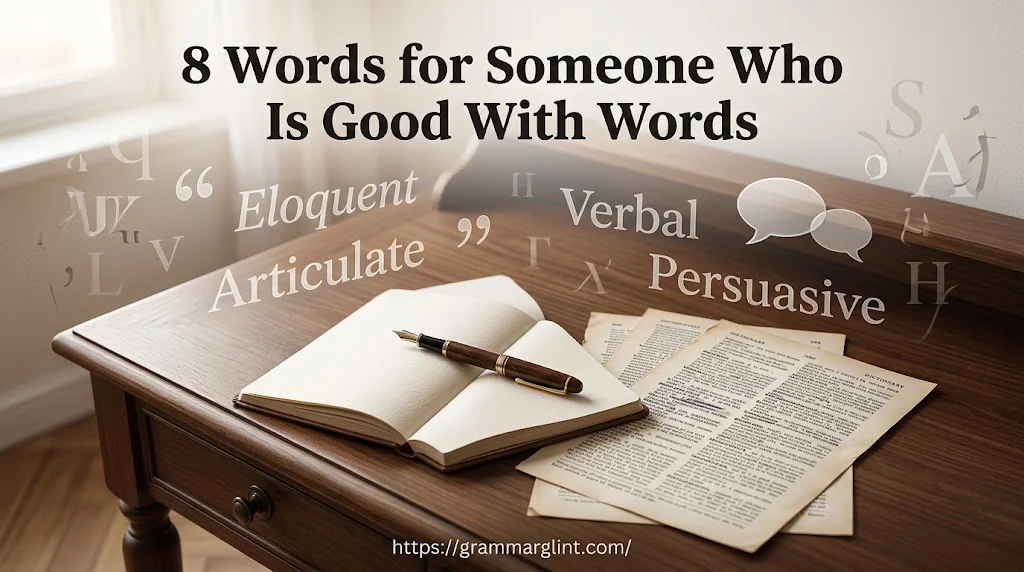
When you need 8 Words for Someone Who Is Good With Words, a Wordsmith is a strong choice because they use words with skill. An Eloquent person speaks with eloquence, while an Articulate speaker can explain ideas clearly. An Expressive person adds feeling through expression and expressiveness.
Someone with a good vocabulary can describe thoughts accurately and make communication easier. Their vocabulary and vocabulary skills help them choose the right word for each situation. A Communicative person also has useful communication skills and shares ideas openly.
A Logophile enjoys language and has a natural interest in words. Someone Well-spoken often has strong verbal ability, while a Fluent speaker shows natural fluency. You can see these qualities in everyday conversation, writing, and presentations, especially when clear expression matters.
What Do You Call Someone Who Is Good With Words?
The most useful general term is often wordsmith when you’re describing someone who skillfully crafts language. However, articulate may work better for someone who explains ideas clearly, while eloquent suggests graceful and powerful expression.
The right choice depends on the person’s particular strength.
| Word | Main Meaning | Common Use | Tone |
| Wordsmith | Someone skilled at crafting words | Writing and creative language | Positive |
| Eloquent | Expressive, fluent, and powerful | Speaking or writing | Formal/positive |
| Articulate | Able to express ideas clearly | Conversation and professional communication | Neutral/positive |
| Expressive | Able to communicate thoughts or feelings vividly | Writing, speech, storytelling | Positive |
| Persuasive | Able to convince others | Arguments, sales, debates, negotiations | Professional |
| Well-spoken | Speaks clearly and appropriately | Conversations and formal settings | Positive |
| Fluent | Uses language smoothly and naturally | Language ability | Neutral |
| Silver-tongued | Charming or highly convincing with words | Persuasion and rhetoric | Playful/mixed |
This distinction matters because vocabulary isn’t the same as communication skill. Someone can memorize thousands of words yet struggle to explain a simple idea.
Conversely, a skilled communicator may use ordinary vocabulary with remarkable precision.
Think of language like a toolbox. Knowing every tool doesn’t make someone a great carpenter. Skill comes from knowing which tool to use, when to use it, and how to use it well.
1. Wordsmith: Someone Skilled at Crafting Words
Wordsmith is one of the best words for someone who is exceptionally skilled with language. It describes a person who carefully creates, shapes, and polishes words to produce an effective result.
The word often applies to writers, editors, poets, journalists, copywriters, novelists, and other language professionals.
A wordsmith doesn’t merely know words. They understand how words work together.
For example, a writer might replace “very tired” with “exhausted” because the stronger word creates a sharper image. Another writer might deliberately keep “very tired” because the simpler phrase better matches the character’s voice.
That judgment is part of wordsmithing.
Examples of “wordsmith”
- She’s a talented wordsmith who can make ordinary subjects fascinating.
- The author is known as a brilliant wordsmith.
- He worked as a wordsmith for several advertising campaigns.
- Her speeches reveal the instincts of a true wordsmith.
The term also has a slightly artistic quality. It compares language work to craftsmanship.
A blacksmith shapes metal. A wordsmith shapes language.
When should you use “wordsmith”?
Use wordsmith when the person’s main talent involves carefully choosing, arranging, or refining words.
It works particularly well when describing:
- Writers
- Editors
- Copywriters
- Poets
- Journalists
- Speechwriters
- Storytellers
- Creative communicators
If someone writes beautiful sentences but doesn’t necessarily persuade people, wordsmith can be more accurate than persuasive.
2. Eloquent: Someone Who Expresses Ideas Powerfully
Eloquent describes someone who expresses ideas in a fluent, powerful, and often graceful way.
An eloquent person doesn’t simply speak correctly. Their language tends to have force, clarity, rhythm, or emotional impact.
You might describe a political speech as eloquent. You could also call a heartfelt letter eloquent. The word applies to both speech and writing.
For example:
Her eloquent speech changed how the audience viewed the issue.
Here, “eloquent” suggests more than grammatical correctness. It implies that the speaker chose language that made the message memorable and compelling.
What makes someone eloquent?
Eloquence often involves several qualities working together:
- Clarity
- Strong word choice
- Fluency
- Emotional impact
- Logical organization
- Effective rhythm
- Appropriate tone
An eloquent speaker doesn’t need to use obscure vocabulary. In fact, unnecessarily complicated language can weaken eloquence.
Consider these two versions:
Complicated:
“The implementation of this multifaceted methodology facilitates the optimization of communicative effectiveness.”
Clear:
“This approach helps people communicate more effectively.”
The second sentence uses simpler language. Yet in the right context, it can be more eloquent because the meaning arrives quickly and cleanly.
Examples of “eloquent”
- He gave an eloquent explanation of the problem.
- Her eloquent writing captured the character’s emotions perfectly.
- The lawyer delivered an eloquent closing argument.
- His tribute to his friend was simple but deeply eloquent.
Eloquent vs. wordsmith
A wordsmith focuses on the craft of language.
An eloquent person focuses on expressing ideas beautifully or powerfully.
A novelist can be a wordsmith. A speaker can be eloquent. One person can certainly be both.
Read More: 1500 In Words: Fifteen Hundred or One Thousand Five Hundred?
3. Articulate: Someone Who Expresses Ideas Clearly
If you want a practical word for someone who is good with words, articulate is one of the safest choices.
An articulate person can explain thoughts, opinions, experiences, or arguments in a way that others understand.
The emphasis falls on clarity and effective expression.
Imagine someone discussing a complicated workplace problem. Instead of rambling through disconnected points, they explain what happened, identify the problem, and present a reasonable solution.
You might say:
“She’s extremely articulate.”
That compliment doesn’t necessarily mean she uses beautiful or poetic language. It means she communicates her thoughts exceptionally well.
Examples of “articulate”
- He’s articulate and thoughtful during interviews.
- She articulated her concerns without sounding confrontational.
- The student gave an articulate answer to a difficult question.
- He’s particularly articulate when explaining technical subjects.
The word also works as a verb:
“She articulated her position clearly.”
Here, articulated means expressed an idea clearly and effectively.
Articulate vs. eloquent
These words overlap, but they aren’t identical.
Articulate emphasizes clarity.
Eloquent emphasizes expressive power, fluency, or elegance.
Someone can be articulate without sounding poetic. Likewise, someone can produce beautiful language without explaining a complicated idea clearly.
That’s why the distinction matters.
4. Expressive: Someone Who Communicates Ideas or Feelings Vividly
Expressive describes someone who communicates thoughts, emotions, or ideas in a vivid and noticeable way.
The word doesn’t necessarily imply formal speech or impressive vocabulary. Instead, it focuses on the person’s ability to make meaning and emotion come through.
An expressive writer might make you feel a character’s fear without directly saying, “The character was afraid.”
An expressive speaker might use tone, rhythm, pauses, and carefully chosen words to communicate emotion.
Examples of “expressive”
- She’s an expressive writer who creates vivid characters.
- His storytelling is incredibly expressive.
- The speaker used expressive language to describe the experience.
- Her expressive writing makes ordinary moments feel significant.
This term works especially well when discussing storytelling and emotional communication.
Expressive vs. eloquent
An eloquent person often communicates with elegance or persuasive force.
An expressive person communicates with vividness and emotional character.
For example, a personal essay can be highly expressive without sounding formal. A courtroom argument might be eloquent without being especially emotional.
5. Persuasive: Someone Who Is Good at Convincing Others
Some people don’t merely use words well. They use them to change minds.
That’s where persuasive comes in.
A persuasive person knows how to present ideas in ways that influence an audience. Their skill may involve logic, emotional appeal, credibility, timing, and carefully chosen language.
You’ll commonly see this word in contexts involving:
- Sales
- Marketing
- Negotiation
- Debate
- Public speaking
- Advertising
- Leadership
- Legal arguments
For example:
“She’s a persuasive speaker who can turn a complicated proposal into a compelling case.”
The compliment focuses on her ability to influence people rather than simply speak beautifully.
What makes language persuasive?
Effective persuasion usually combines several elements:
- A clear position
- Relevant evidence
- Logical reasoning
- Audience awareness
- Appropriate emotional appeal
- Credible presentation
- Strong but natural wording
Persuasion isn’t simply about talking more. Sometimes the strongest argument is the shortest one.
Examples of “persuasive”
- He’s a persuasive negotiator.
- She gave a persuasive argument during the debate.
- The advertisement uses persuasive language without making exaggerated claims.
- His writing is concise, logical, and persuasive.
A person can therefore be persuasive without being eloquent. Their strength may lie in reasoning rather than beautiful expression.
6. Well-Spoken: Someone Who Speaks Clearly and Appropriately
Well-spoken is a straightforward compliment for someone who communicates effectively in speech.
It usually suggests that a person speaks clearly, confidently, appropriately, and with good command of language.
The expression works especially well in everyday and professional situations.
You might describe a candidate as well-spoken during a job interview, You could call a presenter well-spoken after a conference. You might even use it when complimenting someone after an ordinary conversation.
Examples of “well-spoken”
- She’s articulate and well-spoken.
- He came across as confident and well-spoken during the interview.
- The student is remarkably well-spoken for his age.
- He’s a thoughtful, well-spoken presenter.
Well-spoken vs. articulate
These expressions are close.
Well-spoken focuses more on the quality and manner of someone’s speech.
Articulate focuses more strongly on the person’s ability to express ideas clearly.
For instance, someone might be well-spoken because they communicate politely and clearly. Someone articulate can explain a complicated concept with impressive precision.
The two qualities frequently appear together.
7. Fluent: Someone Who Uses Language Smoothly
Fluent describes someone’s ability to use a language smoothly and naturally.
It commonly refers to language proficiency, especially when someone speaks a second or additional language.
For example:
“Maria is fluent in Spanish.”
This means she can use Spanish with a high degree of ease and continuity.
However, fluent doesn’t automatically mean eloquent, persuasive, or creative.
A fluent speaker may communicate naturally while still using ordinary vocabulary. Likewise, someone may have a sophisticated vocabulary without speaking fluently.
Examples of “fluent”
- He’s fluent in English and French.
- She speaks fluent Japanese.
- The interpreter is fluent in several languages.
- Her English is fluent and easy to understand.
The distinction becomes important when describing someone’s general language ability.
If you mean “This person speaks a language smoothly,” use fluent.
If you mean “This person expresses ideas exceptionally well,” consider articulate or eloquent.
Fluent vs. articulate
These words describe different dimensions of communication.
Fluent = smooth and proficient language use.
Articulate = clear and effective expression of ideas.
Someone can be fluent but not particularly articulate. Someone can also be articulate while occasionally searching for words.
8. Silver-Tongued: Someone Highly Skilled at Persuasion
Silver-tongued is a colorful expression for someone who speaks in a charming, clever, or persuasive way.
It often describes someone who can convince others through smooth verbal communication.
Unlike articulate or well-spoken, however, silver-tongued can carry a slightly skeptical meaning.
For example:
“The silver-tongued salesman convinced everyone to reconsider the deal.”
That sentence could sound complimentary. It could also suggest that the salesman was too persuasive.
Context determines the implication.
Examples of “silver-tongued”
- The silver-tongued speaker quickly won over the audience.
- He’s a silver-tongued negotiator who rarely loses a verbal battle.
- Her silver tongue helped settle the disagreement.
- Be careful around a silver-tongued salesperson.
The expression is more colorful and informal than eloquent.
Use it when you want to emphasize charm and persuasive ability, especially when the person’s verbal skill seems almost effortless.
Wordsmith vs. Eloquent vs. Articulate
These three terms often cause the most confusion because they can describe the same person.
However, each highlights something different.
| Term | What It Emphasizes | Typical Example |
| Wordsmith | Crafting and shaping language | A novelist carefully revising a paragraph |
| Eloquent | Powerful and graceful expression | A speaker delivering a moving speech |
| Articulate | Clear expression of ideas | A professional explaining a complex problem |
Consider a university professor explaining a difficult theory.
1. If the professor makes the concept easy to understand, the professor is articulate.
2. If the explanation is beautifully phrased and memorable, the professor may be eloquent.
3. If the professor has an exceptional talent for crafting language, the professor could also be a wordsmith.
The same person can fit all three descriptions.
Other Words Related to Being Good With Words
English offers many additional terms that describe specific language abilities.
These aren’t perfect synonyms for good with words, but they can be useful when the context calls for greater precision.
Communicative
Communicative describes someone who readily shares information, thoughts, or feelings.
It focuses more on willingness and effectiveness in communication than on verbal artistry.
Coherent
Coherent describes communication that is logical, organized, and easy to follow.
A coherent speaker connects ideas naturally instead of jumping randomly between points.
Cogent
Cogent is especially useful when describing a strong argument.
A cogent argument is clear, logical, convincing, and well-reasoned.
Rhetorical
Rhetorical relates to the art of using language effectively, particularly in speeches and arguments.
A skilled rhetorician understands how wording, structure, emphasis, and audience expectations influence communication.
Logophile
A logophile is someone who loves words.
This term is different from wordsmith. A wordsmith actively crafts language skillfully, while a logophile simply has a strong interest or affection for words.
Loquacious
Loquacious describes someone who talks a lot.
That distinction matters. Being loquacious doesn’t necessarily mean being articulate, eloquent, or persuasive.
Someone can talk endlessly and still struggle to communicate a clear point.
How to Choose the Right Word for Someone Who Is Good With Words
The easiest way to choose the right term is to identify what the person does especially well.
Use this quick guide:
| If the Person… | Best Word |
| Crafts beautiful or precise language | Wordsmith |
| Speaks or writes with power and elegance | Eloquent |
| Explains ideas clearly | Articulate |
| Communicates emotion vividly | Expressive |
| Convincingly changes people’s minds | Persuasive |
| Speaks clearly and appropriately | Well-spoken |
| Uses a language smoothly | Fluent |
| Charms or convinces people effortlessly | Silver-tongued |
This approach prevents a common mistake: treating every language-related compliment as interchangeable.
For instance, calling a novelist fluent doesn’t capture the writer’s creative ability. Calling a multilingual speaker persuasive may describe a particular skill but says nothing about language proficiency.
Precision makes the compliment stronger.
What Is the Difference Between Being Articulate and Eloquent?
Articulate and eloquent overlap, but they carry different shades of meaning.
Someone who is articulate expresses ideas clearly and effectively.
Someone who is eloquent expresses ideas with particular fluency, force, beauty, or emotional impact.
Consider these examples:
Articulate:
“He clearly explained why the proposal wouldn’t work.”
Eloquent:
“He explained the proposal’s weaknesses so effectively that the entire room reconsidered its position.”
The first example emphasizes clarity.
The second emphasizes impact and expressive skill.
In everyday professional communication, articulate often sounds more natural. In formal writing, speeches, tributes, and literary discussion, eloquent may fit better.
Does Having a Large Vocabulary Mean Someone Is Good With Words?
Not necessarily.
A large vocabulary gives someone more linguistic resources. It doesn’t guarantee effective communication.
Real verbal skill involves knowing which word fits the situation.
Imagine two people describing a broken machine.
One uses ten technical terms that nobody understands.
The other says, “The motor overheats because the cooling system isn’t moving enough air.”
The second person may have chosen simpler words. Yet the explanation is far more effective.
Good communication depends on several factors:
- Vocabulary
- Clarity
- Context
- Precision
- Tone
- Audience awareness
- Organization
- Timing
- Emotional intelligence
The best communicators don’t show off their vocabulary. They make their message land.
How to Compliment Someone Who Is Good With Words
Sometimes you don’t need a single adjective. A short, specific compliment can communicate the idea more naturally.
Try these examples:
1. For a writer
- “You’re a real wordsmith.”
- “Your word choice is incredibly precise.”
- “You have a gift for turning simple ideas into memorable writing.”
2. For a public speaker
- “You’re an eloquent speaker.”
- “You explain complicated ideas incredibly well.”
- “You’re remarkably articulate.”
3. For a storyteller
- “You’re an expressive storyteller.”
- “You have a real talent for bringing stories to life.”
- “Your descriptions make every scene feel vivid.”
For someone who persuades easily
- “You’re remarkably persuasive.”
- “You know exactly how to make a strong argument.”
- “You have a silver tongue.”
Specific praise often feels more genuine because it identifies the actual skill.
Case Study: One Person, Eight Different Descriptions
Imagine a professional speaker named Daniel.
Daniel writes his own speeches. He explains complicated subjects clearly. His stories create strong emotions, and his arguments often persuade skeptical audiences.
Which word describes him?
Several can work.
As a speechwriter, Daniel is a wordsmith because he carefully crafts language.
As a speaker, he’s eloquent when his delivery becomes powerful and memorable.
1. He’s articulate because he explains complicated ideas clearly.
2. He’s expressive when he uses vivid stories and emotional language.
3. He’s persuasive when he changes the audience’s position.
4. He’s well-spoken when he communicates confidently and appropriately.
If Daniel also speaks several languages with ease, he may be fluent in those languages.
If he can charm a reluctant audience into agreement, someone might jokingly call him silver-tongued.
This example shows why context matters. The words aren’t competing for one universal definition. Each one reveals a different facet of verbal skill.
Common Mistakes
Even closely related terms can create awkward meanings when used carelessly.
Calling every skilled writer “articulate”
Articulate isn’t wrong for a writer. However, it usually emphasizes the clear expression of ideas rather than the craft of writing itself.
If you want to praise someone’s literary technique, wordsmith may be stronger.
Using “fluent” to mean “persuasive”
Fluency concerns smooth language use. It doesn’t inherently mean someone can convince others.
A person can be fluent in English without being persuasive.
Treating “eloquent” and “articulate” as exact synonyms
These words overlap, but their emphasis differs.
Articulate highlights clarity.
Eloquent adds expressive power, grace, or force.
Assuming “silver-tongued” is always positive
It isn’t.
The expression can suggest that someone is too charming or manipulative.
If you want a straightforward professional compliment, articulate or eloquent is usually safer.
Confusing “logophile” with “wordsmith”
A logophile loves words.
A wordsmith skillfully uses or crafts them.
Those qualities can exist together, but they aren’t identical.
Read More: Word for a Person Who Finds Fault in Everything: 10 Words
Frequently Asked Questions
1. What do you call someone who is good with words?
A Wordsmith is someone who uses words skillfully, especially when writing or speaking.
2. What is another word for an eloquent person?
Eloquent describes someone who expresses ideas clearly, confidently, and effectively.
3. What does articulate mean?
Articulate means being able to express thoughts and ideas clearly.
4. What does it mean to be well-spoken?
Being Well-spoken means communicating in a clear, confident, and pleasant way.
5. What word describes someone who loves words?
A Logophile is someone who has a strong interest in words and language.
6. What does fluent mean when describing a speaker?
Fluent describes someone who can use a language smoothly and naturally.
7. Is having a good vocabulary the same as being articulate?
Not exactly. A good vocabulary helps you choose words, while being Articulate means expressing ideas clearly.
8. What word describes someone who communicates feelings well?
Expressive is a useful word for someone who communicates thoughts and feelings with clarity and emotion.
9. Why are communication skills important?
Strong communication skills help people share ideas, explain information, and understand one another more effectively.
10. Can these words describe both writers and speakers?
Yes. Words such as Eloquent, Articulate, Expressive, and Well-spoken can describe strong writers and speakers.
Conclusion
Knowing the right word can make your description much more accurate. Wordsmith, eloquent, articulate, and well-spoken each highlight a different strength. Some people choose words with remarkable precision, while others communicate ideas with warmth, confidence, or creativity. The best choice depends on what you want to emphasize about the person’s ability.
Whether you’re describing a skilled writer, confident speaker, or passionate logophile, these terms give you plenty of useful options. A strong vocabulary isn’t only about knowing unusual words. It’s also about understanding language, expressing ideas clearly, and choosing words that fit the situation. That’s what makes communication feel natural, effective, and memorable.

For Shafiq ur Rehman, writing is an art form and grammar is the toolbox that makes it beautiful. As a dedicated content writer at Grammar Lantern, Shafiq approaches every topic like an architect carefully laying down strong foundations of understanding before adding the finer details. He loves diving into the trickiest grammar points and resurfacing with simple, bite-sized takeaways that anyone can grasp. When he’s not crafting articles, you’ll likely find him strategizing over a game of chess, exploring dusty local bookshops, or quietly jotting down poetic observations in his notebook.

[…] Read More: 8 Words for Someone Who Is Good With Words: Powerful Terms […]
[…] Read More: 8 Words for Someone Who Is Good With Words: Powerful Terms […]