
Flatform vs Platform helps shoppers understand why flatform and platform create confusion when choosing shoes, fashion terms, and their meanings. I have noticed many writers and style lovers feel unsure when they see these words because flatform looks like a typo or misspelling of platform. Both are real words, but their meanings change depending on the context.
A flatform is a type of shoe connected with fashion terminology and footwear, while a platform can describe platform shoes, a raised surface, or a technology system. This difference explains why people searching online may find both terms and face word confusion in different contexts.
Learning this comparison improves your vocabulary, spelling, and usage in everyday communication. In this complete guide, understanding how these words differ through real-life examples and practical examples helps you choose the correct term confidently.
Flatform shoes and platform shoes belong to shoe terminology, while a technology platform, business platform, transportation platform, and digital platform connect with technology, business, and other fields. Clear knowledge of these entities improves accurate writing, helps you communicate ideas properly, and lets you avoid common mistakes by using each word correctly every time.
Quick Answer
The difference between flatform and platform is simple:
- Flatform is a fashion term that describes a shoe with a uniformly thick, flat sole from the heel to the toe.
- Platform is a much broader word. It can refer to a raised surface, a train station platform, an online platform, a software platform, a political platform, or a type of shoe with an elevated sole.
Although every flatform shoe belongs to the broader platform shoe family, not every platform shoe is a flatform.
| Feature | Flatform | Platform |
| Primary Meaning | A shoe with an even-thickness sole | A raised surface, system, stage, or elevated shoe |
| Part of Speech | Noun | Noun |
| Common Usage | Fashion | Everyday English |
| Frequency | Relatively uncommon | Extremely common |
| Industries | Fashion | Technology, politics, transportation, architecture, fashion, business |
| Can They Replace Each Other? | Usually no | Only when referring to certain shoes |
What Does “Flatform” Mean?
Definition
A flatform is a type of footwear featuring a sole that remains almost the same thickness from front to back. Unlike traditional high heels or wedges, a flatform lifts your entire foot evenly.
The word combines flat and platform, creating a name that perfectly describes its design.
Fashion designers introduced the term to distinguish these shoes from standard platform heels.
Key Characteristics of Flatform Shoes
Flatform shoes usually have these features:
- Uniform sole thickness
- Flat walking surface
- Added height without a raised heel
- Better weight distribution
- Casual or modern fashion style
- Available as sandals, sneakers, boots, and loafers
Unlike many elevated shoes, flatforms often feel more stable because your foot stays level.
Example Sentences
- She paired her summer dress with white flatform sandals.
- Black leather flatform boots became one of the season’s biggest trends.
- The designer introduced colorful flatform sneakers during Fashion Week.
What Does “Platform” Mean?
Definition
The word platform has several meanings depending on the context. It generally refers to a raised surface, foundation, structure, or system that supports people, ideas, or technology.
Because of its flexibility, platform is one of the most commonly used nouns in modern English.
Platform as a Physical Structure
A platform often refers to a raised area used for standing, performing, or displaying something.
Examples include:
- Performance stages
- Speaking podiums
- Observation decks
- Construction platforms
Example:
“The speaker walked onto the platform before addressing the audience.”
Platform in Transportation
Train stations and subway systems use platforms where passengers safely board and leave vehicles.
Examples include:
- Railway platform
- Subway platform
- Metro platform
Example:
“The train arrived at Platform 6 exactly on schedule.”
Platform in Technology
Technology has made this meaning incredibly popular.
A platform may describe:
- Operating systems
- Software environments
- Social media websites
- Streaming services
- E-commerce marketplaces
- Cloud services
Examples include:
- Windows
- Android
- iOS
- YouTube
- Shopify
- GitHub
Example:
“The company launched its application on multiple software platforms.”
Platform in Business
Businesses often create digital platforms where buyers and sellers interact.
Examples include:
- Freelance marketplaces
- Online learning platforms
- Food delivery platforms
- Investment platforms
Platform in Politics
A political platform outlines the policies, promises, and goals of a political party or candidate.
Example:
“Healthcare became a central issue in the candidate’s platform.”
Platform as Influence
People also use platform to describe someone’s ability to reach an audience.
Examples include:
- Media platform
- Personal platform
- Public platform
Example:
“She uses her platform to promote environmental awareness.”
Read More: Tie vs. Tye: Meaning, Difference, Spelling, and Correct Usage
The Main Differences
Although the words differ by only one letter, their meanings are very different.
Meaning
A flatform refers only to footwear.
A platform has dozens of meanings depending on context.
Usage
Flatform appears mainly in fashion magazines, clothing stores, and shoe catalogs.
Platform appears almost everywhere.
Popularity
Platform has existed in English for centuries.
Flatform became popular only in modern fashion.
Industries
| Industry | Flatform | Platform |
| Fashion | ✅ | ✅ |
| Technology | ❌ | ✅ |
| Transportation | ❌ | ✅ |
| Politics | ❌ | ✅ |
| Business | ❌ | ✅ |
| Architecture | ❌ | ✅ |
Why People Mix Up
Several reasons explain this confusion.
Similar Spelling
Only one letter separates the two words.
Shared Fashion Roots
Both words appear in shoe descriptions.
Many shoppers assume they mean exactly the same thing.
Online Shopping
Retail websites sometimes categorize flatforms under “platform shoes.”
That isn’t technically wrong because flatforms belong to the platform shoe family.
Autocorrect
Many spell-check tools replace flatform with platform, leading people to think flatform isn’t real.
English Learners
Someone learning English may never encounter flatform until browsing fashion websites.
Is “Flatform” a Real Word?
Yes.
Flatform is recognized by major English dictionaries and fashion publications.
Although it isn’t nearly as common as platform, it has become a standard fashion term worldwide.
The word gained popularity as designers introduced thick-soled shoes that remained completely level.
Today, major footwear brands regularly market flatform sandals, sneakers, boots, and loafers.
Can “Flatform” Replace “Platform”?
Almost never.
Consider these examples.
Correct:
- I bought new flatform sandals.
Incorrect:
- I uploaded my video to a flatform.
Correct:
- I uploaded my video to a platform.
Likewise:
Correct:
- The train is waiting at Platform 3.
Incorrect:
- The train is waiting at Flatform 3.
Only use flatform when discussing a specific footwear style.
Common Mistakes to Avoid
Many writers accidentally misuse these words.
Avoid these mistakes.
- Calling every thick-soled shoe a flatform
- Using flatform in technology articles
- Replacing railway platform with flatform
- Confusing flatform shoes with wedge shoes
- Assuming platform always refers to shoes
Choosing the correct word depends entirely on context.
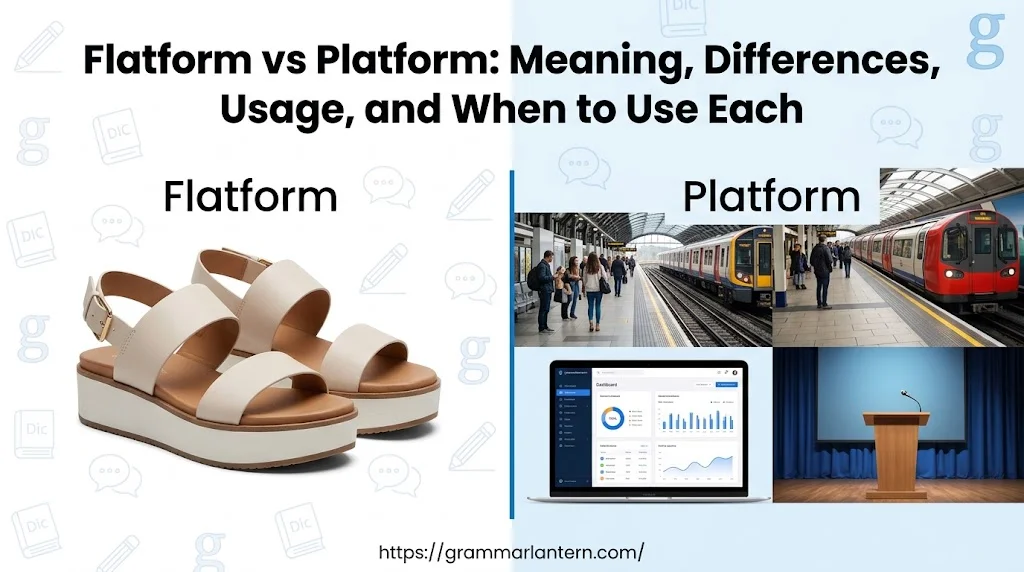
Flatform vs Platform Shoes
People often assume these shoes are identical.
They’re not.
What Is a Platform Shoe?
A platform shoe has a thick sole under part or all of the foot.
Some platform shoes also have high heels.
Examples include:
- Platform heels
- Platform boots
- Platform sandals
- Platform sneakers
What Is a Flatform Shoe?
A flatform keeps the entire sole almost level.
There is little or no height difference between the heel and the front.
Key Design Differences
| Feature | Flatform Shoe | Platform Shoe |
| Sole Shape | Uniform | May vary |
| Heel Height | Flat | Often raised |
| Walking Position | Level | Sometimes angled |
| Stability | Generally higher | Depends on design |
| Everyday Comfort | Often excellent | Varies |
| Fashion Style | Casual to modern | Casual to formal |
Real-World Examples
Fashion
- Chunky white flatform sneakers
- Leather flatform sandals
- Summer flatform espadrilles
Technology
- Cloud computing platform
- Social media platform
- Online learning platform
Business
- Payment platform
- Freelancing platform
- Marketplace platform
Transportation
- Railway platform
- Airport boarding platform
- Subway platform
Politics
- Environmental platform
- Economic platform
- Education platform
These examples show just how versatile platform has become compared to flatform.
Related Terms Worth Knowing
Wedge Shoes
Wedges raise the heel gradually using a continuous sole.
Unlike flatforms, wedges slope upward.
Chunky Sneakers
Chunky sneakers feature oversized soles but aren’t always flatforms.
Platform Sandals
These sandals include thick soles and may or may not have raised heels.
Platform Heels
Platform heels combine an elevated front sole with a noticeably higher heel.
Digital Platform
A digital platform connects users through software or online services.
Examples include streaming websites, marketplaces, and collaboration tools.
Platform Economy
The platform economy refers to businesses that connect customers and providers through digital services.
Examples include ride-sharing, food delivery, and freelance marketplaces.
Memory Trick
Here’s an easy way to remember the difference.
Think of the first four letters.
- Flatform contains flat, reminding you that the sole stays flat.
- Platform supports people, technology, transportation, businesses, and ideas.
If you’re talking about anything besides shoes, platform is almost certainly the correct word.
Practical Usage Examples
These examples show how native speakers naturally use each word.
Correct Uses of Flatform
- She bought black flatform sandals for vacation.
- My favorite flatform sneakers are surprisingly comfortable.
- Flatform loafers have become increasingly popular.
Correct Uses of Platform
- The passengers waited on Platform 5.
- The company built a secure cloud platform.
- She spoke from the main platform.
- Their online platform serves millions of users.
- His political platform focused on education reform.
Case Study: A Common Shopping Mistake
Imagine two shoppers searching online.
The first searches for platform sandals.
Results include:
- High platform heels
- Chunky sandals
- Flatform sandals
- Platform wedges
The second searches for flatform sandals.
Results mostly include shoes with completely flat elevated soles.
Although the searches overlap, the second delivers much more specific results.
This example shows why understanding the distinction helps you find exactly what you want.
“Every flatform is a platform shoe, but not every platform shoe is a flatform.”
That simple sentence captures the relationship perfectly.
Read More: Sewed or Sewn? Difference Explained With Helpful Examples
FAQs
1. What is the main difference between flatform and platform?
The main difference between flatform and platform is their meaning and usage. A flatform usually refers to a type of shoe with a flat, thick sole, while a platform can describe shoes, a raised surface, or a system used in technology and business.
2. Is flatform a real word or a misspelling of platform?
Flatform is a real word, not a simple misspelling of platform. It is mainly used in the fashion world to describe a style of footwear that combines a flat shape with a raised sole.
3. Are flatform shoes and platform shoes the same?
No, flatform shoes and platform shoes are different styles. Flatforms usually have a uniform sole height from front to back, while platform shoes may have a raised heel area with a different front sole height.
4. When should I use the word flatform?
You should use flatform when discussing fashion, footwear, or shoe designs. For example, you can say, “She bought a pair of black flatform sandals for summer.”
5. When should I use the word platform?
You can use platform in many situations, including fashion, technology, business, and transportation. For example, a person may talk about platform shoes, a digital platform, or a train platform.
6. Why do people confuse flatform and platform?
People often confuse these words because they look and sound very similar. The extra “f” in flatform makes it appear like a spelling mistake, even though it has its own meaning.
7. Can platform refer to something other than shoes?
Yes, platform has several meanings. It can describe a raised surface, a technology system, an online service, a business model, or a place where passengers wait for transportation.
8. Are flatform shoes comfortable?
Many people find flatform shoes comfortable because they provide height without the steep angle often found in traditional heels. However, comfort depends on the shoe design, fit, and materials.
9. How can I remember the difference between flatform and platform?
A simple way to remember is that flatform starts with “flat,” which connects to a flat shoe sole. Platform is a broader word used for raised surfaces, systems, and different shoe styles.
10. Is platform more common than flatform?
Yes, platform is much more common because it is used in many fields, including technology, business, and transportation. Flatform is a more specialized fashion term.
Conclusion
Understanding Flatform vs Platform helps you avoid confusion and use each word correctly. While flatform belongs mainly to the world of fashion and footwear, platform has wider meanings across shoes, technology, business, and everyday communication.
Knowing the difference improves your vocabulary, writing accuracy, and confidence when choosing the right term in different contexts. Whether you are discussing shoe styles or digital systems, using the correct word makes your message clearer and more effective.

For Shafiq ur Rehman, writing is an art form and grammar is the toolbox that makes it beautiful. As a dedicated content writer at Grammar Lantern, Shafiq approaches every topic like an architect carefully laying down strong foundations of understanding before adding the finer details. He loves diving into the trickiest grammar points and resurfacing with simple, bite-sized takeaways that anyone can grasp. When he’s not crafting articles, you’ll likely find him strategizing over a game of chess, exploring dusty local bookshops, or quietly jotting down poetic observations in his notebook.



[…] Read More: Flatform vs Platform: Meaning, Differences and Usage […]