
Tie vs. Tye explains why many people feel confused when choosing between these spellings because they look similar but have different meanings. Many English learners and native speakers see both spellings and wonder whether tye is a British version, an American spelling, or a real word. This common question exists because these English words sound exactly the same when spoken, but they carry completely different meanings in usage. At first glance, the pair may appear almost identical, creating confusion between pronunciation and spelling.
The word tie is the correct and widely used form in modern English. It can mean to knot, fasten, or join something and appears in many situations like tying shoes, joining ideas, and describing a connection. This guide helps clear up the difference through simple examples, origins, and grammar rules. Although tye appears in historical records, place names, and surnames, it is rarely used today and often works as a misspelling in everyday English.
Learning proper usage, practical usage, and the simple rule helps you follow the right choice, avoid common mistakes, never make a mistake, and confidently choose the right word with accuracy. This article explores why these terms differ dramatically in frequency, as tie appears everywhere in schools, offices, sports broadcasts, newspapers, books, and everyday conversations, while the other mostly survives in limited contexts.
Quick Answer
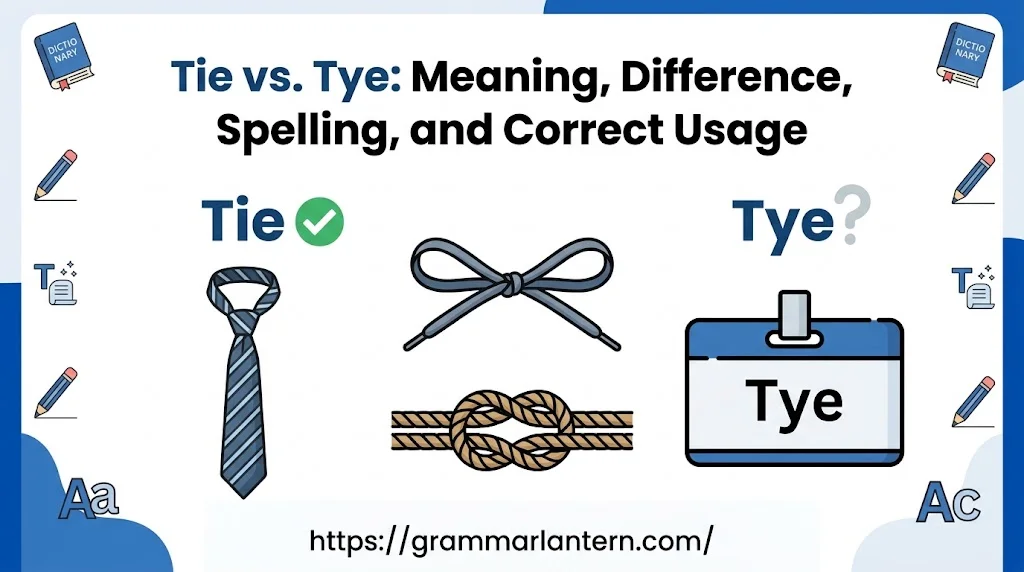
Tie is the correct English word for most situations. You use it to describe a knot, a necktie, a connection, or a game that ends with equal scores. Tye, on the other hand, is not a standard English vocabulary word. It usually appears as a person’s first name, surname, business name, or geographic name. Unless you’re referring to someone or something officially named Tye, you almost always want tie.
| Feature | Tie | Tye |
| Standard English word | ✅ Yes | ❌ No |
| Dictionary entry | ✅ Yes | Usually only as a proper noun |
| Part of speech | Noun and verb | Proper noun |
| Everyday use | Very common | Rare |
| Correct in normal writing | ✅ Yes | Only when referring to a name |
What Does “Tie” Mean?
The word tie has several meanings depending on the context. It can function as both a noun and a verb, making it one of the more versatile words in English.
Tie as a Noun
As a noun, tie refers to several different things.
A Piece of Clothing
Perhaps the most familiar meaning is a necktie, which people wear with formal clothing.
Examples:
- He wore a blue tie to the interview.
- The red tie matched his suit perfectly.
- A silk tie makes an elegant gift.
A Knot or Fastener
A tie can also describe anything used to fasten or secure something.
Examples:
- The cable tie kept the wires organized.
- Use a twist tie to close the bread bag.
- She tightened the tie around the package.
A Draw in Competition
In sports and competitions, a tie means that both sides finish with the same score.
Examples:
- The soccer match ended in a tie.
- Both chess players agreed to a tie.
- The debate resulted in a tie vote.
A Relationship or Connection
A tie can also describe a personal, professional, cultural, or family connection.
Examples:
- Family ties are important.
- The company strengthened its ties with international partners.
- The two countries share strong economic ties.
Structural Support
In engineering and construction, a tie refers to a structural component that provides support.
Examples include:
- Railroad ties
- Tie beams
- Roof ties
Tie as a Verb
As a verb, tie means to fasten, connect, or secure something.
Fasten Something
Examples:
- Tie your shoes before you run.
- She tied the ribbon around the gift.
- Please tie the rope securely.
Connect Two Things
Examples:
- The evidence ties the suspect to the crime.
- Strong communication ties the team together.
Finish Even
Examples:
- The teams tied 3–3.
- We tied for first place.
What Does “Tye” Mean?
Unlike tie, Tye is not a common English word.
Instead, it most often appears as a proper noun.
A First Name
Many people have the first name Tye.
Examples include:
- Tye Johnson
- Tye Sheridan
- Tye Smith
Read More: Proving vs Prooving: Meaning, Difference, and Examples
A Surname
Some families use Tye as their last name.
A Place Name
Several locations include Tye as part of their official name.
Brand or Business Name
Businesses occasionally choose Tye as a brand name for marketing purposes.
Outside these situations, using tye instead of tie is considered a spelling mistake.
The Main Difference
The distinction is straightforward.
| Tie | Tye |
| Standard English vocabulary | Proper noun |
| Used daily | Used mainly as a name |
| Appears in dictionaries | Appears primarily in name directories |
| Used as noun and verb | Rarely functions as a regular word |
In almost every piece of everyday writing, tie is the correct choice.
Why People Confuse
Several factors contribute to this common mistake.
They Sound Exactly Alike
Both words share the same pronunciation.
This makes them homophones, which are words that sound identical but differ in spelling or meaning.
Typing Errors
The letters i and y sit close enough in many typing habits that quick typing can produce mistakes.
Autocorrect Doesn’t Always Help
If someone frequently communicates with a person named Tye, autocorrect may begin suggesting that spelling.
Limited Vocabulary
Some learners simply assume tye is another accepted spelling.
It isn’t.
Pronunciation
Both words are pronounced:
/taɪ/
The pronunciation is identical.
That means only the spelling and context tell readers which one you mean.
Examples of “Tie” in Sentences
Understanding real examples makes the difference much easier to remember.
Clothing
- His tie matched his shoes.
- She bought three new ties for work.
Knots
- Tie the rope tightly.
- Tie the package with string.
Sports
- The championship ended in a tie.
- Neither team managed to break the tie.
Relationships
- Family ties often last a lifetime.
- Cultural ties connect communities.
Business
- Strong customer ties build loyalty.
- The merger created closer business ties.
Education
- The teacher asked students to tie their aprons before the science experiment.
Examples of “Tye” in Sentences
When used correctly, Tye refers to a name.
Examples:
- Tye arrived early for the meeting.
- We met Tye during the conference.
- Coach Tye congratulated the players.
- Tye signed the agreement yesterday.
- The award went to Tye Wilson.
Notice that every example uses Tye as a person’s name.
Common Mistakes People Make
Many writers accidentally misuse these words.
Here are the most common errors.
Writing “tye” Instead of “tie”
❌ I need to tye my shoes.
✅ I need to tie my shoes.
Using “Tye” for Clothing
❌ His tye matched his suit.
✅ His tie matched his suit.
Confusing Names with Common Words
❌ The game ended in a Tye.
✅ The game ended in a tie.
Assuming Both Spellings Are Correct
Only tie works as the ordinary English word.
When Should You Use “Tie”?
Choose tie whenever you’re talking about:
- Shoes
- Knots
- Ropes
- Clothing
- Equal scores
- Connections
- Relationships
- Business partnerships
- Structural supports
- Competitions
If the word isn’t someone’s name, tie is almost certainly correct.
When Is “Tye” Correct?
Use Tye only when referring to:
- Someone’s legal first name
- Someone’s surname
- A city or town named Tye
- A registered company or organization
- A branded product
Outside these cases, avoid using tye.
Memory Trick to Remember the Difference
A simple trick makes this easy.
Tie contains the letter “I.”
Think:
I tie my shoes.
Since I tie my shoes, the correct spelling uses I, not Y.
Another easy reminder:
- Tie = everyday English
- Tye = someone’s name
Similar Words People Often Confuse
English has many confusing word pairs.
Here are several related examples.
| Correct Pair | Difference |
| Tie vs. Tied | Present vs. past tense |
| Tie vs. Tying | Base verb vs. present participle |
| Tie vs. Knot | A tie may create a knot, but they are not identical |
| Tie vs. Bow | A bow is one type of tie |
| Dye vs. Tie | Dye changes color, tie fastens something |
| Ty vs. Tye | Both are names, not standard vocabulary words |
Understanding these differences improves your spelling accuracy.
Real-World Case Study
Imagine two job applicants submitting cover letters.
Applicant One
I always tye my work to clear business goals.
The hiring manager immediately notices the spelling mistake.
Applicant Two
I always tie my work to clear business goals.
This sentence appears polished and professional.
One letter changed the reader’s first impression.
Small spelling errors can affect credibility, especially in resumes, business emails, academic papers, and professional reports.
Expert Writing Tip
“Correct spelling isn’t about memorizing every word. It’s about choosing the form that matches the context.”
Context always matters more than pronunciation.
That’s why professional writers proofread carefully before publishing.
Read More: Currier vs Courier: Meaning and Correct Usage Explained
FAQs
1. What is the correct spelling, tie or tye?
The correct and commonly used spelling in modern English is tie. It is the standard word used for actions like fastening, joining, or creating a connection. Tye is rarely used and is usually found in historical references, names, or specific contexts.
2. Is tye a real word?
Yes, tye is a real word, but it is not commonly used in everyday English. It can appear in some place names, surnames, and older records. In most writing situations, using tie is the correct choice.
3. Why do people confuse tie and tye?
People confuse these words because they have the same pronunciation and almost identical spelling. English has many words that sound alike but have different meanings, making pairs like tie vs. tye confusing for learners and native speakers.
4. Can tye be used instead of tie?
No, tye should not replace tie in normal writing. If you mean to knot, fasten, or connect something, the correct word is tie.
5. What does the word tie mean?
The word tie can mean to knot, fasten, or join something together. It can also describe a connection between people, ideas, or objects. For example, you can tie your shoes or describe a strong tie between friends.
6. Is tie used more often than tye?
Yes, tie is used much more frequently in modern English. You will find it in schools, offices, books, newspapers, sports discussions, and everyday conversations, while tye appears only in limited situations.
7. Is tye an American or British spelling?
Neither. Tye is not a British or American version of tie. It is a separate and uncommon word that does not replace the standard spelling tie in either variety of English.
8. How can I remember the difference between tie and tye?
A simple way to remember it is that tie is the everyday word you use for connecting, fastening, or knotting something. Think of common examples like tying shoes or tying a package.
9. What are common mistakes with tie and tye?
The most common mistake is writing tye when you mean tie. This usually happens because both words sound the same. Checking the meaning and context can help you choose the correct spelling.
10. Why is understanding tie vs. tye important?
Understanding the difference helps you avoid spelling errors and communicate clearly. Using the correct word improves your writing accuracy and makes your English look more professional.
Conclusion
The difference between tie vs. tye becomes simple once you understand their meanings and usage. Tie is the correct and widely accepted word in modern English, while tye has limited use in historical records, names, and uncommon contexts. Although both words sound the same, their roles in English are different.
Learning this distinction helps you write with confidence and avoid common spelling mistakes. Whenever you need a word for knotting, fastening, or joining something, choose tie to ensure your writing remains clear, accurate, and natural.




[…] Read More: Tie vs. Tye: Meaning, Difference, Spelling, and Correct Usage […]
[…] Read More: Tie vs. Tye: Meaning, Difference, Spelling, and Correct Usage […]
[…] Read More: Tie vs. Tye: Meaning, Difference, Spelling, and Correct Usage […]