Eccentric vs Eclectic often confuses people because both words seem similar, yet their meaning changes with context. This guide in plain English helps you understand the difference through better word choice, grammar, and vocabulary.
From my everyday writing and speech, I have learned that simple examples, practical ways, and careful usage make ideas easier to express. When you compare Eclectic vs Eccentric or ask What’s the Difference, you improve understanding, communication, and follow the right way to use each word correctly, properly, clearly, accurately, and precisely, helping you avoid mistakes in every situation.
This implies an extreme departure from convention, while Eclectic focuses, focus, and highlights diversity, variety, diverse, and varied choices in fashion, interior design, design, art, an art project, an artist’s collection or collections, and everyday life instead of one fixed style. These distinct ideas help describe person, personalities, support creativity, explain what is different from the norm rather than normal, and create positive change in communication.
Quick Answer
Eccentric means unusual, unconventional, or different from normal expectations.
Eclectic means combining different styles, ideas, or influences from various sources.
A simple way to remember the difference:
- Eccentric = unusual individual behavior
- Eclectic = diverse mixture of influences
Example:
- “The scientist had an eccentric personality because he followed unusual daily routines.”
- “The designer created an eclectic collection by mixing traditional and modern styles.”
A person can be both eccentric and eclectic. Someone might have an eccentric personality while also having an eclectic taste in music, art, or fashion.
What Does Eccentric Mean?
The word eccentric describes something that does not follow common patterns or expectations. It often refers to people who behave, think, dress, or live in unusual ways.
The term does not automatically mean negative. In many situations, eccentric suggests creativity, originality, and independence.
An eccentric person may simply refuse to follow ordinary rules. They might develop unique habits, have unusual interests, or approach problems differently from others.
For example:
“The eccentric inventor created unusual machines that nobody else understood at first.”
The sentence does not necessarily criticize the inventor. Instead, it highlights that the person thinks differently.
Read More: Tie vs. Tye: Meaning, Difference, Spelling, and Correct Usage
Characteristics of an Eccentric Person
An eccentric person may:
- Have unusual hobbies or interests
- Follow unique personal routines
- Dress differently from social expectations
- Express uncommon opinions
- Think creatively
- Avoid traditional approaches
However, being eccentric does not mean someone is careless or irrational. Many creative people throughout history have been considered eccentric because they challenged traditional ideas.
Examples of Eccentric in Sentences
Here are different ways to use eccentric:
- “The eccentric artist painted portraits using unexpected colors.”
- “Her eccentric fashion choices made her easy to recognize.”
- “The professor was known for his eccentric teaching methods.”
- “The writer lived an eccentric lifestyle away from modern technology.”
In each example, the focus is on something unusual or outside normal expectations.
What Does Eclectic Mean?
The word eclectic describes something created by selecting elements from many different sources.
Unlike eccentric, eclectic does not focus on being strange. Instead, it highlights diversity, variety, and the ability to combine different influences.
An eclectic person may enjoy many different things without limiting themselves to one category.
For example:
- Someone who listens to classical music, rock, and electronic music has an eclectic music taste.
- Someone who decorates their home with vintage furniture, modern artwork, and traditional designs has an eclectic interior style.
The key idea is mixing different elements together.
Characteristics of an Eclectic Style
An eclectic approach often includes:
- Different cultural influences
- Multiple artistic styles
- A variety of ideas
- Creative combinations
- Wide-ranging interests
Eclectic choices often show curiosity and openness.
A person with eclectic interests may enjoy learning about different subjects instead of staying within one area.
Examples of Eclectic in Sentences
- “She has an eclectic collection of books covering science, history, and fiction.”
- “The restaurant offers an eclectic menu inspired by several cultures.”
- “His eclectic taste in music includes everything from opera to hip-hop.”
- “The room has an eclectic design that combines modern furniture with antique decorations.”
Main Differences
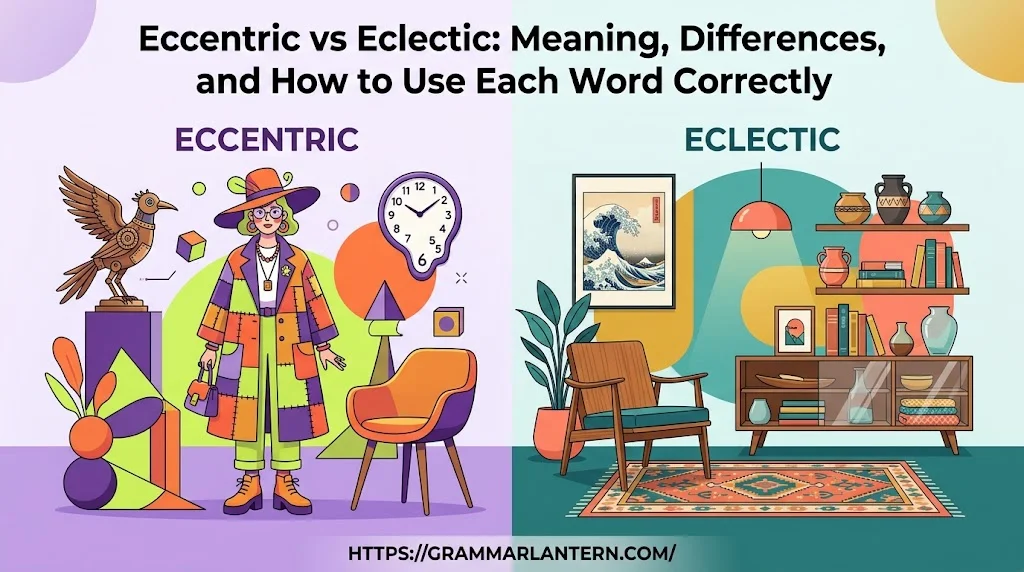
The easiest way to understand eccentric vs eclectic is to compare their meanings side by side.
| Feature | Eccentric | Eclectic |
| Main meaning | Unusual or unconventional | A combination of different influences |
| Focus | Being different | Bringing different things together |
| Commonly describes | People, behavior, ideas, habits | Styles, tastes, collections, designs |
| Feeling | Unique, strange, unconventional | Diverse, creative, mixed |
| Example | An eccentric artist with unusual habits | An eclectic artist influenced by many styles |
A helpful comparison:
Imagine two musicians.
The first musician performs while wearing unusual costumes, creating strange sounds, and following a completely different approach. That musician may be eccentric.
The second musician combines jazz, rock, classical, and electronic music into one style. That musician has an eclectic approach.
One stands apart. The other brings things together.
Examples in Real Life
Eccentric vs Eclectic in Personality
When describing people, eccentric is usually the better choice.
Example:
“Mark always carries a notebook, wears mismatched clothing, and follows unusual morning rituals. His friends consider him eccentric.”
The focus is Mark’s unusual behavior.
However, you might describe someone as eclectic when talking about their interests.
Example:
“Sarah has eclectic interests. She studies astronomy, practices cooking from different cultures, and enjoys historical novels.”
Sarah is not necessarily unusual. She simply enjoys many different areas.
Eccentric vs Eclectic in Art
Art provides a great example of the difference.
An eccentric artist may:
- Use unusual materials
- Create unexpected designs
- Challenge traditional ideas
An eclectic artist may:
- Combine multiple artistic movements
- Mix different cultural influences
- Use various techniques
For example, a painter who creates strange abstract images based on unusual concepts may be eccentric.
A painter who combines Renaissance techniques, modern art, and cultural symbols may have an eclectic style.
Eccentric vs Eclectic in Fashion
Fashion also shows the difference clearly.
An eccentric fashion style might include:
- Unusual clothing combinations
- Unexpected accessories
- Bold personal choices
An eclectic fashion style might include:
- Vintage jackets
- Modern shoes
- Traditional patterns
- Different cultural influences
The eccentric person wants to stand out.
The eclectic person enjoys combining different elements.
Word Origins
Understanding the origins of these words makes the difference easier to remember.
Origin of Eccentric
The word eccentric comes from Greek roots meaning “outside the center.”
Originally, it described something that was not positioned in the middle.
Over time, the meaning expanded. It began describing people and ideas that moved away from accepted norms.
The connection is simple:
Something outside the center = something outside the ordinary.
Origin of Eclectic
The word eclectic comes from a Greek word meaning “to choose.”
Historically, it described people who selected ideas from different philosophical traditions instead of following only one school of thought.
Today, it refers to anything that combines different influences.
The connection:
Choosing from many sources = creating something eclectic.
Common Mistakes
Many people confuse these words because both can describe something different. However, they are not interchangeable.
Mistake 1: Using Eccentric for a Collection of Different Things
Incorrect:
“His eccentric collection includes books from many countries.”
Better:
“His eclectic collection includes books from many countries.”
Why?
The collection is diverse, not unusual in behavior.
Mistake 2: Using Eclectic for Strange Behavior
Incorrect:
“Her eclectic behavior surprised everyone.”
Better:
“Her eccentric behavior surprised everyone.”
Why?
The behavior is unusual, so eccentric is the correct word.
Mistake 3: Thinking Eclectic Means Weird
Eclectic does not mean strange.
It means varied.
A person with eclectic taste may simply appreciate many different styles, cultures, or ideas.
How to Remember the Difference
Memory tricks can make these words easier.
Remember Eccentric as “Extraordinary”
Both words start with E, but think:
Eccentric = Extraordinary person
It describes someone who acts differently.
Example:
- An eccentric inventor
- An eccentric artist
- An eccentric personality
Remember Eclectic as “Everything Combined”
Think:
Eclectic = Elements Combined
It describes a mixture.
Example:
- Eclectic music
- Eclectic design
- Eclectic collection
A quick reminder:
Eccentric people are different. Eclectic things are diverse.
Synonyms for Eccentric and Eclectic
Synonyms for Eccentric
Common alternatives include:
- Unusual
- Quirky
- Odd
- Strange
- Unconventional
- Original
- Offbeat
The best synonym depends on the situation.
For example, calling someone “quirky” often sounds friendly, while calling someone “strange” may sound negative.
Synonyms for Eclectic
Common alternatives include:
- Diverse
- Varied
- Mixed
- Wide-ranging
- Multifaceted
- Broad
- Inclusive
These words usually carry a positive meaning because they suggest openness and variety.
Read More: Sewed or Sewn? Difference Explained With Helpful Examples
FAQs
1. What is the difference between Eccentric vs Eclectic?
Eccentric describes someone or something unusual or unconventional, while eclectic describes a mix of styles, ideas, or influences from different sources.
2. Can a person be both eccentric and eclectic?
Yes. Someone can have eccentric behavior while also having eclectic tastes in fashion, music, art, or home décor.
3. Does eccentric always have a negative meaning?
No. Eccentric is usually neutral and often describes someone with unique or quirky habits rather than criticizing them.
4. What does eclectic mean in design?
In design, eclectic means combining elements from different styles, periods, or cultures to create a balanced and creative look.
5. Why do people confuse eccentric and eclectic?
People often confuse them because the words sound similar and both relate to things that are different from the ordinary. However, their meanings are not the same.
6. Is eclectic used only for art and fashion?
No. You can use eclectic to describe music, books, interests, collections, food, education, or any combination of diverse influences.
7. How can I remember the difference between eccentric and eclectic?
Think of eccentric as describing a person’s unusual behavior and eclectic as describing a collection or mix of different styles or ideas.
8. Which word is better for describing a unique personality?
Use eccentric if the person has unusual habits or behavior. Use eclectic if they have varied interests, tastes, or influences.
9. Are eccentric and eclectic interchangeable?
No. Although they are sometimes used interchangeably in casual conversation, they have distinct meanings and should be used in the correct context.
10. Which word should I use in writing?
Choose eccentric when talking about unconventional people or behavior. Choose eclectic when referring to a diverse mix of styles, ideas, tastes, or collections.
Conclusion
Understanding Eccentric vs Eclectic is easier once you focus on what each word actually describes. Eccentric is about unusual behavior, personality, or habits, while eclectic is about combining different styles, ideas, tastes, or influences. Although they may seem similar at first, they are not interchangeable in most situations.
The more you read and practice these words in everyday writing and conversation, the more natural their usage becomes. Remember this simple rule: if you are describing an unusual person, choose eccentric; if you are describing a diverse mix, choose eclectic. Using the right word makes your English clearer, more accurate, and more confident.


[…] Read More: Eccentric vs Eclectic: Meaning and Differences […]