Enable vs Inable explains a common English confusion where writers compare similar-looking terms and try to find the correct word through simple language rules. Many learners pause while writing because they are unsure which term fits their sentence. Understanding this difference helps improve accuracy and makes everyday writing more confident and clear.
The English language can create big problems from small words when writers become confused about two words that appear similar. This confusion often happens in emails, essays, and professional writing, where people second-guess the right word because is inable and is it inable or unable create hesitation. These small doubts can interrupt the natural flow of writing and make people question their word choices.
Fear not, this confusion is easy to fix when you understand the pattern behind these terms and follow the real rules of English. A clear understanding allows you to clarify that enable is the proper word and the correct word to use in standard sentences. On the other hand, inable is not a recognized word in the English language, even though it may look acceptable because of its structure.
The inable meaning myth can make writing feel less natural, but learning the real difference between these words improves your sentences and keeps your message smooth. Choosing enable helps your words sound sharper, smoother, and more polished. When you use the right term, your message becomes easier to understand and is better perceived by readers.
Quick Answer
Enable is the correct and commonly used word. It means to make something possible, provide the ability to do something, or give someone the tools or resources needed to complete an action.
Inable is not normally used in modern English. Although it has appeared historically in some dictionaries, most writers should avoid it because readers may consider it a spelling mistake.
Examples:
- ✅ The new software enables employees to work faster.
- ❌ The new software inables employees to work faster.
If you want to express the opposite of having ability, use unable, not inable.
- ✅ She was unable to attend the meeting.
- ❌ She was inable to attend the meeting.
What Does Enable Mean?
Enable is a verb that means to give someone the ability, opportunity, permission, or resources to do something.
The word comes from the combination of en- (meaning “to cause or put into”) and able (having the power or skill to do something). Together, they create the meaning “to make able.”
In simple terms:
Enable means making something possible.
When you enable something, you remove a barrier and create a way for an action to happen.
For example:
- A teacher enables students to learn by providing knowledge and guidance.
- A smartphone enables people to communicate instantly.
- A wheelchair ramp enables easier access to buildings.
- A password enables users to access an account.
The word does not always mean physically giving someone a skill. It can also mean creating the conditions that allow something to happen.
Common Uses of Enable
Enable appears in many areas of life, including technology, education, business, and personal development.
| Area | Example | Meaning |
| Technology | “The update enables users to customize settings.” | The update makes customization possible. |
| Education | “Training enabled employees to improve their skills.” | Training gave them the ability. |
| Business | “Automation enables companies to save time.” | Automation creates efficiency. |
| Daily life | “The internet enables global communication.” | The internet makes communication possible. |
What Does Inable Mean?
The word inable creates confusion because it appears to follow a common English pattern.
Many words use prefixes to create opposites:
- active → inactive
- correct → incorrect
- complete → incomplete
Because of this pattern, some people assume:
- able → inable
However, modern English does not use inable as the normal opposite of able.
Although inable has appeared in older English usage, it is considered rare, outdated, or unnecessary today. Most dictionaries either label it as obsolete or uncommon.
In everyday communication, professional writing, and academic work, using inable can make your writing appear incorrect.
Instead, choose:
- unable when talking about a lack of ability
- disable when talking about stopping a function
- prevent when talking about stopping an action
Examples:
Incorrect:
The employee was inable to complete the project.
Correct:
The employee was unable to complete the project.
Main Difference Explained
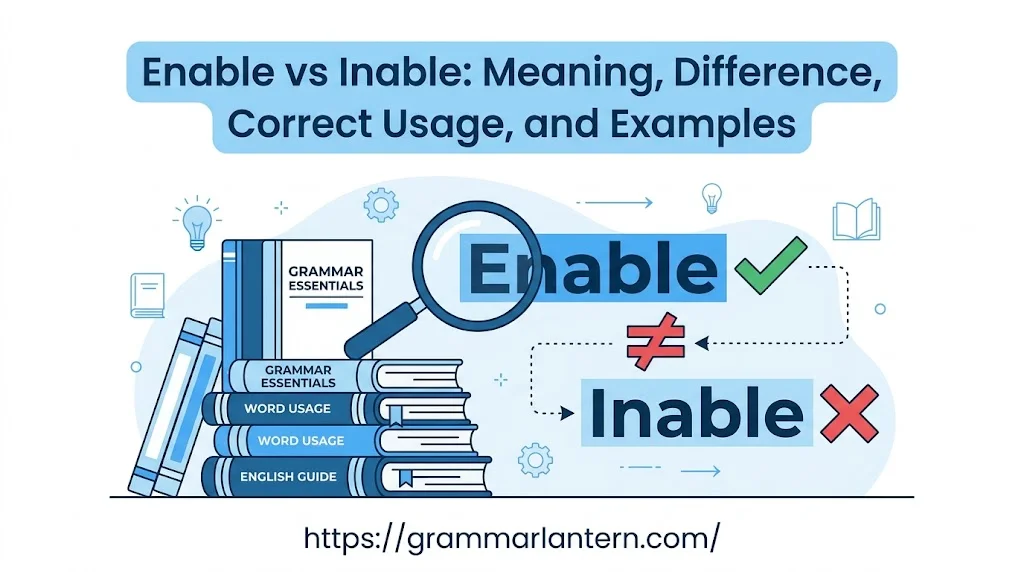
The difference between enable and inable is simple:
| Word | Meaning | Modern Usage |
| Enable | To make something possible or give ability | Common and correct |
| Inable | Rare historical word, generally avoided | Not recommended |
Think of it this way:
- Enable opens a door.
- Unable means the door cannot be opened.
For example:
“The scholarship enabled Maria to attend university.”
The scholarship created an opportunity.
“Maria was unable to attend university without financial support.”
Maria lacked the ability or opportunity.
The two words express completely different ideas.
Read More: Words for When Someone Accuses You of What They Are Guilty Of
Enable vs Unable: The Confusion Most Writers Actually Have
Many people searching for enable vs inable are actually trying to understand the difference between enable and unable.
These two words are opposites in meaning.
Enable
Enable = make able
Example:
The course enabled students to improve their writing skills.
The course provided knowledge and practice.
Unable
Unable = not able
Example:
The student was unable to complete the assignment.
The student could not complete it.
Here is the comparison:
| Word | Type | Meaning | Example |
| Enable | Verb | Make something possible | Technology enables remote work. |
| Unable | Adjective | Not capable of doing something | He was unable to attend. |
| Inable | Rare word | Not commonly accepted | Avoid using it. |
How to Use Enable Correctly in Sentences
Using enable correctly becomes easier when you understand common sentence structures.
Enable + Someone + To + Verb
This is one of the most common patterns.
Examples:
- The training enabled workers to operate new equipment.
- The scholarship enabled her to continue her education.
- The technology enables customers to complete payments online.
The structure shows that something gives a person the ability to perform an action.
Enable + Something
You can also use enable with objects or concepts.
Examples:
- This feature enables faster communication.
- The system enables automatic updates.
- The policy enables better decision-making.
In these examples, enable means “make possible.”
Common Mistakes
Even experienced writers sometimes misuse enable. Here are the most common mistakes.
Mistake: Using Inable Instead of Unable
This is the biggest error.
Incorrect:
I am inable to understand this topic.
Correct:
I am unable to understand this topic.
Remember:
Unable describes a limitation. Enable describes creating an ability.
They work in opposite directions.
Mistake: Confusing Enable With Allow
Many people use enable and allow as if they mean exactly the same thing. They overlap, but there is a small difference.
Allow focuses on permission.
Enable focuses on ability or possibility.
Compare:
The manager allowed employees to leave early.
This means the manager gave permission.
The new scheduling system enabled employees to leave early.
This means the system created a way for it to happen.
A simple comparison:
| Word | Main Idea | Example |
| Enable | Create ability | The app enables online payments. |
| Allow | Give permission | The company allows flexible hours. |
Mistake: Using Enable for Negative Situations
Enable usually has a positive or neutral meaning.
Incorrect:
The broken machine enabled production to stop.
The machine did not make production stop possible in the intended sense.
Better:
The broken machine prevented production from continuing.
Enable vs Inable vs Unable: Complete Comparison
Understanding all three words together makes the difference clearer.
| Word | Meaning | Example |
| Enable | Make something possible | The internet enables communication worldwide. |
| Unable | Not having the ability | She was unable to solve the problem. |
| Inable | Rare and outdated usage | Avoid using it in modern writing. |
A helpful memory trick:
- Enable = Give ability
- Unable = Lack ability
- Inable = Avoid
Real-Life Examples
The word enable appears everywhere because many things in modern life create opportunities.
Technology Examples
Technology constantly enables new possibilities.
Examples:
- Smartphones enable instant communication.
- Artificial intelligence enables businesses to analyze large amounts of data.
- Cloud storage enables people to access files from anywhere.
Technology does not simply exist. It creates new ways for people to work, communicate, and solve problems.
Education Examples
Education is another area where enable is frequently used.
Examples:
- Good teachers enable students to think critically.
- Online courses enable learners to study from home.
- Libraries enable communities to access information.
Education gives people tools that increase their ability to succeed.
Business Examples
Businesses use the word enable when discussing growth and improvement.
Examples:
- Digital payment systems enable faster transactions.
- Employee training enables better performance.
- Automation enables companies to reduce repetitive tasks.
Companies often invest in tools because those tools enable better results.
Why Enable Is More Common Than Inable
English vocabulary develops through common usage. A word may look logical but still disappear if speakers do not use it regularly.
Inable follows a pattern that seems reasonable, but English speakers chose unable instead.
Language does not always follow perfect mathematical rules. It grows through history, culture, and everyday communication.
For example:
| Word | Opposite |
| Enable | Disable |
| Able | Unable |
| Allow | Prevent |
Notice that enable and able have different opposites.
This is why:
- Enable ≠ opposite of unable
- Unable ≠ opposite of enable
They belong to different word relationships.
How to Remember the Difference
A simple trick can help:
Think about the first letters.
Enable starts with “en,” which means adding or creating something.
Examples:
- Enable = add ability
- Encourage = add courage
- Enrich = add value
Meanwhile:
Unable starts with “un,” which often means the opposite or absence.
Examples:
- Unhappy = not happy
- Unclear = not clear
- Unable = not able
This pattern makes remembering easier.
Read More: Day vs. Date: Difference Explained With Clear Examples
FAQs
1. What is the difference between enable and inable?
The main difference is that enable is a correct English word, while inable is not recognized as a standard English word. Enable means to give someone the ability, power, or opportunity to do something.
2. Is inable a correct word in English?
No, inable is not considered a correct word in modern standard English. Writers often create this mistake because they think adding “in-” changes “able” into the opposite meaning, but English does not work this way in this case.
3. What does enable mean?
Enable means to make something possible or to provide the ability to complete an action. For example, “This tool enables users to edit documents quickly” means the tool allows users to perform that task.
4. Can I use unable instead of inable?
Yes, unable is the correct word when you want to express the opposite meaning of able. Unable means lacking the ability or not having the power to do something.
5. Why do people confuse enable and inable?
People often confuse these words because they look similar and follow a common English pattern where prefixes change meanings. However, some words have established forms that cannot be changed by simply adding a prefix.
6. Is enable used in professional writing?
Yes, enable is commonly used in professional writing, business communication, technology, and academic contexts. It helps explain how something provides support, access, or ability.
7. How can I remember the correct word between enable and inable?
You can remember that enable is the accepted word because it means “to make able.” If you want to show the opposite meaning, use unable instead of creating the incorrect form inable.
8. Is the phrase “is it inable or unable” correct?
The phrase “is it inable or unable” shows a common spelling confusion. The correct choice is usually unable when referring to a lack of ability, while enable refers to giving ability.
9. Does using inable affect writing quality?
Yes, using inable can make writing appear incorrect because readers may recognize it as a spelling mistake. Choosing the right word improves clarity and makes your writing look more polished.
10. Why is understanding enable vs inable important?
Understanding enable vs inable helps writers avoid common mistakes in sentences, emails, essays, and professional communication. Correct word choices make your message clearer, smoother, and easier for readers to understand.
Conclusion
The difference between enable and inable is simple once you understand the correct usage. Enable is the proper English word that means to give ability or make something possible, while inable is not accepted in standard English. Many writers face confusion because the words look similar, but learning the correct pattern removes hesitation.
Using accurate words improves the quality of your communication. Whether you are writing emails, essays, or professional content, choosing enable and using unable when needed helps your sentences sound natural, clear, and polished. Understanding these small differences can make a big improvement in your overall writing skills.

For Shafiq ur Rehman, writing is an art form and grammar is the toolbox that makes it beautiful. As a dedicated content writer at Grammar Lantern, Shafiq approaches every topic like an architect carefully laying down strong foundations of understanding before adding the finer details. He loves diving into the trickiest grammar points and resurfacing with simple, bite-sized takeaways that anyone can grasp. When he’s not crafting articles, you’ll likely find him strategizing over a game of chess, exploring dusty local bookshops, or quietly jotting down poetic observations in his notebook.
[…] Read More: Enable vs Inable: Meaning, Difference, Usage, and Examples […]