Have you ever wondered whether to use “in the beginning” or “at the beginning” when writing a sentence? Both phrases are correct, but they have slightly different meanings. Understanding their difference can improve your English grammar, vocabulary, and writing skills.
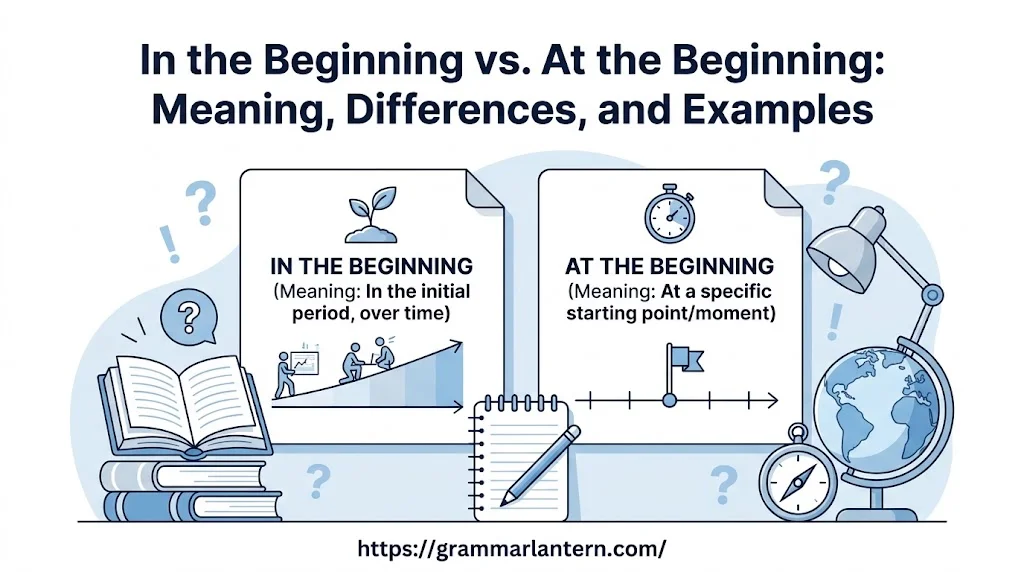
The phrase “in the beginning” refers to an early period or the first stage of a situation, while “at the beginning” identifies a specific starting point. For example, learning English may seem difficult in the beginning, but you should introduce the main topic at the beginning of an article.
Choosing the right phrase depends on your sentence’s meaning and context. Whether you’re writing an email, telling a story, discussing a project, or explaining a process, knowing when to use each expression helps you communicate clearly. In this guide, you’ll discover their key differences, explore practical examples, and learn how to use both phrases confidently in everyday and professional writing.
Quick Answer
In the beginning refers to an initial period, condition, or stage of development. At the beginning identifies the starting point or opening part of something specific.
| Phrase | Meaning | Example |
| In the beginning | During an initial period or stage | In the beginning, the new job seemed overwhelming. |
| At the beginning | At the starting point of something | At the beginning of the meeting, everyone introduced themselves. |
Use “in the beginning” when describing how something was early on, especially when the situation later changes. Choose “at the beginning” when identifying when or where something starts.
For instance:
- In the beginning: In the beginning, our small business struggled to find customers.
- At the beginning: At the beginning of the presentation, the speaker introduced the main topic.
Remember this simple distinction: in often emphasizes a period or phase, while at highlights a point or position.
What Does “In the Beginning” Mean?
The phrase “in the beginning” describes an early period in a situation, experience, story, or process. It often appears when the writer wants to explain how something started out before circumstances changed.
Think of it as looking back at the early chapter of a longer story. You’re not necessarily pointing to one exact moment. Instead, you’re describing what things were like during an initial phase.
For example:
“In the beginning, the team struggled to work together.”
This sentence suggests that the team experienced difficulties during its early days. It doesn’t specify one particular meeting or moment. The focus is on the initial situation.
Definition and Grammatical Function of “In the Beginning”
Grammatically, “in the beginning” functions as an adverbial phrase of time. It tells readers when something happened or what a situation was like during its initial period.
The preposition in often presents time as a period within which something occurs. Compare these expressions:
- In the beginning
- In the summer
- In the early years
- In the first few months
Each expression places an event or condition within a period rather than simply identifying a starting point.
The phrase can appear at the beginning of a sentence or later in the sentence.
Examples:
- In the beginning, Maya found her new school intimidating.
- The software seemed confusing in the beginning.
- In the beginning, nobody expected the business to grow so quickly.
- Our friendship was awkward in the beginning but became stronger over time.
Notice the pattern. Each sentence describes an early condition or experience, often with the suggestion that something changed afterward.
Read More: 6 More Formal Ways to Say “Please Provide…” at Work
When to Use “In the Beginning”
Use “in the beginning” when your sentence emphasizes an initial state, an early experience, or the first phase of a longer development.
Here are the most common situations.
1. Describing an experience that changes
When something feels different later, this phrase helps establish the contrast.
Example: “In the beginning, working remotely felt lonely, but I eventually developed a comfortable routine.”
2. Discussing the early stages of a project
The phrase works well when describing the initial condition of a project, business, or plan.
Example: “In the beginning, the company operated from a small rented office.”
3. Explaining the development of a relationship
Relationships often change as people become more familiar with one another.
Example: “In the beginning, the two neighbors barely spoke to each other.”
4. Introducing a story or historical account
Writers can use the phrase to establish an early situation before explaining what happened next.
Example: “In the beginning, the settlement depended almost entirely on farming.”
5. Describing an initial belief or understanding
The expression can introduce an idea that later proves incomplete or changes.
Example: “In the beginning, researchers believed the problem had a simple solution.”
In each case, the phrase gives readers a sense of an earlier stage. The precise duration depends on the context.
Examples of “In the Beginning” in Sentences
These examples show how the phrase works in everyday writing.
- In the beginning, learning to drive made me nervous.
- The restaurant had very few customers in the beginning.
- In the beginning, we disagreed about nearly every decision.
- The author introduces a difficult situation in the beginning of the story.
- In the beginning, the project seemed manageable, but the workload increased.
- The new employee needed extra guidance in the beginning.
- In the beginning, the garden produced very little fruit.
- Their communication was awkward in the beginning, but they soon became comfortable.
The phrase is particularly useful when a sentence describes a change between an earlier situation and a later one.
Common Expressions and Contexts for “In the Beginning”
You’ll encounter this expression in several types of writing.
- Personal experiences: “In the beginning, I found public speaking frightening.”
- Business development: “In the beginning, the company relied on a handful of clients.”
- Historical accounts: “In the beginning, the community depended on local trade.”
- Fiction: “In the beginning, the village seemed peaceful.”
- Religious writing: “In the beginning” is famously used in the opening of Genesis in the Bible.
The religious and literary use deserves a little attention. In familiar creation narratives, the phrase can refer to the origin of the world or the start of existence itself. That use carries a broader sense of beginning than a reference to the first page of a book or the opening minutes of a meeting.
What Does “At the Beginning” Mean?
The phrase “at the beginning” refers to the starting point or opening portion of something. It commonly identifies when an event occurs or where something appears within a sequence.
Imagine opening a book and finding the author’s introduction on its first few pages. You might say, “The author explains the main idea at the beginning of the book.”
Here, the phrase identifies a location within the book’s structure. It doesn’t primarily describe an extended early experience.
Similarly, “At the beginning of the meeting, the manager reviewed the agenda” identifies when the review occurred.
Definition and Grammatical Function of “At the Beginning”
Like “in the beginning,” “at the beginning” functions as an adverbial phrase of time or position. Its exact role depends on the sentence.
The preposition at often identifies a point, location, or stage. In this expression, it directs attention to the start of a defined activity, event, text, or process.
Compare these examples:
- At the beginning of the meeting
- At the beginning of the book
- At the beginning of the course
- At the beginning of the year
The noun following of tells you what has a beginning. This structure is especially useful when the writer needs to identify a specific starting point.
Examples:
- The instructions appear at the beginning of the document.
- At the beginning of the course, students complete a short assessment.
- We met at the beginning of the conference.
- At the beginning of the trail, you’ll see a wooden sign.
The final example shows that the phrase can describe physical position as well as time.
When to Use “At the Beginning”
Use “at the beginning” when you want to identify the start of something recognizable or defined.
1. Referring to the opening of a book or article
Example: “At the beginning of the article, the writer defines the main problem.”
This sentence identifies where the definition appears.
2. Describing the opening of an event
Example: “At the beginning of the ceremony, the host welcomed the guests.”
The phrase places the welcome at the event’s starting point.
3. Giving instructions
Example: “Write your full name at the beginning of the form.”
Here, the expression identifies a position on the form.
4. Explaining a process
Example: “At the beginning of the application process, you’ll need to create an account.”
The phrase points to the first stage of a defined sequence.
5. Describing the start of a period
Example: “At the beginning of the year, the organization announced its new goals.”
The year provides a clear time frame for the starting point.
Examples of “At the Beginning” in Sentences
Here are additional examples to help you recognize the expression in context.
- At the beginning of the movie, the main character moves to another city.
- Please review the safety rules at the beginning of the manual.
- At the beginning of the meeting, everyone received a printed agenda.
- The teacher explained the assignment at the beginning of class.
- At the beginning of the race, the runners gathered behind the starting line.
- The website displays a welcome message at the beginning of the registration process.
- We noticed a small crack at the beginning of the path.
- At the beginning of the interview, the candidate introduced herself.
These examples share one feature: the phrase identifies the opening point or portion of something specific.
Common Expressions and Contexts for “At the Beginning”
The expression frequently appears in practical, everyday communication.
- At the beginning of the day: “At the beginning of the day, I check my schedule.”
- At the beginning of a meeting: “At the beginning of the meeting, the chair reviews the agenda.”
- At the beginning of a book: “At the beginning of the book, the author introduces the setting.”
- At the beginning of a process: “At the beginning of the process, applicants submit their forms.”
- At the beginning of a road: “At the beginning of the road, a sign marks the entrance.”
These patterns make the phrase useful for giving directions, explaining procedures, describing document structure, and organizing information.
Key Differences
Although both expressions refer to something starting, they don’t always communicate the same idea. The difference becomes clearer when you examine the time frame, the intended emphasis, and the surrounding words.
Difference in Meaning
“In the beginning” typically emphasizes what happened or what a situation was like during an initial period.
“At the beginning” typically identifies the starting point of an event, sequence, or defined period.
Consider this comparison:
- “In the beginning, the lessons were difficult.”
- “At the beginning of the lesson, the teacher reviewed the homework.”
The first sentence describes an early learning experience. The second identifies something that happened when a particular lesson started.
The difference isn’t simply about grammar. It’s about the information you want your reader to notice.
Difference in Time and Duration
“In the beginning” often suggests an initial phase that may extend over time. However, the phrase doesn’t specify how long that phase lasts.
For example:
“In the beginning, the team needed daily guidance.”
This could describe the team’s first few days, weeks, or months. The context determines the duration.
By contrast, “at the beginning” often focuses on an opening point or portion.
For example:
“At the beginning of each shift, employees check their equipment.”
The sentence describes a recurring action at the start of every shift.
Keep in mind that these are common patterns, not strict rules. An opening section can last several minutes or pages, and an initial period can be quite short.
Difference in Sentence Structure
Both expressions can appear at the start or in the middle of a sentence.
| Sentence position | In the Beginning | At the Beginning |
| At the start | In the beginning, the plan seemed promising. | At the beginning, the instructor explained the rules. |
| In the middle | The plan seemed promising in the beginning. | The instructor explained the rules at the beginning of the class. |
| With a specific noun | In the beginning of the story, the family lives in poverty. | At the beginning of the story, the family lives in poverty. |
The final row is especially useful. Both constructions can be grammatical, and the difference may be small. However, “at the beginning of the story” is generally the more natural choice when identifying the opening section of a text.
Comparison Table
| Feature | In the Beginning | At the Beginning |
| Main emphasis | Initial period or condition | Starting point or opening portion |
| Common purpose | Describing early experiences or developments | Locating an event within a sequence |
| Typical context | Relationships, projects, personal experiences, narratives | Meetings, books, lessons, procedures, events |
| Example | In the beginning, the work seemed easy. | At the beginning of the assignment, the teacher explained the requirements. |
| Common contrast | An early state compared with a later state | The start compared with later points in a sequence |
A useful rule is to focus on the sentence’s meaning rather than memorize a list of expressions. The more clearly you understand your intended message, the easier your choice becomes.
Can “In the Beginning” and “At the Beginning” Be Used Interchangeably?
Yes, “in the beginning” and “at the beginning” can sometimes be used interchangeably, but the meaning or emphasis may change slightly. Both expressions can describe an initial stage, especially when the surrounding context makes the intended time clear.
However, they aren’t equally natural in every sentence. The best choice depends on whether you’re describing an early condition or identifying the start of something specific.
Examples Where Both Phrases Can Work
Consider these two sentences:
- “In the beginning, the project seemed easy.”
- “At the beginning, the project seemed easy.”
Both sentences are understandable and grammatically acceptable. The first emphasizes the project’s initial experience or condition. The second highlights its starting stage.
Now consider a relationship:
- “In the beginning, we found it difficult to communicate.”
- “At the beginning, we found it difficult to communicate.”
Again, both work. The first sounds more reflective, as though you’re looking back on an early period. The second places the difficulty at the relationship’s starting point.
When the context is already clear, the difference can be subtle rather than dramatic.
Examples Where One Phrase Is More Natural
Sometimes, the context strongly favors one expression.
Example: Referring to a book
- More natural: “At the beginning of the book, the author introduces the main character.”
- Also possible: “In the beginning of the book, the author introduces the main character.”
The first version is generally preferred when locating information in a book’s opening section. The second is possible, especially when discussing the story’s initial events, but it can sound less direct.
Example: Describing a learning experience
- Natural: “In the beginning, I struggled to understand the lessons.”
- Natural: “At the beginning of the course, I struggled to understand the lessons.”
Both sentences work, but the second explicitly connects the experience to a defined course.
Example: Describing an event
- Natural: “At the beginning of the conference, the organizer welcomed everyone.”
- Less precise in this context: “In the beginning of the conference, the organizer welcomed everyone.”
The first version identifies an action at the event’s opening. It communicates the intended meaning more directly.
The lesson is simple: grammatical possibility and natural usage aren’t always the same thing. Choose the expression that best matches your intended emphasis.
In Different Contexts
The distinction becomes easier to remember when you see how each phrase works in real situations.
In Storytelling and Writing
Writers use beginnings to establish settings, introduce characters, and prepare readers for what follows. Both expressions help, but they serve slightly different purposes.
“In the beginning” often introduces an initial situation:
“In the beginning, Elena trusted everyone in the village.”
This sentence establishes Elena’s early attitude. The story may later reveal why her trust changes.
“At the beginning” often directs attention to the opening of a narrative:
“At the beginning of the novel, Elena arrives in the village.”
This sentence tells readers where a particular event occurs within the novel.
For writers, the distinction can improve clarity. Use the first expression to describe an early condition and the second to identify a specific opening section or event.
In Everyday Conversation
In casual speech, both phrases sound natural when used appropriately.
Imagine telling a friend about learning to cook:
“In the beginning, I burned almost everything I made.”
You’re describing an early experience that improved with practice.
Now imagine explaining a recipe:
“At the beginning of the recipe, you mix the flour and sugar.”
You’re identifying the first step in a sequence.
Other everyday examples include:
- “In the beginning, I wasn’t sure about moving to another city.”
- “At the beginning of the trip, we stopped for breakfast.”
- “In the beginning, working from home felt strange.”
- “At the beginning of each workday, I review my priorities.”
The subject may be similar, but the emphasis changes with the situation.
In Academic and Professional Writing
These expressions also appear in essays, reports, presentations, and workplace communication.
Use “at the beginning” when referring to the structure of a document or a defined procedure.
For example:
“At the beginning of the report, the researcher summarizes the study’s objectives.”
Use “in the beginning” when discussing how a project or idea developed during its early stages.
For example:
“In the beginning, the research team considered several possible explanations.”
In formal writing, precision matters more than choosing the phrase that sounds sophisticated. A straightforward expression that communicates the intended meaning is usually the better choice.
In Historical and Religious Contexts
Historical writing often describes the early development of a civilization, movement, or institution.
For example:
“In the beginning, the settlement depended on nearby rivers for water and transportation.”
The phrase introduces an early condition without identifying a single date or moment.
However, a historian might write:
“At the beginning of the nineteenth century, industrialization was transforming many communities.”
Here, the expression identifies the start of a defined historical period.
Religious writing offers another familiar example. The phrase “In the beginning” appears in the opening of Genesis, where it introduces the biblical creation account. This established usage gives the expression a strong association with origins and the start of existence.
The context determines whether the phrase describes an extended early period, a historical starting point, or a broader origin.
Common Mistakes to Avoid
Even experienced writers can confuse these expressions. Fortunately, a few common mistakes are easy to correct.
Using “In the Beginning” for Every Starting Point
Not every sentence about a start needs “in the beginning.”
Consider this sentence:
“ In the beginning of the meeting, the manager distributed the agenda.”
The meaning is understandable, but “at the beginning of the meeting” is generally more natural when identifying an action at the meeting’s opening.
Better: “At the beginning of the meeting, the manager distributed the agenda.”
The correction makes the starting point clearer.
Using “At the Beginning” to Describe an Extended Early Period
The phrase “at the beginning” isn’t wrong when describing an initial stage. However, it may not express the broader time frame you intend.
For example:
“At the beginning, I found the new job challenging.”
This sentence is acceptable when the starting stage is clear. But if you’re reflecting on an extended early experience, the following may sound more natural:
“In the beginning, I found the new job challenging.”
The difference is one of emphasis, not a strict rule about correctness.
Assuming “In the Beginning of” Is Always Incorrect
Some writers believe that only “at the beginning of” is grammatically correct. That claim is too broad.
Both constructions occur in standard English:
- “At the beginning of the story, the narrator introduces the family.”
- “In the beginning of the story, the family struggles to survive.”
The first usually works better when locating information in a text. The second can work when emphasizing the story’s early events or circumstances.
When editing, consider the sentence’s meaning and natural flow instead of automatically treating one construction as an error.
Forgetting the Article “The”
The familiar expressions use “the”:
- In the beginning
- At the beginning
When referring to a particular event or object, the article may also appear in a longer construction:
- At the beginning of the meeting
- At the beginning of the chapter
- In the beginning of the story
However, English uses other expressions without the same structure. For example, “from the start” and “at first” have their own grammatical patterns.
Avoid changing articles or prepositions simply because another phrase looks similar.
Related Expressions: “From the Beginning,” “At First,” and “In the Early Stages”
English has several expressions for discussing beginnings. Although they overlap in meaning, each one highlights something different.
In the Beginning vs. From the Beginning
“In the beginning” describes an initial period or condition. “From the beginning” often means starting at the outset and continuing from that point.
Compare:
- “In the beginning, the team struggled to communicate.”
- “The manager supported the team from the beginning.”
The first sentence describes the team’s early condition. The second emphasizes that the manager’s support existed from the outset.
Another example makes the distinction clearer:
“She knew from the beginning that the project would require patience.”
This sentence suggests that her understanding existed from the start. It doesn’t simply describe a temporary early experience.
In the Beginning vs. At First
“At first” commonly introduces an initial reaction, belief, or condition that later changes.
For example:
“At first, I didn’t enjoy the new schedule, but I eventually adjusted.”
This sentence works much like “In the beginning, I didn’t enjoy the new schedule, but I eventually adjusted.”
However, “at first” is often shorter and more conversational when describing a contrast between an initial reaction and a later one.
Use it when you want a direct, natural way to show that your feelings, opinions, or circumstances changed.
At the Beginning vs. In the Early Stages
“At the beginning” often identifies a starting point or opening section. “In the early stages” emphasizes an initial phase of development.
Consider these examples:
- “At the beginning of the project, the team assigned responsibilities.”
- “In the early stages of the project, the team tested several ideas.”
The first identifies when a particular action occurred. The second describes activities across an initial development phase.
This distinction is especially useful in business reports, research papers, and project updates.
How to Choose the Correct Phrase
When you’re unsure which expression to use, start by identifying what your sentence needs to communicate.
Ask yourself one simple question: Am I describing an early period, or am I identifying the starting point of something specific?
Use this quick guide:
- Choose “in the beginning” to describe an initial condition, experience, or phase of development.
- Choose “at the beginning” to identify the opening of an event, text, process, or sequence.
- Consider “at first” when describing an initial reaction that later changes.
- Consider “from the beginning” when emphasizing that something existed or happened from the outset.
- Consider “in the early stages” when discussing a period of development rather than one starting point.
A Simple Rule to Remember
Think of “in the beginning” as looking back at an early chapter of a story. Think of “at the beginning” as pointing to where that chapter starts.
For example:
“In the beginning, the new business struggled to attract customers.”
This describes an early business condition.
“At the beginning of the business presentation, the owner explained the company’s goals.”
This identifies the opening of a specific presentation.
The difference becomes clear when you focus on the meaning rather than the words alone.
Practice Examples: Choose the Correct Phrase
Fill in each blank with “in the beginning” or “at the beginning.” Choose the expression that best fits the intended meaning.
- ___, I thought the task would be easy, but it became more challenging.
- The author introduces the main character ___ of the novel.
- ___, the company had only three employees.
- The manager explained the agenda ___ of the meeting.
- Learning to drive felt overwhelming ___, but I became more confident with practice.
Answer key and explanations
- In the beginning — The sentence describes an initial impression that changed.
- At the beginning — The phrase identifies the opening section of a novel.
- In the beginning — The sentence describes the company’s early condition.
- At the beginning — The agenda explanation occurred at the meeting’s starting point.
- In the beginning — The sentence describes an early experience that improved with practice.
The final example could also use “at the beginning” if the context clearly identifies a particular learning period. These choices reflect the most natural emphasis in the sentences as written.
Read More: Wore or Worn: Which Is Correct? Helpful Examples
FAQs
1. What is the difference between “in the beginning” and “at the beginning”?
“In the beginning” refers to an early period or the first stage of something. “At the beginning” points to a specific starting point. For example, “In the beginning, I felt nervous” describes an early experience, while “At the beginning of the class, the teacher took attendance” identifies a particular moment.
2. Is “in the beginning” grammatically correct?
Yes, “in the beginning” is grammatically correct. It describes how something was during its early stages. For example, “In the beginning, learning English seemed difficult, but I improved with practice.”
3. Is “at the beginning” grammatically correct?
Yes, “at the beginning” is also correct. You can use it to identify the starting point of an event, activity, or written work. For example, “At the beginning of the meeting, everyone introduced themselves.”
4. When should I use “in the beginning” in a sentence?
Use “in the beginning” when talking about an early period, especially when something changes over time. For example, “In the beginning, she struggled with the new job, but she soon became confident.”
5. When should I use “at the beginning” in a sentence?
Use “at the beginning” when referring to a particular point where something starts. For example, “Please write your name at the beginning of the document.” It often appears with nouns such as class, book, meeting, and year.
6. Can I use “in the beginning” and “at the beginning” interchangeably?
Not always. Although both phrases refer to a starting point in some contexts, they emphasize different things. “In the beginning, the project seemed easy” describes an early impression. “At the beginning of the project, we discussed our goals” refers to a specific stage or moment.
7. Should I write “in the beginning” or “at the beginning of the story”?
Both can be correct, depending on your meaning. Use “at the beginning of the story” to identify the opening section. Use “in the beginning” to describe what happened during the story’s early period. For example, “At the beginning of the story, a young girl moves to a new town.”
8. Is “at the beginning” more formal than “in the beginning”?
Neither phrase is automatically more formal than the other. Both work in academic, professional, and everyday writing. Your choice should depend on what you want to express rather than the level of formality.
9. What is the difference between “in the beginning” and “from the beginning”?
“In the beginning” describes an early period, while “from the beginning” emphasizes the starting point and often suggests that something continued from that point onward. For example, “In the beginning, I felt unsure” describes an early feeling. “I understood the instructions from the beginning” means I understood them right from the start.
10. What is an easy way to remember the difference?
Think of “in” as an early period and “at” as a specific starting point. For example, “In the beginning, I was shy” describes how you felt during an early stage. “At the beginning of the interview, I introduced myself” identifies when the introduction happened.
Conclusion
Understanding the difference between “in the beginning” and “at the beginning” makes your English clearer and more natural. Both phrases are grammatically correct, but they serve slightly different purposes. Use “in the beginning” to describe an early period or stage, and use “at the beginning” to point to a specific starting moment or position.
The easiest way to choose the right phrase is to consider the meaning of your sentence. Are you describing how something was during its early stages, or are you identifying where or when something started? Once you recognize this distinction, selecting the correct expression becomes much easier. With regular practice, you can use both phrases confidently in conversations, essays, emails, and professional writing.

For Shafiq ur Rehman, writing is an art form and grammar is the toolbox that makes it beautiful. As a dedicated content writer at Grammar Lantern, Shafiq approaches every topic like an architect carefully laying down strong foundations of understanding before adding the finer details. He loves diving into the trickiest grammar points and resurfacing with simple, bite-sized takeaways that anyone can grasp. When he’s not crafting articles, you’ll likely find him strategizing over a game of chess, exploring dusty local bookshops, or quietly jotting down poetic observations in his notebook.