
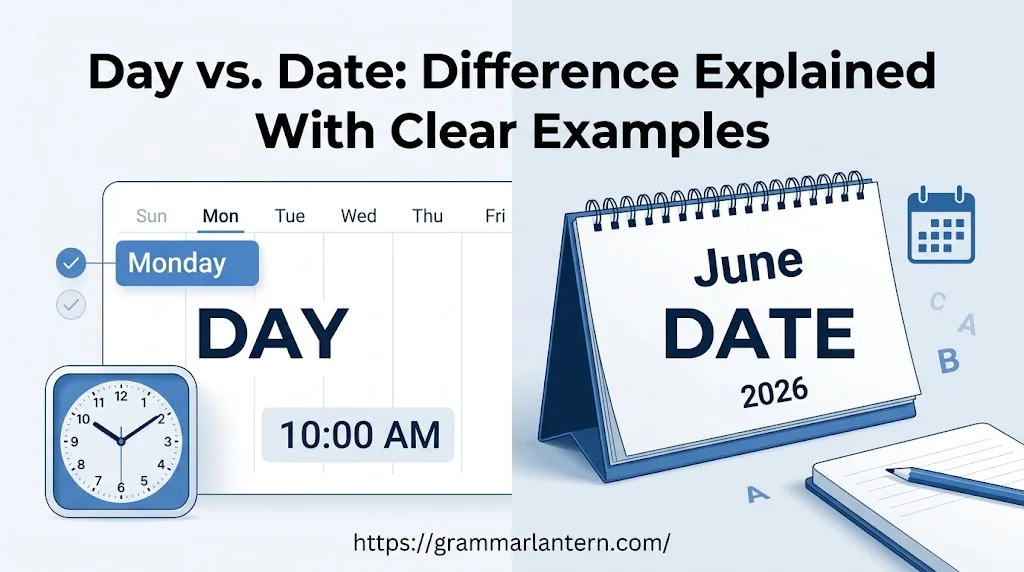
Day vs. Date is a common English confusion, especially when talking about time, schedules, or appointments. The word day usually refers to a period of time or a particular day of the week, such as Monday or Friday. For example, you might say, “Which day is your meeting?” In contrast, date refers to the specific calendar day, usually written with a month and number, such as September 5 or September 5, 2026. Knowing this simple difference can make your everyday English clearer and more accurate.
The word day can also mean the period from one midnight to the next or the time when there is daylight. The word date, however, identifies a specific point on the calendar. For example, “The event is on Friday” tells us the day, while “The event is on September 5” gives the date. These words may appear together because a date includes information about a particular day. Understanding their roles helps you choose the right word when discussing calendars, plans, birthdays, deadlines, or appointments.
A simple way to remember the difference is to think of day as the general name and date as the exact calendar reference. If someone asks, “What day is it?” you can answer “Friday.” If they ask, “What is the date?” you would give the month and number. Both words are useful in everyday conversations, but they answer slightly different questions. Using them correctly can make your writing and speaking sound more natural and precise.
Quick Answer
The simplest difference is this:
- Day usually refers to a period of time or a named weekday such as Monday or Friday.
- Date refers to a specific calendar day, such as June 15, 2026.
- A day doesn’t always tell you exactly where that day falls on the calendar.
- A date gives a more precise calendar reference.
- “What day is it?” usually asks for the weekday.
- “What’s the date?” usually asks for the month and day of the month.
For instance:
What day is the conference?
It’s Monday.
What’s the date of the conference?
It’s June 15, 2026.
The first answer identifies the day of the week. The second identifies the calendar date.
What Does “Day” Mean?
The word day has several closely related meanings. In everyday English, it can describe a period of time, a point in a sequence, or one of the seven weekdays.
In its basic time-related sense, a day refers to a period of 24 hours. For example, you might say, “The package should arrive in three days.” Here, days measure duration.
The word can also identify a weekday:
- Monday
- Tuesday
- Wednesday
- Thursday
- Friday
- Saturday
- Sunday
When someone asks, “What day is your appointment?”, they usually want to know whether it falls on Monday, Tuesday, Wednesday, or another weekday.
However, day doesn’t always refer to a weekday. Consider the sentence, “I’ll finish the project one day.” Here, one day means some future time rather than a specific date.
Day as a 24-Hour Period
A day can measure how long something lasts.
Examples include:
- The trip lasted five days.
- The medicine should arrive within two days.
- The event runs for one day.
- The repair took three days.
In these examples, replacing day with date would change the meaning and create an error.
You wouldn’t normally say, “The trip lasted five dates.” A date identifies a point on the calendar. A day can describe duration.
Day as a Weekday
Day commonly appears when people discuss schedules.
For example:
- What day is the meeting?
- Which day works for you?
- The class meets every Monday.
- We’ll leave on Friday.
- She called me the next day.
The context determines whether day means a weekday or a general period.
Day in Relative Expressions
English frequently uses day with words that establish a time relationship.
Common expressions include:
- today
- yesterday
- tomorrow
- the next day
- the previous day
- the following day
- one day
- another day
- every day
For example, “They arrived on Tuesday and left the next day.” The phrase the next day means Wednesday because the previous sentence establishes Tuesday as the reference point.
Read More: Mather vs Mother: Meaning, Differences, Examples, and Usage
What Does “Date” Mean?
A date identifies a particular day on the calendar. It usually combines a month with a number and may also include a year.
Examples include:
- January 1
- March 14
- July 4, 2026
- December 25, 2030
The word date becomes especially useful when precision matters. If a company says, “Applications close on September 30,” it has given a specific calendar date.
Similarly, an appointment system may ask you to select a date. The system isn’t asking whether you prefer Monday or Tuesday in a general sense. It wants a particular calendar day.
Date as a Calendar Reference
A date gives an event a fixed location in the calendar.
For example:
July 4, 2026
This tells you the month, the day of the month, and the year.
By contrast:
Saturday
only tells you the weekday.
The difference becomes important when several possible Saturdays exist. If someone says, “The event is on Saturday,” you still don’t know which Saturday they mean. If they say, “The event is on July 4, 2026,” the calendar reference becomes much more precise.
Date in Everyday Questions
You commonly use date when asking for an exact calendar reference.
Examples include:
- What’s the date today?
- What’s the date of the exam?
- What date is the appointment?
- What date did the contract begin?
- Can we change the date of the meeting?
The expected answer normally includes a calendar reference such as June 15 or June 15, 2026.
The Main Difference
The clearest way to understand day vs. date is to compare what each word identifies.
| Feature | Day | Date |
| Basic meaning | A period of time or a particular day | A specific calendar day |
| Weekdays | Yes | Can be included with a date |
| Duration | Yes | No |
| Month and number | Not necessarily | Usually |
| Year | Not necessary | Often included for precision |
| Example | Monday | June 15, 2026 |
| Question | “What day is it?” | “What’s the date?” |
There is an important relationship between the two. Every date identifies a particular day, but the word day doesn’t necessarily identify a particular calendar date.
Think of the distinction like an address. Saying “Monday” gives you one piece of information about where an event sits in the week. Saying “June 15, 2026” gives you its exact calendar location.
“What Day Is It?” vs. “What’s the Date?”
These questions look similar, yet they normally ask for different answers.
“What day is it?” usually means:
Which day of the week is today?
The answer could be:
It’s Monday.
“What’s the date?” usually means:
What is today’s position on the calendar?
The answer could be:
It’s June 15, 2026.
You can also ask both questions about the same event.
What day is the appointment?
Monday.
What’s the date of the appointment?
June 15, 2026.
One asks for the weekday. The other asks for the calendar date.
What Does “What Date Is It?” Mean?
“What date is it?” also asks for the calendar date.
For example:
What date is it today?
A natural answer would be:
It’s June 15, 2026.
In ordinary American English, “What’s the date?” is often the more natural short question.
When to Use “Day”
Knowing the basic definition isn’t enough. The real skill comes from recognizing situations where day sounds natural.
Use “Day” for a Weekday
Use day when you want to identify Monday through Sunday.
Examples:
- Which day is the workshop?
- The interview is on Tuesday.
- We usually meet every Thursday.
- Friday is my busiest day.
Here, the focus falls on the weekday rather than the exact calendar number.
Use “Day” for Duration
Use day when you describe how long something takes.
Examples:
- The course lasts ten days.
- We stayed there for four days.
- Give me a day to finish it.
- The delivery should take two days.
The word expresses length or duration in these sentences.
Use “Day” for Relative Time
Use day when the exact calendar date isn’t important.
Examples:
- I’ll call you another day.
- She arrived the next day.
- We can discuss it one day.
- He left two days ago.
The listener can understand the time relationship without receiving a specific calendar date.
When to Use “Date”
Use date when a precise calendar reference matters.
Use “Date” for Specific Calendar Days
Examples:
- The deadline is June 15.
- The sale starts on November 1.
- The ceremony takes place on December 20, 2026.
- Please enter your preferred date.
These examples point to specific positions on the calendar.
Use “Date” for Appointments and Deadlines
When scheduling something, date helps identify the exact calendar day.
For example:
We need to choose a date for the meeting.
If you say:
We need to choose a day for the meeting.
the meaning can still be correct. However, day may emphasize the weekday or general scheduling choice.
If the discussion involves several calendar options, date often gives greater precision.
Use “Date” for Birth Information
The phrase date of birth refers to the exact calendar day when someone was born.
For example:
Please enter your date of birth.
A person’s date of birth might be:
June 15, 2000.
The weekday isn’t normally the important information in this context.
Can “Day” and “Date” Refer to the Same Event?
Yes. This is where the distinction gets interesting.
Suppose a wedding takes place on Saturday, July 18, 2026.
You could say:
The wedding is on Saturday.
Here, Saturday gives the day of the week.
You could also say:
The wedding is on July 18, 2026.
Now you’ve given the calendar date.
You could combine both:
The wedding is on Saturday, July 18, 2026.
This gives the reader both pieces of information.
Why Both Can Be Useful
Imagine receiving this message:
“The interview is on Monday.”
That’s useful if you already know which Monday the person means.
Now imagine receiving:
“The interview is on June 15, 2026.”
That’s much more precise.
The strongest version may be:
“The interview is on Monday, June 15, 2026.”
The weekday helps with quick orientation. The date removes ambiguity.
In Common Grammar Patterns
The words behave differently in common expressions.
Common Expressions With “Day”
- on Monday
- every day
- one day
- another day
- the next day
- the previous day
- two days ago
- in three days
- all day
- each day
Examples:
We’ll meet on Monday.
She finished the work two days ago.
The store remains open all day.
Common Expressions With “Date”
- on June 15
- the date of the event
- date of birth
- a specific date
- an earlier date
- a later date
- change the date
- set a date
- confirm the date
- choose a date
Examples:
Please confirm the date of the appointment.
The company moved the event to a later date.
Enter your date of birth carefully.
Day of the Week vs. Day of the Month
One source of confusion comes from the word day itself.
The phrase day of the week refers to Monday through Sunday.
The phrase day of the month refers to a numbered position within a month.
For example:
- Monday = day of the week
- June 15 = date
- 15 = day of the month
- June 15, 2026 = complete date
This distinction explains why someone might call “15” a day in one context while calling “June 15” a date in another.
Consider this sentence:
My appointment is on the 15th.
The 15th identifies the day of the month.
Now consider:
My appointment is on June 15, 2026.
That’s a complete calendar date.
Day vs. Date in American English
American English commonly writes dates in month-day-year order.
For example:
June 15, 2026
When the date appears in a sentence, American English normally places a comma between the day and year:
The meeting is scheduled for June 15, 2026.
In numerical form, Americans commonly write:
6/15/2026
However, numerical formats can create confusion across countries. In many places, 6/15/2026 clearly represents June 15 because 15 cannot represent a month. Other dates can be ambiguous.
For example:
6/7/2026
could mean June 7 in the United States. In a day-month-year system, it could mean July 6.
For important documents, writing the month in words can prevent confusion.
Common Mistakes
Understanding the difference also means knowing which mistakes to avoid.
Mistake: Treating “Day” and “Date” as Exact Synonyms
The two words overlap in meaning, but they aren’t interchangeable in every sentence.
Correct: What’s the date today?
Correct: What day is it today?
Both sentences are grammatical. They simply ask for different information.
The first normally expects a calendar date. The second normally expects a weekday.
Read More: Vinal vs Vinyl: Which Spelling Is Correct?
Mistake: Using “Date” When You Mean a Weekday
Suppose your friend wants to know whether you can meet on Monday.
You could ask:
What day works for you?
That question naturally focuses on the weekday.
If you ask:
What date works for you?
you’re asking for a particular calendar date instead.
Neither word is automatically wrong. The intended information determines the better choice.
Mistake: Giving Only a Weekday When an Exact Date Matters
Imagine someone tells you:
The deadline is Friday.
If several Fridays exist within the relevant period, you may still need clarification.
You could ask:
Which date is the deadline?
This shifts the conversation from the weekday to the exact calendar day.
Mistake: Confusing Day of the Week With Day of the Month
Monday and the 15th don’t serve the same role.
Monday tells you the weekday.
15th tells you the day of the month.
A complete date can combine the information:
Monday, June 15, 2026
That’s why calendar language can contain several layers of information.
Examples in Real-Life Situations
Real situations make the distinction much easier to remember.
At School
A student might ask:
What day is the exam?
The teacher could answer:
Monday.
If the student needs the exact calendar date, the better question is:
What date is the exam?
The answer might be:
June 15, 2026.
At Work
A manager might ask:
Which day should we meet?
The conversation may focus on Monday, Tuesday, or another weekday.
If the team has several possible meetings across different weeks, someone might ask:
Which date should we choose?
Now the exact calendar day matters.
While Traveling
A traveler could ask:
What day does the flight leave?
The answer might be:
Friday.
If the traveler needs the exact booking information, the question could become:
What’s the departure date?
The answer might be:
July 24, 2026.
For Birthdays
Consider the difference between:
What day is your birthday this year?
and:
What’s your date of birth?
The first can ask for the weekday on which the birthday falls in a particular year. The second asks for the person’s fixed birth date.
Those are two different pieces of information.
For Appointments
You might hear:
What day is your dentist appointment?
That question often expects something like Tuesday.
Meanwhile:
What’s the date of your dentist appointment?
expects something like September 8.
Both questions can be useful. Context decides which one fits.
A Simple Case Study: Choosing the Right Word
Imagine that a business schedules a training session.
At first, the manager says:
“The training will happen on Thursday.”
The employees now know the day of the week. However, they don’t necessarily know which Thursday the manager means.
The manager then sends a calendar invitation:
“Training: Thursday, June 18, 2026.”
Now everyone has both pieces of information.
This example shows why day and date aren’t competing terms. They often work together.
The day provides the weekday. The date provides the exact calendar reference.
Quick Comparison: Day or Date?
| What you want to know | Best word | Example |
| Weekday | Day | “What day is the meeting?” |
| Period of 24 hours | Day | “The trip lasted three days.” |
| Relative time | Day | “I’ll call you the next day.” |
| Exact calendar reference | Date | “What’s the date of the meeting?” |
| Month and day | Date | “The date is June 15.” |
| Month, day, and year | Date | “June 15, 2026” |
| Weekday plus calendar reference | Both | “Monday, June 15, 2026” |
FAQs
1. What is the main difference between day and date?
A day can refer to a day of the week or a period of 24 hours, while a date refers to a specific day on the calendar.
2. Is Monday a day or a date?
Monday is a day of the week. It is not a complete date unless a specific calendar date is also given.
3. Is September 5 a day or a date?
September 5 is a date because it identifies a specific day on the calendar.
4. Can day and date be used together?
Yes. For example, “The meeting is on Friday, September 5” gives both the day and the date.
5. When should I use the word day?
Use day when talking about a day of the week, a period of time, or a particular day in general.
6. When should I use the word date?
Use date when you need to identify a specific calendar day, usually with a month, number, and sometimes a year.
7. Is a birthday a day or a date?
A birthday can be described as both. “My birthday is Friday” gives the day, while “My birthday is September 5” gives the date.
8. What does “What day is it?” mean?
It usually asks for the day of the week, such as Monday, Tuesday, or Saturday.
9. What does “What is the date?” mean?
It asks for the specific calendar date, such as September 5, 2026.
10. Which is more specific, day or date?
A date is more specific because it identifies an exact calendar day. A day such as Monday can occur many times throughout a year.
Conclusion
Understanding Day vs. Date becomes simple when you remember what each word identifies. Day is commonly used for a day of the week or a general period, while date points to a specific place on the calendar. This difference is useful when discussing appointments, birthdays, schedules, deadlines, and important events.
When you need to mention whether something happens on Monday, use day. When you need to give an exact calendar reference such as September 5, use date. Keeping this distinction in mind will help you use both words naturally and correctly in everyday English.

For Shafiq ur Rehman, writing is an art form and grammar is the toolbox that makes it beautiful. As a dedicated content writer at Grammar Lantern, Shafiq approaches every topic like an architect carefully laying down strong foundations of understanding before adding the finer details. He loves diving into the trickiest grammar points and resurfacing with simple, bite-sized takeaways that anyone can grasp. When he’s not crafting articles, you’ll likely find him strategizing over a game of chess, exploring dusty local bookshops, or quietly jotting down poetic observations in his notebook.