When writers need 4 Words to Describe the Sound of Coughing (Onomatopoeia), choosing the right Words can make an article clearer and more vivid. Onomatopoeia uses words that imitate real sounds, helping readers imagine the action of someone making a cough. There are many ways to represent this sound, but the best choice depends on the situation and the type of cough being described.
Ahem is useful for showing a soft, polite cough, especially when someone wants attention or pauses before speaking. Kaff, Kaff! creates a sharper repeated sound and can suggest a more noticeable cough. These expressions include different styles of coughing and allow writers to present the action naturally. In my experience, short sound words often make dialogue feel more lively.
Khoff khak khak! gives a rougher and stronger impression than Ahem. It can be useful when the cough needs to sound harsh or repeated. The key is to match the Sound with the situation so readers can easily understand what they hear. These Words can make descriptions more engaging without adding unnecessary detail.
Quick Answer
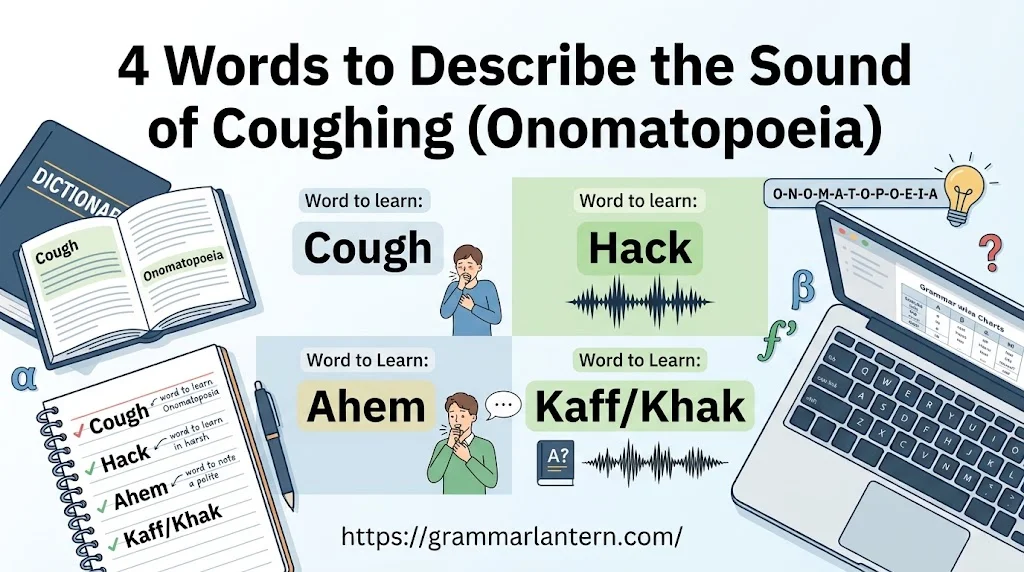
The four useful words and expressions for describing the sound of coughing are cough, hack, ahem, and kaff/khak.
| Word or expression | What it suggests | Best use |
| Cough | A general cough | Everyday writing and dialogue |
| Hack | A dry, rough, sharp cough | Descriptive writing |
| Ahem | Throat clearing or a deliberate vocal interruption | Dialogue and social situations |
| Kaff / Khak | A stylized coughing sound | Comics and exaggerated creative writing |
If you want the most natural and recognizable option, use “cough.” If you want to suggest a dry or rough sound, “hack” can add more detail.
However, “ahem” isn’t normally a regular cough. It usually represents deliberate throat clearing. Meanwhile, “kaff” and “khak” are creative spellings rather than universally standardized English words.
What Is an Onomatopoeia for Coughing?
An onomatopoeia is a word or expression that imitates, echoes, or strongly suggests a sound. Common examples include words such as buzz, bang, hiss, and splash.
Coughing is slightly trickier because people don’t all cough in the same way. Even the same person can produce different sounds depending on the situation.
A short cough might sound like a quick burst. A dry cough can sound harsh and repetitive. A deliberate throat-clearing sound may be quieter and more controlled.
Writers therefore have to consider more than the physical action. They also need to consider tone, context, intensity, and purpose.
For example:
“Cough!”
This immediately tells the reader that a cough happened.
Now consider:
“He gave a dry hack before continuing.”
The second sentence gives the reader more information. The cough feels rough and deliberate rather than completely neutral.
Are All Cough-Related Words Strict Onomatopoeia?
Not necessarily.
English contains many words that can represent sounds without being perfect attempts to reproduce those sounds. Some words describe an action or quality associated with a sound instead.
This distinction matters because writers often call every sound-related expression an onomatopoeia. In practice, the boundary isn’t always perfectly sharp.
For writing purposes, the important question is simple:
Does the expression help the reader hear or imagine the cough?
If it does, it may serve the purpose you need.
4 Words to Describe the Sound of Coughing
Cough
“Cough” is the clearest and most natural word for a coughing sound.
It works because readers already understand exactly what it represents. You don’t need to explain it, spell it creatively, or add unusual punctuation.
The word can function as both a noun and a verb.
For example:
- She gave a sudden cough.
- He began to cough.
- Cough, cough. She tried to speak again.
- One sharp cough broke the silence.
In dialogue or fiction, repetition can make the sound feel more immediate.
“Cough, cough! Sorry, something went down the wrong way.”
Here, the repeated word creates the impression of two quick coughs.
You can also combine “cough” with descriptive words to create a more specific image:
- dry cough
- sharp cough
- deep cough
- rough cough
- weak cough
- persistent cough
- violent coughing fit
The advantage of “cough” is its flexibility. It doesn’t force a particular sound onto the reader.
If the exact quality of the cough doesn’t matter, this is usually your best choice.
Read More: Together vs. Togather: Which Spelling Is Correct?
Hack
“Hack” can describe a short, dry, rough, or harsh cough.
The word gives the reader a stronger auditory impression than the neutral word “cough.” It often suggests repeated or forceful coughing.
For example:
He hacked into his sleeve before answering the question.
That sentence feels rougher than:
He coughed before answering the question.
The difference is subtle but useful. “Cough” tells you what happened. “Hack” gives you a clue about how it sounded.
You might use it when describing:
- A dry cough
- A harsh cough
- A repeated cough
- A rough-sounding cough
- A character struggling to stop coughing
For example:
The old engine rattled as Marcus hacked into his hand.
Or:
She gave a dry hack and reached for the glass of water.
The word “hack” has other meanings in English, including cutting roughly and gaining unauthorized access to computer systems. Context therefore matters.
When the surrounding sentence clearly involves coughing, readers generally understand the intended meaning.
Ahem
“Ahem” usually represents throat clearing rather than an ordinary involuntary cough.
That distinction is important.
People often use “ahem” when they want to get someone’s attention, signal impatience, interrupt politely, or create an awkward social moment.
For example:
“Ahem,” the teacher said, staring at the two students.
The teacher probably isn’t sick. Instead, the throat-clearing sound signals that the students should pay attention.
It can also suggest embarrassment:
“Ahem. As I was saying…”
In fiction, “ahem” can carry social meaning that a normal cough doesn’t.
It might communicate:
- Attention
- Awkwardness
- Impatience
- Politeness
- Embarrassment
- A subtle interruption
- A deliberate attempt to speak
This makes “ahem” especially useful in dialogue.
However, calling every cough an “ahem” can create an inaccurate impression. If a character is genuinely coughing repeatedly, “cough” or “hack” will usually work better.
Kaff or Khak
“Kaff” and “khak” can serve as stylized spellings for a rough coughing sound.
These forms appear mainly in creative representations where the writer wants the reader to almost hear the cough on the page.
They’re especially useful in comics, humorous writing, exaggerated dialogue, and informal creative work.
For example:
“Khak! Khak! I can’t believe I swallowed that!”
The repeated spelling visually represents repeated coughing.
However, there’s an important caveat: these spellings aren’t as standardized or universally recognizable as “cough.”
Different writers may choose different spellings to represent similar sounds. You may encounter forms such as:
- Kaff!
- Khak!
- Koff!
- Cough!
- Hack!
Creative writing gives you more freedom than formal prose. Still, clarity should come first.
If readers have to stop and wonder what “khak” means, the sound effect may work against the scene.
Coughing Sound Words at a Glance
Choosing the right expression becomes easier when you compare their roles directly.
| Expression | General meaning | Sound quality | Formality | Typical context |
| Cough | General cough | Neutral | Any | Stories, dialogue, everyday writing |
| Hack | Rough or dry cough | Harsh | Any | Fiction and descriptive prose |
| Ahem | Throat clearing | Controlled | Any | Dialogue and social situations |
| Kaff/Khak | Stylized cough | Exaggerated | Informal | Comics and creative writing |
The key difference is specificity.
“Cough” gives you the broadest meaning. “Hack” adds a rougher quality. “Ahem” introduces social intention. “Kaff” or “khak” focuses on visual sound imitation.
How to Choose the Right Cough Sound
The easiest way to choose a coughing onomatopoeia is to ask what you want the reader to hear.
1.If the sound is ordinary and the exact quality doesn’t matter, choose “cough.”
2.If the sound is dry, rough, or harsh, “hack” may fit better.
3.If someone deliberately clears their throat to attract attention, use “ahem.”
4.If you’re writing a comic or intentionally exaggerated scene, a stylized form such as “kaff” or “khak” may work.
Consider this simple guide:
- Normal cough: “Cough!”
- Dry or rough cough: “Hack!”
- Throat clearing: “Ahem.”
- Exaggerated comic cough: “Kaff! Kaff!” or “Khak! Khak!”
Don’t choose a sound effect simply because it looks dramatic. The expression should match the action.
How to Write a Cough in Dialogue
A cough can do more than represent a physical sound. It can change the rhythm of dialogue.
Consider this:
“I didn’t mean—cough—I didn’t mean to…”
The cough interrupts the character’s speech. That interruption can make the moment feel more realistic.
You can also use a cough as an action beat:
“That’s not what happened.” She coughed and looked away.
Or:
“Excuse me,” he said after a sharp cough.
Another option uses repetition:
“Cough, cough.” Daniel rubbed his throat. “Sorry.”
The choice depends on the style of the scene.
Avoid Overusing Sound Effects
Writing every cough as “cough, cough, cough” can quickly become distracting.
Instead, vary your descriptions.
For example:
She coughed once.
He gave a dry hack.
A rough cough escaped her throat.
He broke into a brief coughing fit.
These alternatives create variation without forcing unusual spellings into every sentence.
How Different Coughs Sound in Writing
A cough can have many qualities. The word you choose should reflect that quality when it matters to the scene.
Dry Cough
A dry cough usually suggests a cough without noticeable mucus.
Useful descriptions include:
- dry cough
- dry hack
- harsh cough
- short hack
Example:
A dry hack escaped him as he walked into the dusty room.
Deep Cough
A deep cough sounds lower and heavier.
You could write:
A deep cough echoed through the hallway.
There’s no need to invent an unusual onomatopoeia when a descriptive phrase communicates the sound more clearly.
Repeated Cough
Repeated coughing works well with repetition or a descriptive phrase.
For example:
“Cough, cough, cough.” She covered her mouth.
Or:
He coughed repeatedly until he finally caught his breath.
The second option often sounds more natural in serious prose.
Harsh Cough
For a harsh cough, “hack” can be particularly effective.
He hacked twice and reached for the water.
The verb gives the reader a stronger sense of roughness.
Weak Cough
A weak cough doesn’t need an elaborate sound effect.
Try:
She gave a small cough.
Or:
A faint cough came from the corner of the room.
This approach keeps the writing understated.
Cough Sound Words vs. Descriptive Phrases
Sometimes an onomatopoeia isn’t the strongest choice.
Compare these sentences:
“Cough!”
He gave a dry cough.
A harsh cough shook his shoulders.
Each sentence creates a different effect.
The first feels immediate and dramatic. The second provides a little more information. The third gives the reader a physical image as well as an auditory one.
When to Use an Onomatopoeia
Use a sound word when you want to emphasize the sound itself.
This works especially well in:
- Dialogue
- Comics
- Humorous scenes
- Dramatic interruptions
- Informal writing
- Fast-paced action
When to Use a Description
Use a descriptive phrase when the quality or physical effect matters more.
For example:
A deep cough rattled in his chest.
This communicates more than simply writing:
“Cough!”
The strongest writers know when to use each approach.
Case Study: Choosing the Right Word
Imagine a character named Daniel sitting through an important meeting.
First, he deliberately clears his throat because nobody is listening:
“Ahem.”
Here, “ahem” works because the sound has a social purpose.
Later, dust from an old file makes him cough:
“Cough!”
The neutral word works because the exact sound isn’t important.
Now imagine that the dust causes several harsh coughs:
He hacked into his sleeve.
“Hack” adds the rough quality missing from the neutral version.
Finally, imagine the same scene as a humorous comic:
“Khak! Khak!”
The exaggerated spelling can work because the format encourages visual sound effects.
The physical event is similar in all four examples. The writer’s purpose changes the best word.
Common Mistakes
Even a tiny sound effect can weaken otherwise strong writing when you use it incorrectly.
Treating Every Word as a Strict Onomatopoeia
Not every cough-related expression perfectly imitates an actual cough.
“Ahem” primarily represents throat clearing. “Hack” can describe a type of cough while also having unrelated meanings.
Understanding those distinctions helps you use the words accurately.
Using “Ahem” for a Normal Cough
This is one of the most common mistakes.
If someone is genuinely coughing because something irritated their throat, “ahem” may not communicate the right action.
Use “ahem” when the character is intentionally clearing their throat or signaling something.
Overusing Creative Spellings
Writing:
“Kaff!, Kaff!, Kaff!, Kaff! Kaff!”
may look entertaining once. Repeating it throughout an article or story can quickly become tiring.
Creative sound effects work best when they have a clear purpose.
Choosing Drama Over Accuracy
A huge “KHAAAAK!” may not suit a quiet conversation.
The sound should fit the scene’s volume, mood, and character.
Forgetting Context
A single word can carry different meanings.
For instance, “hack” might refer to coughing, cutting, computer security, or a person who uses a shortcut. Context removes that ambiguity.
Coughing Onomatopoeia in Fiction, Comics, and Informal Writing
Different writing formats give sound words different jobs.
Fiction
Traditional prose usually benefits from clarity.
Instead of forcing a strange spelling into every scene, combine ordinary vocabulary with sensory description.
He gave a dry hack and lowered his head.
That sentence sounds natural while still giving the reader an auditory clue.
Comics
Comics often use exaggerated sound effects because readers process words alongside visual images.
A large “COUGH!” can immediately communicate action.
A humorous comic might use:
KHAK! KHAK!
The visual presentation supports the unusual spelling.
Informal Messages
Text messages and casual writing allow more freedom.
Someone might write:
“Ahem 👀”
to humorously signal that they want attention.
That doesn’t represent a medical cough. Instead, it represents the social meaning of throat clearing.
Screenwriting
Screenplays generally rely more on action descriptions than elaborate sound spellings.
For example:
Marcus coughs and pauses before answering.
The action tells the performer what happens without forcing a specific written sound effect.
Read More: Countries or Country’s or Countries’? Possessive Explained
Examples in Sentences
Here are practical examples showing how these words work in context.
General cough:
“Cough!” Sarah covered her mouth.
Repeated cough:
“Cough, cough.” He reached for his water.
Dry cough:
She gave a dry cough before continuing.
Harsh cough:
A rough hack escaped him in the silent room.
Throat clearing:
“Ahem,” the professor said, waiting for the class to settle down.
Attention-seeking throat clear:
“Ahem,” Daniel said when nobody noticed him.
Comic-style cough:
“Kaff! Kaff!” the detective sputtered dramatically.
Stylized repeated cough:
“Khak! Khak!” He waved away the dust.
Notice that the more unusual forms work best when the surrounding context makes their meaning obvious.
Is “Cough” an Onomatopoeia?
“Cough” is commonly treated as an onomatopoeic or sound-imitative word because its form is closely associated with the sound or action it represents.
It also functions as an ordinary vocabulary word with established grammatical roles.
You can use it as a noun:
His cough woke everyone.
Or as a verb:
He began to cough.
In creative writing, it can also appear directly as a sound:
“Cough!”
That flexibility makes “cough” the safest option when you want readers to understand the sound immediately.
Is “Hack” an Onomatopoeia for Coughing?
“Hack” can represent or describe a rough, dry, forceful cough.
However, it has many meanings outside coughing.
For example, someone can hack at a piece of wood, hack into a computer, or use a hack as a practical shortcut.
When the context involves someone’s throat or breathing, the coughing meaning becomes clear.
Compare:
He coughed.
with:
He hacked.
The first is neutral. The second suggests a rougher, more unpleasant sound.
That difference makes “hack” valuable when you want more texture.
Is “Ahem” Really a Cough?
Usually, no.
“Ahem” generally represents throat clearing, particularly a deliberate sound used in a social situation.
Someone might say “ahem” because they want another person to notice them. They might also use it to signal impatience or politely interrupt a conversation.
For example:
“Ahem,” she said, glancing at the clock.
The sound carries a message beyond the physical noise.
That’s why “ahem” works best when the character intentionally produces the sound.
Can “Kaff” or “Khak” Be Used for Coughing?
Yes, “kaff” and “khak” can be used as creative representations of coughing sounds, particularly in informal writing and comics.
However, they’re less standardized than “cough.”
There isn’t one universally accepted spelling that perfectly captures a human cough. Writers often adapt sound effects to match the style and audience.
Use these forms when you deliberately want a stylized effect. For standard prose, “cough” or “hack” will usually communicate more clearly.
Quick Comparison: Which Cough Word Should You Use?
| If you want to express… | Best choice |
| A normal cough | Cough |
| A dry cough | Hack |
| A rough cough | Hack |
| A deliberate throat clear | Ahem |
| Getting someone’s attention | Ahem |
| A comic-style cough | Kaff / Khak |
| A repeated ordinary cough | Cough, cough |
| A serious descriptive scene | Cough + description |
The simplest rule is this: match the word to the sound and the situation.
FAQs
1. What is an onomatopoeia for coughing?
An onomatopoeia for coughing is a word or phrase that represents the sound of a cough, such as “Ahem!” or “Kaff, Kaff!”
2. What are some words that describe a cough?
Common examples include Ahem, Kaff, Kaff!, and Khoff khak khak! Each can suggest a different type of coughing sound.
3. Is “Ahem” a coughing sound?
Yes. “Ahem” commonly represents a gentle or polite throat-clearing sound and can also be used to show a light cough.
4. What does “Kaff, Kaff!” mean?
“Kaff, Kaff!” is a written representation of a repeated coughing sound. It can make a cough feel more noticeable in a sentence.
5. What does “Khoff khak khak!” represent?
“Khoff khak khak!” represents a rough, repeated coughing sound. It can be useful when a writer wants the cough to sound stronger.
6. Why do writers use coughing onomatopoeia?
Writers use coughing onomatopoeia to help readers imagine the sound without needing a long description.
7. Can onomatopoeia make dialogue more natural?
Yes. Adding a coughing sound to dialogue can make a character’s actions easier to imagine and can add movement to a scene.
8. Are these words suitable for formal writing?
They are more common in creative writing, dialogue, comics, stories, and informal descriptions than in highly formal writing.
9. Can one coughing sound have different spellings?
Yes. Writers may represent a cough in different ways because real coughing sounds can vary in strength, rhythm, and pitch.
10. Which coughing sound should I choose?
Choose the expression that best matches the sound you want readers to imagine. Ahem suits a lighter sound, while Kaff, Kaff! and Khoff khak khak! can suggest stronger coughing.
Conclusion
Coughing sounds can be difficult to describe because a real cough can vary from soft and brief to harsh and repeated. Using onomatopoeic expressions gives writers a simple way to represent these sounds and make their descriptions more lively.
Ahem, Kaff, Kaff!, and Khoff khak khak! each create a different impression. The best choice depends on the scene, character, and type of cough you want to present. With the right expression, readers can more easily imagine the sound while reading.

Muhammad Haroon is the voice behind many of the clear, practical grammar guides you’ll find on Grammar Lantern. With a strong background in content writing and a genuine love for the English language, Haroon specializes in breaking down intimidating grammar topics into simple, digestible lessons. His goal is simple: to empower readers to write with confidence and clarity. Whether he’s explaining tricky tenses or demystifying punctuation, Haroon approaches each topic with patience, precision, and a touch of warmth—because he knows that learning grammar is a journey, not a race.