Convertor vs Converter is a common spelling question in English, and it often causes confusion because many words have multiple spelling variations, different spellings, and small spelling differences. Both Convertor and Converter mean someone or something that converts by performing a conversion, but their exact meaning depends on the general or particular context.
While the two forms look very similar, choosing the correct word is important for clear writing, speaking, and everyday language usage.
From my experience with technical editing, Converter is the preferred, widely accepted, and correct spelling in modern English. Although Convertor is still used in some technical fields, especially in older references, Converter appears more often in dictionaries, manuals, and professional documents.
Understanding the difference, recognizing the different meanings, and improving your word choice can help you avoid mistakes and write with greater confidence. This article will explore the comparison, explain each linguistic variant, and provide clear examples that make every word easy to understand and remember.
The context always plays an important role because general language usage and language usage often varies across technology, electronics, engineering, and many modern applications. In digital tools, apps, devices, or electrical, mechanical, and signal systems, Converter remains the proper spelling in everyday English and most modern usage. Even though both forms are sometimes interchangeably used, the preferred choice usually depends on the audience and the type of document you are creating.
Your understanding should come from a reliable guide, the correct form, and the rules of the language, rather than from habit or a common typo. Referring to the correct form correctly helps prevent errors in different groups and particular circumstances, whether you are converting data, describing changes, or writing about technology.
Taking this practical approach makes it easier to determine the right spelling through clear explanations, accurate usage, and real-life examples.
Quick Answer: Convertor vs Converter
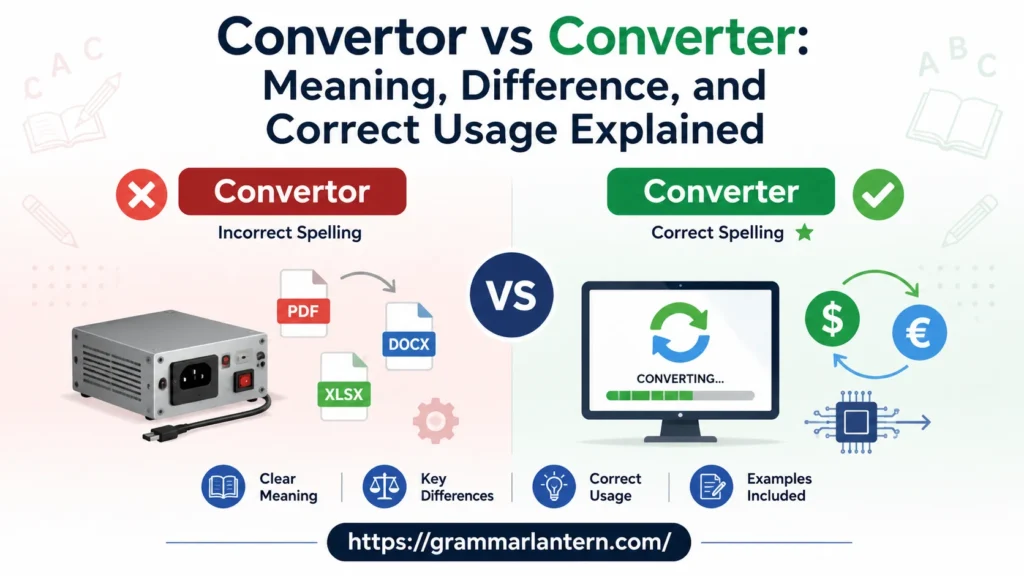
Converter is the correct and commonly used spelling in modern English.
A converter is a person, device, or software tool that changes something from one form into another.
Examples:
- A currency converter changes one currency value into another.
- A PDF converter changes files from PDF format into another format.
- A power converter changes electrical energy from one type to another.
Convertor is a rare spelling variation. Although some dictionaries recognize it, people rarely use it in modern writing. In most situations, choosing converter is the safest and most natural option.
| Word | Meaning | Modern Usage |
| Converter | Something or someone that converts | Common and recommended |
| Convertor | A rare variant of converter | Uncommon and usually avoided |
What Is the Difference Between Convertor and Converter?
The difference between convertor and converter is mainly about usage, not meaning.
Both words come from the verb convert. The suffixes -er and -or often create nouns that describe a person or thing performing an action.
For example:
- Teach → Teacher
- Translate → Translator
- Create → Creator
- Convert → Converter
English sometimes allows both endings, but one form usually becomes more popular over time. That happened with converter.
Today, English speakers naturally say:
- “I need a file converter.”
- “Use a currency converter.”
- “The car has a catalytic converter.”
Almost nobody says:
- “I need a file convertor.”
- “Use a currency convertor.”
- “The car has a catalytic convertor.”
The second group sounds unusual because modern English has standardized around converter.
Converter Meaning Explained
The word converter has a simple meaning:
A converter is a person, device, machine, or program that changes something from one form into another.
The exact meaning depends on the context.
General Meaning of Converter
In everyday language, a converter can refer to anything that transforms something.
For example:
“This adapter works as a voltage converter for international travel.”
Here, the device changes electrical voltage so another device can work safely.
Another example:
“The online converter changed my document into a different file format.”
The software transformed one type of file into another.
Converter Meaning in Technology
Technology uses the word converter frequently because digital systems constantly change information between different formats.
Common examples include:
File Converter
A file converter changes a file type into another format.
Examples:
- Word document to PDF
- JPG image to PNG
- Video file to MP4
- Audio file to MP3
A student might use a PDF converter to turn class notes into a shareable document.
Currency Converter
A currency converter calculates the value of one currency compared with another.
For example:
- US dollars to euros
- Pakistani rupees to US dollars
- British pounds to Japanese yen
Banks, travel websites, and financial apps commonly use currency converters.
Electrical Converter
An electrical converter changes electrical properties such as:
- Voltage
- Current
- Frequency
Examples include:
- AC to DC converters
- DC to AC converters
- Voltage converters
These devices play a major role in electronics, renewable energy systems, and transportation.
Automotive Converter
The automotive industry uses converter in several important terms.
A well-known example is the catalytic converter.
A catalytic converter reduces harmful emissions from vehicle exhaust by converting toxic gases into less harmful substances.
Another example is a torque converter, which transfers engine power to an automatic transmission.
Convertor Meaning Explained
Although convertor appears much less often, it is considered a variant spelling of converter.
The word carries the same basic meaning:
A convertor is something that converts one thing into another.
However, modern English rarely chooses this spelling.
You may find convertor in:
- Older technical documents
- Historical engineering references
- Certain product names
- Less common regional usage
For example, an old engineering manual might use “convertor” when describing a machine that changes materials or energy.
However, modern technical writing almost always uses converter.
A modern engineer, software developer, or researcher would normally write:
✅ “Digital signal converter”
not:
❌ “Digital signal convertor”
Why Is Converter More Common Than Convertor?
The popularity of converter did not happen randomly. Several factors helped it become the dominant spelling.
1. Everyday Technology Uses Converter
Technology has made the word extremely common.
People regularly search for:
- Online converter
- Video converter
- Image converter
- Currency converter
- Unit converter
Because millions of people interact with these tools, converter became deeply familiar.
2. Industries Standardized Converter
Many industries adopted converter as their official terminology.
Examples:
| Industry | Common Term |
| Software | File converter |
| Finance | Currency converter |
| Electronics | Power converter |
| Automotive | Catalytic converter |
| Engineering | Signal converter |
When industries choose a standard term, that spelling becomes dominant.
3. Dictionaries Favor Converter
Major English dictionaries list converter as the primary spelling.
While some dictionaries acknowledge convertor, they usually treat it as a less common alternative.
For learners and professional writers, dictionary preference matters because it reflects accepted modern usage.
4. English Naturally Prefers -er in Many Cases
The suffix -er commonly creates words for tools and people that perform actions.
Examples:
- Calculate → Calculator
- Print → Printer
- Mix → Mixer
- Convert → Converter
This pattern feels natural to most English speakers.
Convertor vs Converter: Detailed Comparison
| Feature | Converter | Convertor |
| Correct spelling | Yes | Yes, but rare |
| Common in modern English | Very common | Very uncommon |
| Used in technology | Frequently | Rarely |
| Used in academic writing | Recommended | Usually avoided |
| Used in business writing | Preferred | Not recommended |
| Meaning | Something that converts | Same meaning |
The key point is simple:
Both words can refer to something that converts, but converter is the word most readers expect.
Is Convertor Wrong?
No, convertor is not completely wrong.
It exists as a legitimate variant spelling. However, using it may create confusion because many readers consider it unusual or even a spelling mistake.
Think about it like this:
If you write:
“I downloaded a video convertor.”
Most readers will understand your meaning. However, many will think:
“Shouldn’t this be video converter?”
The word is understandable, but it does not match normal modern usage.
For professional writing, websites, academic papers, and product descriptions, converter is the better choice.
How Dictionaries Define Converter and Convertor
Dictionaries help show how words are used in real life. When we compare convertor vs converter, most major dictionaries recognize converter as the primary and widely used form.
The important difference is not meaning. Both words describe something that changes one thing into another. The difference is frequency and acceptance in modern communication.
Most English speakers expect to see:
- Currency converter
- PDF converter
- Voltage converter
- Signal converter
- Catalytic converter
The word convertor may appear occasionally, but it is much less common.
| Dictionary Reference | Converter Status | Convertor Status |
| Merriam-Webster | Common entry | Rare variant usage |
| Cambridge Dictionary | Standard word | Not commonly used |
| Collins Dictionary | Standard word | Listed as uncommon variant |
| Oxford English Dictionary | Recognized form | Historical or less common variant |
The overall pattern is clear: converter is the modern standard.
Convertor vs Converter in Different Industries
The spelling difference becomes easier to understand when you look at real-world industries. Almost every professional field uses converter as the accepted term.
Computing and Software
The technology industry heavily depends on converters.
Every day, millions of people use software tools that transform digital information.
Common examples include:
- File converter
- Image converter
- Video converter
- Audio converter
- Document converter
- Format converter
Imagine you receive a document that your device cannot open. A file converter solves that problem by changing the file into a compatible format.
Example:
“I used a PDF converter to turn my scanned notes into an editable Word document.”
You would rarely see a professional software company advertise a “PDF convertor.” The standard term is always PDF converter.
Electrical Engineering
Electrical engineering uses converters to transform energy.
A converter may change:
- Alternating current (AC) into direct current (DC)
- Direct current (DC) into alternating current (AC)
- One voltage level into another
- One frequency into another
Examples include:
- Solar power converters
- Voltage converters
- Power converters
- Frequency converters
For instance, solar panels produce direct current electricity, but many homes use alternating current. A power converter helps transform the energy into a usable form.
The engineering world almost exclusively uses converter, not convertor.
Automotive Industry
The automotive industry provides some of the most familiar examples of the word converter.
Catalytic Converter
A catalytic converter is an emission-control device found in most modern vehicles.
It reduces harmful gases from exhaust systems by converting pollutants into less harmful emissions.
It helps reduce:
- Carbon monoxide
- Nitrogen oxides
- Hydrocarbons
Example:
“A damaged catalytic converter can affect vehicle performance and increase emissions.”
Torque Converter
A torque converter connects the engine and automatic transmission.
It transfers power smoothly while allowing the vehicle to stop without shutting off the engine.
Example:
“Automatic transmissions use a torque converter to deliver smoother acceleration.”
Both terms use converter, not convertor.
Read More: Oversite vs Oversight: Correct Usage Explained
Finance and Business
Financial services commonly use converters to make calculations easier.
A currency converter helps users compare exchange rates between different currencies.
Examples:
- USD to EUR converter
- PKR to USD converter
- GBP to CAD converter
Businesses use currency converters for:
- International purchases
- Travel expenses
- Import and export calculations
- Financial planning
A travel website would write:
✅ “Use our currency converter before your trip.”
It would not normally write:
❌ “Use our currency convertor before your trip.”
Why Do People Search for “Convertor”?
Many people type convertor because the spelling feels logical.
The confusion happens for several reasons.
1. Confusion With Other “-or” Words
English has many words ending in -or:
- Creator
- Translator
- Operator
- Generator
- Calculator
Because of these examples, some people assume convertor follows the same pattern.
However, English does not always follow fixed rules. Some words become popular because of common usage rather than strict spelling patterns.
2. Pronunciation Creates Confusion
When people hear “converter,” the ending may sound similar to “convertor.”
English pronunciation often does not clearly reveal spelling.
Examples:
- Advisor / adviser
- Traveler / traveller
- Theater / theatre
Similarly, people may write convertor because it seems like a reasonable spelling.
3. Older Materials Used Convertor
Some older documents and technical resources used convertor.
When people copy terminology from older sources, the spelling can continue spreading.
However, modern publications, software companies, and technical manuals overwhelmingly use converter.
4. Search Results Influence Spelling
The internet can sometimes reinforce uncommon spellings.
If someone searches for “convertor,” they may find pages using that spelling. This can make the word appear more common than it actually is.
Search visibility does not always equal correct or preferred usage.
Convertor vs Converter in US and UK English
Some spelling differences exist between American and British English.
Examples:
| American English | British English |
| Color | Colour |
| Center | Centre |
| Meter | Metre |
However, convertor vs converter is not one of these differences.
Both American and British English prefer:
✅ Converter
Neither variety commonly chooses:
❌ Convertor
This makes the choice easier. Whether you write for readers in the United States, United Kingdom, Canada, or Australia, converter is the safer option.
Examples of Correct Usage
Here are examples showing how converter works naturally in sentences.
Technology Examples
- “This online converter changes Word files into PDFs.”
- “The video converter supports multiple file formats.”
- “I downloaded an image converter to resize my photos.”
Electrical Examples
- “The voltage converter allows foreign devices to work safely.”
- “Solar systems require a power converter to manage energy flow.”
Automotive Examples
- “The mechanic inspected the catalytic converter during the vehicle check.”
- “A damaged torque converter can cause transmission problems.”
Finance Examples
- “The currency converter shows today’s exchange rate.”
- “Travelers often check a currency converter before exchanging money.”
General Examples
- “This tool works as a unit converter for measurements.”
- “The device acts as a signal converter between two systems.”
Common Mistakes When Using Convertor vs Converter
Even experienced writers sometimes make spelling mistakes with similar words. Here are the most common problems.
Mistake 1: Using Convertor in Professional Content
A company website, product description, or technical article should use the standard spelling.
Wrong:
“Our online PDF convertor is fast and secure.”
Better:
“Our online PDF converter is fast and secure.”
The second version looks more professional and matches reader expectations.
Mistake 2: Assuming Convertor Is British English
Some writers believe British English prefers convertor because other British spellings differ from American English.
That assumption is incorrect.
Both varieties use converter.
Mistake 3: Mixing Both Spellings
Using both spellings in one article creates inconsistency.
Example:
“Our converter tool works faster than other convertor programs.”
This looks unpolished.
Choose one spelling and stay consistent.
Mistake 4: Using Convertor for SEO Keywords
Some websites target misspelled keywords because people search them.
While this may bring visitors, using incorrect or uncommon spelling throughout your content can reduce trust.
A better approach is:
- Use converter as the main term.
- Mention convertor once when explaining the difference.
This helps readers without making your content look unnatural.
Converter vs Convertor: Which One Should You Use?
The answer depends on your goal.
| Situation | Recommended Choice |
| Blog writing | Converter |
| Academic writing | Converter |
| Business documents | Converter |
| Software names | Converter |
| Technical manuals | Converter |
| Casual communication | Converter |
Almost every situation calls for converter.
The only time you may use convertor is when you are discussing the spelling itself or quoting a specific source that uses it.
A Simple Way to Remember the Correct Spelling
Need a quick memory trick?
Think about the tools you already know:
- Google converter tools
- Currency converter apps
- PDF converter software
- Video converter programs
You have probably seen converter hundreds of times.
A simple rule:
If you are writing about a tool, machine, or program that changes something, use converter.
It is the spelling most people recognize immediately.
Similar Word Pairs Related to Convertor vs Converter
English contains many word pairs that confuse writers because the spelling looks almost identical. Understanding these patterns can help you avoid mistakes when choosing between convertor vs converter and similar terms.
Adapter vs Adaptor
Adapter and adaptor are another pair that creates confusion.
Both words can refer to a device that connects or changes compatibility between two things.
Examples:
- A phone adapter connects a charger to a power source.
- A travel adapter allows a device to work in another country.
In modern American English, adapter is usually preferred.
However, adaptor still appears, especially in British English and technical contexts.
This difference is similar to converter vs convertor, where one spelling has become more common even though another form exists.
Transformer vs Converter
These two words are sometimes confused because both involve changing electrical energy.
However, they are not the same.
A transformer changes voltage levels in alternating current systems.
A converter changes electrical energy from one type into another.
For example:
- A transformer may reduce 240 volts to 120 volts.
- A converter may change AC power into DC power.
| Device | Main Function |
| Transformer | Changes voltage level |
| Converter | Changes energy type or format |
Translator vs Interpreter
Many people use these words interchangeably, but they have different meanings.
A translator converts written language from one language into another.
Example:
“The translator converted the Spanish document into English.”
An interpreter converts spoken language in real time.
Example:
“The interpreter helped during the international meeting.”
The same idea applies to converter: the exact word depends on the type of transformation happening.
Encoder vs Decoder
In computing, an encoder changes information into another format, while a decoder reverses the process.
Examples:
- A video encoder compresses video data.
- A decoder converts compressed data back into a usable format.
These terms show how English creates specialized words for transformation processes.
FAQs
1. Which is correct: Convertor or Converter?
Converter is the preferred and most widely accepted spelling in modern English. Convertor is still used in some technical and engineering contexts but is much less common.
2. Is Convertor a real word?
Yes. Convertor is a valid word, especially in certain technical fields. However, Converter is the standard spelling in most dictionaries and general writing.
3. Why do people confuse Convertor and Converter?
The confusion comes from their similar spelling and identical meaning. Since both refer to something that converts, many people assume they are equally common, even though Converter is used far more often.
4. When should I use Converter?
Use Converter in everyday English, academic writing, business communication, software documentation, and when referring to digital tools, file converters, or electronic devices.
5. When is Convertor used?
Convertor may appear in older publications or specialized engineering and electrical contexts. Some manufacturers and industries also continue to use this spelling.
6. Are Convertor and Converter different in meaning?
No. Both words share the same basic meaning. The main difference is their preferred usage rather than their definition.
7. Which spelling do dictionaries recommend?
Most modern English dictionaries list Converter as the primary spelling, while Convertor is often shown as a less common or alternative form.
8. Is Converter correct in American and British English?
Yes. Converter is the standard and preferred spelling in both American and British English.
9. Can I use Convertor in professional writing?
You can, but Converter is usually the better choice unless you are following industry-specific terminology or an organization’s style guide.
10. How can I remember the correct spelling?
A simple tip is to remember that Converter is the version you will see most often in software, technology, electronics, and everyday English, making it the safest choice in almost every situation.
Conclusion
Understanding the difference between Convertor vs Converter helps you make better word choices in both everyday and professional writing. Although both spellings are correct and share the same meaning, Converter is the preferred form in modern English because it appears more frequently in dictionaries, technology, business communication, and general language usage. Choosing the standard spelling makes your writing clearer and more consistent.
The best spelling often depends on context, but for most situations, Converter is the recommended option. Keeping this distinction in mind will help you avoid common spelling mistakes, improve your confidence, and communicate more effectively whether you are writing about software, electronics, engineering, or general English.

For Shafiq ur Rehman, writing is an art form and grammar is the toolbox that makes it beautiful. As a dedicated content writer at Grammar Lantern, Shafiq approaches every topic like an architect carefully laying down strong foundations of understanding before adding the finer details. He loves diving into the trickiest grammar points and resurfacing with simple, bite-sized takeaways that anyone can grasp. When he’s not crafting articles, you’ll likely find him strategizing over a game of chess, exploring dusty local bookshops, or quietly jotting down poetic observations in his notebook.