
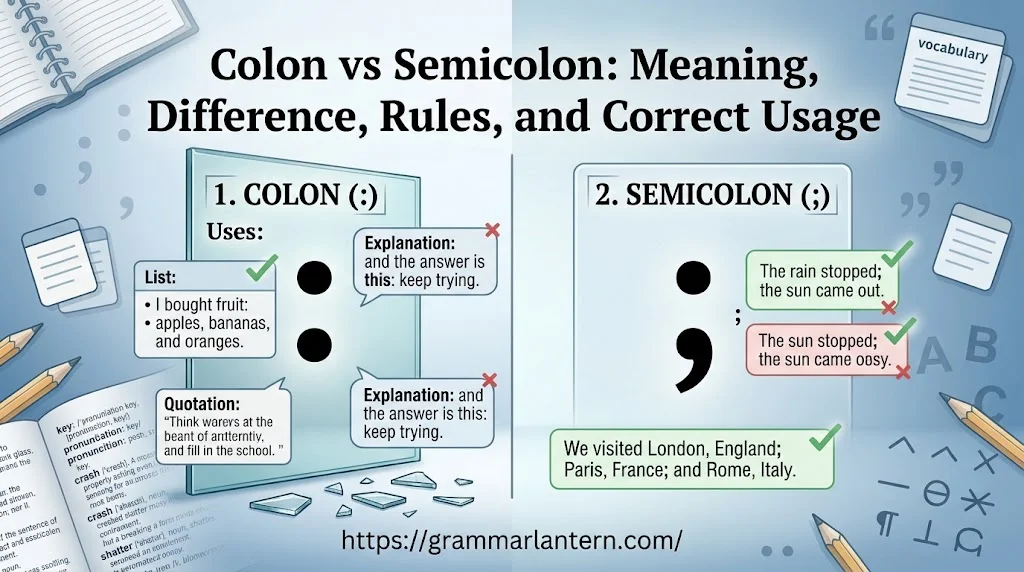
In English, punctuation is a system of symbols and signs that gives structure, pace, and helps clarify communication. Colon vs Semicolon is an important distinction because both marks can connect related ideas in writing. The colon and semicolon have different functions, and understanding their difference helps readers follow a sentence clearly. A semicolon is commonly used to separate independent clauses that are related, while a colon can introduce lists and quotations.
A simple decision framework can make the choice clearer. When two independent clauses express closely related thoughts, a semicolon is often the right mark. When the first part of a sentence prepares readers for an explanation, list, or quotation, a colon is usually appropriate. These punctuation marks can be misapplied, even by experienced writers, so careful review is useful.
In academic and professional writing, punctuation precision matters because it affects how your work is received. Using these marks correctly helps reinforce accuracy, clarify meaning, and make writing more succinct and persuasive. Through clear examples and side-by-side comparisons, writers can simplify their understanding, avoid common mistakes, and know when to reach for each punctuation mark.
Quick Answer
The simplest rule is this:
A colon introduces; a semicolon connects.
Use a colon (:) when the second part of a sentence introduces a list, explanation, example, quotation, or other information that develops the first part.
Use a semicolon (;) when you want to connect two closely related independent clauses without using a coordinating conjunction such as and, but, or so. You can also use semicolons to separate items in a complicated list when those items already contain commas.
| Feature | Colon (:) | Semicolon (;) |
| Main purpose | Introduces or explains | Connects or separates |
| Common use | Lists, explanations, examples | Related independent clauses |
| Can join two complete clauses? | Yes, when the second explains or expands the first | Yes, when the clauses are closely related |
| Used in complex lists? | Sometimes introduces the list | Separates complex list items |
| Basic idea | “Here comes more information” | “These thoughts belong together” |
| Example | I need three items: paper, ink, and envelopes. | The store was closed; we went home. |
A useful mental picture is simple: the colon points forward, while the semicolon builds a bridge.
What Is a Colon?
A colon (:) is a punctuation mark that signals that additional information is about to follow. That information may explain a statement, provide examples, introduce a list, or present a quotation.
The material before the colon normally forms a complete thought in standard constructions.
For example:
There was only one problem: nobody had the key.
The words before the colon, “There was only one problem,” form a complete clause. The words after the colon explain what that problem was.
A colon therefore creates a relationship between two parts of a sentence. The second part doesn’t simply sit beside the first. It develops or specifies it.
Think of the colon as a small sign that says:
“Here is what I mean.”
Colon Examples
- The recipe requires three ingredients: flour, eggs, and milk.
- She had one goal: finish the project before Friday.
- Remember this rule: practice improves accuracy.
- He gave us some good advice: don’t rush the decision.
In each example, the material after the colon adds specific information to the statement before it.
When to Use a Colon
A colon has several established uses. The most common ones involve introducing information that directly relates to what came before.
Use a Colon to Introduce a List
One of the most familiar uses of a colon is introducing a list.
For example:
The box contained four items: a charger, a cable, a manual, and a case.
The colon tells the reader that the specific items are coming next.
You can use this pattern in everyday writing, academic work, business documents, and articles.
Examples:
- Bring these supplies: paper, scissors, glue, and tape.
- The team needs three things: patience, focus, and preparation.
- We visited several cities: Chicago, Denver, Seattle, and Boston.
However, don’t automatically put a colon before every list. If the sentence flows naturally without one, adding a colon may create an unnecessary break.
For example:
My favorite fruits are apples, oranges, and bananas.
The verb “are” already leads directly into the list. A colon isn’t needed.
The following version is generally incorrect in standard prose:
My favorite fruits are: apples, oranges, and bananas.
The problem comes from separating the verb “are” from its complement.
Use a Colon to Introduce an Explanation
A colon works especially well when the second part explains the first.
The meeting ended early: the manager had an emergency.
The second clause explains why the meeting ended early.
Other examples include:
- The reason was obvious: nobody had prepared.
- She knew what she had to do: apologize.
- The result surprised everyone: the smallest team won.
This structure gives the reader a clear sense of cause, clarification, or expansion.
Read More: 5 Words for the Sound of Glass Breaking (Onomatopoeia)
Use a Colon to Introduce an Example
A colon can introduce a specific example after a general statement.
Some punctuation marks have specialized jobs: a colon can introduce an explanation.
The first part makes a broad statement. The second part gives a concrete example.
This technique works particularly well in educational writing because it moves naturally from a general idea to a specific case.
Use a Colon Before a Quotation
A colon can introduce a quotation when the preceding words form an appropriate complete introduction.
For example:
The teacher ended the lesson with one simple message: “Keep practicing.”
The colon prepares the reader for the quoted words.
However, a colon isn’t required simply because quotation marks appear. The grammatical relationship between the introduction and quotation determines the punctuation.
Compare:
She said, “The test begins at nine.”
Here, “She said” naturally introduces the quotation, so a comma is appropriate.
Use a Colon in Titles and Subtitles
Colons commonly separate a main title from a subtitle.
For example:
Grammar Essentials: A Practical Guide to Better Writing
This structure lets the first part identify the broad topic while the second part provides additional detail.
You often see this format in:
- Books
- Academic papers
- Reports
- Articles
- Presentations
- Courses
Use a Colon for Time and Ratios
Colons also appear in established formats that aren’t based on introducing a list or explanation.
For example:
- The meeting starts at 9:30.
- The final score was 3:1.
- The mixture uses a 2:1 ratio.
These uses follow conventional formatting rules.
What Is a Semicolon?
A semicolon (;) is a punctuation mark that creates a stronger pause than a comma while keeping closely related ideas within the same sentence.
Its most important grammatical use is connecting two independent clauses.
An independent clause can stand on its own as a complete sentence.
Consider this example:
The weather changed quickly; we returned home.
Both parts can stand alone:
- The weather changed quickly.
- We returned home.
The semicolon connects them because their meanings are closely connected.
A useful way to think about the semicolon is as a middle ground between a comma and a period.
- Comma: creates a relatively light connection.
- Semicolon: creates a stronger connection while keeping the ideas together.
- Period: separates the thoughts into separate sentences.
The semicolon is the punctuation equivalent of saying, “These ideas are separate, but they belong together.”
When to Use a Semicolon
Semicolons have fewer major functions than colons, but each one is important.
Use a Semicolon to Join Related Independent Clauses
This is the classic semicolon construction.
The restaurant was crowded; we decided to eat somewhere else.
Both clauses are complete:
- The restaurant was crowded.
- We decided to eat somewhere else.
Because the ideas have a clear relationship, the semicolon works naturally.
More examples:
- The deadline is tomorrow; we need to finish today.
- Maria loves historical fiction; her brother prefers science fiction.
- The road was blocked; the drivers took another route.
- The computer stopped working; I restarted it.
You could replace each semicolon with a period. The meaning would remain largely intact. The semicolon simply emphasizes the connection.
Use a Semicolon Before a Conjunctive Adverb
Words such as however, therefore, moreover, nevertheless, consequently, and meanwhile can connect related independent clauses.
When a conjunctive adverb connects two independent clauses, a semicolon commonly appears before it.
For example:
The forecast predicted rain; however, the sky remained clear.
The structure is:
Independent clause + semicolon + conjunctive adverb + comma + independent clause
More examples:
- The first plan seemed expensive; however, it saved money later.
- The evidence was limited; therefore, the researchers continued testing.
- The product received criticism; nevertheless, sales increased.
- The road looked dangerous; consequently, the driver turned around.
A common mistake involves replacing the semicolon with a comma:
The forecast predicted rain, however, the sky remained clear.
That construction creates a comma splice when both sides function as independent clauses.
Use Semicolons to Separate Items in a Complex List
A semicolon can separate list items when the items themselves contain commas.
Consider this sentence:
The conference included speakers from Austin, Texas; Portland, Oregon; Miami, Florida; and Boston, Massachusetts.
The semicolons make the boundaries between the locations obvious.
Without them, the many commas would make the sentence harder to scan.
This technique works especially well with lists containing:
- Cities and states
- People and their roles
- Detailed descriptions
- Dates and locations
- Multiple phrases containing internal commas
For example:
The finalists were James Carter, the sales director; Priya Shah, the research manager; and Daniel Lee, the project coordinator.
The semicolons prevent the internal commas from becoming confusing.
The Key Difference
The biggest difference between these punctuation marks comes down to their relationship with the information around them.
A colon generally says:
“The information that follows explains or identifies what came before.”
A semicolon generally says:
“These two complete thoughts are closely connected.”
Compare these examples:
She had one concern: the deadline was approaching.
The second part identifies the concern.
Now compare:
The deadline was approaching; she worked through the weekend.
The second clause doesn’t identify something contained in the first clause. Instead, the two clauses describe related events.
Colon vs Semicolon Examples
| Sentence | Correct Mark | Reason |
| He needed one thing: a second chance. | Colon | Introduces an explanation |
| He needed a second chance; he had made a serious mistake. | Semicolon | Connects related complete clauses |
| We bought three supplies: paper, ink, and folders. | Colon | Introduces a list |
| We bought the supplies; then we returned to the office. | Semicolon | Connects related thoughts |
| She knew the truth: the report contained errors. | Colon | Introduces clarification |
| The report contained errors; the team corrected them. | Semicolon | Connects two complete clauses |
The distinction becomes much clearer when you ask what the second part is doing.
Can a Colon and Semicolon Be Used Interchangeably?
Usually, no.
Even when both marks can appear between complete clauses, they don’t create exactly the same relationship.
Consider:
The experiment failed: the temperature was too high.
The colon presents the second clause as an explanation of the first.
Now consider:
The experiment failed; the researchers repeated it.
The semicolon links two related actions or facts.
The two punctuation marks therefore communicate different relationships.
A colon has a more introductory and explanatory role. A semicolon has a more connecting and balancing role.
Colon vs Semicolon in the Same Sentence
Understanding the difference becomes easier when you place both marks in one sentence.
Consider:
The research team had one priority: collect reliable data; the schedule could wait.
Here, the colon introduces the team’s priority. The semicolon then connects that statement to another complete thought.
This example shows that the marks aren’t competing versions of the same punctuation. They can perform different jobs within a single sentence.
Another example:
She packed everything she needed: clothes, toiletries, and a notebook; then she headed to the airport.
The colon introduces the list. The semicolon separates the completed thought from another closely related clause.
Common Colon Mistakes
Colons are useful, but they don’t belong wherever a dramatic pause seems appropriate.
Don’t Put a Colon Directly After a Verb
Avoid this construction:
The items I need are: a laptop, a charger, and a notebook.
A cleaner version is:
The items I need are a laptop, a charger, and a notebook.
The verb already introduces the items.
However, you can restructure the sentence to make a colon appropriate:
I need three items: a laptop, a charger, and a notebook.
Now the words before the colon form a complete thought.
Don’t Put a Colon After a Preposition
This sentence doesn’t need a colon:
The package was sent to: New York, Boston, and Chicago.
Instead, write:
The package was sent to New York, Boston, and Chicago.
A colon shouldn’t interrupt a grammatical unit merely because a list follows.
Don’t Use a Colon for Every Pause
A colon isn’t simply a fancy comma.
If the second part doesn’t introduce, explain, identify, or expand the first part, another punctuation mark may work better.
Punctuation should reflect the relationship between ideas. It shouldn’t exist merely to create a dramatic pause.
Common Semicolon Mistakes
Semicolon errors often happen because writers treat the mark as a stronger comma.
Don’t Use a Semicolon Between a Dependent Clause and an Independent Clause
A semicolon normally requires independent clauses on both sides when it joins clauses.
For example:
Although the weather was cold; we went outside.
This is incorrect because “Although the weather was cold” is dependent.
Write:
Although the weather was cold, we went outside.
The comma works because the dependent clause begins the sentence.
Don’t Use a Semicolon to Introduce an Ordinary List
This is incorrect:
She bought three things; milk, bread, and eggs.
The list needs a colon:
She bought three things: milk, bread, and eggs.
The semicolon doesn’t normally introduce an ordinary list.
Don’t Use a Semicolon Where a Period Works Better
A semicolon isn’t mandatory simply because two sentences are related.
For example:
The movie ended late; everyone went home.
This is grammatically fine.
However, you could write:
The movie ended late. Everyone went home.
If the connection isn’t important enough to emphasize, two sentences may read more naturally.
Don’t Capitalize Automatically After a Semicolon
In ordinary English sentences, the word after a semicolon usually begins with lowercase unless it is a proper noun or another word that normally requires capitalization.
Correct:
The store was closed; we returned the next day.
Not:
The store was closed; We returned the next day.
A semicolon doesn’t create a new sentence.
In Formal and Academic Writing
Both marks can improve formal writing when you use them with purpose.
In academic writing, a colon can introduce a finding, explanation, definition, or list.
The study reached one important conclusion: regular practice improved accuracy.
A semicolon can connect closely related findings or arguments.
The first group improved significantly; the second group showed little change.
The key is restraint. Formal writing doesn’t become more sophisticated simply because it contains more semicolons and colons.
Good punctuation makes complex ideas easier to follow. That’s the real goal.
In Everyday Writing
You don’t need either punctuation mark in every situation.
For short messages, a period may often be clearer:
The meeting is over. Let’s go home.
In a longer sentence, a semicolon may provide a useful connection:
The meeting is over; let’s go home.
Neither choice is automatically better. The right option depends on the relationship between the thoughts and the tone of the writing.
In professional emails, reports, articles, and essays, both marks can help you avoid repetitive short sentences while keeping your ideas organized.
A Simple Decision Guide
When you’re unsure which mark to use, ask these questions.
Are You Introducing a List?
Use a colon.
I need four things: time, money, patience, and practice.
Are You Introducing an Explanation?
Use a colon.
There was one problem: the door was locked.
Are You Connecting Two Complete, Related Thoughts?
Use a semicolon.
The door was locked; we looked for another entrance.
Are You Separating Complex List Items?
Use a semicolon.
The winners came from Dallas, Texas; Tampa, Florida; and Phoenix, Arizona.
Is a Conjunctive Adverb Connecting Two Independent Clauses?
Use a semicolon before the adverb.
The plan looked promising; however, it needed more testing.
Quick Decision Tree
What relationship do the ideas have?
|
+——+——+
| |
Introducing? Connecting?
| |
v v
Use a colon Use a semicolon
| |
List/example/ Related complete
explanation independent clauses
The most important question isn’t “Which mark looks right?” Ask instead, “What job does this punctuation need to perform?”
Case Study: Choosing the Right Punctuation
Imagine you’re writing this sentence:
The manager had one request ___ finish the report today.
The second part tells us what the request was.
So the correct choice is a colon:
The manager had one request: finish the report today.
Now change the sentence:
The manager had one request ___ the team finished the report before lunch.
Both sides now express complete thoughts. They remain closely related.
A semicolon works:
The manager had one request; the team finished the report before lunch.
Notice the shift. The punctuation reflects the relationship between the ideas.
Case Study: A Complicated List
Suppose you’re describing several employees and their departments:
The participants included Sarah Miller, marketing director; Robert Jones, finance manager; and Elena Garcia, operations specialist.
Each person has a name and a role. The comma already separates the name from the job title.
The semicolon separates the larger list items.
Without the semicolons, readers may struggle to determine where one participant ends and the next begins.
This is one of the most practical uses of the semicolon.
Case Study: Colon for Explanation
Consider:
The project faced a major obstacle: the main supplier stopped production.
The phrase after the colon explains the obstacle.
Now compare:
The supplier stopped production; the company found another manufacturer.
The first clause doesn’t introduce the second clause. Instead, both clauses describe connected events.
That’s the colon-versus-semicolon distinction in action.
Rules to Remember
Keep these core rules handy when editing your writing:
- Use a colon to introduce a list.
- Use a colon to introduce an explanation.
- Use a colon to introduce an example.
- Use a colon to introduce certain quotations.
- Use a colon between a title and subtitle.
- Use a semicolon to connect closely related independent clauses.
- Use a semicolon before conjunctive adverbs connecting independent clauses.
- Use semicolons to separate complicated list items that contain commas.
- Don’t place a colon unnecessarily after a verb or preposition.
- Don’t use a semicolon between a dependent clause and an independent clause.
- Don’t treat a semicolon as a stronger comma.
Practice: Colon or Semicolon?
Test your understanding with these sentences.
Choose the correct punctuation mark for each blank.
- She had one goal ___ win the competition.
- The store was closed ___ we returned the next morning.
- We visited three locations ___ Boston, Massachusetts; Denver, Colorado; and Austin, Texas.
- He knew the answer ___ he had studied the subject carefully.
- The report identified one major issue ___ the data contained several errors.
Answers
- She had one goal: win the competition.
The colon introduces the specific goal. - The store was closed; we returned the next morning.
The semicolon connects two related independent clauses. - We visited three locations: Boston, Massachusetts; Denver, Colorado; and Austin, Texas.
The colon introduces the list. The semicolons separate list items that already contain commas. - He knew the answer; he had studied the subject carefully.
Both parts can stand alone, and their ideas are closely connected. - The report identified one major issue: the data contained several errors.
The second part explains the issue.
Read More: Waring vs Wearing: The Complete Guide
FAQs
1. What is the difference between a colon and a semicolon?
A colon usually introduces an explanation, list, example, or quotation after a complete statement. A semicolon usually connects two closely related independent clauses.
2. When should I use a colon?
Use a colon when the first part of the sentence prepares the reader for more information, such as a list, explanation, example, or quotation.
3. When should I use a semicolon?
Use a semicolon to join two closely related independent clauses without using a coordinating conjunction such as “and” or “but.”
4. Can a colon join two independent clauses?
Yes. A colon can sometimes connect two independent clauses when the second clause explains, expands on, or illustrates the first.
5. Can a semicolon introduce a list?
A semicolon can separate items in a complex list, especially when individual items already contain commas. It is not normally used simply to introduce an ordinary list.
6. Can I use a comma instead of a semicolon?
Not always. When two complete, closely related sentences are joined without a coordinating conjunction, a comma can create a comma splice. A semicolon can correctly join them.
7. Is a colon stronger than a semicolon?
Neither punctuation mark is simply “stronger.” They perform different grammatical functions. A colon signals that the following information explains or develops what came before, while a semicolon signals a close relationship between independent clauses.
8. What is an easy way to remember colon vs semicolon?
Think of a colon as meaning “here is more information,” while a semicolon means “these two complete ideas are closely connected.”
9. Are colons and semicolons common in academic writing?
Yes. Both are useful in academic and professional writing because they help organize complex ideas and make relationships between statements clearer.
10. What is the most common mistake with colons and semicolons?
A common mistake is using the two marks interchangeably. Writers should first identify the relationship between the parts of the sentence and then choose the punctuation mark that fits that relationship.
Conclusion
Understanding the difference between a colon and a semicolon makes writing clearer, more accurate, and easier to follow. A colon generally introduces information that explains, expands, or follows naturally from the preceding statement, while a semicolon connects closely related independent clauses. Learning these basic functions can prevent common punctuation mistakes.
The easiest approach is to consider what relationship you want to show between your ideas. If the second part provides an explanation, list, example, or quotation, consider a colon. If you are connecting two complete and closely related thoughts, a semicolon may be the better choice. With regular practice, choosing between these punctuation marks becomes much more natural.

For Shafiq ur Rehman, writing is an art form and grammar is the toolbox that makes it beautiful. As a dedicated content writer at Grammar Lantern, Shafiq approaches every topic like an architect carefully laying down strong foundations of understanding before adding the finer details. He loves diving into the trickiest grammar points and resurfacing with simple, bite-sized takeaways that anyone can grasp. When he’s not crafting articles, you’ll likely find him strategizing over a game of chess, exploring dusty local bookshops, or quietly jotting down poetic observations in his notebook.



[…] Read More: Colon vs Semicolon: Meaning, Difference, Rules, and Usage […]