Have you ever struggled to describe a funny sound in writing? Learning the 7 Ways To Spell The Sound Of A Fart can make dialogue, stories, and creative writing more vivid and entertaining. These playful sound words help readers imagine the sound while adding humor and personality to your writing.
In English, onomatopoeia, English usage, grammar, and formal writing influence how sounds are represented. Different spellings can suggest different tones, volumes, and situations. Some expressions are best for comics and fiction, while others suit casual conversations and humorous content. Choosing the right sound word also improves writing consistency.
This guide explores the 7 Ways To Spell The Sound Of A Fart, including examples and practical usage tips. Understanding expressive language can strengthen communication skills across business communication, meetings, broadcasting, project management, scheduling, time management, calendar planning, and online booking, where clear and appropriate language remains important.
Quick Answer
There isn’t one universally correct spelling for a fart sound. Writers use different forms to suggest different noises.
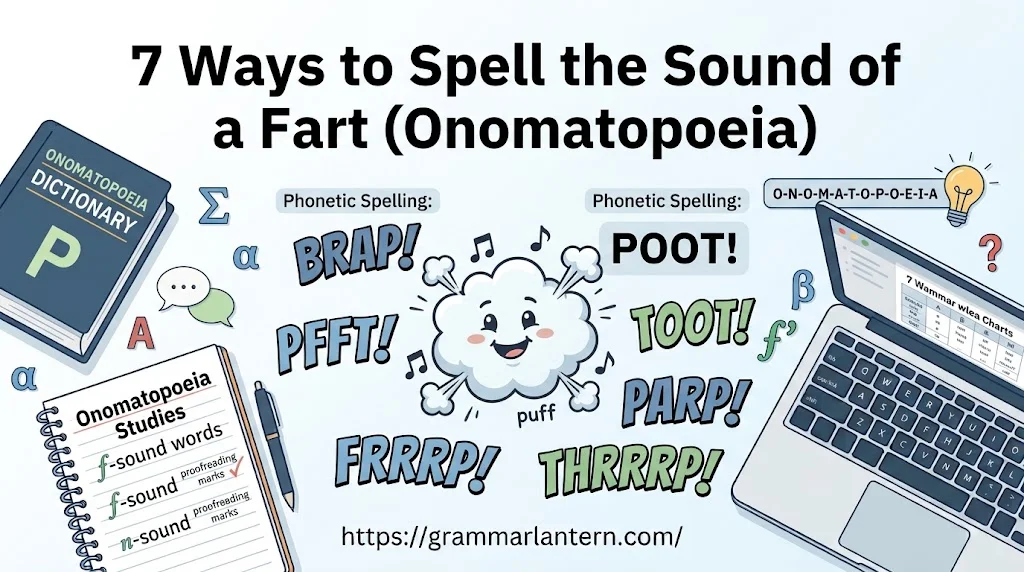
Here are seven useful fart sound spellings:
| Fart sound spelling | What it suggests | Best context |
| Brap | Loud, sudden, explosive | Comics, comedy, fiction |
| Pfft | Short, airy, quiet | Subtle or awkward moments |
| Poot | Soft, gentle, playful | Children’s humor, casual writing |
| Toot | Light and brief | Innocent or euphemistic humor |
| Parp | Blunt and comic | Humorous writing |
| Frrt / Frrrp | Vibrating or fluttering | Comics and exaggerated scenes |
| Thrrrp | Long, rolling, exaggerated | Cartoons and slapstick |
The best spelling depends on what the sound is supposed to feel like. If the noise is loud, brap may fit. If it’s barely noticeable, pfft can work better.
What Is Fart Sound Onomatopoeia?
Onomatopoeia refers to words or expressions that imitate, resemble, or evoke sounds. English contains many familiar examples.
Think about words such as:
- buzz for an insect or electrical sound
- hiss for escaping air
- pop for a sudden small explosion
- clang for metal striking metal
- splash for liquid hitting a surface
- crackle for a series of small sharp sounds
Fart sound effects follow the same basic idea. The writer chooses letters that make the reader imagine a particular noise.
However, a written sound isn’t an audio recording. It can’t reproduce every detail of the original noise. Instead, it gives the reader a visual approximation.
That’s why you may see pfft, pffft, pfffft, or poot used for broadly similar situations. Each spelling creates a slightly different mental picture.
7 Ways to Spell the Sound of a Fart
Different spellings create different impressions. The following seven forms are particularly useful when writing humorous dialogue, comic-book sound effects, fiction, captions, or informal content.
Brap
Brap suggests a loud, abrupt, and fairly forceful sound.
The opening br- gives the word a hard beginning. The ending -ap makes it feel short and punchy. As a result, brap works especially well when the sound is supposed to interrupt a scene.
For example:
BRAP! The room suddenly went silent.
The capitalization isn’t part of the spelling itself. It simply makes the sound effect more visually prominent.
Brap works particularly well in:
- Comics
- Cartoon scripts
- Slapstick humor
- Humorous fiction
- Informal captions
It isn’t the best choice for a barely audible sound. Its shape naturally feels more dramatic.
Pfft or Pffft
Pfft gives the impression of a short burst of air.
The repeated f visually suggests airflow, while the final t gives the sound a quick stopping point. Writers can lengthen the spelling when they want the noise to seem slightly longer.
Compare these forms:
- Pft — very brief
- Pfft — short burst
- Pffft — slightly longer
- Pfffft — exaggerated airflow
These aren’t separate standardized words with precise acoustic meanings. They’re creative spellings.
For example:
He tried to stay completely still. Pffft. Too late.
This spelling can work particularly well when the humor comes from understatement. Instead of announcing a huge noise, the writer lets a tiny sound effect create the joke.
Read More: Constant vs Attentive: Difference With Examples
Poot
Poot has a distinctly playful sound.
Its rounded vowels and soft consonants make it feel less harsh than some alternatives. That’s why poot often appears in lighthearted or child-friendly humor.
For example:
The little dog sat down and let out a tiny poot.
The word can also function as a verb in informal usage:
The character accidentally pooted during the meeting.
Because poot sounds deliberately silly, it can soften the subject. A writer who wants a scene to feel goofy rather than crude may prefer it to the more direct word fart.
Toot
Toot already has an established use for a short horn-like or blowing sound. It can also work as a humorous euphemism for flatulence.
That dual meaning gives toot a somewhat innocent feel.
For example:
A tiny toot escaped, and everyone at the table tried not to laugh.
The sound doesn’t necessarily suggest a realistic acoustic match. Instead, the word creates a light comic effect.
That’s useful when the audience includes children or when the writer wants to avoid stronger language.
A useful distinction is:
Toot usually sounds more innocent, while brap sounds more blunt and forceful.
Parp
Parp is another comic sound effect that can represent a short, blunt noise.
It has a particularly playful quality and can work well in humorous writing where the sound itself is part of the joke.
For example:
PARP! The character froze halfway through the speech.
The spelling feels slightly exaggerated, which makes it suitable for comic scenes.
Parp can also be used for other blunt noises in informal writing. Context therefore matters. If a reader sees the word without any surrounding description, the intended sound may not always be obvious.
Frrt or Frrrp
Frrt and frrrp focus more on vibration than a simple pop or burst.
The repeated r creates a visual suggestion of fluttering or vibrating movement. Adding another r or p can make the sound appear longer or more exaggerated.
For example:
Frrrp! The awkward silence somehow became even worse.
These forms are especially effective in comics and cartoons, where visual exaggeration matters.
The spelling doesn’t need to follow a dictionary-approved pattern. In a comic panel, the reader understands that the unusual letters represent a sound effect.
Thrrrp
Thrrrp is one of the more exaggerated choices.
It visually stretches the sound and suggests a rolling, vibrating noise. That makes it better suited to cartoon humor, slapstick, and deliberately ridiculous scenes than ordinary prose.
For example:
THRRRP! The entire class burst into laughter.
The long cluster of consonants immediately looks unusual. That’s useful because sound effects often need to stand out from ordinary dialogue.
However, this spelling can become distracting if used too often. A good sound effect should enhance the joke rather than compete with the story.
How to Choose the Right Spelling
The easiest way to choose a spelling is to imagine the sound first.
Don’t begin by asking which spelling is “official.” Ask what the reader should hear in their head.
For a Loud Fart
Try:
- Brap
- Frrrp
- Thrrrp
These forms visually carry more weight and exaggeration.
For a Quiet Fart
Try:
- Pfft
- Pffft
- Poot
These spellings work better when the humor depends on subtlety.
For a Playful Fart
Try:
- Poot
- Toot
They create a softer and more innocent tone.
For a Cartoon Fart
Try:
- Frrrp
- Thrrrp
- Brap
Cartoons can support exaggerated spellings because the sound effect becomes part of the visual comedy.
For a Short Comic Sound
Try:
- Pfft
- Parp
- Brap
The choice depends on whether you want the sound to feel airy, blunt, or explosive.
Why Are There So Many Ways to Spell a Fart Sound?
Written language can’t perfectly capture sound.
When you hear a fart, your ears receive information about its duration, loudness, pitch, vibration, rhythm, and intensity. A handful of letters can’t reproduce all those characteristics precisely.
Writers therefore use visual clues.
For example, repeated letters can suggest duration:
- Pft → very brief
- Pfft → slightly fuller
- Pffft → longer
- Pfffft → exaggerated
Likewise, certain consonants can influence the reader’s impression. A hard ending can make a sound seem abrupt. Repeated consonants can suggest vibration or continuation.
This is one reason sound-effect spellings have so much flexibility.
A sound effect doesn’t need to reproduce a noise perfectly. It needs to make the reader imagine the intended noise.
That distinction explains why two writers can spell the same type of sound differently and still communicate effectively.
Is “Fart” Itself an Onomatopoeia?
This question requires a little more care.
Fart is an established English word for the act of passing intestinal gas and the gas itself. It has a long history in English and related Germanic languages.
However, calling the word simply an onomatopoeia can oversimplify its linguistic history.
A deliberate sound effect such as pfft is easier to classify as sound imitation because its form is designed to evoke a particular noise. The word fart, meanwhile, functions as an ordinary lexical item with a broader history and grammatical role.
In practical writing, the distinction matters.
Compare:
He farted during the meeting.
with:
Pfft! Everyone looked around.
The first sentence names an action. The second uses a written sound effect.
Fart vs. Fart Sound Effects
These expressions perform different jobs.
| Expression | Primary function | Tone |
| Fart | Names the bodily action or emission | Direct, informal |
| Brap | Represents a loud sound | Comic |
| Pfft | Represents a short airy burst | Subtle |
| Poot | Represents a soft sound | Playful |
| Toot | Suggests a light sound | Innocent |
| Parp | Represents a blunt comic noise | Humorous |
| Frrt | Suggests vibration | Cartoonish |
| Thrrrp | Suggests a longer rolling sound | Exaggerated |
This distinction becomes especially helpful when writing dialogue.
If the character describes what happened, fart may be appropriate. If the page needs to show the sound, a sound effect such as pfft or brap can do the job.
How to Write Fart Sounds in Dialogue
A sound effect can work inside dialogue or narration, but punctuation and formatting affect how strongly it lands.
Use capitalization for emphasis
BRAP!
Capital letters make the sound visually loud.
Use italics for a softer effect
Pfft.
Italics can make a small sound feel less aggressive on the page.
Use punctuation to control timing
Pfft.
feels different from:
PFFT!
The second version looks louder and more dramatic.
Don’t overdo repeated letters
A spelling such as:
Pfffffffffffffffft
may communicate exaggeration. However, it can quickly become difficult to read.
A cleaner form usually works better:
Pfffft!
The goal is clarity, not a contest to see how many letters can fit into one sound.
Read More: Enable vs Inable: Meaning, Difference, Usage, and Examples
Case Study: How Context Changes the Best Spelling
Imagine three characters sitting quietly in a library.
A tiny sound slips out.
Pfft.
That spelling fits because the comedy comes from the quiet setting.
Now imagine a cartoon character running through a chaotic scene.
BRAP!
The louder visual treatment fits the exaggerated action.
Finally, imagine a children’s story where a character tries to hold back laughter after an embarrassing moment.
Poot!
The softer spelling keeps the scene playful.
The underlying event hasn’t changed much. The storytelling context has.
That’s the key lesson with onomatopoeia: the spelling should match the scene.
Fart Sound Onomatopoeia in Comics and Fiction
Comics give sound effects a special advantage because readers see the words as part of the artwork.
A large BRAP! can occupy an entire corner of a panel. A tiny pfft can appear beside a character’s speech bubble. The size, position, capitalization, and typography can all contribute to the joke.
Fiction works differently.
In prose, sound effects compete with the surrounding sentences. A writer therefore needs to use them more carefully.
For example:
Everyone stopped talking. Then came a tiny pfft from the other side of the couch.
The narration provides context. The sound effect adds the comic beat.
This approach usually works better than repeatedly inserting exaggerated words without explanation.
Fart Sound Effects in Casual Writing and Text Messages
Informal digital communication gives writers considerable freedom.
A text message might say:
PFFFFT 😂
or:
lol that was a poot
Nobody expects these spellings to function like formal vocabulary. Their purpose is to communicate a sound, reaction, or joke quickly.
Social posts, memes, comic captions, and casual conversations often use creative spelling because readers already understand that the form is playful.
Still, context matters. A spelling that works perfectly in a meme could look out of place in a business email or academic paper.
Fart Sounds in Children’s Writing
Writers often choose softer alternatives when the audience includes children.
Poot and toot are useful because they sound silly without feeling especially harsh.
For example:
“Oh no!” Tim shouted as a tiny poot escaped.
The word itself helps establish the tone. It signals that the scene is meant to be funny rather than unpleasant.
For a children’s story, sound effects can also become part of the rhythm. A repeated poot-poot or toot-toot may create a playful pattern.
The important thing is to keep the joke appropriate for the story’s audience.
Are These Fart Sound Spellings Correct English?
Not every sound effect needs a single standardized spelling.
Some forms, such as toot, have established dictionary uses beyond their role as comic fart sounds. Others, such as thrrrp, function mainly as creative sound effects.
That doesn’t automatically make them “wrong.”
Sound-effect writing is flexible because the writer’s goal isn’t always to create a conventional dictionary entry. The goal is to help the reader hear something mentally.
A comic writer can invent a sound effect when the context makes its meaning clear.
This is common across English:
- Zap!
- Whoosh!
- Kaboom!
- Splat!
- Thud!
Sound effects often rely on recognizable patterns rather than rigid spelling rules.
Common Mistakes
Even a silly sound effect can benefit from careful word choice.
Treating one spelling as universally correct
There isn’t one official spelling that works for every imagined fart sound.
Choosing the wrong level of intensity
A giant BRAP! can undermine a scene that calls for a barely audible sound.
Adding too many letters
Extra letters can suggest length, but excessive repetition makes the word harder to read.
Ignoring the audience
A crude sound effect may suit adult comedy but feel inappropriate in a children’s story.
Confusing the action with the sound
Fart names the action or bodily emission. Pfft or brap functions more like a sound effect.
Using sound effects without context
If the reader can’t tell what the strange spelling represents, the joke can fall flat.
Quick Reference: Which Fart Sound Should You Use?
| Situation | Recommended spelling | Why it works |
| Loud and sudden | Brap | Short and forceful |
| Quiet and airy | Pfft | Suggests a small burst |
| Soft and playful | Poot | Has a silly, gentle feel |
| Innocent or euphemistic | Toot | Familiar and lighthearted |
| Blunt and comic | Parp | Strong comic sound |
| Vibrating | Frrt / Frrrp | Repeated letters suggest fluttering |
| Long and exaggerated | Thrrrp | Visually stretches the sound |
| Cartoon scene | Brap / Frrrp / Thrrrp | Strong visual impact |
| Children’s humor | Poot / Toot | Softer tone |
| Subtle comedy | Pfft / Pffft | Less aggressive sound |
FAQs
1. What are some ways to spell the sound of a fart?
Common playful spellings include poot, toot, fart, pfffft, brap, pop, and rumble. The best choice depends on the sound and context.
2. Is “poot” a real English word?
Yes. Poot is an informal word commonly used to represent or describe a fart, especially in humorous or casual writing.
3. What is the onomatopoeia for a fart?
There is no single standard spelling. Words such as poot, toot, brap, and pfffft can imitate different types of fart sounds.
4. Is “toot” used for a fart?
Yes. Toot can describe a short, light sound and is often used in humorous or child-friendly contexts.
5. What does “brap” mean?
Brap is an informal sound effect that can represent a loud or exaggerated fart. It is especially common in humorous writing and online communication.
6. Can I use fart sound words in formal writing?
Generally, these expressions are better suited to creative writing, comedy, dialogue, or informal communication. Formal writing usually avoids unnecessary sound effects.
7. Why are there different spellings for the same sound?
Sound words are flexible because writers use spelling to suggest differences in volume, duration, tone, and character. There is no universal spelling for every sound.
8. Are fart sound effects examples of onomatopoeia?
Yes. When a word imitates or suggests a real sound, it can function as onomatopoeia. Fart-related sound effects are informal examples of this technique.
9. Which spelling is best for creative writing?
The best spelling depends on the scene. A soft sound might be represented by poot, while a louder or more exaggerated sound could use brap or pfffft.
10. Are these spellings considered proper grammar?
They can be used correctly as informal sound effects, but they are not standard grammatical forms. Their suitability depends mainly on the audience, tone, and writing context.
Conclusion
Knowing the 7 Ways To Spell The Sound Of A Fart can make humorous dialogue, fiction, comics, and casual writing more expressive. Since sound words do not have one fixed spelling, writers can choose an expression that best matches the imagined sound, character, and situation.
Whether you use poot, toot, brap, or another playful sound effect, context is important. These words are most effective when used naturally and sparingly. Understanding onomatopoeia, English usage, and creative writing helps you choose sound words that make your writing clearer, more entertaining, and memorable.