
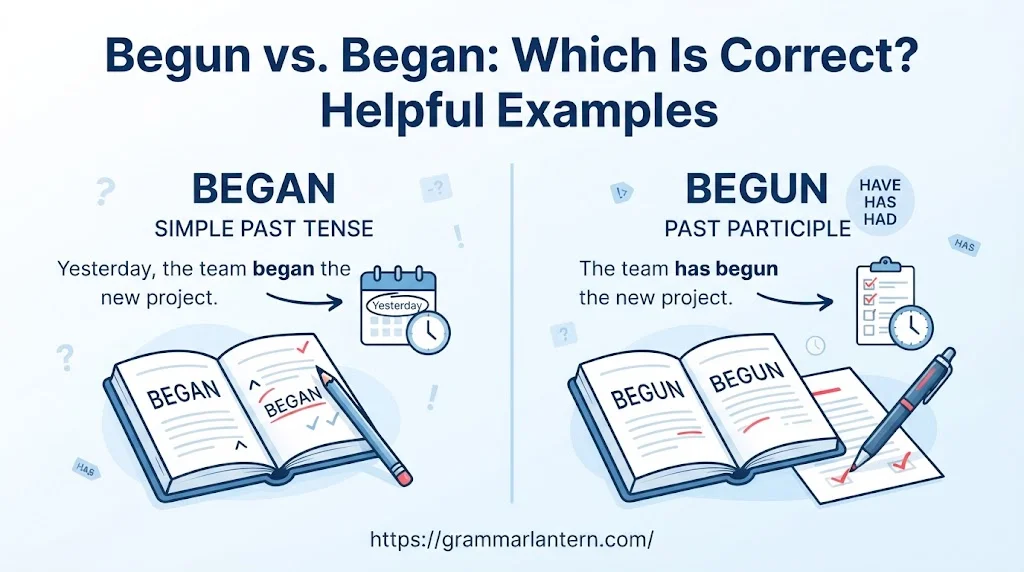
For English learners, Begun vs. Began can seem confusing because begin is an irregular verb that does not follow the usual rules. Began is the simple past tense of begin and describes an action that started at a particular time in the past. Begun is the past participle, so it usually needs a helping verb such as have. Understanding this grammar rule makes correct usage easier.
The subject, context, sentence, and grammatical structure help you choose the correct verb forms. For example, an activity began yesterday, while an activity has begun connects a past starting point with the present. These forms are important when learning tenses, conjugation, and other irregular verbs. With practice, learners can avoid common mistakes and improve their English usage.
English is a widely spoken language used by almost 2 billion people worldwide. Its grammar, pronunciation, spellings, and rules can be challenging, especially for English learners. Learning past, present, and past participle tense forms improves fluency, writing skills, speaking skills, and language proficiency. It also helps learners communicate clearly in everyday, academic, and professional situations.
Quick Answer
Began is the simple past tense of begin.
Begun is the past participle of begin and normally appears with a helping verb such as has, have, or had.
| Word | Verb form | Main use | Example |
| begin | Base form | Present, infinitive, and after certain auxiliaries | We will begin soon. |
| began | Simple past | An action that started in the past | We began yesterday. |
| begun | Past participle | Perfect tenses and some passive structures | We have begun already. |
A useful shortcut is this:
Began stands alone for simple past. Begun usually needs a helping verb.
So:
- I began my homework. ✓
- I have begun my homework. ✓
- I begun my homework. ✗
- I have began my homework. ✗
Once you recognize the verb form, the choice becomes much less mysterious.
The Basic Difference
The verb begin is an irregular verb. That means its past forms don’t follow the regular pattern of simply adding -ed.
Its three principal forms are:
begin → began → begun
These forms correspond to different grammatical functions.
Begin is the base form. You use it in the present tense with appropriate subjects and after many auxiliary or modal verbs.
Began is the simple past form. It tells you that something started at a point in the past.
Begun is the past participle. It normally combines with an auxiliary verb to create a perfect tense.
Consider these examples:
- The class begins at eight.
- The class began at eight.
- The class has begun.
The meaning revolves around starting, but the grammatical structure changes each time.
The Three Forms of Begin
| Form | Example | Why it works |
| begin | I begin work at eight. | Base/present form |
| began | I began work at eight. | Simple past |
| begun | I have begun work. | Past participle |
The most important point is that begun isn’t simply another version of began. You can’t swap them freely.
Think of them as different tools in the same toolbox. They’re related, but each has a specific job.
When to Use Began
Use began when you’re describing an action that started in the past using the simple past tense.
The sentence usually doesn’t need another auxiliary verb before the main verb.
For example:
- The movie began at seven.
- She began her presentation.
- We began the project last Monday.
- The rain began during the night.
- He began learning Spanish in college.
In each sentence, began directly carries the past-tense meaning.
Began With Specific Past Time
Began frequently appears with expressions that clearly place an event in the past.
Common time expressions include:
- yesterday
- last night
- last week
- last year
- two hours ago
- three months ago
- in 2020
- when I was a child
- after lunch
For example:
The conference began yesterday.
She began working there in 2021.
The storm began two hours ago.
These sentences simply tell you that the starting event happened in the past.
Read More: Goodmorning or Good Morning: Which Is Correct?
Began Doesn’t Mean the Action Ended
One subtle point often causes confusion. Using began doesn’t necessarily mean the activity finished.
Consider:
Maria began reading the book yesterday.
The sentence tells you when the reading started. It doesn’t tell you whether Maria finished the book.
Likewise:
The company began developing the software in January.
The development may still be happening. The word began simply identifies the starting point in the past.
That’s an important distinction because began focuses on when something started rather than automatically describing its completion.
When to Use Begun
Use begun as the past participle of begin.
In standard English, it generally appears with an auxiliary verb. The most common combinations are:
- has begun
- have begun
- had begun
- will have begun
For example:
- The show has begun.
- The students have begun their exams.
- The meeting had begun before we arrived.
- By noon, the ceremony will have begun.
Here, begun can’t simply replace began.
You wouldn’t normally say:
The show begun. ✗
You would say:
The show began. ✓
Or:
The show has begun. ✓
Has Begun
Use has begun with a singular third-person subject such as he, she, it, or a singular noun.
Examples:
- The lesson has begun.
- The meeting has begun.
- Winter has begun.
- The new semester has begun.
- The child has begun to walk.
The structure is:
subject + has + begun
This is the present perfect tense.
It connects a past event with the present situation. For example, if someone asks whether a meeting is underway, you might say:
Yes, the meeting has begun.
The starting event happened before now, and its relevance continues into the present.
Have Begun
Use have begun with I, you, we, they, and plural nouns.
Examples:
- We have begun the project.
- They have begun construction.
- I have begun writing the report.
- The workers have begun repairs.
- You have begun to understand the pattern.
The structure is:
subject + have + begun
The key isn’t the meaning of the subject alone. The auxiliary have signals that the following verb needs its past participle form.
Had Begun
Use had begun when one past action started before another past event.
For example:
The movie had begun before we entered the theater.
Two events occurred in the past:
- The movie started.
- We entered the theater.
The movie started first, so had begun establishes that earlier past relationship.
More examples include:
- The meeting had begun before the manager arrived.
- It had begun to snow when we left.
- She had begun cooking before the guests called.
This is the past perfect tense.
In Perfect Tenses
Perfect tenses provide one of the clearest ways to understand began vs. begun.
The perfect construction uses a form of have followed by a past participle.
Since begun is the past participle, it appears after these forms of have.
Present Perfect
The present perfect uses has/have + begun.
Examples:
- The program has begun.
- The students have begun studying.
- We have begun the next phase.
The construction emphasizes a past beginning that has some connection to the present.
Past Perfect
The past perfect uses had + begun.
Examples:
- The game had begun before we arrived.
- She had begun writing before dinner.
- The negotiations had begun months earlier.
This construction establishes sequence between past events.
Future Perfect
The future perfect uses will have + begun.
For example:
By next Monday, the new semester will have begun.
This means the semester’s starting point will already have occurred by that future time.
The pattern is straightforward:
will + have + begun
Notice that began doesn’t fit into these perfect-tense structures.
In Questions
Questions often make the distinction even clearer because auxiliary verbs control the form of the main verb.
Compare:
When did the meeting begin?
Has the meeting begun?
Had the meeting begun before you arrived?
Each question uses a different structure.
Questions With Did
After did, use the base form begin, not began or begun.
Correct:
Did the movie begin at eight?
Incorrect:
Did the movie began at eight?
Incorrect:
Did the movie begun at eight?
Why?
Because did already carries the past-tense meaning. The main verb returns to its base form.
The same rule applies to other verbs:
- Did she go? not Did she went?
- Did he see it? not Did he saw it?
- Did they begin? not Did they began?
Questions With Has or Have
After has or have, use begun.
Correct:
Has the meeting begun?
Correct:
Have the students begun the test?
Incorrect:
Has the meeting began?
Incorrect:
Have the students began the test?
The auxiliary determines the grammatical structure.
In Negative Sentences
Negative sentences follow the same logic.
With did not, use begin:
The meeting did not begin on time.
With has not or have not, use begun:
The meeting has not begun yet.
With had not, use begun:
The meeting had not begun when we arrived.
Compare the structures:
| Sentence | Correct form | Reason |
| The event did not begin. | begin | Did takes the base form |
| The event has not begun. | begun | Has takes the past participle |
| The event had not begun. | begun | Had takes the past participle |
| The event began late. | began | Simple past needs no auxiliary |
This pattern is highly reliable.
Common Mistakes
Certain errors appear again and again because speakers treat began and begun as interchangeable.
“I Have Began”
1.I have began the assignment. ✗
2.I have begun the assignment. ✓
The auxiliary have requires a past participle. Since begun is the past participle, it belongs after have.
“I Begun Yesterday”
1.I begun the assignment yesterday. ✗
2.I began the assignment yesterday. ✓
There is no auxiliary before the verb. The sentence uses simple past, so began is required.
“Did It Begun?”
Did it begun at noon? ✗
Did it begin at noon? ✓
The auxiliary did already expresses the past. Therefore, the main verb stays in its base form.
“It Has Began”
1.It has began. ✗
2.It has begun. ✓
The word has requires the past participle.
“They Had Began”
1.They had began the work. ✗
2.They had begun the work. ✓
The auxiliary had creates the past perfect structure, which requires begun.
Began vs. Begun vs. Begin
Understanding all three forms makes the entire pattern easier.
| Situation | Correct form | Example |
| Base form | begin | We will begin soon. |
| Simple present | begin/begins | They begin at nine. |
| Simple past | began | They began at nine. |
| After did | begin | Did they begin? |
| Present perfect | begun | They have begun. |
| Past perfect | begun | They had begun. |
| Future perfect | begun | They will have begun. |
This table reveals an important principle: the auxiliary verb often determines which form you need.
Begin After Modal Verbs
Modal verbs take the base form begin.
Examples include:
- can begin
- could begin
- may begin
- might begin
- should begin
- must begin
- will begin
- would begin
For example:
The meeting will begin at ten.
Not:
The meeting will began at ten. ✗
And not:
The meeting will begun at ten. ✗
The same pattern applies after can:
We can begin now.
The modal carries the grammatical function, leaving begin in its base form.
Began vs. Begun With “To” and “-ing”
The verb begin can commonly appear before either an infinitive or an -ing form.
Compare:
- She began to cry.
- She began crying.
Both are standard constructions.
You can also use the same patterns with begun:
- She has begun to cry.
- She has begun crying.
The central tense distinction remains unchanged.
Began marks simple past.
Begun appears as a past participle after an appropriate auxiliary.
In many everyday contexts, begin to + verb and begin + -ing have nearly the same meaning.
For example:
The children began to laugh.
The children began laughing.
Neither sentence needs a completely different interpretation. Context determines the finer emphasis.
In Different Contexts
The distinction becomes more practical when you see it across everyday situations.
Education
The class began at 8 a.m.
This tells you when the class started.
The class has begun.
This tells you that the class is now underway.
The class had begun before I reached the room.
This tells you that the class started before another past event.
Read More: Answer To, For, Or Of the Question? Correct Version Explained
Work and Business
1.The company began operations in 2018.
2.The company has begun expanding into new markets.
3.The company had begun negotiations before the announcement.
Each sentence uses a different tense because the time relationship differs.
Events
1.The concert began late.
2.The concert has begun.
3.The concert had begun when we arrived.
Again, the difference isn’t about the basic meaning of “start.” It’s about tense and grammatical structure.
Weather
1.The rain began around midnight.
2.The rain has begun again.
3.The rain had begun before we left.
Weather provides a particularly clear example because the same event can be described from different points in time.
A Practical Case Study: Choosing Began or Begun
Imagine that a manager wants to describe a new training program.
The first sentence says:
The training program began Monday.
This is simple past. The manager is identifying when the program started.
Later, the manager sends an update:
The training program has begun successfully.
Now the focus shifts to the current situation. The program has started and is relevant now.
The next day, the manager describes an earlier event:
The training program had begun before several employees joined the department.
Here, had begun establishes which past event happened first.
The underlying event is similar in all three sentences. The grammatical viewpoint changes.
| Situation | Sentence | Verb form |
| Past starting point | The program began Monday. | Simple past |
| Current relevance | The program has begun. | Present perfect |
| Earlier past event | The program had begun earlier. | Past perfect |
This is why memorizing isolated sentences isn’t enough. Understanding the time relationship makes the choice much easier.
Helpful Facts About Begin, Began, and Begun
- Begin is an irregular verb.
- Began is its simple past form.
- Begun is its past participle.
- Began can function as the main verb in a simple-past sentence.
- Begun commonly follows has, have, or had.
- Did is followed by begin, not began or begun.
- Modal verbs such as will, can, should, and might take begin.
- Began doesn’t necessarily mean the activity ended.
- Begun doesn’t independently mark simple past.
- Begin to and begin + -ing are both common constructions.
How to Remember
A simple memory trick can save you from most mistakes.
Think of began as the straightforward past form:
Yesterday → began
Think of begun as the form that usually needs a helper:
has/have/had → begun
For example:
- Yesterday, I began.
- I have begun.
- She began earlier.
- She had begun earlier.
Another useful test is to look at the word immediately before the verb.
1.If you see did, choose begin.
2.If you see has, have, or had, choose begun.
3.If there is no auxiliary and you’re describing a completed starting event in the past, began will often be correct.
The Three-Question Test
When you’re unsure, ask:
Is this simple past?
Use began.
Is there has, have, or had?
Use begun.
Is there did, will, can, should, or another auxiliary that requires the base form?
Use begin.
This quick check works like a grammatical traffic signal. It tells you which form belongs in the sentence before you commit to the word.
In Everyday Writing
Small verb errors can make otherwise clear writing look unfinished. The distinction matters in emails, assignments, reports, workplace messages, and formal documents.
Consider this sentence:
The project has began.
The reader can understand the meaning, but the verb combination is grammatically incorrect.
The corrected version is:
The project has begun.
Now compare:
The project began last month.
Both sentences are correct because they use different grammatical structures.
The first uses the present perfect.
The second uses the simple past.
That difference is more important than the fact that both sentences describe the same project.
More Helpful Examples
Here are practical examples that show the distinction in different sentence patterns.
Simple Past With Began
- The meeting began at noon.
- She began her presentation confidently.
- We began our journey before sunrise.
- The discussion began after lunch.
- He began studying for the exam last week.
- The machine began making a strange noise.
Perfect Tenses With Begun
- The meeting has begun.
- They have begun work on the new building.
- She has begun learning French.
- The discussion had begun before we arrived.
- The workers had begun repairs earlier.
- By Friday, the project will have begun.
Questions
- When did the meeting begin?
- Has the meeting begun?
- Have the workers begun repairs?
- Had the event begun when you arrived?
Negative Sentences
- The meeting did not begin on time.
- The meeting has not begun yet.
- The meeting had not begun when we arrived.
Notice how the auxiliary determines the form. That’s the grammatical engine behind the entire begun vs. began distinction.
Quick Comparison
| Feature | Began | Begun |
| Base verb | Begin | Begin |
| Verb type | Simple past | Past participle |
| Used alone as simple past? | Yes | No, not normally |
| Works after has/have? | No | Yes |
| Works after had? | No | Yes |
| Works after did? | No | No |
| Example | She began yesterday. | She has begun already. |
The easiest rule to carry into your writing is this:
Began = simple past
Begun = past participle
Begin = base form
Once those three roles become familiar, the spelling difference stops feeling like a trap.
FAQs
1. What is the difference between begun and began?
Began is the simple past form of begin, while begun is the past participle. For example, “The class began at nine” is correct, while “The class has begun” uses the past participle.
2. Is began the past tense of begin?
Yes. Began is the simple past tense of begin. You use it when describing something that started in the past.
3. Is begun a past tense word?
Begun is not the simple past tense. It is the past participle of begin and normally appears with a helping verb such as has, have, or had.
4. Can I say “I have began”?
No. The correct form is “I have begun.” The helping verb have requires the past participle begun.
5. Can I say “I began the work yesterday”?
Yes. Began is correct because the sentence describes a completed starting action at a specific time in the past.
6. Can I use begun without a helping verb?
Usually, no. Begun normally needs an auxiliary or helping verb, such as has begun, have begun, or had begun.
7. What is the verb form of begin, began, and begun?
The three main forms are begin for the base form, began for the simple past, and begun for the past participle.
8. Which is correct: “The meeting began” or “The meeting begun”?
“The meeting began” is correct when using the simple past. “The meeting has begun” is correct when using the present perfect.
9. Why are began and begun confusing?
They look and sound related because they come from the same irregular verb. The main difference is their grammatical role and the tense structure in which they appear.
10. How can I remember begun vs. began?
A useful trick is to remember that began can stand alone as a simple past verb, while begun usually needs a helping verb. Reading and practicing examples can make the difference automatic.
Conclusion
Understanding begun vs. began becomes much easier once you remember their grammatical roles. Began is the simple past form, while begun is the past participle and normally works with a helping verb. Keeping this basic difference in mind can prevent many common grammar mistakes.
With regular practice, you can recognize the correct form naturally while writing and speaking. Pay attention to the helping verb, the time of the action, and the overall sentence structure. These small details will help you use begin, began, and begun with greater confidence.

Muhammad Haroon is the voice behind many of the clear, practical grammar guides you’ll find on Grammar Lantern. With a strong background in content writing and a genuine love for the English language, Haroon specializes in breaking down intimidating grammar topics into simple, digestible lessons. His goal is simple: to empower readers to write with confidence and clarity. Whether he’s explaining tricky tenses or demystifying punctuation, Haroon approaches each topic with patience, precision, and a touch of warmth—because he knows that learning grammar is a journey, not a race.