Have you ever heard a window shatter or a glass fall to the floor and wondered how to describe the sound accurately? Learning 5 Words For The Sound Of Glass Breaking can make your creative writing more vivid, precise, and engaging. The right word helps readers imagine the sudden noise and understand exactly what happened.
English provides several expressive words for describing breaking glass, and each one has a slightly different meaning. Some words suggest a loud crash, while others describe a sharp crack, light tinkle, or the sound of glass shattering into pieces. Understanding these differences can improve English usage, grammar, storytelling, and formal writing.
Choosing the correct expression also helps maintain clarity and consistency in different types of communication. Whether you are writing a story, preparing business communication, creating broadcasting content, or describing an event, precise vocabulary makes your message easier to understand. By learning these five words, you can confidently describe the sound of breaking glass in the right context.
Quick Answer
The five useful words for the sound of glass breaking are:
| Word | What It Suggests | Best Used For |
| Crack | A sharp, sudden fracture | Glass developing a break or splitting |
| Smash | A forceful, noisy break | Glass breaking violently |
| Crash | A loud, chaotic impact | Large or dramatic glass breakage |
| Shatter | Breaking into many small pieces | Glass completely breaking apart |
| Tinkle | A light, ringing sound | Small pieces or fragments hitting surfaces |
If the glass breaks violently, smash usually works well. If you want to emphasize the glass breaking into many pieces, shatter is stronger. For a sharp initial fracture, choose crack. When broken pieces create a light ringing noise, tinkle can fit.
Crash works particularly well when the glass break happens as part of a larger, noisy impact.
What Is the Sound of Glass Breaking Called?
There isn’t one universal English word for the sound of breaking glass.
English uses several sound words and descriptive verbs because glass can break in different ways. A thin glass pane may crack before it gives way. A bottle dropped onto concrete may smash instantly. A large window hit by an object may crash loudly as it falls.
This distinction matters because the physical event and the sound aren’t always identical.
For example, shatter primarily describes glass breaking into many pieces. Tinkle, on the other hand, focuses much more strongly on the light ringing sound made by small pieces.
That’s why context matters.
Think of the five words as five different microphones recording the same event. Each microphone emphasizes something different.
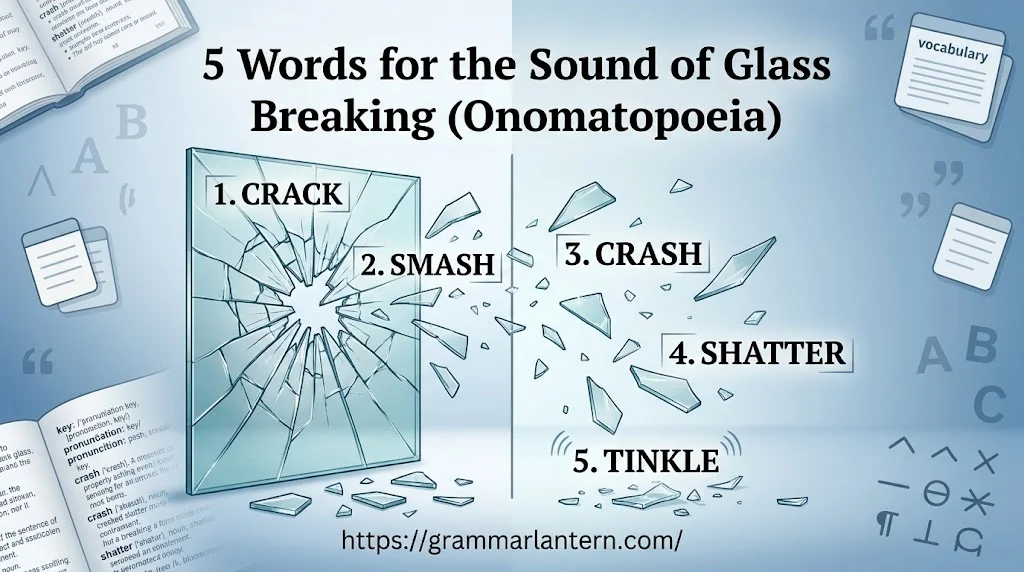
5 Words for the Sound of Glass Breaking
Crack
Crack is one of the best choices when glass develops a sharp fracture or produces a sudden, short sound.
Imagine a baseball hitting a window. You might hear a sharp crack before the glass finally gives way. The word creates an immediate impression of something splitting under pressure.
As a verb, crack can describe the physical damage:
The stone hit the window and cracked the glass.
As a noun, it can describe the sound:
A sharp crack came from the window.
The word is especially useful when the glass doesn’t immediately turn into hundreds of fragments.
A crack can also represent the beginning of the break rather than the entire event. That’s an important distinction.
Consider these two sentences:
Crack! A tiny fracture appeared across the windshield.
Crash! The entire window collapsed onto the floor.
The first sentence focuses on the initial fracture. The second creates a much bigger sense of destruction.
Best use of “crack”:
- A window developing a fracture
- Glass splitting under pressure
- A sudden sharp break
- The initial stage of glass damage
- A short, startling sound
Smash
If you want a word that feels forceful, smash is hard to beat.
Smash describes breaking something noisily and often violently. It works especially well when an object hits a hard surface or when someone deliberately breaks glass.
For example:
The bottle hit the concrete with a loud smash.
Or:
The thief smashed the window with a brick.
Unlike crack, which can describe a relatively small fracture, smash suggests considerable force.
It also commonly implies that the object breaks into pieces. That’s why it works naturally with glasses, bottles, mirrors, windows, and dishes.
The word carries a strong sense of physical energy.
Imagine someone dropping a delicate wineglass onto a carpet. It might not smash at all. Now imagine throwing that same glass against a tile floor. Smash suddenly feels much more appropriate.
Best use of “smash”:
- Violent glass breakage
- A glass hitting a hard surface
- A window being deliberately broken
- Bottles breaking forcefully
- Dramatic scenes in fiction
As a noun, smash can directly refer to the sound:
We heard a sudden smash from the kitchen.
That makes it especially useful when describing what someone hears rather than what they see.
Read More: Words for When Someone Accuses You of What They Are Guilty Of
Crash
Crash describes a loud and often chaotic sound produced by an impact, collision, fall, or breakage.
It isn’t exclusive to glass. That’s actually one of its strengths.
A car can crash. Plates can crash onto the floor. Furniture can crash down a staircase. A large window can crash inward.
When glass breaks as part of a larger noisy event, crash often sounds more natural than a narrower word.
For example:
The window fell from its frame with a tremendous crash.
Here, the focus isn’t simply on the glass fragmenting. The sentence emphasizes the large, noisy event.
Compare it with:
The window cracked.
This sounds quieter and more controlled.
Now compare:
The window shattered.
This emphasizes the glass breaking into pieces.
Finally:
The window crashed to the floor.
This emphasizes the loud impact and movement.
The differences are subtle, but they change the mental picture.
Best use of “crash”:
- Large windows breaking
- Glass falling from a height
- Glass breaking during a collision
- Loud and chaotic breakage
- A mixture of impact and fragmentation
Shatter
Shatter is probably the clearest word when the important detail is that glass breaks into many pieces.
When a window shatters, readers immediately picture fragments spreading across the area.
For example:
The ball hit the window and shattered it.
Or:
The mirror fell and shattered across the bathroom floor.
The key idea is fragmentation.
That’s what separates shatter from crack. A crack may leave the glass largely intact. Shattering suggests that the object has broken apart extensively.
It also differs from smash. Smash emphasizes forceful breakage, while shatter emphasizes the resulting condition.
Consider this simple comparison:
| Word | Main Focus |
| Crack | Fracture |
| Smash | Force |
| Crash | Loud impact |
| Shatter | Pieces |
| Tinkle | Light ringing |
A writer can even combine these ideas:
The brick struck the window with a crash, and the glass shattered across the floor.
That’s much more descriptive than simply saying:
The window broke.
The first version tells the reader what happened, how it sounded, and what happened afterward.
Tinkle
Tinkle is the quietest and most delicate word on this list.
It describes a light, high-pitched ringing sound. When used with broken glass, it often refers to small fragments touching each other or hitting a hard surface.
For example:
Tiny pieces of glass tinkled across the floor.
Or:
The last fragments fell with a faint tinkle.
Notice how different that feels from smash.
A smash sounds violent. A tinkle sounds light.
That makes tinkle particularly useful for describing the aftermath of broken glass rather than the initial impact.
Imagine a large mirror falling from a wall. The first sound might be a heavy crash. The glass then shatters. A moment later, small pieces may tinkle across the floor.
One event can therefore contain several different sounds.
Best use of “tinkle”:
- Small glass fragments
- Pieces settling on the floor
- Light ringing sounds
- Delicate glass objects
- The aftermath of a larger break
Crack vs. Smash vs. Crash vs. Shatter vs. Tinkle
These words overlap, but they aren’t interchangeable.
| Word | Meaning | Intensity | Main Focus | Example |
| Crack | To split or fracture | Medium | Initial break | The window gave a sharp crack. |
| Smash | To break violently | High | Force | The bottle smashed against the wall. |
| Crash | To make a loud impact | High | Noise and impact | The window crashed onto the floor. |
| Shatter | To break into many pieces | High | Fragmentation | The mirror shattered into fragments. |
| Tinkle | To make a light ringing sound | Low | Small sounds | The shards tinkled across the tiles. |
The easiest way to remember them is to ask one question:
What part of the event do you want the reader to notice?
1.If it’s the fracture, use crack.
2. If it’s the force, use smash.
3.If it’s the loud impact, use crash.
4.If it’s the fragments, use shatter.
5.If it’s the delicate ringing afterward, use tinkle.
How to Write the Sound of Glass Breaking
Writing a sound effect isn’t simply about choosing a dictionary word. Context, punctuation, rhythm, and surrounding description all influence how readers experience it.
A short sentence can make a sound feel sudden:
Crack!
A stronger scene might use a complete sentence:
The stone struck the window with a sharp crack.
For an explosive moment:
Smash! The bottle hit the concrete and burst apart.
For a large noisy event:
The window crashed onto the pavement below.
For fragmentation:
The mirror shattered across the floor.
For the aftermath:
The tiny fragments tinkled beneath her shoes.
Each version creates a different rhythm.
Use Short Sentences for Sudden Sounds
Short sentences often work well in dramatic scenes because they imitate the speed of the event.
A stone flew through the air.
Crash!
Glass scattered across the floor.
The sudden standalone sound interrupts the rhythm. That interruption can make the moment feel immediate.
Combine Sound Words With Physical Details
A sound word becomes much stronger when the reader can visualize what caused it.
Instead of:
Smash!
Try:
Smash! The bottle struck the concrete and exploded into glittering fragments.
The sound comes first. The physical description follows.
This combination gives readers both audio and visual information.
A Glass-Breaking Sound Sequence
One of the most effective ways to describe breaking glass is to divide the event into stages.
Think about what happens from the first impact to the final fragment.
Impact → fracture → breakage → fragmentation → aftermath
For example:
The brick struck the window with a heavy crash.
A sharp crack raced across the glass.
The entire pane shattered.
Tiny fragments tinkled across the floor.
Notice that no single word has to describe everything.
That’s often the secret to strong descriptive writing.
Instead of searching for one “perfect” word, choose several words that accurately represent different moments.
Is “Shatter” Really an Onomatopoeia?
This question deserves careful attention because onomatopoeia has a specific meaning.
An onomatopoeic word imitates or strongly evokes a sound associated with the thing it describes. Common English examples include words such as buzz, hiss, bang, and pop.
The five glass-related words don’t all function as pure sound imitations in exactly the same way.
Crack, crash, and tinkle have strong sound-related uses. Their forms can evoke the noises they describe.
Smash can also function as a sound effect, particularly when written dramatically:
Smash!
However, shatter primarily describes the action or result of something breaking into pieces. It doesn’t always function as a direct imitation of the sound.
That distinction doesn’t make the word useless.
Quite the opposite.
Writers frequently use verbs such as shatter to create a strong sense of sound and movement even when the word’s primary dictionary function describes the physical result.
So, if the question is “What are five useful words for the sound of breaking glass?” all five work in descriptive writing. If the question is “Which five are strict examples of onomatopoeia?” the answer requires more care.
Read More: Enable vs Inable: Meaning, Difference, Usage, and Examples
Common Mistakes
Using “Tinkle” for Violent Breakage
Calling a huge window explosion a tinkle can make the scene sound strangely gentle.
The entire storefront window exploded with a delicate tinkle.
The sentence creates conflicting images.
A better choice would usually be crash, smash, or shatter, depending on what the writer wants to emphasize.
Using “Crack” for Complete Destruction
Crack works well for a fracture, but it doesn’t necessarily communicate complete fragmentation.
Compare:
The windshield cracked.
with:
The windshield shattered.
The first sentence suggests damage or splitting. The second suggests extensive breakage.
Using “Crash” for Every Glass Sound
Crash is useful, but it’s broad.
A tiny glass ornament falling onto a rug probably doesn’t need the word crash.
Likewise, tiny fragments settling across a countertop may be better described as tinkling.
Strong writing depends on proportion.
Treating All Five Words as Exact Synonyms
They aren’t.
Although all five can appear in descriptions of broken glass, their meanings point in different directions.
Replacing tinkle with smash can completely change the mood. Replacing crack with shatter can change the scale of the event.
Choose the word based on the image you want to create.
Confusing “Tinkle” With “Clink”
Clink and tinkle are related but not identical.
Clink commonly suggests a short, light contact between hard objects, especially glass objects touching one another.
For example:
The glasses clinked as everyone raised a toast.
Tinkle can suggest a lighter, more ringing series of sounds.
For broken glass, either word may work in the right context, but tinkle is more useful when you want to emphasize the ringing sound of small fragments.
Examples in Different Situations
A Drinking Glass Falls on Tile
The glass slipped from her hand and smash! It broke across the kitchen floor.
Here, smash highlights the sudden breakage.
A Window Develops a Fracture
A stone struck the pane with a sharp crack, leaving a web of fractures across the glass.
Here, crack captures the initial damage.
A Large Window Falls
The old window dropped from its frame with a tremendous crash.
The focus is on the loud impact.
A Mirror Breaks Into Pieces
The mirror slipped from the wall and shattered across the floor.
The important detail is the many pieces.
Small Fragments Remain on the Floor
As the room grew quiet, the remaining shards tinkled beneath the sweeping brush.
Here, tinkle describes the delicate sound of small fragments.
Case Study: Describing One Glass-Breaking Event Five Ways
Consider the same basic event: a ball hits a window.
The wording changes the reader’s perception.
Version using “crack”:
The ball struck the window with a sharp crack.
The sentence emphasizes the sudden fracture.
Version using “smash”:
The ball smashed through the window.
This version emphasizes forceful destruction.
Version using “crash”:
The window came down with a loud crash.
The focus shifts toward the noise and impact.
Version using “shatter”:
The ball hit the window, causing the glass to shatter.
This version emphasizes fragmentation.
Version using “tinkle”:
Broken pieces tinkled across the floor after the window fell.
Now the scene feels quieter. The major impact has already happened.
This example shows why choosing the right word isn’t simply a vocabulary exercise. The word controls the camera angle of the sentence.
Best Words for Different Levels of Glass-Breaking Intensity
| Situation | Recommended Word | Why |
| A small fracture appears | Crack | Focuses on splitting |
| A glass object breaks violently | Smash | Conveys force |
| A large pane falls noisily | Crash | Highlights impact |
| Glass breaks into many fragments | Shatter | Highlights fragmentation |
| Small pieces make a light ringing noise | Tinkle | Creates a delicate sound |
This isn’t a rigid rulebook. English gives writers room to choose based on context.
Still, this table provides a reliable starting point.
How to Choose the Right Glass-Breaking Word
When you’re unsure which word to use, identify the strongest feature of the scene.
Ask yourself:
- Did the glass simply fracture? Use crack.
- Did something hit it with great force? Use smash.
- Was there a loud impact or collision? Use crash.
- Did the glass break into many pieces? Use shatter.
- Are small fragments making a delicate ringing sound? Use tinkle.
This simple approach prevents your description from becoming vague.
For example, if you’re writing a mystery scene, crash may immediately alert the reader to a sudden disturbance. If you’re writing a quiet literary scene after an accident, tinkle may better capture the small sounds that remain after the main impact.
FAQs
1. What is the best word for the sound of glass breaking?
Crash is a common word for a loud, sudden sound caused by breaking or falling glass. However, the best choice depends on the situation and the intensity of the sound.
2. What word describes a small glass breaking sound?
Tinkle can describe a light, delicate sound, especially when small pieces of glass strike each other or fall onto a hard surface.
3. Is “shatter” a sound word?
Shatter primarily describes the action of glass breaking into many small pieces. It can also be used in descriptions such as “the glass shattered loudly,” but it is not strictly an onomatopoeic sound word.
4. What word describes the sharp sound of breaking glass?
Crack can describe a short, sharp sound associated with glass breaking. It works particularly well when the breaking happens suddenly.
5. Can “smash” describe the sound of glass breaking?
Yes. Smash can describe both the action and the resulting loud noise. It is especially useful when glass breaks forcefully after being hit or dropped.
6. What is an onomatopoeic word for breaking glass?
Words such as crash, crack, and tinkle can be used to imitate or suggest the sounds associated with breaking glass.
7. Which word is best for a loud glass-breaking sound?
Crash or smash usually works best when the sound is loud and dramatic. The choice depends on whether you want to emphasize the noise or the force of the impact.
8. How can I describe breaking glass in creative writing?
You can combine a sound word with descriptive details. For example, “The window crashed onto the floor, scattering glass across the room” creates a clearer mental image.
9. Is “tinkle” suitable for a large window breaking?
Usually, tinkle suggests a lighter and more delicate sound. For a large window breaking loudly, crash, smash, or shatter may be more appropriate.
10. Why is choosing the right glass-breaking word important?
Choosing the right word gives readers a better sense of the volume, intensity, and nature of the sound. It also makes your writing more accurate, natural, and engaging.
Conclusion
Knowing the 5 Words For The Sound Of Glass Breaking can make your writing more descriptive and expressive. Words such as crash, crack, tinkle, smash, and shatter each create a slightly different impression, so choosing one depends on the situation and the type of sound you want to communicate.
Whether you are writing a story, explaining an event, or improving your English vocabulary, using precise sound words can help readers clearly imagine what is happening. With the right word choice, even a simple description of breaking glass can become more vivid and effective.

Muhammad Haroon is the voice behind many of the clear, practical grammar guides you’ll find on Grammar Lantern. With a strong background in content writing and a genuine love for the English language, Haroon specializes in breaking down intimidating grammar topics into simple, digestible lessons. His goal is simple: to empower readers to write with confidence and clarity. Whether he’s explaining tricky tenses or demystifying punctuation, Haroon approaches each topic with patience, precision, and a touch of warmth—because he knows that learning grammar is a journey, not a race.