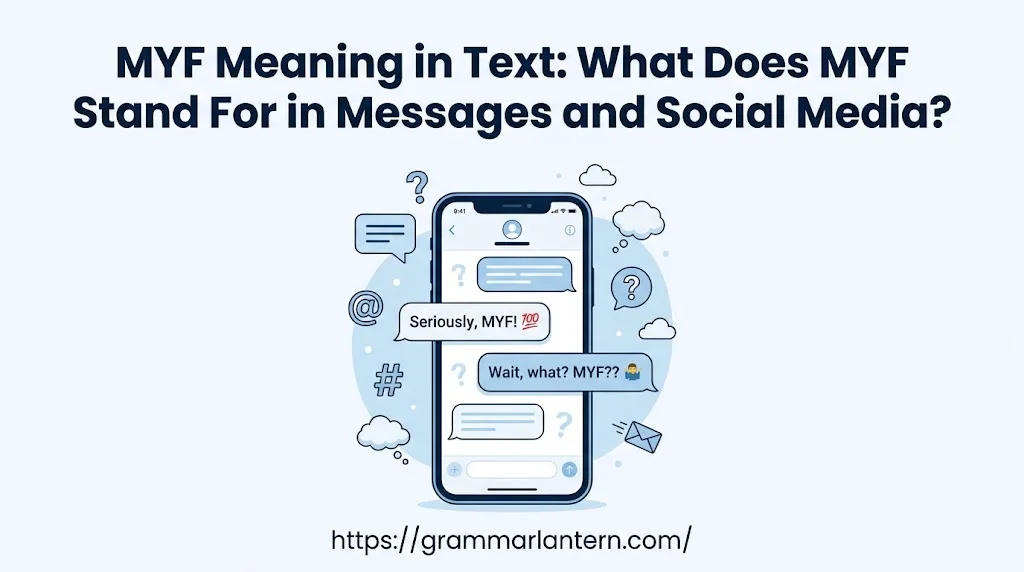
If you’ve seen MYF in a text message, social media comment, or online chat, you might wonder what those three letters mean. Unlike familiar abbreviations such as LOL, BRB, and IDK, MYF meaning in text can change depending on the conversation. Two common interpretations are “My Fault,” which acknowledges a mistake, and “Miss Your Face,” an affectionate way to tell someone you miss seeing them.
The tricky part is figuring out which meaning the sender intends. If a friend uses MYF after forgetting something, they may be admitting their mistake. However, if someone sends it during a sweet conversation, they might be expressing affection. The context of the message, your relationship with the sender, and the surrounding words can all help you understand the abbreviation.
In this guide, you’ll discover the common MYF meanings, how people use this text abbreviation on platforms like Instagram, Snapchat, and TikTok, and how to interpret it in different situations. You’ll also find practical examples and suitable replies to help you understand internet slang and communicate more confidently online.
Quick Answer
MYF does not have one universally established meaning in everyday texting. Its intended meaning depends on the context in which someone uses it. It may be personal shorthand, an abbreviation specific to an online community, or an acronym whose meaning the sender expects you to understand.
For example, imagine receiving this message from a friend:
“Can you explain what MYF means here?”
In this case, the sender is asking about the abbreviation itself. However, if someone simply sends “MYF” in a private message, you may not have enough information to interpret it correctly.
Here are the main points to remember:
- Context matters: Read the entire message instead of interpreting three letters in isolation.
- The platform isn’t enough: Seeing MYF on Snapchat, Instagram, TikTok, or WhatsApp doesn’t automatically establish its meaning.
- Personal shorthand is possible: Friends and online groups sometimes use abbreviations that outsiders don’t recognize.
- Asking is perfectly fine: A quick question can prevent a misunderstanding.
If you’re unsure what someone means by MYF, don’t assume it has a particular slang meaning without supporting context.
What Does MYF Stand For in Text Messages?
When someone asks what MYF stands for, the first thing to understand is the difference between a recognized acronym and an abbreviation used within a particular group.
An acronym or initialism uses the first letters of a longer expression. People may use these shortened forms to save time, avoid repeating familiar phrases, or communicate with others who share the same vocabulary.
However, not every three-letter combination has a standard definition in texting. Some abbreviations have widely understood meanings, while others depend on the person who uses them.
For instance, LOL commonly means “laughing out loud,” and BRB commonly means “be right back.” Readers often recognize these abbreviations without needing much explanation.
MYF is different because its intended expansion may not be clear from the letters alone. Without additional information, assigning it one definite meaning could mislead the reader.
Consider these possibilities:
- A friend might use MYF as personal shorthand.
- A group might use it as an abbreviation for a phrase familiar to its members.
- Someone might use MYF in a specialized setting where the letters have a specific meaning.
- A sender might have made a typo or used an abbreviation unfamiliar to the recipient.
These possibilities aren’t interchangeable. The goal is to identify the meaning that fits the actual conversation rather than inventing an expansion that merely sounds plausible.
How Is MYF Used in Texting and Online Chats?
MYF can appear in a private message, a social media comment, or a conversation within an online community. However, its presence in any of these places doesn’t establish a single standard interpretation.
Understanding the way people communicate online can help you investigate an unfamiliar abbreviation without jumping to conclusions.
MYF in Casual Conversations
Casual conversations often include shortened words, missing punctuation, emojis, and expressions that make sense only to the people involved.
Imagine two friends discussing an unfamiliar abbreviation:
Alex: Someone just sent me “MYF.” Do you know what it means?
Jordan: Not without seeing the rest of the message. What were you talking about?
Jordan’s response makes sense because the conversation’s subject may help explain the letters.
If MYF appears in a longer sentence, pay attention to the words around it. A question, a request, or a reference to an earlier message may provide clues about what the sender intended.
On the other hand, a message containing only MYF offers very little information. In that situation, asking for clarification is more reliable than guessing.
MYF in Social Media Messages
Social media creates a mix of communication styles. A public comment might use popular slang, an inside joke, or terminology familiar only to a small group.
For example, someone might encounter MYF under a video and assume it represents a trending expression. Yet the commenter could be using a private abbreviation or referring to something discussed earlier.
Before interpreting MYF in a comment, consider these questions:
- What is the post about?
- Does the comment include other words that clarify the abbreviation?
- Are other people using MYF in the same discussion?
- Does the commenter appear to be responding to someone else’s message?
- Could the letters refer to a person, organization, or subject rather than slang?
These clues can narrow down the possibilities. Still, a few similar comments don’t necessarily prove that everyone uses the abbreviation the same way.
MYF Between Friends
Friends often develop their own shorthand over time. They may shorten a recurring joke, create nicknames, or reuse a phrase until its meaning becomes obvious to everyone in the group.
Suppose two friends regularly discuss a shared activity. One sends MYF, expecting the other person to recognize the reference. A third person reading the message might have no idea what those letters mean.
That doesn’t automatically make MYF a widely recognized slang term. It may simply reflect the friends’ shared history.
The important distinction is between a meaning that two people understand and a meaning that the wider texting community recognizes.
MYF Meaning on Different Platforms
People often search for the meaning of an abbreviation alongside a specific social media platform. They might want to know what MYF means on Snapchat, Instagram, TikTok, or WhatsApp.
That distinction is understandable, but the platform alone cannot tell you what the sender intended.
What Does MYF Mean on Snapchat?
Snapchat conversations often include short messages, emojis, reactions, and references to previous snaps. Some messages make sense only when you know what happened earlier in the conversation.
If someone sends MYF on Snapchat, check the surrounding messages before interpreting it.
For example, if the letters appear after a discussion about a particular subject, that subject may help you understand the sender’s intention. If the message contains nothing else, you may need to ask.
There is no reason to assume that MYF has a special Snapchat-specific definition simply because it appears in the app.
What Does MYF Mean on Instagram?
On Instagram, MYF might appear in a direct message, comment, caption, or reply to a story.
Each setting offers a different amount of context. A direct message may refer to an earlier private conversation, while a public comment might respond to something in a post.
To interpret MYF on Instagram, examine the surrounding words and the discussion’s subject. If the abbreviation appears in a conversation between friends, their shared knowledge may also matter.
Avoid treating an unexplained abbreviation as an official Instagram term unless its meaning is clearly established.
Read More: Snowball Kisses Meaning: What Does It Mean in Slang?
What Does MYF Mean on TikTok?
TikTok comments can contain niche expressions, references to popular videos, and abbreviations used by particular communities.
An abbreviation may appear repeatedly within one comment section because viewers understand the same reference. However, repetition within a small group doesn’t necessarily establish a universal meaning.
If you encounter MYF on TikTok, read the original post and several relevant comments. Look for a consistent explanation rather than relying on a single person’s guess.
If the discussion still doesn’t clarify the letters, it’s reasonable to leave the meaning unresolved until more information becomes available.
What Does MYF Mean on WhatsApp and Other Messaging Apps?
Private messaging apps often contain informal language that reflects personal relationships.
On WhatsApp, for example, a group of friends might use abbreviations that they created themselves. Another group might use the same letters differently or never use them at all.
The best way to interpret MYF in a private chat is to consider the sender’s previous messages and the current topic.
If neither provides a clear answer, ask a straightforward question. You don’t need to memorize every abbreviation to communicate effectively.
Examples in Text Conversations
Examples are useful for learning how context affects meaning. However, they should not turn an uncertain abbreviation into a supposedly established definition.
The following conversations demonstrate how to handle MYF when its intended meaning is unclear.
Example: MYF Appears Without Context
Sam: MYF
Taylor: What do you mean by MYF?
Sam: I meant the abbreviation we were discussing earlier.
Explanation: Taylor doesn’t have enough information to interpret the message independently. Asking for clarification helps Sam explain the intended reference.
Example: MYF Appears During a Discussion
Riley: I saw MYF in the comments under that video.
Casey: What were the comments about?
Riley: A discussion about an unfamiliar phrase.
Explanation: Casey asks about the subject rather than guessing what the letters stand for. That question may help identify a relevant interpretation.
Example: MYF Appears in a Group Chat
Morgan: Does anyone know what MYF means?
Jamie: Not sure. Where did you see it?
Morgan: In a message from someone I don’t know.
Explanation: Jamie recognizes that the sender’s original context may be more useful than a random expansion found elsewhere.
Example: MYF Appears in a Professional Message
Employee: I received a message containing MYF, but I don’t understand the abbreviation.
Colleague: Ask the sender to clarify before acting on it.
Explanation: When a message relates to work, instructions, or deadlines, confirming the meaning is safer than relying on an uncertain interpretation.
These examples highlight one practical rule: the presence of an abbreviation doesn’t guarantee that its meaning is obvious or universally shared.
How to Understand MYF From Context
If you want to work out the MYF meaning in text, use a simple process. Start with the message itself, consider the sender’s likely reference, and ask for clarification when necessary.
Read the Entire Message
The surrounding sentence often contains more useful information than the abbreviation itself.
For example, MYF in a longer message may appear alongside a question, a subject, or a reference to something previously discussed. Those details can help you determine what the sender is talking about.
Read the complete conversation if possible. A message that appears confusing on its own might become understandable when you see the earlier exchange.
However, context should guide your interpretation rather than force a particular answer. If the message remains ambiguous, don’t pretend the meaning is certain.
Consider Who Sent the Message
The sender’s communication habits can offer useful clues.
A close friend might regularly use personal abbreviations. A colleague may use terminology associated with a particular industry. Someone commenting on a specialized online community may assume readers understand its vocabulary.
Ask yourself whether the sender has used MYF before and whether the current conversation provides a likely explanation.
Even then, familiarity isn’t proof. People make mistakes, change their wording, and use unfamiliar shorthand.
Check the Topic of the Conversation
The subject can help narrow down possible interpretations.
If the conversation concerns a specific activity, organization, or technical topic, the letters may relate to that subject. In a casual chat, they might instead represent informal shorthand.
Don’t choose an expansion simply because it fits the topic loosely. Look for additional evidence in the sentence or surrounding messages.
Ask the Sender Directly
Sometimes, the fastest solution is the simplest one.
You can ask:
- “What does MYF mean here?”
- “Sorry, what do you mean by MYF?”
- “Can you explain that abbreviation?”
- “I’m not familiar with MYF. What does it stand for?”
These responses are polite, clear, and easy to send.
Asking for clarification doesn’t make you a poor communicator. It shows that you want to understand the message accurately.
Is MYF a Common Texting Abbreviation?
MYF isn’t as widely recognizable in everyday texting as abbreviations such as LOL, BRB, or TBH.
These familiar examples illustrate the difference between a commonly established abbreviation and a letter combination whose meaning may depend on context.
| Abbreviation | Common meaning | Typical use |
| LOL | Laughing out loud | Reacting to something funny |
| BRB | Be right back | Temporarily leaving a conversation |
| TBH | To be honest | Introducing an honest opinion |
| IDK | I don’t know | Expressing uncertainty |
| MYF | Context-dependent | Requires additional information |
The table doesn’t mean that every person will interpret the familiar abbreviations identically. It simply shows that some abbreviations have more widely recognized meanings than others.
MYF requires more caution because its intended expansion isn’t reliably established by the letters alone in everyday texting.
Online language also changes over time. A phrase can become familiar within one community without becoming standard across every platform or age group.
For that reason, popularity claims should be treated carefully. Seeing an abbreviation several times doesn’t necessarily establish how common it is among all texters.
MYF vs. Similar Text Abbreviations
When you encounter an unfamiliar abbreviation, it’s tempting to compare it with other expressions that look similar. However, similar spelling doesn’t mean similar meaning.
MYF should be interpreted according to its own context rather than being confused with a more familiar abbreviation.
Here are several common texting abbreviations that can help you understand the difference:
| Abbreviation | Meaning | Example |
| MYF | Context-dependent | “What does MYF mean in this message?” |
| WYD | What are you doing? | “WYD tonight?” |
| WYM | What do you mean? | “WYM by that comment?” |
| HMU | Hit me up | “HMU when you’re free.” |
| FYI | For your information | “FYI, the meeting starts at noon.” |
| IMO | In my opinion | “IMO, this option works better.” |
| TBH | To be honest | “TBH, I wasn’t expecting that.” |
Notice that each established abbreviation has a recognizable function. Some ask questions, others introduce information, and a few express opinions.
MYF doesn’t automatically fit into any of these categories. You need more information before deciding what it means.
Also, avoid assuming that an abbreviation is a variation of another term simply because the letters look alike. A single letter can change an expression entirely.
How to Respond When Someone Texts You MYF
Your response should depend on how much you understand about the message. You don’t need a clever reply when a simple question will do.
When You Think You Understand the Meaning
If the conversation makes the intended meaning reasonably clear, respond naturally to the message.
For example, if someone explains an abbreviation in the previous message and then refers to it again, you may already understand the reference.
In that situation, continue the conversation normally. There’s no need to stop and investigate every unfamiliar-looking combination of letters.
However, make sure your interpretation genuinely fits the exchange. If the meaning remains uncertain, a quick clarification can save you from replying to something the sender never intended.
When You Don’t Know What MYF Means
The easiest response is a polite question.
Here are a few options for different situations:
- Casual: “What’s MYF?”
- Friendly: “Wait, what does MYF mean?”
- Polite: “Could you explain what you mean by MYF?”
- Direct: “I’m not familiar with that abbreviation. What does it stand for?”
- Professional: “Could you clarify the abbreviation MYF in your message?”
Choose a response that matches your relationship with the sender.
With a close friend, a short question may feel natural. In a workplace conversation, a complete sentence can sound clearer and more professional.
When MYF Appears in a Public Comment
Public comments can be tricky because you might not know the person who wrote them.
Start by reading the original post and the surrounding discussion. Other comments may clarify the reference, particularly when people are discussing the same subject.
If the abbreviation remains unclear, you can ask the commenter what it means. You can also ignore it if understanding the abbreviation isn’t necessary to follow the discussion.
There’s no need to turn every mysterious comment into a research project.
Is MYF Appropriate for Professional Messages?
Using MYF at work depends on whether the people involved understand the abbreviation. If its meaning isn’t clear, writing it without explanation can create confusion.
Professional communication usually benefits from clear wording. This is especially important when messages involve deadlines, instructions, customer requests, or decisions that affect other people.
Consider these two approaches:
Unclear message: “Please check the MYF before sending the document.”
Clearer message: “Please check the document and confirm what MYF refers to before sending it.”
The second example doesn’t invent a meaning for MYF. Instead, it makes the need for clarification explicit.
When writing professional messages, follow these guidelines:
- Use familiar abbreviations only when your audience understands them.
- Explain specialized terminology the first time you introduce it.
- Ask the sender to clarify unfamiliar abbreviations.
- Avoid guessing when an unclear term could affect a decision.
- Prefer direct, complete wording when accuracy matters.
MYF isn’t automatically inappropriate in professional communication. The problem is using an unexplained abbreviation that leaves the reader uncertain.
A Practical Case Study: Understanding MYF Without Guessing
Imagine that a student receives a message from a classmate containing only the letters MYF.
The student searches for the meaning online but finds conflicting explanations. One person suggests a particular expansion, while another gives a completely different interpretation.
Neither explanation matches the original conversation clearly.
What should the student do?
Step One: Review the Conversation
The student checks the earlier messages but finds no obvious clue. The abbreviation might refer to a previous topic, but the evidence isn’t strong enough.
Step Two: Avoid Choosing an Unsupported Meaning
Instead of assuming the first explanation is correct, the student recognizes that the available information is incomplete.
This matters because an incorrect interpretation could lead to an irrelevant or confusing reply.
Step Three: Ask for Clarification
The student sends a simple message:
“Hey, what does MYF mean in your message?”
The classmate explains the intended meaning.
What This Example Teaches
The student solves the problem without needing to memorize every possible acronym.
The key lesson is that understanding a message matters more than guessing an abbreviation’s expansion. When the context doesn’t provide a reliable answer, asking the sender is the most practical approach.
This method works for unfamiliar abbreviations in friendships, school discussions, workplace chats, and social media conversations.
Read More: Buses or Bus’s or Bus’? Correct Possessive Explained
FAQs
1. What does MYF mean in text messages?
MYF can mean “My Fault” or “Miss Your Face” in text messages. “My Fault” acknowledges a mistake, while “Miss Your Face” expresses affection toward someone you miss. The surrounding conversation usually helps you identify the intended meaning.
2. What does MYF mean on Instagram?
On Instagram, MYF may appear in direct messages, comments, or captions. Someone might use it to apologize for a mistake or tell a friend they miss seeing them. The meaning depends on the message and the relationship between the people communicating.
3. What does MYF mean on Snapchat?
On Snapchat, MYF can be used as a casual abbreviation in conversations between friends or romantic partners. It may stand for “My Fault” or “Miss Your Face.” Check the context before deciding what the sender means.
4. Does MYF mean “My Fault”?
Yes, MYF can stand for “My Fault.” People may use it when admitting a mistake or accepting responsibility for something that happened.
For example:
- Friend: “You forgot to bring the notes!”
- You: “MYF, I’ll bring them tomorrow.”
Here, MYF means “My Fault.”
5. Does MYF mean “Miss Your Face”?
Yes, MYF can also mean “Miss Your Face.” This affectionate expression tells someone that you miss seeing them or spending time together. It may appear in messages between close friends, family members, or romantic partners.
For example: “It’s been weeks since we met. MYF!”
6. How do I know which meaning of MYF someone intends?
Look at the words surrounding the abbreviation and the tone of the conversation. If someone is discussing a mistake, MYF may mean “My Fault.” If the conversation is warm or affectionate, it may mean “Miss Your Face.” When you’re still unsure, asking the sender is the easiest solution.
7. How should I reply when someone texts MYF?
Your reply should match the intended meaning. If the sender is apologizing, you can acknowledge the mistake or reassure them. If they’re expressing that they miss you, respond warmly.
Examples include:
- “No worries!”
- “It’s okay, don’t stress.”
- “Aww, I miss you too!”
- “Let’s catch up soon!”
8. Is MYF a romantic abbreviation?
MYF can have a romantic meaning when it stands for “Miss Your Face,” particularly when used between partners or people who are dating. However, it isn’t automatically romantic. Friends and family members may use the expression affectionately, too.
9. Is MYF commonly used in online conversations?
MYF appears in informal texting and online conversations, but its popularity and meaning can vary across communities. Unlike widely recognized abbreviations such as LOL, it doesn’t have one universally established interpretation. It’s best to consider the context rather than assume everyone uses it the same way.
10. Is MYF appropriate for professional messages?
Generally, it’s better to avoid MYF in formal or professional communication because the abbreviation can be unclear to people who aren’t familiar with it. If you need to apologize at work, write “My fault” or “I apologize for the mistake” instead. Clear wording helps prevent unnecessary confusion.
Conclusion
Understanding MYF meaning in text becomes much easier when you consider the conversation around it. The abbreviation can mean “My Fault” when someone acknowledges a mistake or “Miss Your Face” when someone expresses affection. Since these interpretations communicate different feelings, the surrounding words and the relationship between the sender and recipient are important clues.
The next time you see MYF in a text message, Snapchat conversation, or Instagram DM, don’t rush to assume what it means. Look at the situation, consider the sender’s tone, and ask for clarification if necessary. Once you understand the context, you’ll be able to interpret this texting abbreviation more confidently and respond naturally.

For Shafiq ur Rehman, writing is an art form and grammar is the toolbox that makes it beautiful. As a dedicated content writer at Grammar Lantern, Shafiq approaches every topic like an architect carefully laying down strong foundations of understanding before adding the finer details. He loves diving into the trickiest grammar points and resurfacing with simple, bite-sized takeaways that anyone can grasp. When he’s not crafting articles, you’ll likely find him strategizing over a game of chess, exploring dusty local bookshops, or quietly jotting down poetic observations in his notebook.