
When I first began learning English, Bright vs Brite seemed confusing because both words have a similar sound and almost identical pronunciation. I would pause for a moment and think before writing, but I soon learned that Bright is the correct spelling and the proper term for everyday usage.
The dictionary recognizes Bright as the word used to describe things that emit light or refer to an intelligent person with intelligence. It is listed in official dictionaries, widely accepted, and used in speech, articles, literature, email, and daily conversations. Brite, however, is usually seen in brand names, on a product, products, a consumer sign, or events such as Brite Nite festival.
Understanding this difference makes choosing the right word much easier. With practice, confidence, and clarity, the answer becomes clear, even though grammar questions, conundrums, and historical contexts may seem complex at first. I have found that reading examples, works, and different forms helps me remember the essential spelling.
The language flows, changes, and appears in diverse versions, but Bright remains the proper choice. Always use it correctly when expressing something full of light or when you feature an idea in everyday communication because precision matters. Appear consistently between the two spellings, and even hard mistake-filled situations become easier for people to handle confidently over time.
Quick Answer
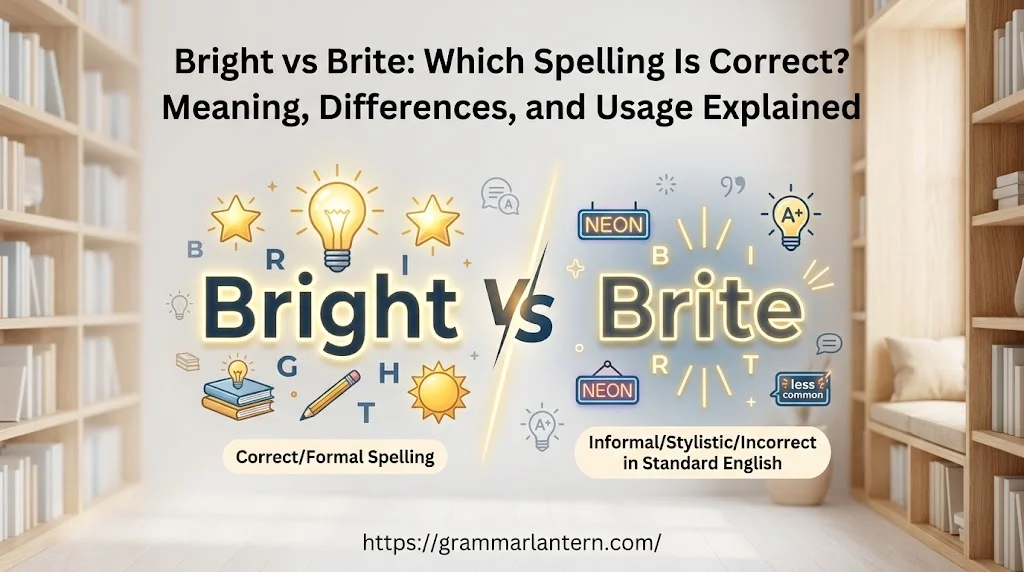
Bright is the correct standard English spelling used in everyday writing. It describes light, colors, intelligence, or positive situations.
Brite is usually a creative spelling of “bright” used in brand names, product names, and marketing. It is not normally used in formal writing.
| Word | Correct Usage | Example |
| Bright | Standard English word | The room has bright sunlight. |
| Brite | Brand or stylized spelling | A company may use “Brite” in its name. |
A simple way to remember the difference:
Use “bright” when you are writing English. Use “brite” only when it is part of an official name.
What Does Bright Mean?
The word bright has been part of the English language for centuries. It comes from Old English beorht, which meant shining, clear, or brilliant.
Today, bright has several meanings depending on the context.
Bright Meaning Related to Light
The most common meaning of bright refers to something that produces or reflects a strong amount of light.
For example:
- The sun looks bright in the morning sky.
- She turned on a bright lamp while reading.
- The bright headlights made it easier to see the road.
In these examples, bright describes intensity or visibility.
A bright object does not always create light itself. A mirror, snow-covered mountain, or polished surface can also appear bright because it reflects light.
Bright Meaning Related to Colors
Bright can also describe colors that are strong, vivid, and easy to notice.
Examples:
- She wore a bright yellow dress.
- The artist used bright colors in the painting.
- The room was decorated with bright blue walls.
A bright color usually has high intensity. It stands out compared with softer or darker shades.
For example:
| Bright Color | Less Bright Version |
| Bright red | Dark red |
| Bright green | Olive green |
| Bright blue | Navy blue |
Bright Meaning Related to Intelligence
The word bright can describe someone who is smart, quick to learn, or creative.
Examples:
- Maria is a bright student who understands difficult concepts quickly.
- The company hired several bright young engineers.
- That was a bright idea.
In this context, bright does not refer to physical light. Instead, it suggests mental ability and sharp thinking.
Bright Meaning Related to Hope and Success
English speakers often use bright to describe positive possibilities.
Common expressions include:
- A bright future
- A bright opportunity
- A bright outlook
For example:
“After years of hard work, she finally saw a bright future ahead.”
Here, bright means promising or successful.
What Does Brite Mean?
Brite is generally a nonstandard spelling of “bright.” It is mostly used intentionally rather than accidentally.
Companies often replace traditional spelling with shorter or unusual versions because unique names can be easier to remember.
For example, a business may choose Brite instead of Bright because:
- The name looks modern.
- It may be easier to create a unique brand identity.
- It can stand out in advertisements.
- It may be easier to register as a business name.
However, when you are writing an essay, report, email, or article, brite is usually not the right choice.
Key Differences
Although these words look similar, their purpose is different.
| Difference | Bright | Brite |
| Standard spelling | Yes | Usually no |
| Dictionary meaning | Multiple meanings | Limited meaning |
| Common in writing | Very common | Rare |
| Used in branding | Sometimes | Very common |
| Formal writing | Recommended | Usually avoided |
| Pronunciation | /braɪt/ | /braɪt/ |
The biggest difference is not pronunciation. Both words sound the same.
The difference is where and why they are used.
Why Do Brands Use Brite Instead of Bright?
Businesses spend a lot of time choosing names. A small spelling change can create a completely different brand image.
Brite Creates a Modern Identity
Many companies use alternative spellings because they want to appear innovative.
Words like:
- Brite
- Lite
- Kwik
- Xpress
often create a casual or modern feeling.
For example, replacing “bright” with “brite” removes traditional spelling expectations and gives a brand a more distinctive appearance.
Brite Can Make Names Easier to Remember
Marketing depends heavily on recognition. A unique spelling can help customers remember a product.
Imagine two businesses:
- Bright Solutions
- Brite Solutions
The second name may stand out more because the unusual spelling catches attention.
Read More: Constant vs Attentive: Difference With Examples
Brite Helps Create Unique Brand Names
Many common words are already registered as business names, websites, or trademarks. Companies sometimes adjust spelling to create something more unique.
However, this does not mean the new spelling becomes a replacement for the original word.
Is Brite a Correct English Word?
The answer depends on the situation.
If you are asking whether brite can appear in English, the answer is yes. You may see it in:
- Company names
- Product names
- Advertising
- Informal branding
However, if you are asking whether it replaces bright in normal writing, the answer is no.
For example:
✅ Correct:
The room has bright natural light.
❌ Incorrect:
The room has brite natural light.
The second sentence looks like a spelling error because the context requires the standard English word.
Examples in Sentences
Examples Using Bright
Light meaning:
- The bright moon illuminated the dark sky.
- We moved into a bright apartment with large windows.
Color meaning:
- She painted the door a bright orange color.
- The children carried bright balloons at the party.
Intelligence meaning:
- He is one of the brightest students in his class.
- The team developed a bright solution to the problem.
Future meaning:
- The young athlete has a bright future ahead.
- New technology creates bright opportunities for businesses.
Examples Using Brite
Because “brite” is usually a name, it appears differently.
Examples:
- The company launched a product called “Brite.”
- The brand chose the spelling “Brite” to create a unique identity.
Notice that the word functions like a name rather than a normal adjective.
Common Mistakes
Using Brite in Formal Writing
One of the most common mistakes is replacing “bright” with “brite” because the two words sound identical.
Academic and professional writing should use standard spelling.
Examples:
Incorrect:
She has a brite personality.
Correct:
She has a bright personality.
Assuming Brite Is Always a Shorter Version of Bright
Many people think “brite” is simply a shorter spelling. However, spelling changes do not automatically create standard English words.
A company can choose a creative spelling, but that does not change the rules of everyday writing.
Ignoring Context
Context decides which spelling works.
Compare:
Bright Future Academy
If this is the official name of a school, “Bright” may be correct.
However:
Brite Future Academy
If a company officially uses this spelling, it should remain unchanged as a proper name.
Bright vs Brite vs Blight: Understanding Similar Words
English contains many words that look or sound similar but have completely different meanings.
| Word | Meaning | Example |
| Bright | Full of light, smart, vivid | She has a bright idea. |
| Brite | Creative spelling or brand name | Brite is part of the company name. |
| Blight | Damage, decay, or destruction | The disease caused crop blight. |
A single letter can change the entire meaning of a word.
How to Remember the Difference
Use this simple rule:
Bright = normal English spelling.
Brite = special spelling used for names.
A helpful memory trick:
Think of the word light. Both “bright” and “light” describe illumination. Since “light” uses traditional spelling, “bright” follows the same idea.
When writing:
- Describing sunlight? Use bright.
- Talking about colors? Use bright.
- Describing intelligence? Use bright.
- Writing a company name that uses “Brite”? Keep Brite.
Read More: “By Now” Meaning and Usage: Complete Guide With Examples
FAQs
1. Is Bright the correct spelling?
Yes, Bright is the correct English spelling. It is recognized by dictionaries and is used in both formal and informal writing.
2. Is Brite a real word?
Brite is not a standard dictionary word. It is mostly used in brand names, product names, or event titles.
3. Why do Bright and Brite sound the same?
They have the same pronunciation because English contains many words with different spellings but identical sounds.
4. Can I use Brite in school or business writing?
No. In academic, professional, and everyday writing, you should use Bright unless you are referring to a specific brand or product called Brite.
5. What does Bright mean?
Bright usually describes something that gives off a lot of light. It can also describe an intelligent, cheerful, or promising person.
6. Why do people confuse Bright and Brite?
People often see Brite in advertisements, packaging, and brand names, which makes it easy to mistake it for the standard spelling.
7. How can I remember the correct spelling?
A simple trick is to remember that dictionaries list Bright, while Brite is mainly used for branding and marketing purposes.
8. Is Brite Nite spelled incorrectly?
Not necessarily. If Brite Nite is the official name of an event or brand, the spelling is intentional and should not be changed.
9. Does using Brite instead of Bright count as a spelling mistake?
Yes, unless you are referring to a specific brand or official name. In normal English writing, using Brite instead of Bright is considered an error.
10. Which spelling should I use in emails and articles?
Always use Bright in emails, essays, reports, and articles unless you are mentioning a company, product, or event that officially uses the spelling Brite.
Conclusion
Choosing between Bright and Brite becomes simple once you understand their different purposes. Bright is the standard English spelling accepted by dictionaries and should be used in everyday writing, while Brite is mainly reserved for brand names, products, and certain event titles.
Whenever you are unsure, think about the context. If you are describing light, intelligence, or writing in a professional or academic setting, Bright is almost always the correct choice. Keeping this small distinction in mind will help you write with greater accuracy and confidence.

For Shafiq ur Rehman, writing is an art form and grammar is the toolbox that makes it beautiful. As a dedicated content writer at Grammar Lantern, Shafiq approaches every topic like an architect carefully laying down strong foundations of understanding before adding the finer details. He loves diving into the trickiest grammar points and resurfacing with simple, bite-sized takeaways that anyone can grasp. When he’s not crafting articles, you’ll likely find him strategizing over a game of chess, exploring dusty local bookshops, or quietly jotting down poetic observations in his notebook.



[…] Read More: Bright vs Brite: Which Spelling Is Correct? […]
[…] Read More: Bright vs Brite: Which Spelling Is Correct? […]